If you want a portable air conditioner that minimizes energy use while cooling effectively, choose a model with inverter or high CEER ratings, eco-friendly refrigerant, or dual-hose airflow. Below are five energy-focused portable ACs chosen for specific buyer needs: great for large rooms, smart-home integration, eco-conscious buyers, quieter bedrooms, and budget-minded efficiency. The short table compares capacity and best use to speed selection.
| Model | Approx. Coverage | Best For |
|---|---|---|
| Gasbye Dual-Hose 14,000 BTU | Up to 500 sq.ft. | Energy-conscious buyers / fast cooling |
| QZMDSM 16,000 BTU Smart AC | Up to 750 sq.ft. | Large spaces & smart-home users |
| DOMANKI 14,000 BTU | Up to 700 sq.ft. | High-capacity R32 unit for big rooms |
| KoolSiln 12,000 BTU | Up to 550 sq.ft. | Quiet, eco-friendly refrigerant |
| CARLOX 10,000 BTU | Up to 450 sq.ft. | Budget-friendly energy-saving option |
Gasbye Dual-Hose 14,000 BTU

Key features: full DC inverter compressor, 13.6 CEER rating verified by DOE, dual-hose cooling to avoid negative pressure, low noise around 45dB, and rated for cooling up to 500 sq.ft. The listing explicitly notes accurate SACC sizing and unit dimensions.
Best for buyers who prioritize measurable energy efficiency and consistent cooling in mid-to-large rooms. The DOE-verified CEER and inverter tech reduce compressor cycling and energy draw compared to non-inverter single-hose models.
Caution: the manufacturer warns the unit is full-size; check the listed dimensions to ensure it fits your intended space and window layout.
QZMDSM 16,000 BTU Smart AC

Key features: 16,000 BTU cooling for up to 750 sq.ft., 6-in-1 modes (Cool, Dehumidify, Fan, Auto, Sleep, Energy-Saving), WiFi app control and child lock, and ultra-quiet 45dB sleep mode with 24-hour timer.
Best for large rooms, open-plan areas, and smart-home users who want remote control and explicit energy-saving modes. The energy-saving mode and app scheduling help reduce runtime and adapt cooling to occupancy patterns.
Caution: high-capacity units can draw more power when running at full output; choose the energy-saving or auto modes to limit continuous high-load operation.
DOMANKI 14,000 BTU Portable AC

Don’t Overpay for HVAC Services – Call 888-894-0154 Now to Compare Local Quotes!
Key features: 14,000 BTU (ASHRAE) / 10,000 BTU (SACC), uses R32 refrigerant, ETL certified, upgraded compressor, operating temperature 61°F–88°F, and functions for cooling, dehumidifying, and fan modes. Includes washable filter and casters for mobility.
Best for buyers seeking a high-capacity portable AC with a modern refrigerant (R32) and simple maintenance. The washable filter and multiple smart functions make it suitable for larger rooms, campervans, or temporary spaces needing flexible cooling modes.
Caution: ASHRAE BTU differs from SACC; check the SACC figure for realistic cooling capacity in typical room conditions.
KoolSiln 12,000 BTU Quiet AC
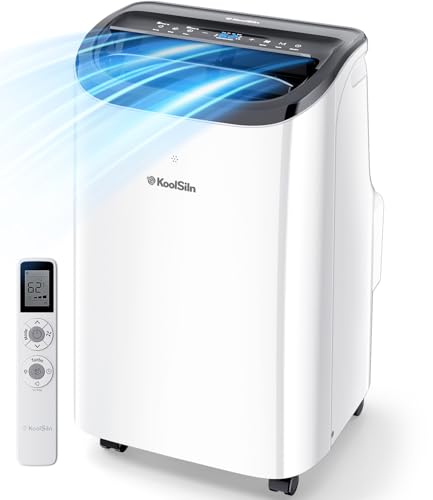
Key features: 12,000 BTU cooling up to 550 sq.ft., R32 refrigerant for greener cooling, 360° auto-evaporation tech converting moisture to airflow, noise reduction down to about 44dB, and sleep mode with dim display.
Best for buyers who want a balance between energy efficiency and quiet operation for bedrooms or offices. The auto-evaporation technology reduces the need for manual draining and keeps continuous operation efficient overnight.
Caution: effective auto-evaporation depends on humidity and room temperature; heavy dehumidification may still require occasional drainage or maintenance.
CARLOX 10,000 BTU Energy-Saving AC

Key features: 10,000 BTU cooling up to 450 sq.ft., promoted as energy-saving and cost-efficient, 3-in-1 modes (cool, fan, dehumidifier), upgraded compressor for faster cooling and quieter operation, and included air filter for improved indoor air quality.
Best for budget-minded buyers and medium-sized rooms who want a unit that markets lower running costs and decent coverage. The 3-in-1 versatility helps reduce the need for separate dehumidifiers or fans, saving overall energy use.
Caution: marketing claims of daily cost depend on usage patterns and local electricity rates; compare power draw specifications to your local rates for accurate operating cost estimates.
Buying Guide: How To Choose An Energy-Efficient Portable AC
What BTU Rating Do I Need For My Room?
Match BTU to room size: roughly 8,000–10,000 BTU for 200–450 sq.ft., 12,000 for 400–550 sq.ft., and 14,000–16,000 for 500–750 sq.ft. Oversized units may cycle less but can use more power when operating at full capacity; use manufacturer SACC values for realistic estimates.
Does Inverter Or Dual-Hose Tech Save Energy?
Yes. Inverter compressors modulate speed to maintain temperature with fewer power surges, improving efficiency. Dual-hose designs supply and exhaust air separately, reducing negative pressure and improving cooling efficiency in many settings.
Should I Look For CEER Or DOE SACC Numbers?
CEER and DOE SACC are standardized metrics to compare efficiency and realistic cooling capacity. Higher CEER means more cooling per watt. Use DOE SACC figures rather than ASHRAE numbers for expected in-room performance.
Is Refrigerant Type Important?
R32 refrigerant is more energy-efficient and has lower global warming potential than older refrigerants in many models. Choose R32 when available and confirm manufacturer specifications for environmental preferences.
How Much Does Noise Level Affect Efficiency?
Noise (measured in dB) is not a direct indicator of energy use, but quieter units often use inverter tech and run more steadily, which can correlate with lower energy consumption. For bedrooms, target units around 44–45dB or lower in sleep mode.
What Installation And Maintenance Factors Save Energy?
- Seal the window kit and exhaust hose properly to avoid hot-air re-entry.
- Use timers and programmable schedules to limit run time when rooms are unoccupied.
- Clean or replace washable filters regularly to maintain airflow and efficiency.
- Use auto-evaporation or condensation management to avoid frequent manual draining, which can interrupt efficient operation.
FAQ
How can I maximize energy efficiency when using a portable AC? Use correctly sized BTU for the room, run in energy-saving or auto mode, seal windows and exhaust connections, schedule operation with a timer, and keep filters clean.
Are dual-hose portable ACs always more efficient than single-hose models? Dual-hose systems often maintain neutral indoor pressure and can cool faster with less short-cycling, making them more efficient in many cases, but efficiency also depends on compressor type and overall unit design.
Does R32 refrigerant reduce energy use? R32 typically allows more efficient heat transfer and a lower global warming potential than older refrigerants, which can improve system efficiency when paired with good compressor design.
How important is CEER or DOE SACC when comparing models? Very important. CEER indicates energy efficiency, and DOE SACC reflects expected in-room cooling capacity; both offer comparable measures across models and help predict running costs.
Don’t Overpay for HVAC Services – Call 888-894-0154 Now to Compare Local Quotes!
Will a portable AC cool an entire house? Portable ACs are designed for single rooms or open-plan areas. For whole-house cooling, a central or multi-zone system is required. Use BTU guidelines per room to size portable units correctly.

How to Get the Best HVAC Prices
- Firstly, keep in mind that installation quality is always the most important thing for residential HVAC project. So never sacrifice contractor quality for a lower price.
- Secondly, remember to look up the latest rebates as we talked above.
- Thirdly, ask for at least 3 bids before you make the decision. You can click here to get 3 free estimates from your local contractors, and this estimate already takes rebates and tax credit into consideration and filter unqualified contractors automatically.
Lastly, once you chose the right contractor, remember to use the tactics from this guide: Homeowners Tactics When Negotiating with HVAC Dealer to get the final best price.