If you need a secure outdoor mount for a mini split condenser, these brackets provide durable, weather-resistant support across common BTU ranges and mounting scenarios. SMOQIO is best for installers who want pre-drilled studs and extra clearance; Toutgood and HIODIYI suit heavy-load or DIY installs that need adjustable leveling; DuctlessAire is better for vibration control; SUREPHON fits typical 9,000–15,000 BTU units. Summary of top picks is below.
| Bracket | Best For | Key Feature |
|---|---|---|
| SMOQIO Pre-Drilled Bracket | High-capacity installs and U.S. stud spacing | Pre-drilled 16″ holes, 550 lb capacity |
| Toutgood Heavy-Duty Wall Bracket | Heavy condensers needing strong welded crossbar | Up to 400 lb, galvanized and powder coated |
| DuctlessAire Outdoor Wall Bracket | Reduced-vibration installations | Vibration control feet and shock absorbers |
| HIODIYI Adjustable Heavy-Duty Bracket | DIY installers who need leveling and anti-vibration | 400 lb capacity, adjustable crossbar, anti-vibration pads |
| SUREPHON Universal Support Bracket | Standard 9k–15k BTU systems needing compact support | Galvanized steel, supports 280 lb |
SMOQIO Pre-Drilled Bracket

SMOQIO lists universal compatibility for 6000–36000 BTU mini split systems and a maximum weight capacity of 550 lbs. It is made from heavy-duty galvanized steel with a powder-coated finish for corrosion resistance and outdoor durability. The bracket includes a foldable L-shape design with a 23.6″ length to increase clearance for airflow and heat dissipation. The crossbar comes pre-drilled to match U.S. 16″ on-center stud spacing for straightforward attachment to wood studs.
Choose this if you need high capacity, extra wall clearance, or studs-aligned mounting. This bracket was selected for its high load rating and pre-drilled stud spacing that simplifies standard installations. Avoid this if your wall cannot accept studs or you need a very compact mount; the longer L-shape requires more wall space.
Toutgood Heavy-Duty Wall Bracket

Toutgood advertises support for 7,000–12,000 BTU units with a rated capacity up to 400 (490) pounds, depending on model configuration. The bracket is galvanized and powder-coated for corrosion resistance and weatherproofing. It uses a welded-angle steel design plus an adjustable crossbar with leveling to help align condensers during installation.
Best for installers needing a heavy-duty, stable bracket for mid-sized mini splits. It was selected for its high weight capacity and leveling crossbar that speeds alignment. Caution: verify your specific condenser footprint fits the crossbar range and confirm the quoted higher capacity applies to the exact model variant you receive.
DuctlessAire Outdoor Wall Bracket

DuctlessAire lists universal compatibility for systems from 9,000 to 36,000 BTU and support up to 300 lbs. The bracket is made from powder-coated hardened steel designed for outdoor use. It includes integrated vibration control feet and shock absorbers to reduce noise and movement during operation.
Choose this bracket if vibration reduction and quiet operation are priorities. It was selected for its stated vibration-control features and weather-resistant finish. Avoid this if you need a higher load capacity above 300 lbs or require pre-drilled stud spacing for quick mounting.
Don’t Overpay for HVAC Services – Call 888-894-0154 Now to Compare Local Quotes!
HIODIYI Adjustable Heavy-Duty Bracket

HIODIYI specifies a 400 lb load capacity and fits 7,000–12,000 BTU outdoor units. The bracket is built from galvanized steel with dual anti-rust coating and includes an adjustable crossbar and leveling support. Anti-vibration pads are listed as included to reduce noise and movement.
Better for DIY homeowners or installers who want adjustable leveling and vibration isolation for small to mid-size condensers. It was selected for its combination of load capacity, corrosion protection, and adjustable alignment features. Caution: verify the condenser mounting hole pattern lines up with the crossbar range before installation.
SUREPHON Universal Support Bracket
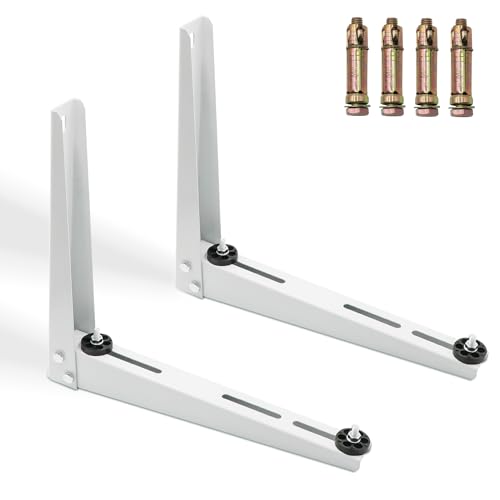
SUREPHON lists compatibility with most wall-mounted mini-split AC and heat pump systems between 9,000 and 15,000 BTU and a capacity up to 280 lbs. The bracket is galvanized steel with a rust-resistant powder coating. The bracket elevates the unit to protect against debris, snow, and water and improves air circulation for better heat dissipation.
Choose this if you have a standard 9k–15k BTU unit and need a compact, corrosion-resistant support. It was selected for its standard compatibility and protective elevation. Avoid this if your condenser weighs more than 280 lbs or you need additional clearance beyond the bracket’s dimensions.
Buying Guide
What weight capacity do I need?
Match the bracket’s rated capacity to your condenser’s full installed weight, including any accessories. Choose a bracket with at least 20–30% higher capacity than the unit weight to allow a safety margin. High-capacity brackets (400–550 lb) suit larger condensers or future upgrades.
How does BTU range affect bracket choice?
Manufacturers list BTU ranges as a proxy for typical condenser sizes. Smaller BTU ranges (6k–15k) usually need compact brackets; larger ranges (up to 36k) require wider or stronger mounts. Confirm the bracket’s mounting pattern matches your condenser.
What materials and coatings matter?
- Galvanized steel and powder-coated finishes resist rust and outdoor weathering.
- Hardened or welded steel frames increase rigidity for heavy units.
- Dual anti-rust coatings provide longer surface protection in coastal or humid areas.
Do I need vibration isolation?
Yes for noise-sensitive locations. Brackets with vibration feet or rubber pads help reduce noise and prevent loosening of fasteners. Choose vibration-featured brackets if the condenser sits near living areas or thin walls.
Which wall types require special hardware?
Wood stud: use lag bolts into studs and check for pre-drilled 16″ spacing. Concrete or brick: use masonry anchors or sleeve anchors sized for the load. Hollow walls: avoid mounting directly without structural backing or a header plate.
Adjustable crossbar and leveling—when is it useful?
Adjustable crossbars speed alignment and leveling during installation. Choose them if you expect slight mismatches in mounting holes or if precise leveling is important for drainage and compressor longevity.
DIY vs. professional installation
- DIY is reasonable for wood-stud walls, straightforward brackets, and when you have appropriate tools and anchors.
- Professional installers are recommended for heavy units, masonry walls, rooftop attachments, or complex electrical/plumbing clearances.
FAQ
Q: How high above ground should a mini split condenser be mounted?
A: Mount the condenser high enough to avoid water, snow, and debris accumulation while maintaining manufacturer-recommended clearances for airflow. Elevation also helps prevent corrosion and flooding damage.
Q: Can I mount a condenser on brick or concrete walls?
A: Yes, use masonry anchors or sleeve anchors rated for the bracket load. Ensure the anchor type and embedment depth match the bracket’s weight capacity and local codes.
Q: What if the condenser mounting holes don’t match the bracket crossbar?
A: Use an adjustable crossbar bracket or choose spacers and stainless-steel hardware as needed. Confirm hole spacing and crossbar adjustability before purchase to avoid modification.
Q: Are anti-vibration pads necessary?
A: They reduce noise transmission and protect fasteners from loosening due to vibration. Use them in noise-sensitive installations or where the unit contacts metal supports.
Q: How do I know if my wall studs align with pre-drilled brackets?
Don’t Overpay for HVAC Services – Call 888-894-0154 Now to Compare Local Quotes!
A: Measure stud spacing (commonly 16″ on center in the U.S.). Choose brackets pre-drilled for 16″ spacing or plan to add a plywood backing/header if stud positions differ.
Q: Do brackets protect against theft or require extra security?
A: Brackets elevate and secure condensers, but they do not inherently prevent theft. Consider anti-theft hardware or bolting methods if security is a concern.

How to Get the Best HVAC Prices
- Firstly, keep in mind that installation quality is always the most important thing for residential HVAC project. So never sacrifice contractor quality for a lower price.
- Secondly, remember to look up the latest rebates as we talked above.
- Thirdly, ask for at least 3 bids before you make the decision. You can click here to get 3 free estimates from your local contractors, and this estimate already takes rebates and tax credit into consideration and filter unqualified contractors automatically.
Lastly, once you chose the right contractor, remember to use the tactics from this guide: Homeowners Tactics When Negotiating with HVAC Dealer to get the final best price.