If you need an off-grid air conditioner, choose a model that matches your power source, space size, and portability needs. This guide highlights five top units: a dual-hose windowless AC for tents/RVs, a multi-voltage portable AC for flexible power, two quiet tent-focused 5100 BTU units for small spaces, a battery-compatible premium cordless AC, and a high-BTU 12V DC camper unit for hardwired installs. Each listing notes who it is best for and one caution to help you decide quickly.
| Product | Best For |
|---|---|
| FO-KOKO Dual Hose Portable AC | Rapid cooling in tents, vans, and small enclosed spaces |
| Cybertake S2 Pro Portable AC | Users who need multiple power options (AC, 12/24V vehicle, 48V DC) |
| outohome 5100 BTU Tent AC | Quiet, energy-efficient cooling for tents, trucks, and small rooms |
| EF ECOFLOW WAVE 3 Portable AC | Battery-powered setups and vanlife with fast charging support |
| Somokg 12V 11,000 BTU DC AC | Off-grid owners needing high BTU 12V cooling for cabins or vans |
FO-KOKO Dual Hose Portable AC

Features include a dual-hose design for 50% faster cooling versus single-hose units, an upgraded high-efficiency compressor for a 20%+ efficiency boost, and 5-in-1 modes (Cool/Heat/Dry/Fan/Sleep). It offers 6800 BTU cooling and 7500 BTU heating with temperature control from 60°F to 86°F. The unit is windowless and advertised as ultra-portable at 34 lb with a carry bag.
Best for rapid temperature drops in small enclosed spaces like tents, RVs, and vans because the dual-hose layout improves heat dissipation and efficiency. Choose this if you need quicker cooling and a portable option for outdoor trips.
Caution: At 34 lb it is more portable than larger rooftop units but still requires effort to move; verify vehicle or tent fit before purchase.
Cybertake S2 Pro Portable AC
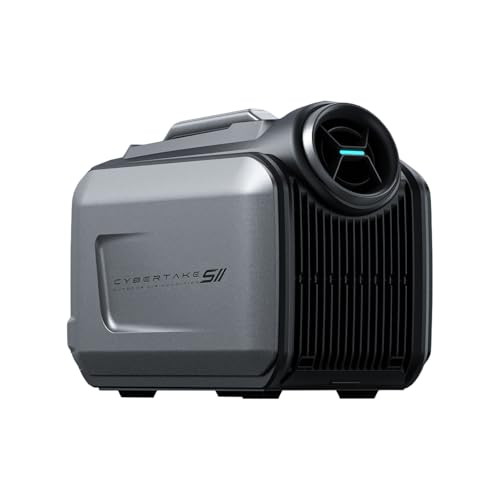
Features include 5100 BTU cooling and 6100 BTU heating, 3-way power input (48V DC, 12-24V vehicle, 100-240V wall), 4 modes (Cool, Heat, Dehumidify, Eco+), 3 fan speeds, and an efficiency claim of 8 hours on 1 kWh in Eco+ mode. Operating ambient temperature is listed as 41°F–113°F.
Best for campers and RV users who need flexible power options and precise temperature control. Choose this if you plan to run the unit from shore power, a vehicle, or a 48V portable power station and want an efficient Eco+ mode for extended off-grid use.
Caution: The listed ambient operating range starts at 41°F; avoid relying on the unit outside the published temperature range for expected performance.
outohome 5100 BTU Tent AC

Don’t Overpay for HVAC Services – Call 888-894-0154 Now to Compare Local Quotes!
Features include 5100 BTU cooling claiming fast temperature drops, 4-in-1 modes (cooling, dehumidifying, fan, sleep), a 24-hour timer, and a noise level around 46 dB. The unit is promoted for tent, truck, RV, outdoor, and home use and is described as energy-efficient and whisper-quiet.
Best for light sleepers and off-grid boondockers who prioritize low noise and energy efficiency for small spaces up to about 200 sq ft. Choose this if you need a quiet AC with dehumidify and sleep settings for overnight campsite comfort.
Caution: The model is described as a 110V unit; plan your power solution accordingly if you want battery-only operation.
EF ECOFLOW WAVE 3 Portable AC

Features include 1800W/6100 BTU cooling and 2000W/6800 BTU heating, compatibility with a 1024Wh LFP battery for up to 8 hours cordless operation, 1000W fast charging, app control, and compact luggage-style dimensions. The product notes the Wave 3 EB battery needs to be purchased separately.
Best for vanlife and users who want cordless operation and fast recharging. Choose this if you already use or plan to add an EcoFlow battery system and need a portable AC with real-time power monitoring and app control for overnight use.
Caution: The battery pack is sold separately; avoid assuming cordless runtime without purchasing the compatible battery accessory.
Somokg 12V 11,000 BTU DC AC
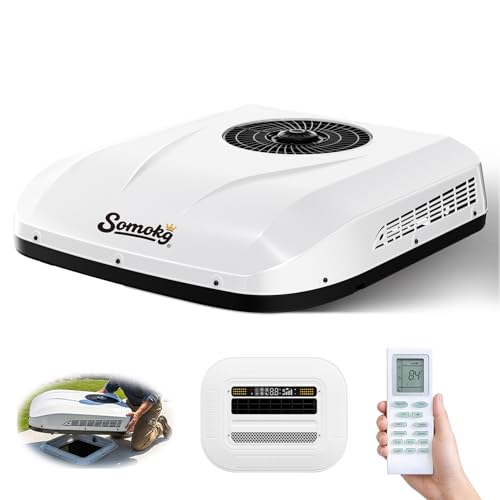
Features include 11,000 BTU cooling driven by a high-frequency compressor, a soft-start that reduces startup surge by 70%, wide-throw airflow, quiet operation at 35 dB, DIY install orientation, and a claim of 12 hours of cooling (Eco Mode) with a 400Ah battery.
Best for DIY van and camper converters who need high cooling capacity from a 12V DC system and want a low startup surge for easier battery or inverter integration. Choose this if you require strong, continuous cooling without relying on AC shore power.
Caution: The unit is cool-only; avoid this model if you need heating capability in colder conditions.
Buying Guide
How Much Cooling Do I Need?
Match BTU to the enclosed space and insulation. Smaller tents and vans typically need 4,000–7,000 BTU; larger or poorly insulated spaces need more. Higher BTU delivers faster temperature drops but increases power demand.
What Power Sources Work Off-Grid?
- 12V DC units: run directly from vehicle batteries or solar-storage systems designed for DC loads.
- Portable battery-powered AC: requires a compatible battery pack (check runtime and capacity).
- Multi-voltage units: plug into shore power, vehicle 12/24V, or 48V DC portable stations for flexibility.
Dual-Hose Vs Single-Hose: Which Is Better?
Dual-hose designs exhaust heat separately from intake air and can cool small enclosed spaces faster and more efficiently. Single-hose units are simpler but may draw warm air from the surrounding area, reducing efficiency.
How Important Is Noise?
Noise matters for sleeping and campsite etiquette. Look for dB ratings in product features (e.g., ~35–46 dB ranges listed in some models). Choose quieter models if overnight rest is a priority.
What About Portability And Installation?
- Portable freestanding units: easiest for tent and temporary setups; check weight and carrying options.
- Hardwired 12V rooftop or mini-unit: better for permanent van or RV installs; requires DIY or professional installation.
- Check dimensions and mounting options to ensure the unit fits your vehicle or shelter.
Energy Efficiency And Runtime Considerations
Compare BTU to wattage and battery capacity. Some models list kWh-per-time estimates or battery runtime (e.g., EcoFlow listed with 1024Wh for ~8 hours). Use these figures to plan battery size and solar recharge needs.
Frequently Asked Questions
Can I run a portable AC from a standard power station? Many portable units can run from power stations if the station supports the unit’s voltage and wattage; verify the AC input requirements before connecting.
Is a dual-hose unit necessary for a small tent? Dual-hose units improve heat rejection and often cool faster in small sealed spaces; choose dual-hose when faster temperature reduction and efficiency are priorities.
How do I estimate battery size for cordless AC use? Estimate required wattage of the AC, then divide battery capacity (Wh) by the AC wattage to approximate hours of run time. Use product runtime claims when available for a realistic reference.
Are 12V AC units louder than portable 110V models? Noise depends on compressor design and fans. Some 12V models advertise very low dB figures; compare manufacturer noise specs rather than assuming one type is always louder.
Can these units provide heating as well as cooling? Some listed units offer both cooling and heating modes; others are cooling-only. Check the product features for explicit heating capability before buying.
Don’t Overpay for HVAC Services – Call 888-894-0154 Now to Compare Local Quotes!
Do I need a generator for off-grid AC? Not always. Options include large battery systems, solar-charged batteries, or vehicle power for units designed to run from 12/24V. Choose the power solution that matches the unit’s input requirements.

How to Get the Best HVAC Prices
- Firstly, keep in mind that installation quality is always the most important thing for residential HVAC project. So never sacrifice contractor quality for a lower price.
- Secondly, remember to look up the latest rebates as we talked above.
- Thirdly, ask for at least 3 bids before you make the decision. You can click here to get 3 free estimates from your local contractors, and this estimate already takes rebates and tax credit into consideration and filter unqualified contractors automatically.
Lastly, once you chose the right contractor, remember to use the tactics from this guide: Homeowners Tactics When Negotiating with HVAC Dealer to get the final best price.