Carrier has a variety of ductless mini split systems to heat and cool homes, which are divided into three primary product lines; the high-end Infinity series, the mid-tier Performance series, and the low-end Comfort series.
The highlights of the main characteristics, capabilities, and best applications of each line are provided below:
| Carrier Mini Split Line | Key Features | Capacity Range (BTU) | Ideal Use Cases |
|---|---|---|---|
| Infinity Series | Ultra-high efficiency (up to 42 SEER, 15 HSPF) , inverter technology, extremely quiet (~29 dB indoor) , advanced features (built-in Wi-Fi, occupancy sensing) | ~9,000–24,000 BTU (single-zone only) | Premium single-room applications where top efficiency and whisper-quiet operation are priorities |
| Performance Series | Moderate-to-high efficiency (up to ~28 SEER, 13 HSPF) , wide model selection, supports multi-zone setups (2–5 zones) , multiple indoor unit styles (wall, cassette, ducted, floor) | ~9,000–36,000+ BTU (single & multi-zone) | Flexible whole-home or multi-room solutions balancing performance and cost; can mix and match indoor unit types for different rooms |
| Comfort Series | Budget-friendly models (~20 SEER, 10.6 HSPF) , basic inverter heat pump functionality, only line with cooling-only (AC) unit option | ~9,000–18,000 BTU (single-zone) | Cost-effective heating/cooling for individual rooms, home additions, or small spaces; ideal for budget-conscious projects or cooling-only needs in warm climates |
Carrier Infinity Series Mini Splits (High-End)
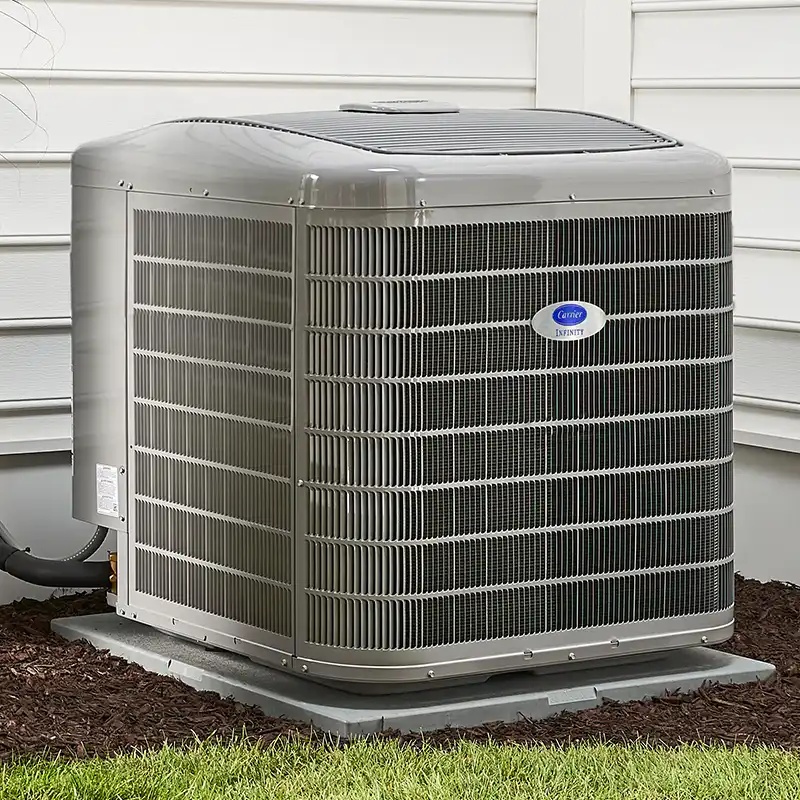
The Infinity series is the best ductless systems that Carrier offers. These units are also very high performance with industry leading efficiency ratings, when used together the Infinity outdoor 38MPRA heat pump and 40MPHA high-wall indoor unit can achieve up to 42 SEER and 15.0 HSPF, making them some of the most efficient residential mini splits.This efficiency is so high that it equates to reduced energy bills and is eligible to ENERGY STAR rebates. Practically speaking, the Infinity series is capable of efficient heating even in extreme cold (operating down to -22°F ) and can be depended upon to deliver cooling in ambient temperatures up to ~122°F.
The infinity units are fitted with sophisticated inverter compressors which adjust the output according to the need and the temperature is controlled accurately and the operation is very silent. The indoor wall-mounted (40MPHA) is approximately 29 dB in sound level, which is similar to the sound of a library.
In the meantime, the Infinity outdoor compressor (38MPRA) is rated at approximately 55 dB (quieter than most of the low-end models). Homeowners often remark about the low noise level; one owner said that his Infinity unit was a great, quiet unit that kept his 140-year-old house comfortable in heating and cooling . The super silent operation is one of the key selling points and Infinity mini splits are ideal in bedrooms and living rooms where noise is an issue.
Technologically, Carrier has equipped the Infinity series with the latest features. The indoor units have in-built Wi-Fi and intelligent sensors.
As an example, the 40MPHA wall unit is able to detect the location of the occupants in the room and direct the flow of air to prevent directing it on the occupants. This occupancy sensing characteristic increases comfort by sending air in the right direction. The Wi-Fi capability allows users to operate Infinity systems using smart home integration or smartphone apps. The ability to control the climate in the home remotely and schedule it enables the user to have a fine control of the climate even when he/she is not at home.
It is necessary to mention that the Infinity line is rather limited in its configuration. It is single-zone oriented. The 38MPRA outdoor heat pump flagship can only accommodate a single indoor unit (which is only in the wall-mounted variety).
Carrier Infinity does not yet have a multi-zone outdoor unit, unlike some of the other premium lines of a competitor, so in case you need multiple indoor zones, you would have to go down to the Performance line. An Infinity mini split is generally easy to install by an HVAC professional: there is one outdoor unit and one wall unit, so it needs a refrigerant line, a condensate drain, and an electrical connection. Since the Infinity components are carefully paired, the installation is simply a case of following the Carrier instructions on placement and line set length (which are generous enough to leave some room to play with).
Main lesson: The Carrier Infinity series mini splits are high-end in terms of efficiency and comfort. They are whisper-quiet, and have smart capabilities such as Wi-Fi and motion-sensing, and are best suited to single-zone residential applications where performance is the key factor.
Don’t Overpay for HVAC Services – Call 888-894-0154 Now to Compare Local Quotes!
Infinity systems will be of great interest to homeowners who want the best energy savings and comfort in one area, although they come at a higher cost than the lower-end models.
Carrier Performance Series Mini Splits (Mid-Range)

Performance series is the middle-range mini split lineup of Carrier, and it is a compromise between efficiency, feature set, and price. They are slightly less powerful than Infinity, but still not inefficient in any way, with some Performance series heat pumps having SEER ratings in the mid-20s (up to ~28.1 SEER) and HSPF up to ~13 , comparable to the higher-end models of many other brands.Meanwhile, Performance line also has a few models with less impressive efficiency (approximately 16-18 SEER) in order to reach a lower price point . This range renders the Performance family rather flexible in terms of achieving various budget and efficiency targets.
One of the characteristics of the Performance series is its flexibility and variety. Carrier offers a great variety of outdoor and indoor units in this line, which allows many configurations. Single-zone Performance systems can be upgraded to multi-zone systems: the Performance 38MGR multi-zone outdoor unit, to take one example, can be used to drive up to 5 indoor units off a single condenser .
This enables you to condition more than one room (or the entire house) using a single outdoor compressor which is a major benefit to larger homes or homes that desire room-by-room zoning. The Performance multi-zone systems provide zone by zone comfort control, but the overall efficiency (up to ~23.8 SEER ) is slightly lower than the single-zone Infinity combo.
The Performance series on the indoor side offers the widest variety of indoor unit styles of any Carrier line. You may opt to have high-wall units (like those of Infinity), ceiling cassettes that slide into the ceiling, ducted concealed units that can be concealed above a ceiling or in an attic (with only vents showing), and even floor-mounted consoles that are low on a wall like a radiator.
Carrier claims that this line provides the most versatile selection of indoor cabinets, which implies that the system can be customized according to the interior design and architecture of the house. An example is that one room can be fitted with a wall unit and another with a ceiling cassette but connected to the same outdoor unit. This versatility is a very good selling point of the Performance series, unlike the single-style Infinity units.
Installation factors: A Performance series system might need additional planning due to the mix-and-match feature. The installer should make sure that the selected outdoor unit is able to support the quantity and kind of indoor units (Carrier offers combination charts).
In multi-zone systems, it is important to size each indoor unit to the room it serves, as one homeowner found out when two heads were oversized by an installer, resulting in high humidity because of short cycling . Performance series systems when properly installed, however, can heat/cool several areas with a low level of noise and high efficiency. Performance units are still very low in sound: the small wall units are rated at 2735 dB and even the multi-zone outdoor compressors are rated in the low 50 dB range on the higher-SEER models (though some lower-SEER versions are rated at 62 dB ). These units are very quiet in practice, at least compared to older HVAC equipment, to many users. A Performance multi-split user said that both the indoor and outdoor units were quiet and had not had any reliability problems after 2+ years of use .
Technologically, Performance series mini splits are inverter-driven compressor, and they provide good efficiency, but may not have some of the bells and whistles of Infinity. As an example, the Performance indoor units lack Wi-Fi in all models (though external Wi-Fi adapters or smart controllers may be used), and lack the motion-sensing feature.
They however have infrared remote controls and other features such as adjustable louvers, sleep modes and timers. Interestingly, since the Performance units manufactured by Carrier are constructed by Midea (the manufacturing partner of Carrier), they have some considerate details, one of the GBA experts mentioned that the Carrier/Midea units have the ability to use the handheld remote as a temperature sensor (the Follow Me feature), which periodically transmits the room temperature at the location of the remote to the indoor unit. This has the potential to result in a more balanced comfort and it is not a default feature on some high-end brands such as Mitsubishi or Fujitsu without an add-on thermostat.
Important lesson: The Carrier Performance series offers a flexible, adjustable mini split system to residential properties. It allows a single-zone installation to a full-house multi-zone system with different types of indoor units.
It is much more efficient (though a bit below the Infinity line) and the price is more moderate. The Performance series is a good compromise of flexibility and value to homeowners who require multi-room coverage or a certain type of indoor unit (cassette, ducted, etc.). All you need to do is to ensure that you use a qualified installer to design the system to give the best results.
Carrier Comfort Series Mini Splits (Economy Tier)
Comfort series is the entry level mini split product offering of Carrier that targets price conscious customers or less demanding applications. These systems are focused on being cheap and having the basic functionality.
They are not as efficient as Infinity or the model range of Performance, but the Comfort series units are still good performers. The single-zone Comfort heat pump (model 38MHRBQ) offers up to 19.8 SEER and 10.6 HSPF, which is about the same as a mid-efficiency central air conditioner or heat pump. That is, it is efficient enough to be up to modern standards (and is ENERGY STAR 1999 certified in some sizes), but the higher series are a bit more efficient in case maximum energy savings are a main objective.
The Comfort line is characterized by the fact that it has the only cooling-only mini split offered by Carrier. The model 38MHRBC is an outdoor unit (no heat pump) that is AC only and is rated at about 19 SEER cooling .
When used with its corresponding indoor unit (40MHHC), it offers a substitute to window AC units or older central AC to those who simply require air conditioning. Carrier observes that the Comfort line is the only one that has a Carrier ductless AC (as opposed to a heat pump) . This may be perfect in hot climates or in places where there is no need to heat such as server rooms or garages. Having a cooling-only model in the line will allow reducing the initial price to customers who do not require heat.
The Comfort series is otherwise very straight forward. Its main setup is a one-zone heat pump, which includes the 38MHRBQ outdoor unit and a wall-mounted 40MHHQ indoor unit. These units are compact and easy to install .Actually, the Comfort outdoor compressor is among the smaller ones that Carrier has to offer and thus it is easily installed in cramped areas outside a house. Indoor air handler is a conventional high-wall unit which is a simple flat panel design, which fits in most rooms. It has a remote control to adjust temperature and fan speed, but no Wi-Fi built in or fancy sensors, and that is the point, it is all about core reliability and value. Although it is a value model, it is still quiet (approximately 27 dB indoors, comparable to the noise levels of Performance series) and can be used to run heating as low as 5°F (-15°C) in certain sizes, based on the specs of the equivalent model according to Bryant .
What do people say about Comfort series units? The price to performance ratio is appreciated by many. The systems are frequently selected to climate-control one room or an addition.
To give an example, a Comfort heat pump may be ideal in a workshop, sunroom, or guest bedroom that is not tied into central HVAC. Carrier points out that the 38MHRBQ is a wonderful unit in a small area such as a workshop or a guest quarters. Even the availability of the cooling-only type receives a positive response by people in very hot areas, it is basically a ductless air conditioner with the Carrier brand name. The negative side is that since the Comfort line offers fewer available indoor types (wall units only) and does not have multi-zone capability, it is not as flexible in terms of future expansion; in case you think you may want to add zones later, it may be better to start with Performance series.
Main lesson: Carrier Comfort series mini splits are bare-bones, low-cost systems that nonetheless bring good performance. They are suitable in single-room applications or as an auxiliary cooling/heating where the cost is a major factor.
Don’t Overpay for HVAC Services – Call 888-894-0154 Now to Compare Local Quotes!
Comfort series models will be a cost-effective solution to homeowners who require a basic ductless AC or heat pump in a single location. However, do not expect the smart functions or extreme efficiencies of the higher-end lines of Carrier, Comfort series units are all about the basics, and the reliability that the Carrier brand is known to provide.
Pros and Cons of Carrier Mini Split Systems
Carrier Mini Split Pros
- Duct-Free Comfort: Carrier ductless systems offer an economical method of heating or cooling an area without the use of ductwork . This eliminates the energy losses that ducts introduce, and in many cases mini splits are more efficient than conventional HVAC in the same application.
- High Energy Efficiency: All Carrier mini splits have inverter technology and provide good to excellent SEER/HSPF ratings. The top-line models are some of the most efficient in the market (Infinity up to 42 SEER) and this can be translated to huge energy savings in the long run.
- Quiet Operation: These systems are designed to be quiet. The indoor units are at library-level sound or below (20-30 dB range) and even the larger outdoor units in the Performance line are at ~50-60 dB (the equivalent of a normal conversation). The fact that the Carrier units are so unobtrusive and so very quiet is specifically mentioned by many users .
- Flexible Zoning & Installation: Carrier mini splits are easy to zone your home: each indoor unit can be controlled separately, and different rooms can be maintained at different temperatures when necessary. It is easier to install than central systems (only a small hole to run refrigerant lines and wiring), and the Performance series has many different styles of indoor units to fit a variety of room layouts.
- Advanced Features (Infinity line): When you choose the Infinity line, you receive such advanced features as built-in Wi-Fi control, occupancy sensors, and a mobile app to make adjustments remotely. These advanced technologies make the products more comfortable and convenient, which provides Carrier with an advantage in the integration of smart homes with its high-end models.
- Reliability: Carrier is a reputable HVAC brand with decades of experience . Their mini splits are backed by a 10-year limited parts warranty on original owners (installed by a professional and registered), so there is peace of mind. The large dealer network that Carrier has also translates to the fact that qualified service is usually readily available.
Carrier Mini Split Cons
- More Expensive Upfront Cost: Carrier mini splits tend to be in the middle to high range of the market . They are usually less expensive than the leading Japanese brands, but still are more expensive to purchase initially than off-brand or do-it-yourself units. To take an example, a single-zone Carrier Infinity system may cost about 3,000-4,000 (installed) dollars, which is a big investment (but may be worth it in energy savings and comfort).
- Proper Installation: Just like any mini split, installation is important. When not properly installed (e.g. improper refrigerant charge or improper location), they may not perform well and even minor refrigerant leaks can be energy wasters . Certain problems that have been blamed on equipment are in fact caused by the installer (such as the humidity problem caused by oversized units in one instance) . This implies that you require a good, competent HVAC contractor, which is a con in case you cannot find one easily in your locality.
- Indoor Units: The ductless systems have wall or ceiling units that are more noticeable in the room compared to the central AC vents. Not all people like the appearance of wall-mounted units or cassettes. Although the indoor units of Carrier are made sleek and compact, they might not suit the taste of all people. This is compensated by ducted mini split units, which are complex and expensive.)
- Mixed Reliability Perception: Carrier mini splits are fairly reliable in the long run, but they lack the decades of history in the ductless field that Mitsubishi or Fujitsu have. The hardware is manufactured with Midea, the largest manufacturer of mini splits in the world. The experiences of many users are very good e.g. one member of a forum stated that he had no problems with his Carrier/Midea unit that ran 24/7 over two years but there have been reports of component failures. Carrier HVAC products have lower satisfaction ratings on certain consumer review sites (e.g. 1.4/5 on one aggregate of 66 reviews) and this is usually because of isolated incidents of unit failure or poor support.
- Maintenance Requirements: Having a mini split – Carrier included – is not a totally hands off experience. The homeowner should clean the filters of the indoor units regularly (usually once a month) to have efficient work. The condenser coil outside must be clean. Although such tasks are not challenging, failure to do them may lead to a decline in performance with time. Also, when a repair is required that is not covered by the warranty, name-brand units such as Carrier may have slightly more expensive parts (and may have to be ordered by an authorized dealer). It is advisable to have a professional check-up (after every two years) to ensure optimum efficiency.
- Heating Capacity in Extreme Cold (on some models): Not every Carrier mini split has the improved low-temperature heating capability that Mitsubishi Hyper-Heat systems or others enjoy. The Infinity single-zone does go down to -22°F, which is great, but the multi-zone Performance units have lower capacity at sub-freezing temperatures (as does many brands). A supplemental heat source or a Hyper-Heat style system by a competitor may be an option in climates that regularly go below 0°F. Carrier also has a warranty that needs professional installation and does not include labor as a default, which is normal but should be mentioned to those who live in extremely harsh environments where service calls may be more probable.
Comparison: Carrier vs. Top Competing Mini Split Brands
Carrier is competing with a number of established brands in residential mini split. In this section we are going to compare Carrier with Mitsubishi, Daikin, LG, and Fujitsu in the important aspects of efficiency, warranty, performance and cost.
All these brands have their advantages, and the most suitable one can be the best one according to your priorities (low initial price, performance in extreme weather conditions, etc.).
Carrier vs. Mitsubishi
Mitsubishi Electric has a long history of reliability and innovation, and is sometimes considered the gold standard of mini splits. The units of Mitsubishi (such as the well-known M-Series and Hyper-Heating) have published peak efficiencies that are slightly lower than Carrier Infinity, with Mitsubishi peaking at ~33 SEER on a 6,000 BTU unit compared to 42 SEER on a 9,000 BTU unit by Carrier.Practically, both brands are very efficient, however, Mitsubishi is famous with its great performance in cold weather. Their Hyper-Heat systems are capable of maintaining 80 percent of heating capacity at -13°F and are rated to work at -13°F or colder. The Infinity single-zone heat pump made by Carrier is in fact rated to operate down to -22°F, just a little lower than Mitsubishi, but Mitsubishi has more cold-climate models in a wider range of sizes. When it comes to warranty, Mitsubishi usually offers a 12-year parts and compressor warranty on ductless systems (when installed by an authorized contractor) which beats out the 10-year warranty of Carrier. This extended coverage is an indication of how Mitsubishi is confident of the durability of their products.
In features, both brands have inverter compressors and are very quiet. The indoor units of Mitsubishi are very silent (as low as 1922 dB) just like the low sound of Carrier. The range of styles of indoor units provided by Mitsubishi is very large, and some of them are even unique, such as the Designer wall units and one-way ceiling cassettes. Performance line by Carrier also deals with the same territory when it comes to the types of indoor units, but the catalogue of Mitsubishi is slightly wider (they also have ducted and floor units, and there are several series).
Smart controls: Mitsubishi models usually need an optional Wi-Fi adapter (e.g. the Kumo Cloud module), but Carrier Infinity has Wi-Fi built-in . This benefit is, however, largely on the high-end; the mid-range models of the two brands would probably require Wi-Fi add-ons.
Price: Mitsubishi mini splits tend to be expensive. It is common to find that a Mitsubishi quote will be more than a Carrier quote of a similar capacity system by homeowners. As an example, one user in Toronto compared a multi-zone system and discovered that the Carrier proposal was much less, approximately $20k vs $25k on Mitsubishi (approximately 20% less on Carrier). This price difference may differ but in most cases Carrier will be keen to offer a price that is slightly lower than Mitsubishi.It should be pointed out that the higher price of Mitsubishi is frequently explained by the quality and its ability to work in extreme conditions, so those who want to have a system that they can set and forget in very cold weather may be willing to pay the extra price to get Mitsubishi. Conversely, the performance of Carrier has been quite similar in normal conditions by many and thus it is a better deal in case the quotation is lower. Mitsubishi is a very reliable brand; you can easily come across stories of their units lasting 15+ years. Carrier (manufactured by Midea) has not been in the business as long under the Carrier brand, but Midea-produced units are common throughout the world and are usually dependable. There are still HVAC professionals who say they do not see anything that compares to Mitsubishi quality, but there are others who admit that Carrier/Midea is a good alternative when cost is a consideration.
In short, it is a matter of reputation vs value between Mitsubishi vs Carrier. Mitsubishi has arguably the best-in-class reliability and cold-weather performance (longer standard warranty), and is a good choice when demanding applications are required. Carrier offers almost the same efficiency and comfort at a marginally lower average price, and also has smart features built-in the Infinity series.
When it comes to the most extreme cold or when you need the very best, Mitsubishi is the one to turn to; but when you want pretty much the same performance with a little cost savings, Carrier is a very attractive choice in the mini split market.
Carrier vs. Daikin
Daikin is another HVAC global leader and the largest manufacturer of HVAC in the world. Daikin is a Japanese company with a large presence in the U.S. (including manufacturing in the U.S.) with an excellent reputation in quality. Daikin products (such as the Daikin Aurora and LV Series) are reputed to be both cooling and heating capable in mini splits.Industry sources say that Daikin has a particularly good reputation in terms of air conditioners and mini splits, and it frequently receives the highest customer satisfaction ratings . Daikin is not extreme in its efficiency levels, but very high, with the best single-zone systems in the mid-20s SEER (about 24-25 SEER max on popular models) . This is a little lower than the Infinity max of Carrier, but Daikin is more interested in solid real-world performance under all operating conditions and not in pursuing the highest lab SEER numbers. On heating, Daikin cold-climate models (Aurora) can operate as low as -13°F and have HSPF as high as ~12.5 which is similar to Mitsubishi and not much behind Carrier.
Warranty Daikin tends to compete with Mitsubishi by offering a 12-year parts and compressor warranty on registered systems (to the original homeowner). This is a good feature of Daikin and Mitsubishi as it demonstrates the confidence in the durability of their products. That is not as good as the 10-year warranty that Carrier offers.
Nonetheless, both Carrier and Daikin warranties usually need professional installation and registration to be fully functional.
Daikin and Carrier offer advanced features when comparing features. The high-end Emura and Quaternity series of Daikin have some features such as built-in humidity control and air purification which are rather unique. Carrier has been concentrating on connectivity and convenience (Wi-Fi, Follow Me remote, etc.).
In one aspect, Daikin is superior: Daikin has greater variety and choice in its mini split line than Carrier, with 8-zone multi-split systems, unusual indoor unit designs, and even some DIY-friendly units via its Goodman/Amana subsidiaries. On the one hand, the lineup of Carrier is rather complete, but on the other hand, it is slightly less multi-zone (max 5 zones) and lacks such features as integrated whole-house solutions beyond the ductless world. Daikin also produces most of its components internally, but Carrier uses the cooperation with Midea.
Price: Daikin systems are approximately in the same league as Carrier or a little more. HVAC.com observes that Daikin systems are slightly more costly than Carrier mini split prices, but they are usually better reviewed by consumers . Therefore you may have to pay a premium of say 5-15 percent more on Daikin than Carrier depending on the model and the dealer prices.
Don’t Overpay for HVAC Services – Call 888-894-0154 Now to Compare Local Quotes!
Most homeowners with a regard to the reputation of Daikin are ready to pay that difference. That notwithstanding, Daikin offers more economy-level products under other brand names (Goodman, etc.) that can compete price-wise with the Carrier Comfort series or the lower-end Performance units. To compare their premium ranges apples to apples, Daikin should be a little higher on quote.
Summary: Daikin vs Carrier is the competition of two HVAC giants. Daikin has an advantage in brand image and product line range, and its quality is highly respected, as well as certain special features.
Carrier is comparable in efficiency and has an easier selection procedure (three series compared to many models of Daikin). Daikin is the best choice when you are interested in a balanced system that has many options available and a long warranty. In case you are already a fan of the Carrier brand or received a better offer through a Carrier dealer, you will not be compromising on performance, as Carrier mini splits are also very much in the same league. Indeed, being the best manufacturers, most homeowners will select between the two depending on the particular installer or quote, as opposed to the hardware itself, as the differences in performance and efficiency are quite small in daily operation.
Carrier vs. LG
LG Electronics is a prominent player in mini splits, known for innovative designs and competitive pricing. LG’s mini split units (such as the LG Art Cool series and RED series for cold climate) have

How to Get the Best HVAC Prices
- Firstly, keep in mind that installation quality is always the most important thing for residential HVAC project. So never sacrifice contractor quality for a lower price.
- Secondly, remember to look up the latest rebates as we talked above.
- Thirdly, ask for at least 3 bids before you make the decision. You can click here to get 3 free estimates from your local contractors, and this estimate already takes rebates and tax credit into consideration and filter unqualified contractors automatically.
Lastly, once you chose the right contractor, remember to use the tactics from this guide: Homeowners Tactics When Negotiating with HVAC Dealer to get the final best price.