For most garage buyers, the fastest practical solution is a portable air conditioner sized to the garage footprint and vented through a window or wall. Choose a unit with enough BTU for your garage size, low noise if you work nearby, and easy exhaust/installation. Below is a quick comparison to match common garage needs: small workshops, large two-car garages, or temporary cooling for projects.
| Product | Best For |
|---|---|
| KoolSiln 12,000 BTU Portable AC | Small to medium garages up to ~550 sq.ft; quieter sleepers |
| KoolSiln 14,000 BTU Portable AC | Larger single-car garages or heavier heat loads up to ~700 sq.ft |
| KoolSiln 16,000 BTU Inverter Portable AC | Large garages and workshops up to ~800 sq.ft; energy-conscious buyers |
| Antarctic Star 10,000 BTU Portable AC | Compact garages, easy installation with included window kit |
| HUMHOLD Inverter 16,000 BTU Portable AC (Dual Hose) | Very large garages, faster cooling and energy savings with dual-hose |
KoolSiln 12,000 BTU Portable AC
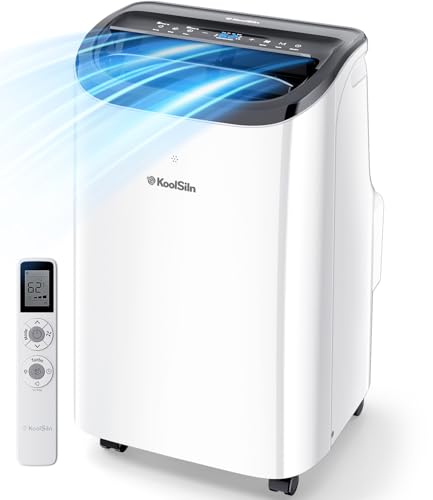
Features include 12,000 BTU cooling, enlarged 77° air outlet, eco-friendly R32 refrigerant, and 360° auto-evaporation tech that converts excess water into cool air. Noise reduction technology lowers sound to about 44dB and a sleep mode dims the display and reduces fan noise.
Best for small to medium garages where quieter operation matters. Choose this if you need a portable unit that balances cooling power and low noise for a workspace or attached garage used for hobbies.
Caution: the listing states exhaust hose installation is required for cooling. Plan for a proper vent or window kit to ensure effective performance.
KoolSiln 14,000 BTU Portable AC

Features include 14,000 BTU cooling, an enlarged 77° air outlet, R32 refrigerant for faster cooling, 360° auto-evaporation tech, and a sleep mode. Noise levels are cited as low as 48dB.
Better for larger single-car garages or workshops where a larger capacity is needed without moving to a permanent system. Choose this if your garage area approaches the higher end of portable AC coverage (up to ~700 sq.ft as described).
Caution: noise runs up to 48dB in typical operation, so it may be noticeably louder than lower-BTU or inverter models when running at full power.
KoolSiln 16,000 BTU Inverter Portable AC
Don’t Overpay for HVAC Services – Call 888-894-0154 Now to Compare Local Quotes!
Features list a 16,000 BTU inverter compressor, enlarged 77° air outlet, R32 refrigerant, and 360° auto-evaporation tech. The inverter design targets noise below 40dB and aims for more consistent temperature control.
Best for large garages and workshops where faster cooling and quieter continuous operation are priorities. Choose this if you want inverter efficiency and lower noise for long sessions in the garage.
Caution: inverter models often require stable electrical supply and may be more complex to service than basic portable units; confirm compatibility with your garage electrical circuit.
Antarctic Star 10,000 BTU Portable AC

This 4-in-1 unit provides 10,000 BTU cooling, dehumidifier, fan modes, sleep mode, 24-hour timer, remote control, wheels, and a window installation kit. The listing specifies compatibility with sliding windows 25 to 50 inches wide.
Better for compact garages, single-car spaces, or buyers who want simple installation with an included window kit. Choose this if you need portability and straightforward window mounting for temporary or seasonal garage cooling.
Caution: the unit is rated at 10,000 BTU; it may be undersized for large garages or heavy heat loads. Confirm your garage area before choosing this smaller-capacity model.
HUMHOLD Inverter 16,000 BTU Dual Hose AC

Features include inverter technology for up to 40% energy savings, 16,000 BTU cooling capacity, dual hose design for faster intake and exhaust, internal temp sensor with Auto Smart mode, and quiet sleep mode around 42dB. The listing notes cooling coverage up to 600–800 sq.ft.
Best for very large garages and buyers focused on faster cooling and energy efficiency. Choose this if you have a large workspace and want the faster response of a dual-hose system plus inverter energy savings.
Caution: dual-hose setups typically require room for both intake and exhaust venting. Ensure you can position both hoses to an outdoor opening or appropriate venting location.
Buying Guide: How To Choose An Air Conditioner For Your Garage
How do I size BTU for my garage?
Match AC capacity to garage square footage and heat sources. Use manufacturer coverage notes as a starting point: 10,000–12,000 BTU for smaller garages or isolated workrooms, 14,000–16,000 BTU for larger single- or two-car garages. Increase capacity for high ceilings, sun exposure, or active heat-generating work.
Should I pick a portable or permanent system?
Portable units are fastest to install and move seasonally; they require a window or wall vent for exhaust. Permanent systems (mini-split or central) provide higher efficiency and permanent ducting but require professional installation. Choose portable if you need flexibility or temporary cooling.
Single-hose versus dual-hose—what’s the difference?
- Single-hose: exhausts warm air and draws replacement air from the room. Simpler setup, generally less costly.
- Dual-hose: separates intake and exhaust, improving efficiency and preventing negative pressure that draws warm air in. Better for large garages and faster cooling.
Is inverter technology worth it?
Inverter compressors vary speed to maintain temperature, which can save energy and reduce noise over long runtime. Consider inverter models if you plan to run the AC for extended periods or want more stable temperatures.
How important is water and condensate management?
Look for auto-evaporation or self-draining features. Garages can be humid; units that convert condensate into cool air or that include easy drain options reduce maintenance and the need to empty pans frequently.
What about installation and venting requirements?
Confirm the included window kit dimensions and whether an exhaust hose is required. Sliding window compatibility, or the ability to vent through a wall, affects placement. Dual-hose units require space for two hoses or a vent adapter.
What safety and environmental concerns apply to garages?
Garages often contain dust, paint, or volatile chemicals. Avoid placing AC intake near paint fumes or open containers. Ensure the electrical circuit can handle the unit, and ventilate when using flammable solvents—air conditioners are not substitutes for proper ventilation when hazardous fumes are present.
FAQ
Q: Can I use a portable AC in an uninsulated garage?
A: Yes, but expect reduced efficiency. Uninsulated garages leak heat; choose a higher BTU unit or add insulation to improve performance.
Q: Do portable ACs need a window?
A: Yes. Most portable ACs require an exhaust hose routed through a window, vent, or wall opening to expel hot air.
Q: Is inverter technology quieter?
A: Inverter units typically run at variable speeds and can be quieter during steady-state operation compared with non-inverter units running at full power.
Don’t Overpay for HVAC Services – Call 888-894-0154 Now to Compare Local Quotes!
Q: How do I manage condensate in a garage?
A: Choose units with auto-evaporation or drain ports. Some models convert condensate to cool air; others will require occasional draining or a condensate hose to a drain.
Q: Will a 16,000 BTU unit cool a two-car garage?
A: It depends on garage size, insulation, and heat sources. Listings that state coverage up to 800 sq.ft are better matches for larger two-car garages; confirm your square footage and heat load before choosing.

How to Get the Best HVAC Prices
- Firstly, keep in mind that installation quality is always the most important thing for residential HVAC project. So never sacrifice contractor quality for a lower price.
- Secondly, remember to look up the latest rebates as we talked above.
- Thirdly, ask for at least 3 bids before you make the decision. You can click here to get 3 free estimates from your local contractors, and this estimate already takes rebates and tax credit into consideration and filter unqualified contractors automatically.
Lastly, once you chose the right contractor, remember to use the tactics from this guide: Homeowners Tactics When Negotiating with HVAC Dealer to get the final best price.