

Black mold in an air conditioner may raise health, comfort, and indoor air quality concerns. It normally occurs as a result of over moisture, stagnant water or poor maintenance.
Although not all molds are toxic, some species may cause adverse effects in vulnerable people. With knowledge of the development of black mold and the ways of dealing with it, building owners or tenants will be able to provide healthier living conditions. This paper describes causes, risks, detection, prevention and remedies of black mold problems in air conditioners.
Understanding Black Mold In An Air Conditioner

When speaking of the black mold, most individuals would consider the Stachybotrys chartarum which is a species that is commonly related to damp or humid environments. Nevertheless, black or dark green color may also be characteristic of other types of mold.
When there is constant moisture, air conditioners, which constantly recirculate air through coils and ducts, can turn into an ideal habitat of mold.
Dust and debris accumulate in the AC system with time. This residue, together with humidity, creates a perfect breeding place of mold.
One of the most important things to keep in mind is that mold spores are present in the environment, but they can only thrive when conditions, including moisture and warmth, come together.
The Role Of Moisture
An air conditioner is able to take heat out of the air and this leads to condensation on the cooling coils. When the drainage is poor, stagnant water will be the trigger of molds.
Mold can grow faster in standing water and warm environment. There should be proper drainage channels to ensure that the level of moisture is controlled.
Moreover, mold grows well in a humid environment. Long exposure to high humidity stimulates condensation and colonization on surfaces. When combined with organic dust and debris, the interior of the AC is a possible breeding ground of mold spores.
Common Causes Of Black Mold In Air Conditioners
Black mold does not come over night. It usually is a combination of maintenance neglect and environmental conditions that promote fungal growth. Among the main problems, there is poor maintenance, poor ventilation, and constant dampness.
Don’t Overpay for HVAC Services – Call 888-894-0154 Now to Compare Local Quotes!
Identifying these issues early is a way of reducing the mold infestation and expensive repairs.
Neglected Maintenance
Any air conditioning system needs routine maintenance. Mold spores can attach and grow well in the presence of dirt that accumulates when filters, coils and drain pans are not cleaned regularly.
Dirty or clogged filters do not only encourage the growth of molds, but also reduce the efficiency of the system. With time, improper maintenance may cause severe outbreaks of molds.
Excessive Humidity And Dampness
Air conditioning systems are meant to control the humidity, however, in the very humid regions or in the poorly ventilated rooms, water can condense. When the moisture is left to stay long, the surfaces within the AC unit may be wet enough to allow the growth of mold.
Even minor leaks around the system may cause constant dampness, which promotes the growth of mold.
Improper Ventilation
An air conditioner may not be able to control the humidity in the house when there is no sufficient airflow. The moisture is trapped in poorly ventilated areas and condensation occurs in the secret areas of the AC system.
This is a perfect condition that promotes the growth of black mold. These conditions are worsened by closed-off rooms and blocked vents which decrease the capacity of the system to circulate clean and dry air.
Potential Health Effects Of Black Mold
Black mold especially when it grows in an air conditioning system may release spores into the indoor air. When these spores are inhaled, they can cause different symptoms, such as allergic reactions, respiratory distress, and even more serious complications in susceptible people.
The health implications that may arise as a result of the growth of molds are important to understand why it is important to prevent the growth of molds.
The following issues can arise from exposure to mold spores:
- Allergic Reactions: Symptoms like sneezing, coughing, and itchy eyes
- Respiratory Irritation: Breathing difficulties, wheezing, or tightness in the chest
- Asthma Exacerbation: Deterioration of asthmatic disorders, particularly among children or elderly people
- Hypersensitivity Pneumonitis: Rare but serious inflammatory condition affecting lung tissue
How To Identify Black Mold In An Air Conditioner
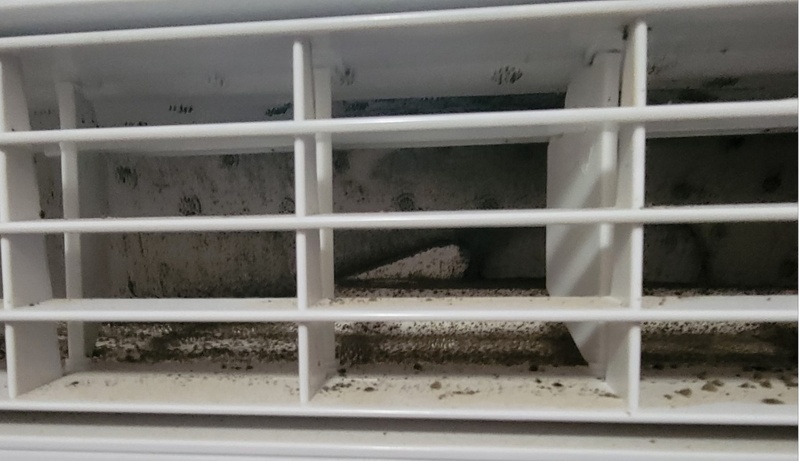
The identification of the presence of mold is a combination of visual examination, smell, and professional testing. Although a musty smell is a typical sign, not all mold growths have an instant smell.
Homeowners and building managers can prevent the spread of mold by conducting routine checkups to identify the signs of mold early enough.
Visual Signs
Mold spots in the AC system may come as dark spots or specks on coils, drip pans, and vents. Certain mold might also be slimy or fuzzy. It is prudent to open the accessible sections of the unit, i.e. the front panel or filter compartment, and check whether there is any suspicious discoloration.
Mold can also be indicated by dark stains on the walls of ducts in central air systems or wet insulation around the vents. In case of any abnormal streaks or growth, it is advisable to investigate.
Unusual Odors
The presence of mold is often characterized by a pungent or musty smell that gets worse when the air conditioner is on. The mustiness in the airflow implies that the mold may not be visible all the time but it may be hiding in the ducts or the evaporator coils.
In case the smell does not disappear or gets worse, it is better to investigate the unit or invite an expert.
Professional Testing
As much as DIY can be used to detect mold, professional testing provides more conclusive results. Professionals are able to collect air or surface samples and examine them in a laboratory.
The findings indicate the type of molds, the level of spores and the risks involved. Professional inspection may prove to be invaluable particularly where massive mold is suspected or where health sensitive areas are involved.
Essential Safety Measures Before Handling Mold
Removal of black mold in an air conditioner should be done with care. Mold or spores inhalation or direct contact with them may influence health, and the proper safety measures are essential.
Although small areas of mould can be addressed by a person wearing the right equipment and using the right techniques, large-scale contamination usually requires the services of a professional.
Don’t Overpay for HVAC Services – Call 888-894-0154 Now to Compare Local Quotes!
Before starting any cleanup, consider these precautions:
- Turn Off The AC: Do not blow around contaminated air during inspection or cleaning
- Use Protective Gear: Gloves, goggles, and an N95 respirator to protect eyes, skin, and lungs
- Protect Adjacent Areas: Cover the adjacent areas with plastic sheeting or drop cloths to prevent the spread of molds
- Provide Proper Ventilation: Open windows or exhaust fans to restrict the accumulation of spores in the air
Methods To Remove Black Mold From An Air Conditioner

Eradication of black mold requires specific methods, which are based on the intensity of the infestation. Small mold issues can be treated with domestic cleaners, whereas bigger or repeated mold problems might require professional assistance.
Whichever way you decide to do it, it is important to attack the underlying causes which are humidity, poor drainage or ventilation to avoid regrowth.
Basic Cleaning For Minor Mold Growth
For smaller areas of mold:
- Turn Off The Power: Shut off electricity to avoid hazards
- Wash And Replace Filters: Wet them in warm soapy water or a weak bleach solution
- Clean Visible Surfaces: Clean visible surfaces with an appropriate cleaning solution, such as diluted bleach or commercial mold cleaners
- Let Dry Completely: Make sure that the AC parts are dry before reconnecting them
The most important thing in preventing the reoccurrence of molds is dryness after cleaning.
Deeper Cleaning For Moderate Growth
In case of mold growth beyond filters and it is evident on coils or internal parts:
- Turn off and unplug the unit to avoid electrical risks
- Remove covers or panels to access coils and fan blades
- Apply a mold cleaning spray or homemade bleach solution (1 cup of bleach in 1 gallon of water)
- Use a soft brush to scrub lightly yet thoroughly to get rid of mold residue
- Wash in clean water as suggested by the product or professional instructions
- Pat or air-dry components before reassembling
Always consult the manufacturer’s manual to ensure proper cleaning procedures.
Professional Mold Remediation
In cases where the mold has penetrated duct work or internal parts, it is usually best to seek the help of a professional service. Professionals employ special tools like HEPA vacuums and commercial-strength antimicrobial cleaners to get rid of mold completely.
They are also able to check structural or mechanical problems that are causing moisture build up. Although professional remediation is more expensive, it provides an all-inclusive solution to the stoppage of mold growth.
Preventing Black Mold Growth
Remediation is never as effective and cheap as prevention. Users can minimize the chances of mold growth by following some practices and maintaining the air conditioner in the best working condition.
Prevention measures include routine maintenance, humidity control and close monitoring of air quality changes.
Routine Maintenance Schedule
Mold risks are significantly reduced by a regular maintenance schedule. Depending on the manufacturer recommendations, filters are usually cleaned or replaced every 1-3 months.
Ducts, coils and drip pans should also be checked to ensure that there is no water build up. Debris or mold that is detected should be cleared immediately. Professional tune-ups once or twice a year will keep the whole system in the best condition.
Controlling Humidity Levels
Too much moisture is a welcome mat to mold. Using an easy tool like a hygrometer to monitor the humidity level in the house will ensure that the level is maintained at the optimal level, which is between 30 and 50 percent.
In the especially humid climates, the general moisture load in the air can be decreased by using dehumidifiers, which will make it more difficult to support the growth of mold in the AC unit. This is further helped by ensuring that air vents and windows are not blocked which helps in maintaining low indoor humidity.
Don’t Overpay for HVAC Services – Call 888-894-0154 Now to Compare Local Quotes!
Proper Airflow And Ventilation
Proper air movement should be encouraged to avoid settling of mold spores and their growth. Vents should not be blocked by furniture or drapery, and the doors should be opened periodically to circulate air between rooms.
In the same way, it is possible to turn on ventilation fans when cooking or taking a shower to get rid of excess moisture. Even air circulation promotes a less favorable environment to the growth of molds.
Choosing The Right Air Conditioner Filters
The filter that is fitted in an air conditioner is important in capturing dust, pollen and other air particles. Homeowners can prevent the entry of mold spores in the system in large numbers by choosing high-quality filters and replacing or cleaning them frequently.
MERV Ratings
The U.S. filters are commonly classified according to their Minimum Efficiency Reporting Value (MERV). With a scale of 1 to 16, the higher the MERV rating, the more it is able to trap smaller particles.
The most typical filters used in residential areas are MERV 8 to 13, which offer a trade-off between airflow and filtration. Nevertheless, exceeding the level (higher than MERV 13) can overload some HVAC systems unless they are compatible, so one should adhere to the recommendations of the manufacturer.
HEPA Filters
The High-Efficiency Particulate Air (HEPA) filters are reputed to filter out at least 99.97 percent of the particles of 0.3 microns or less. Although HEPA filters are very good at capturing microscopic mold spores, they are commonly found in portable air cleaners or special AC units.
Prior to the upgrade to a HEPA filter, ensure that the air conditioner is suitable and modify the system to prevent limited airflow or destruction.
Professional Assistance And When To Seek Help
Even though most homeowners are able to deal with minor mold problems themselves, there are situations when professional help is required. Engaging specialists does not only solve the problem of mold that already exists but also allows identifying the root causes of the problem, including water leaks or structural problems in ducts.
In case of uncertainty, a qualified technician can provide relief and specific solutions.
Signs That Indicate Professional Intervention
It might be necessary to contact a professional mold remediation specialist or HVAC specialist in the event that:
- Mold Covers A Large Area: Generally more than 10 square feet
- There’s Persistent Odor: Musty smell reoccurs despite cleaning efforts
- Multiple Attempts Have Failed: Mold returns quickly after removal
- Health Complications Arise: Family members or occupants exhibit severe symptoms
Prompt action can prevent extensive property damage and medical issues.
How to Avoid Being Ripped Off and Get a Fair Repair Price
It is not easy to find a good air conditioner repair specialist, some companies will quote you the lowest prices as they are new or have bad reputations and others will quote you too high a price to do the same job.
This is why the best and the smartest way to get the quality repairs at a fair price is to compare the estimates of the best-rated local professionals. Visit each of them, learn about their history and the experience of the technicians that will perform the work. Select a professional air conditioner repair contractor who has affordable prices. You may speed up this procedure with the help of our Free Local Estimates service.
By completing a short form and sending it, you will shortly receive a call back by three of the best air conditioner repair and installation companies in your area. They are pre-screened in terms of experience and all of them are licensed and insured to protect you. Click below to start and save your home and wallet now.
Myths And Facts About Black Mold In Air Conditioners
The misinformation about black mold and its effect on the AC systems may cause confusion or panic without any reason. The difference between myths and facts enables the occupants of the building to act accordingly in case of possible mold problems.
| Myth | Fact |
|---|---|
| Mold Growth Is Always Visible | In reality, mold can hide in ducts or behind components, so routine checks are crucial. |
| Black Mold Is Always Toxic | Not all mold that appears black is Stachybotrys chartarum, and not all species produce toxins. |
| Bleach Alone Solves All Mold Issues | While bleach can kill surface mold, deeper infestations might require professional intervention or more thorough remediation. |
| Once Cleaned, Mold Will Never Return | Unless the underlying moisture problem is fixed, mold can reemerge. |
Frequently Asked Questions
Is Black Mold In An Air Conditioner Always Harmful?
Black mold may pose health risks to some people particularly those who have allergies or have weak immune systems. Not every species of mold that is dark in color is toxic, though it is necessary to deal with any mold growth to maintain the quality of indoor air.
Can Switching To A Higher MERV Filter Alone Prevent Mold?
Although filters are useful, an upgrade of filters alone is not a sure way of preventing molds. Mold is a moisture loving organism. It is important to deal with the humidity, condensation, and cleanliness even in case of a high-rated filter installed.
How Often Should The AC Be Inspected For Mold?
During routine home maintenance, it is recommended to inspect filters every month and be on the lookout of mold or water build-up. The risk of a serious mold problem can also be minimized by professional inspection once or twice a year, particularly in humid regions.
Is Professional Testing Necessary For All Mold Problems?
Small, localized mold is not always required to be professionally tested. Nevertheless, when issues are not resolved with DIY cleaning, or the mold infestation is extensive, it may be time-saving and less hazardous to the health to hire a professional to test or remediate.
What If Mold Reappears After Cleaning?
Repeated mold is usually a sign of moisture problem that has not been resolved or a sign of incomplete removal. Check the drainage system of the AC, humidity and ventilation.
In case the issue continues, call an HVAC expert to check more serious problems like concealed leaks or poor airflow.
Addressing Common Underlying Issues
In addition to cleaning mold directly, it is important to investigate any underlying issues that are causing its recurrence. A lasting solution to the mold problem in an air conditioner can be achieved by diagnosing and rectifying the problem of leaks, drainage or mechanical faults.
Leaky Or Blocked Drain Lines
Naturally, the condensation will accumulate on the evaporator coils and drip into a pan that is linked to a drain line. In case this line is filled with debris or has leaks, water can accumulate and mold can grow.
Cleaning the drain line or unclogging it regularly is an easy but necessary procedure. Other systems have a clean-out feature and this makes it more available to the homeowner.
Faulty Seals And Insulation
Worn out or broken seals around the panels or duct connections of the air conditioner may allow humid air to enter and this enhances condensation. Likewise, damaged insulation or old insulation on ducts can cause moisture to accumulate on cold surfaces, which encourages mold.
Regular checking of these places will reduce water penetration.
Oversized Air Conditioning Units
A large AC system cools a room fast but switches off before it is able to dehumidify the air. Short cycles that occur regularly leave a lot of moisture in the surroundings, which is perfect breeding ground of molds.
To minimize the problem of humidity, one should consult a professional to ensure that the right size of the unit is used. In case it is needed, dehumidifiers or ductwork adjustment may also enhance moisture control.
Maintaining Indoor Air Quality Beyond Mold Prevention
Although mold prevention is a key element of good indoor air quality, other elements affect the health of occupants. HVAC systems may accumulate dust, volatile organic compounds (VOCs) and bacterial growth.
Best practices in cleaning and ventilation do not only combat mold but also improve the overall quality of the air.
Regular Filter Replacement
Airborne pollutants are captured by filters, and the irritants to the respiratory system are minimized. Nevertheless, filters that are not taken care of may turn into a source of mold and bacteria.
Regular filter changes or cleaning can keep the airflow at the optimum level and prevent the re-entry of contaminants. A good filter is also energy saving since it does not overwork the AC system.
Using Air Purifiers And Ventilation Enhancements
Mold and bacteria growth can be suppressed by stand-alone air purifiers or UV lights fitted in the HVAC system. In addition, proper ventilation in places such as kitchens and bathrooms removes moisture and bad odor.
Fresh air intakes and exhaust fans enhance air flow reducing chances of mold colonies in concealed areas.
Monitoring For Other Pollutants
There are invisible pollutants in homes. Building materials may contain formaldehyde or cleaning products may contain VOCs which can build up. Regular indoor air quality monitoring will reveal the problems before they become serious.
Adequate humidity, filtration, and minimal use of chemicals together maintain the comfort and safety of the indoor environment.
Energy Efficiency And Mold Prevention
Mold prevention and energy efficiency are two things that are likely to be combined. A properly sized system that is well maintained can strike a balance between cooling, humidity control and power consumption.
Homeowners can save money by insulating strategically, using the right size of AC and servicing them regularly to minimize the chances of mold in air conditioners.
Proper AC Sizing And Operation
As it has been mentioned, an oversized or undersized unit may lead to the development of inappropriate conditions in terms of moisture control. A unit that is too large can short-cycle and leave the humidity high and a unit that is too small can run all the time and accumulate too much condensation.
To have the right capacity of the system, an HVAC expert should be consulted to calculate the load requirements.
Sealing Air Leaks And Insulation
Leaks of air are energy wasting and introduce humid air, particularly in warm climates. This has the potential of sabotaging the dehumidification process of the AC.
Filling cracks on ductwork, windows and doors keeps the indoor environment stable. Adequate insulation means that cooler surfaces within the house will be dry, and this minimizes possible areas where molds can grow.
Long-Term Solutions And Upgrades
In case the mold issues are still present even after regular maintenance, it is possible that more serious upgrades or changes in the system are needed. Preventive measures to deal with recurring problems can be more economical than treating the symptoms.
Long-term strategies include installing high-tech filtration, replacing the current AC with a newer, more efficient model, and so on.
Upgrading To A New Air Conditioner
A unit that is older can become less efficient, which increases the humidity and causes operational problems that encourage mold. Variable-speed compressors and intelligent humidity sensors are some of the advanced features that newer models have.
Such technologies optimize cooling and dehumidification and allow more control over moisture. The cost of the investment can be high, but the energy savings and minimized risk of mold in the long-term can be worth the price.
Installing UV Lights In Ductwork
The air conditioning system can be supplemented with ultraviolet (UV) lights that will focus on the mold spores and bacterial growth on the coils or in the ducts. These systems are aimed at sterilizing the surfaces and air passing through it, which reduces the possibility of mold colonization.
UV lights are not a solution on their own, but they can be useful in combination with a good cleaning and humidity control.
Additional Resources For Mold Prevention
Homeowners can learn more about the best practices and scientific advice to keep themselves informed about the mold prevention strategies. By reading credible sources or talking to licensed experts, one can be sure that any mold scenario is addressed with correct information.
Some useful links are given below:
- EPA’s Mold Resources
- CDC Information On Mold And Dampness
- Firstly, keep in mind that installation quality is always the most important thing for residential HVAC project. So never sacrifice contractor quality for a lower price.
- Secondly, remember to look up the latest rebates as we talked above.
- Thirdly, ask for at least 3 bids before you make the decision. You can click here to get 3 free estimates from your local contractors, and this estimate already takes rebates and tax credit into consideration and filter unqualified contractors automatically.

How to Get the Best HVAC Prices
Lastly, once you chose the right contractor, remember to use the tactics from this guide: Homeowners Tactics When Negotiating with HVAC Dealer to get the final best price.

