The use of portable fans is a common cooling method in most American homes.
This article explores the argument of tower fan vs pedestal fan by comparing the two in terms of design, performance, noise, energy consumption, and other factors that are pertinent to American homeowners.
Knowing these differences will assist homeowners in selecting the correct fan to suit their needs.
The table below is a summary comparison of major differences between tower and pedestal fans:
| Factor | Tower Fan | Pedestal Fan |
|---|---|---|
| Design & Aesthetics | Tall, slim tower shape; modern look; concealed blades | Classic circular fan head on stand; visible blades; larger base |
| Cooling Performance | Gentle, widespread airflow; best for small to medium rooms | Powerful, focused airflow; suitable for larger spaces |
| Noise Level | Generally quieter operation, especially at low speeds | Louder due to large blades, though high-end models can be quieter |
| Energy Efficiency | Typically lower wattage motors; efficient for continuous use | Higher power draw at max speeds; still inexpensive to run |
| Space & Portability | Small footprint; lightweight and easy to move | Requires more floor space; some models have wheels for mobility |
| Safety | Blades are enclosed or bladeless; more child and pet friendly | Exposed blade grill; caution needed with children and pets |
| Features | Often feature-rich (timers, remotes, smart controls, air purifiers) | Generally basic (speed settings, oscillation); fewer extra features |
| Cost & Value | Higher average price; pay for design and features | Lower average cost; great value for strong airflow |
| Maintenance | Can be harder to clean inside; modern designs durable | Easy to clean blades; simple design with proven longevity |
Design and Aesthetics
Tower fans are usually slim, vertical in shape and occupy little space on the floor.
The majority of tower designs have a modern, minimalistic look and vents that are vertical on the unit. This enables them to fit in modern home decoration more than the traditional fans. They tend to have their blades hidden in the tower housing (or not present in the case of bladeless models), making them look cleaner and safer.
Pedestal fans, in their turn, are more traditional fans that have a round fan head on a movable stand.
The fan head which usually has three or five blades is covered by a circular grille to ensure safety. This traditional design is practical and more noticeable in a room. Pedestal fans may be retro or decorative to fit some décor, but in general they are not as sleek as tower fans. The bigger visible blades and grill make pedestal fans look utilitarian, which is a distinctive feature, but tower fans can be easily lost in a corner.
Space is also a factor when it comes to the aesthetics of tower fan vs pedestal fan.
The narrow design of a tower fan (usually less than 1 square foot) can be placed in a tight area or between pieces of furniture. Pedestal fans need a wider base to stand on, usually 1.5-2 square feet of floor space, and are therefore more conspicuous in a room. Tower fan design is generally more suitable to homeowners who want a modern appearance or have limited space to spare. The style of a pedestal fan might be acceptable in the living area of those who do not mind the traditional fan look or even those who like the retro look.
Don’t Overpay for HVAC Services – Call 888-894-0154 Now to Compare Local Quotes!
Cooling Performance and Airflow
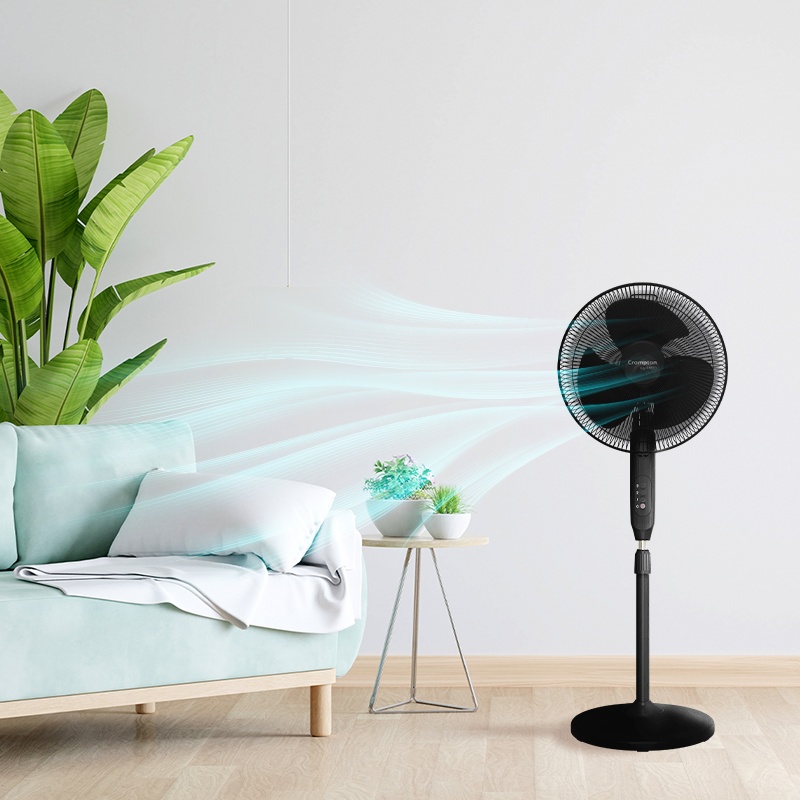
One of the biggest distinctions between tower fans and pedestal fans is the way in which they circulate air and their cooling effect.
Pedestal fans are usually more powerful in terms of airflow. Pedestal fans are able to circulate a lot of air and generate a perceptible breeze even over a large room due to their large, exposed blades and powerful motors. The fan head can be adjusted in height and tilt so that the user can direct this airflow where it is required. This makes pedestal fans useful in cooling people quickly in large areas or air circulation within a room. Pedestal models tend to have greater airflow (in CFM) than tower fans in tests, which means that they will cool the people in their direct line of fire more effectively.
By contrast, tower fans offer a more diffused airflow.
Tower fans do not blow a powerful gust in any one direction, but rather a column of air down their length, which may be experienced as a gentle breeze over a larger area. A lot of tower fans move back and forth, spreading the air more evenly within the room. Although the air movement of a tower fan is not as strong as a pedestal fan, it is more consistent and less direct. This renders tower fans quite appropriate in small to medium-sized rooms or those who do not want a concentrated burst of air but a continuous gentle air flow.
Remember that fans do not reduce the air temperature in a room, they just circulate it.
Therefore, when comparing the cooling performance of tower fan vs pedestal fan, you should take into account the size of the room and the way you are going to use the fan. A pedestal fan has a strong air flow which is beneficial in a large living room or garage where you would like to feel the air on the other side of the room. A tower fan can be more comfortable in a bedroom or office where a general, light breeze is more comfortable. The type of fan you use will depend on the space and this will give you effective cooling and comfort.
Noise Level
They are able to generate a continuous noise when in use and the level of noise is a major factor of comfort to most homeowners.
Generally, tower fans are characterized by less noise as opposed to pedestal fans. Noise is dampened by the internal design of the blades and insulation within the casing of a tower fan. Small blower-type impellers or multiple small fan blades are used in many tower models, and these are less likely to make motor and whooshing noises. Also, tower fans are usually equipped with special modes called quiet or sleep that operate the fan at a low, very quiet speed that is appropriate to use in bedrooms at night.
Pedestal fans tend to be noisier, particularly when they are on high speed.
The bigger blades cutting through the air and the stronger motors may produce a louder hum or whirr sound. A typical pedestal fan could be too noisy on full power especially when you are sound sensitive or when you are sleeping. But in low speed mode, the noise gap between a good pedestal fan and a tower fan closes, both can be fairly quiet when operating at low speed. Newer models of pedestal fans have better blade designs and DC motors to make them less noisy than the older models. Actually, expensive pedestal fans marketed as quiet can be as loud as tower fans when not run on full blast.
In noise-sensitive rooms such as bedrooms or office, tower fans usually win the advantage of keeping the room quiet.
In case of pedestal fan in such environments, consider models that have noise-reduction capabilities or operate at low speed settings to minimize noise levels. Finally, in the comparison of tower fan vs pedestal fan in terms of noise, look at the amount of quiet you require. Tower fans tend to be the safer option when you are a light sleeper or in a quiet environment, but pedestal fans are okay when you do not mind a little white noise, or when you want more airflow than silence.
Energy Efficiency
Both tower fans and pedestal fans are fairly efficient appliances when it comes to electricity consumption, as compared to air conditioning units.
The difference in power consumption between the two types of fans is not dramatic at the similar settings, yet there are certain trends. Tower fans tend to have slightly smaller motors and they can consume less wattage at lower speeds. As an example, most tower fan models can draw a maximum of 40-60 watts of power which is adequate to provide their moderate airflow. They are designed to cool specific areas and this can be done using less energy. This implies that running a tower fan on full time basis over a period of hours does not affect energy bills much- sometimes just a few cents per hour in electricity cost.
Pedestal fans usually use larger motors to power their large blades, and at the top speeds they may use a little more power (some models use 60-100 watts on high).
But since pedestal fans are so efficient in moving air, the user may not have to run them at full speed as long to feel comfortable cooling. A pedestal fan can be as energy efficient as a tower fan at low or medium speeds. Practically, the two types of fans are cheap to run. As an example, a tower fan or a pedestal fan running on high could consume approximately 0.05-0.06 kWh per hour (approximately the same amount of both), or a few pennies. Fans can be used to supplement or instead of air conditioning to save a lot of energy, especially in a hot summer, irrespective of the type of fan.
The important energy factor in the tower fan vs pedestal fan choice is to ensure that the fan is appropriate to the intended application.
A tower fan is effective when used continuously in a small area or when one wants to cool himself or herself around a sitting place. A pedestal fan is more power-hungry when run at full blast but efficient when run intermittently or in a larger room where its greater output can move air further, possibly eliminating the need to have several fans. In general, the differences in energy efficiency are insignificant, both tower and pedestal fans are cost-effective cooling devices in the house.
Space Requirements and Portability
Another practical aspect when comparing tower fans vs pedestal fans is space.
Tower fans tend to be victorious in footprint and form. A tower fan is usually less than one square foot or even less in terms of floor space with a slim and upright shape. One can simply place a tower fan by the side of a sofa, in a corner, or next to a desk without having to move furniture. Tower units are typically light (many weigh less than 10 pounds) and typically have a carrying handle, so they are easy to move about the house.
Don’t Overpay for HVAC Services – Call 888-894-0154 Now to Compare Local Quotes!
Pedestal fans also take up more space since they have a wide base (more than a foot in diameter).
On the upside, the pedestal fans are adjustable in height, and thus they can be elevated to blow air over the beds, couches, or other obstructions, which a tower fan with a fixed height cannot do. Even larger pedestal models have small wheels attached. This makes them more portable particularly in large areas or heavy duty units. Overall, the process of relocating a pedestal fan involves transporting the base; however, the majority of them are not heavy enough to cause a lot of inconvenience.
Tower fans are also better in terms of storage since they can usually be stored in closets or other tight spaces during the off-season.
Pedestal fans may be taken apart (separating the pole and the base) to take up less space, but this is less convenient. To conclude, tower fans are the best in small spaces or rooms, and pedestal fans are the best in case you have space. The shape of tower fans makes them a little more grab-and-go, but both are relatively easy to move around as required by an adult.
Safety and Child-Friendliness
Fan safety features should be given particular attention to households with children or pets.
In this case, tower fans usually have an upper hand due to their design. Tower fans have either closely spaced grilles or are bladeless, that is, the high-speed spinning fan blades are not easily accessible to inquisitive fingers or paws. This closed-blade design greatly decreases the chances of getting injured. The moving parts are well hidden inside even when a child touches the outer casing of a tower fan. Also, most tower fans come with such features as a heavy base to prevent tipping or even child-lock controls.
Pedestal fans although not very dangerous when used correctly do have exposed blades behind a grille.
The grille has holes that may possibly enable a small finger (or a paw of a curious cat) to enter into the blades in case the fan is on and this can lead to injury. Parents should make sure that the grille of the fan is in place and fixed and only pedestal fans should be used under supervision. The pedestal fans are tall, elevated, and thus may be tipped over in case a person pulls it or bumps into the stand, but the base is wide enough to ensure stability. Tipping is not expected when working on a flat, stable surface, but it is possible when kids are climbing or pulling.
Safety wise in the tower fan vs pedestal fan argument, tower fans are considered to be more child and pet friendly since they have enclosed blades and are compact in size.
Bladeless tower fans (such as some of the higher-end models) go one step further and remove the external blades, but are more expensive. It does not imply that pedestal fans are not safe to use in a family home, it only means that they need a little more care. Never leave young children unattended near any fan, and think of placing fans in areas where they can least be interfered with. In case safety is a priority, a tower fan offers additional security due to the safer design.
Features and Smart Capabilities
The modern fans can do a lot more than simply turn on and off, and tower fans in particular are often crammed with additional features.
A standard tower fan is usually provided with a variety of convenience features: multi-speed, oscillation, programmable timers, and remote control. A lot of tower fans are electronic with touch controls. More expensive models might have air filters or ionizers to assist in cleaning the air as they cool, or even in-built heaters to use all year round. Intelligent tower fans are also gaining popularity – these may connect to Wi-Fi and may be controlled through smartphone apps or voice assistants. As an example, newer models of tower fans can be connected to Alexa or Google Assistant to operate without touching them, or have sensors and thermostats to automatically control the speed of the fan depending on the room temperature. Such additional functions turn tower fans into multi-purpose devices that can help to achieve general comfort in the interior rather than merely moving air.
Pedestal fans have traditionally been simpler in features – usually 3 speed, oscillation, and perhaps a crude mechanical timer.
However, in recent years, pedestal fans have also been taking up more advanced features in certain models. Pedestal fans are available with remote controls, digital readouts and multiple settings (including a so-called breeze mode, which alternates the speed to simulate natural wind). Some even have smart connectivity or voice control, but this is not as prevalent as in tower styles. As a rule, however, tower fans are the most innovative, whereas pedestal fans are more functional. That notwithstanding, the two categories have the necessary characteristics required in cooling; adjustable speed and oscillation.
In tower fan vs pedestal fan, it is important to compare features and which extras are important to you.
Don’t Overpay for HVAC Services – Call 888-894-0154 Now to Compare Local Quotes!
A tower fan with more features may be more appropriate to you in case you like tech integrations, air purification, or having a remote nearby to control the fan even when you are on the other side of the room. In case you only need a good fan with simple controls, a pedestal fan may be all you need and a pedestal fan may be cheaper because it does not have extraneous bells and whistles. In the end, both of the types of fans will offer a comfortable breeze, although tower fans tend to offer it in a more sophisticated and customizable way.
Cost and Value
Home appliances are usually a matter of budget and tower fans and pedestal fans differ significantly in price.
Overall, pedestal fans are quite affordable in terms of airflow. The simplest pedestal fan models may be as cheap as 20 dollars, but still, they are able to move a lot of air. The cheapest pedestal fans begin at less than 20 dollars and go up to 300+ dollars in high-end models, with the average price of 86 dollars. That is, a very competent pedestal fan can be acquired by most homeowners without straining the bank. Pedestal fans have a good value proposition when your primary objective is to maximize the airflow per dollar expended.
By contrast, tower fans are more likely to be more expensive to purchase with the same cooling capacity.
The cheapest tower fans are entry level and cost about 40 dollars, although most tower fans are between 80 and 150 dollars. High-end tower fans (such as bladeless or intelligent ones) may be priced at hundreds of dollars, with an average of about 135 dollars. You are paying more to get design and extra features. To some people who care about the design and additional features, that extra cost can be justified; to others who simply need a powerful airflow and simple functionality, a more affordable pedestal fan is more economical.
The difference between the two is mainly the price and features since both types cost pennies to operate.
A pedestal fan is a good value per dollar, especially when you are on a tight budget or only need a fan to cool you down during the summer. In case you can afford more and like the looks or additional functions (such as air purification or heating) of a tower fan, it may be worth the money. Simply put, the frugal shopper will opt to buy a pedestal fan to get the most cooling at the lowest price, whereas the rest of the shoppers can afford to buy a tower fan due to its luxurious design and functionality.
Maintenance and Durability
In this regard, pedestal fans are a little ahead in terms of maintenance.
They are easy to clean because of their open and simple structure blades and grille. The front grille on most pedestal fans is unclipped or unscrewed to provide direct access to the blades to dust or wipe down. Cleaning (every few weeks when it is used heavily) can avoid dust accumulation that may impede airflow or make the fan wobble.
Pedestal fan motors tend to be simple, yet durable; some may last years with little trouble, particularly when occasionally cleaned and lubricated.
The simple design of a pedestal fan implies the reduction of electronic components that may break. On the whole, pedestal fans are simple to maintain devices that can serve many years with little attention.
Tower fans are more complicated inside, and this may complicate the process of cleaning them thoroughly.
The intake vents may allow dust and lint to be pulled into the tower housing where it may collect on the internal fan blades or blower mechanism. Tower fans usually need to be vacuumed in the vents or taken apart to some degree to clean the inside components. Most of the models can be opened with a screwdriver, although some can be cleaned by removing panels or filters. Tower fans are usually durable, although when a significant part of the fan breaks (such as the motor or electronic controls), it is usually not economical to repair. With that said, a good tower fan may last several seasons.
Both tower and pedestal fans are the recipients of simple maintenance: clean them, store them during the off-season, and inspect cords to make sure they are not worn.
Pedestal fan is preferable in case of easy cleaning. The maintenance of a tower fan is also not a big deal as long as you are not against doing a little more work during cleaning.

How to Get the Best HVAC Prices
- Firstly, keep in mind that installation quality is always the most important thing for residential HVAC project. So never sacrifice contractor quality for a lower price.
- Secondly, remember to look up the latest rebates as we talked above.
- Thirdly, ask for at least 3 bids before you make the decision. You can click here to get 3 free estimates from your local contractors, and this estimate already takes rebates and tax credit into consideration and filter unqualified contractors automatically.
Lastly, once you chose the right contractor, remember to use the tactics from this guide: Homeowners Tactics When Negotiating with HVAC Dealer to get the final best price.