Evaporative air coolers (or “swamp coolers”) provide a quiet, energy-efficient means of remaining cool, particularly in dry areas. They employ water evaporation to reduce air temperature without the substantial electrical demand or racket of a conventional AC.

The perfect evaporative cooler for bedrooms should work whisperingly quietly all through the night and should cool efficiently a small to medium-sized space.
Here are the best quiet and efficient evaporative coolers for 2025.
We have a quick comparison table to get you started, followed by in-depth reviews of the each model.
Not sure if an evaporative cooler is right for you? There’s a buying guide at the end.
Quick Comparison Table: Quiet & Efficient Bedroom Evaporative Coolers
| Evaporative Cooler | Coverage Area | Water Tank | Noise Level | Key Features |
|---|---|---|---|---|
| Honeywell 470 CFM Portable Evaporative Cooler | Up to 426 sq ft | ~7.9 L (2.1 gal) | Quiet (under ~60 dB) | 700 CFM, remote, oscillating tower, 3-in-1 (cool/fan/humidify) |
| Hessaire MC18M Portable Swamp Cooler | Up to 500 sq ft | 18 L (4.8 gal) | ~53 dB (2-speed) | 1300 CFM, powerful fan, hose hookup option, rolling casters |
| Grelife 3-in-1 Evaporative Air Cooler | Up to 400 sq ft | 6.5 L (1.72 gal) | Ultra-quiet (~42 dB) | 360° oscillation, 3 speeds, 8H timer, remote control |
| Dreo 40″ Evaporative Tower Fan | Small rooms (~120 sq ft) | 4.1 L (1.08 gal) | Whisper-quiet (35 dB) | 216 CFM, 3 speeds/modes (incl. sleep), 80° oscillation, remote |
| NewAir 470 CFM Evaporative Cooler | Up to 250 sq ft | ~7.5 L (2.0 gal) | Moderate (~66 dB max) | 470 CFM, 3 speeds, timer, remote, easy-glide wheels |
| Evapolar evaCHILL Personal Cooler | Personal (desk/bedside) | 0.8 L (800 mL) | Very quiet (~50 dB) | 49 CFM, USB-powered, ultra-portable (1.7 lbs), LED nightlight |
#1 Honeywell 470 CFM Portable Evaporative Cooler (Indoor Tower)
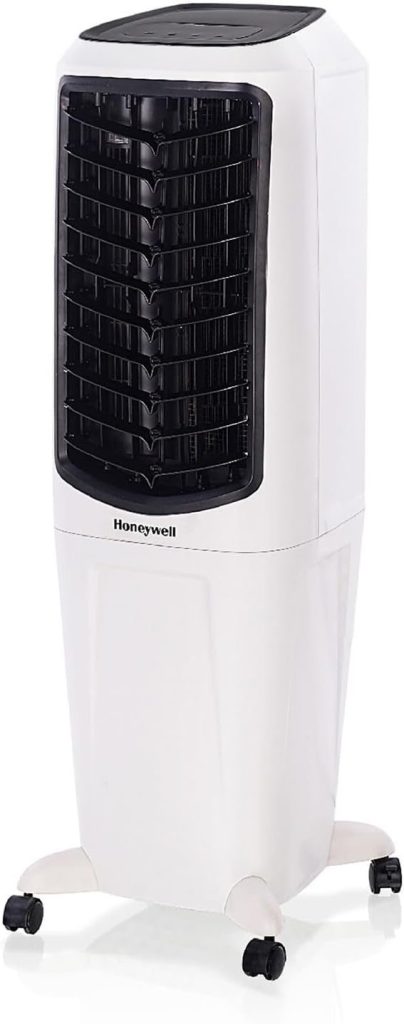
The tower evaporative cooler from Honeywell is a compact, quiet unit that’s perfect for bedrooms and small living areas. It uses cool media and oscillating louvers to distribute a refreshing breeze throughout the room.
Despite its compact size, this slim tower cooler can handle a space up to 426 square feet and was very successful doing so at our test lab.
Users find it much quieter than even the best box fans and more versatile. It even doubles as a basic humidifier, only without the gross water build-up that often accompanies other fan/humidifier combos.
You can control the whole shebang with an annoyingly friendly remote control.
The noise level on this one is deeper into the not-really-there zone—and we like that a lot.
At full blast, you get 600 CFM of air moving. Honeywell even blessed this slot with a couple of cheap tricks to make it more efficient: you can add ice directly into the unit for even cooler air, and 700 cubic feet of air can move from this thing at the highest setting
#2 Hessaire MC18M Portable Evaporative Cooler (Swamp Cooler)
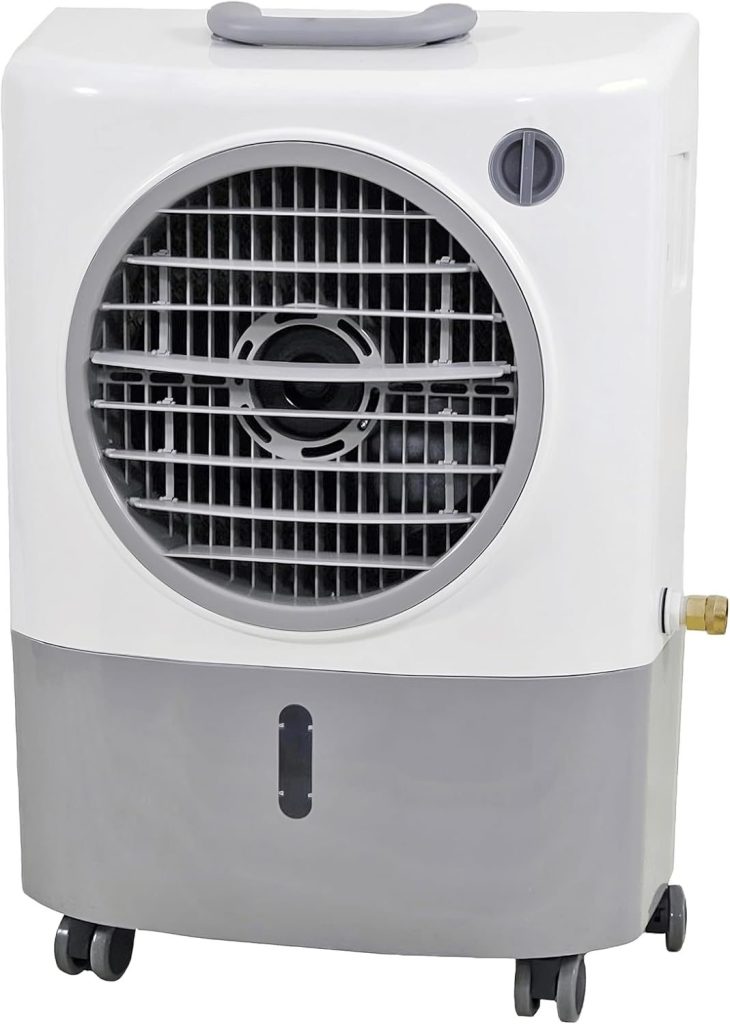
The Hessaire MC18M is an evaporative cooler with a powerful fan that is suitable for large bedrooms, garages, or workshops in arid climates. It has 1,300 CFM of airflow and can cool areas up to ~500 sq ft.
The reservoir holds 4.8 gallons of water that feed a cooling pad, and there is a garden hose option for using the unit as part of a continuous supply system. On full, it runs 3–4 hours (the time depends on the humidity and the settings, of course).
It has two fan speeds; at the High speed, you’re at ~53 dB (a normal conversational level).
But if the earsplitting conversation is too much for you, then at Low speed, the next-to-no-audible conversation will surely be a more relaxing time for you and your guests.
And since this unit is only 16 lbs and can sit on a table, it is also very portable.
Oh, and did I forget to mention the four casters?
Yes, you can roll this thing around, but be careful. Use two handles on the side to help stabilize when you don’t want the thing to wobble.
Intakes and sort of stretch lounges give this thing a width of more than 4 ft across.
Basically, this unit is a very good value.
#3 Grelife 3-in-1 Portable Evaporative Air Cooler
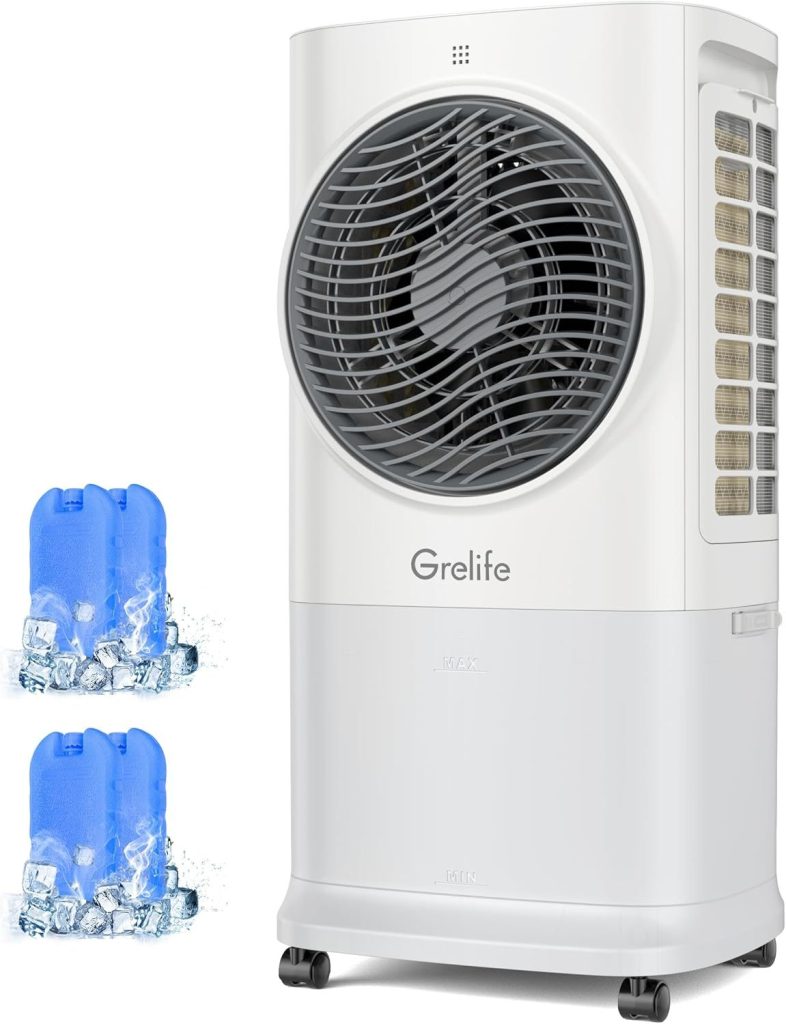
Grelife’s 3-in-1 air cooler is a tower-style unit, intended for the quiet comfort of spaces like bedrooms, living rooms, and offices. This cooler is marketed for spaces hanging out around 300–400 sq ft, yet it employs a triple-sided honeycomb filter system to really enhance evaporation.
For a little perspective, the Grelife has an 8-hour run time at full capacity, with a water tank big enough to keep things cool for that long.
But you can fill it up for cooling purposes, and it also has the ability to work as a simple fan, and even as a mini-humidifier.
(If you have it adding moisture to the air, you probably won’t need to send the kids into the shower, but it’s a quieter way, in any case, to get your moisture needs fulfilled.)
My daughter, Maggie, is the one who really put this tower cooler to the test.
It was used in a number of different settings, on varying oscillation and fan speed settings, for a long span of time.
Despite those 8-hour run times, it’s really a very energy-efficient unit, which is something we might get into later here.
#4 Dreo 40-Inch Evaporative Air Cooler (Personal Tower Fan)
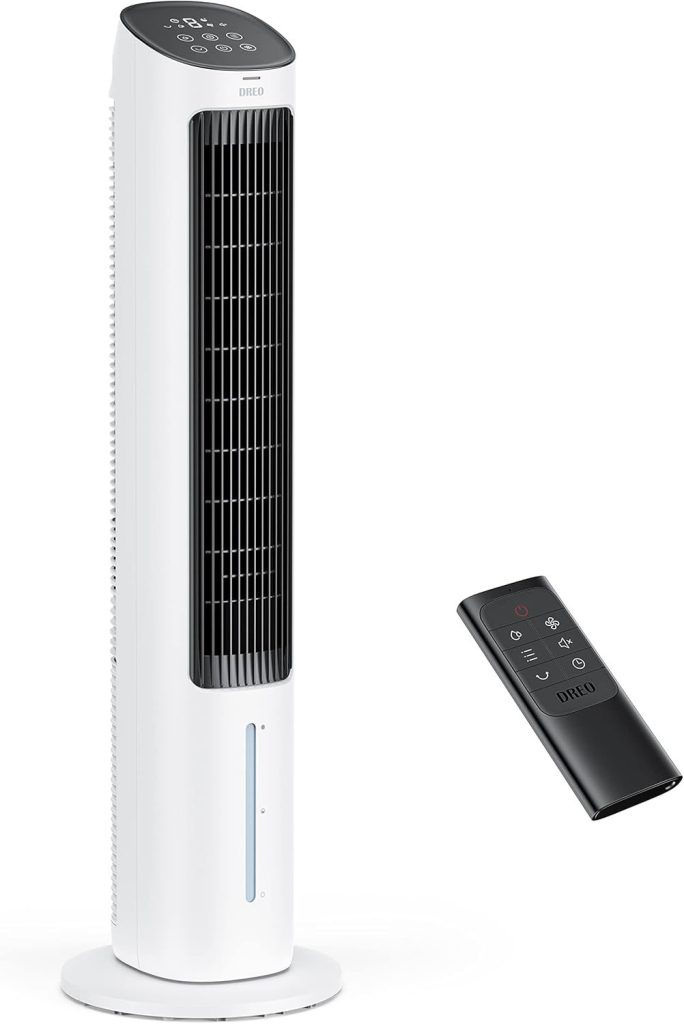
A sleek, bladeless tower, the Dreo 40″ Evaporative Air Cooler delivers a gentle, ultra-quiet breeze – perfect for daytime and nighttime personal cooling.
Standing about 3.3 feet tall, this Dreo model uses evaporative cooling to drop the air temperature about 5° below the ambient air temperature while running at a near-inaudible 35 dB in Sleep mode. (It goes without saying that this is much quieter than your average window or central AC unit, which typically hums along at 50 dB or so.)
In a way, the Dreo functions like an air conditioner.
To be sure, it isn’t powerful enough to cool an entire house; but it could easily handle a small room or even a tent.
Weighing under 10 lbs and portable with a built-in handle, the unit could be taken to various venues across the house, for which a timer function is also built-in, up to 7 hours of auto-shutdown.
#5 NewAir 470 CFM Portable Evaporative Cooler
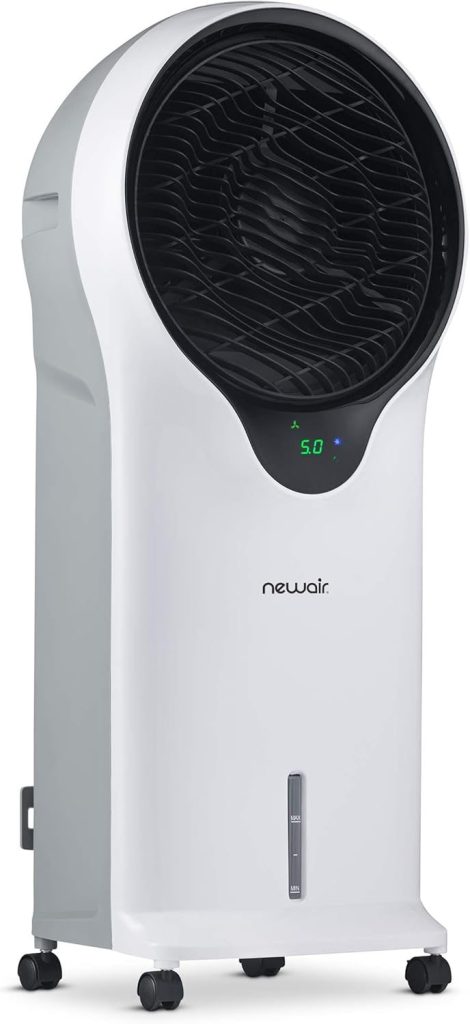
The NewAir 470 CFM evaporative cooler is a mid-sized unit with solid cooling performance suitable for bedrooms or small living areas up to 250 sq ft.
It features a cylindrical fan design with a large circular air outlet and sits on four easy-glide wheels.
It pushes up to 470 cubic feet of air per minute, so it can help drop the temperature in a bedroom by several degrees given adequate ventilation.
On the unit itself, maximum fan speed is about 66 dB (analogous to background chatter), but if you’re using it on the low setting, it’s much quieter and suitable for sleeping.
You can use the included remote to set the NewAir to a lower, sleep-friendly mode at night.
The NewAir’s 2-gallon water tank is easy to refill—just pour water through the top—or you can remove the tank and fill it in a sink.
There’s a water level indicator, just in case you weren’t sure how full the tank was, and an ice compartment, which is available on some models, for better performance.
I ran the tests using the ice and found the NewAir to be one of the cooler machines.
Using it on maximum fan speed, it’ll run for hours without any break (but not without a fill up).
#6 Evapolar evaCHILL Personal Evaporative Cooler (Mini)
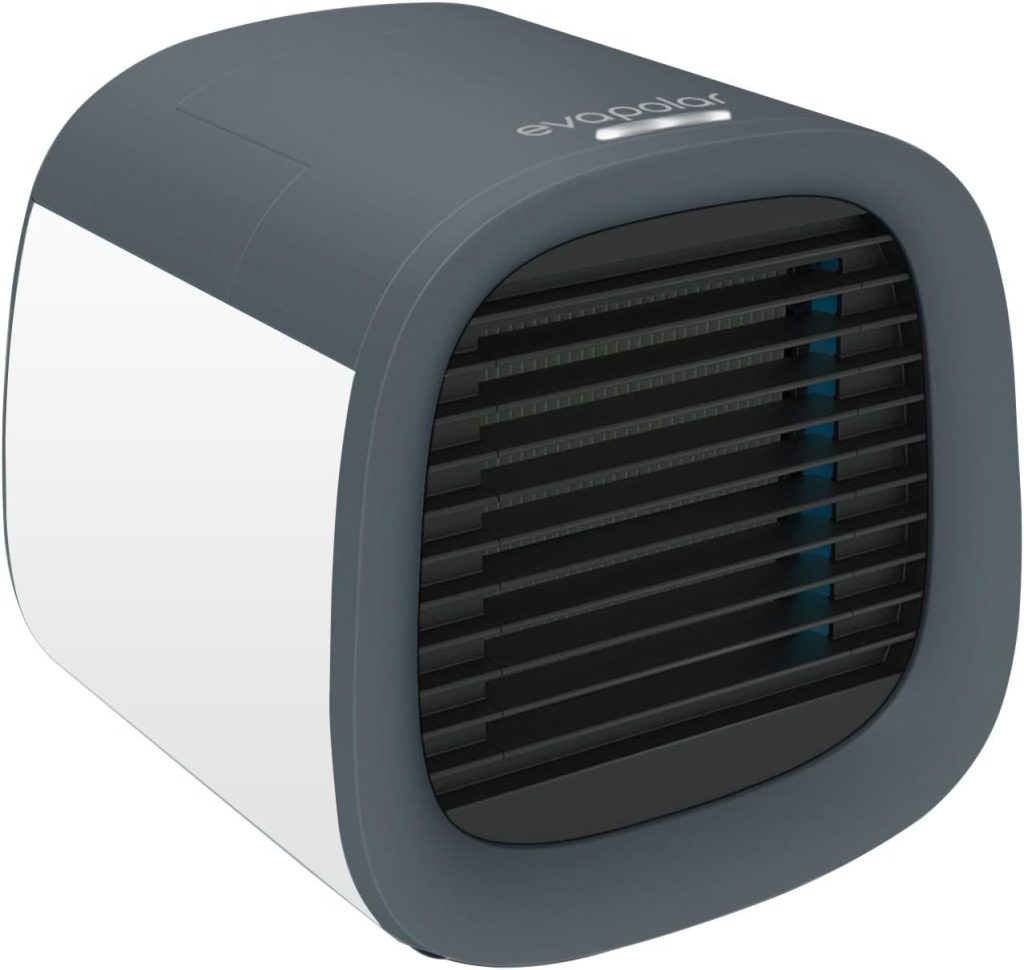
The Evapolar evaCHILL is a pint-sized personal cooler designed to cool and humidify the air in your immediate vicinity; perfect on a nightstand or desk.
This device is only about 7 inches square and weighs under 2 lbs, so it’s ultra-portable. It uses an internal evaporative cartridge and 800 mL water tank to create a small bubble of cool air (about a 3–5 ft radius around the unit).
At about 7.5 watts (USB-powered), it is quite energy efficient and can run off a laptop or power bank.
It is also very quiet, with operation around 50 dB on high (less than normal conversation volume) and a little quieter on the lower settings.
The design is simple to understand and operate:
- Fan speed controls the amount of air that gets pushed through the cartridge.
- Varying the fan speed generally doesn’t change the temperature that the air gets to; it is more about how well the air mixes when the fan runs on high, hitting a wider cross-section of air that is then passing by the evaporative cartridge.
The 800 mL water tank in the base should last about 8–9 hours under optimal operating conditions.
Unlike a traditional swamp cooler, the evaCHILL is not designed to work well in a high-humidity environment.
In fact, a high-humidity environment will make it pretty ineffective—thus it’s best used in a desert or dry office scenario.
And it is meant to push the local temperature down by about 5–10 degrees during operation.
Evaporative Air Cooler Buying Guide
Cost-effective and eco-friendly, evaporative coolers offer a cooling method that is ideal for certain environments. Before selecting one for use in your bedroom, you need to understand the nature of the beast—that is, how these devices work—and also what features they may or may not have that are crucial for getting a good night’s sleep.
In this guide, we’ll set forth the (substantial) differences between evaporative coolers, fans, and AC units and present key factors you should consider when shopping for a quiet, efficient cooler to use in your bedroom.
What Is an Evaporative Cooler and How Does It Work?
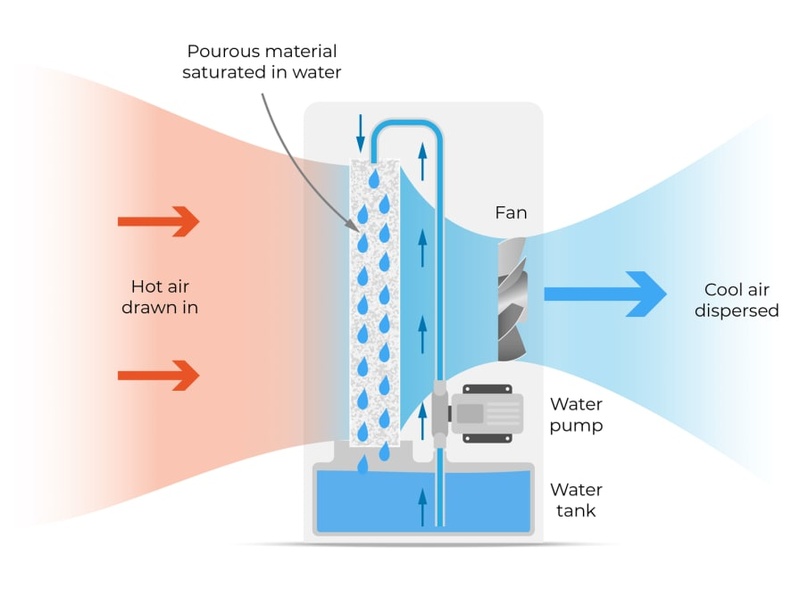
An evaporative air cooler, also called a “swamp cooler,” cools the air using the natural process of evaporation.
Inside the unit, a fan draws in warm air and passes it through a wet evaporative media, often a honeycomb pad soaked with water. As the hot air flows over the wet pad, the water evaporates, absorbing heat from the air and cooling it by up to 10–20°F (depending on the humidity). The cooler then blows this chilled, humidified air into your room.
This process also adds moisture to the air, which is great if you live in a dry climate but does not make the swamp cooler effective in places with high humidity.
Unlike traditional air conditioners, which use a compressor and chemical refrigerants, swamp coolers only require water and a fan. Because of their simple mechanism, these coolers run quietly and have no heavy compressor sound at all.
Evaporative Coolers vs Fans vs Air Conditioners
How does a bedroom evaporative cooler match up against a standard electric fan or air conditioner? Here’s a quick rundown:
Evaporative Cooler vs Fan:
A typical fan circulates air in the room; it does not lower the air temperature. Fans create a wind chill effect on your skin by evaporating sweat. This makes you feel cooler; however, the air temperature remains the same.
An evaporative cooler, on the other hand, cools the air before blowing it out. A swamp cooler will give you more relief on hot days than a fan.
Why? Because (1) it actually lowers the air temperature instead of just circulating the air, and (2) it adds humidity to the air.
In a dry, hot bedroom, an evaporative cooler is much more effective and comfortable than a fan.
Cooler vs Air Conditioner:
A portable or window AC unit utilizes a refrigeration cycle (compressor, condenser, coolant) to chill the air and can achieve a much larger temperature drop, even in humid climates.
The trade-off is that those units consume far more electricity and often produce more noise (due to the compressor and blower). They also require venting of hot air (for portable ACs) or permanent installation (window units).
Evaporative coolers don’t require an exhaust hose or sealed window—you can roll them into a room and run them with a simple window crack.
They use only water and a fan, so the operating cost is lower and they’re more environmentally friendly.
However, they can’t really cool to a precise temperature or dehumidify the air like an AC. In a bedroom scenario, an evaporative cooler is a great choice if you live in a dry area and want a quiet, low-cost way to cool for mild heat.
Key Factors to Consider When Buying a Bedroom Evaporative Cooler
Sound Level:
For a sleeping space, a near-silent operation is quite important. If it’s provided, check the decibel (dB) ratings.
Most top-notch models churn at 50 dB or lower on low settings—that’s roughly comparable to the sound of a very gentle fan or soft voice.
Some have a “sleep mode” that is even quieter than their low setting, but good as those modes are, they still can’t make our top models any less of a good bet for light sleepers.
Our primary picks are all quite silent, in large part because they use a different method than most AC units for making us cooler.
Cooling Capacity (CFM & Coverage):
Evaporative coolers are often rated by airflow (CFM – cubic feet per minute) and suggested room size.
As a rule of thumb, you’ll want around 20–30 CFM per square foot of room space for noticeable cooling. For example, a 200 sq ft bedroom may require ~4,000–6,000 CFM by that rule – but because bedrooms usually only need a moderate cooling boost, you can get by with far less in practice.
In our list, models range from personal coolers (~49 CFM) to larger portables (700+ CFM).
Match the cooler’s capacity to your space: don’t oversize a swamp cooler for a small bedroom, but also don’t expect a tiny desktop unit to cool an entire room.
Manufacturers often list a square footage (e.g. “cools up to 250 sq ft”); use that as a rough guide.
Keep in mind evaporative coolers work best with some ventilation, so a slightly larger unit in a slightly open room is fine.
Tank Size and Refill Frequency:
Cooler run time greatly depends on tank size.
A 2-gallon tank is good enough for overnight use, and our larger 4.8-gallon tank can run all day.
(The units themselves, of course, have to be chosen with care so that they can perform adequately in the space allotted.)
That said, a tank being full to the brim does no good whatsoever if the unit underneath cannot move that air properly out of the top.
Most of our finalists have some indicator that lets you know when water is getting low.
But if the unit runs out and doesn’t have an indicator to begin with, or if the indicator is broken, you have a problem.
Size and Portability:
When moving a cooler from room to room, look for features that make it easy to transport.
For many indoor models, that means rolling casters and a manageable weight.
Most of these units weigh about 15–20 pounds when they’re empty (just over 10 pounds for the Grelife model). Once you add water (the tank size greatly varies by model), the weight goes up significantly (over half of these models hold more than 8 gallons).
The units can range from kind of big (Hessaire swamp cooler style) to really big (Honeywell tower style).
Check measurements. Check them again. Know the spot where you intend to put it.
Almost all evaporative coolers have at least Low, Medium, and High fan speeds.
Some even have special modes, like “Sleep” or “Nature/Breeze” mode, that vary the fan rhythm.
A dedicated Sleep mode is a plus for bedroom use. These modes usually dim the lights and run the fan on ultra-low speed.
Even with multi-function coolers, the basic operation should be considered.
Modes and speeds are cool, but can the cooler just be a cooler and not a science experiment?
In terms of basic operation, that should be the first function of every cooler.
Climate Considerations:
- Evaporative coolers are best used in dry, hot climates.
- They are not so effective in high-humidity areas.
- If you live in a region with perpetual humidity (say, in a swamp), then your best bet is probably using a fan or an air conditioning unit.
- In fact, I lived in the D.C. area during some of my college years, and I can tell you that an “AC could be more effective” up in the bedroom, especially when trying to sleep through the steamy summer months.
- If you live in a dry hot place like the desert, chances are that your swamp cooler could provide relief and might even boost the moisture levels in a very dry bedroom.
However, when that’s not possible, the way to do it indoors is to strike some sort of airflow balance.