When American homeowners want to cool their homes, they usually consider the choice of portable air conditioners vs. window AC.
The two are capable of cooling a room, but they vary in terms of performance, cost, installation among others.
This in-depth comparison looks at cooling power, efficiency, cost, and others to assist homeowners to make the right choice of the unit that suits them.
The following is a brief comparison of the major features of portable AC units and window AC units:
| Aspect | Portable AC Unit | Window AC Unit |
|---|---|---|
| Cooling Performance | Good for single rooms, but less effective cooling per BTU (some cooling lost via exhaust hose) | Higher cooling output for the same BTU rating (more efficient heat removal) |
| Coverage Area | Up to ~500 sq. ft. for largest models (typically 8,000–14,000 BTU) | Available in higher BTUs (5,000–24,000+), can cool larger spaces (700+ sq. ft.) |
| Upfront Cost | Generally higher ($300–$800+ for most units) | Lower upfront cost on average ($150–$600; same capacity usually ~$100 cheaper) |
| Operating Cost | Higher – uses more electricity, less efficient (no Energy Star models) | Lower – uses about half the energy for same cooling output |
| Installation | Easy DIY; requires venting hose through a small window panel | More involved; heavy unit must be mounted securely in window |
| Portability | Mobile (on wheels); can be moved room to room | Fixed in one window; not designed to be moved often |
| Space Usage | Occupies floor space in room (plus hose clearance) | No floor space used (unit sits in window opening) |
| Noise | Similar noise level (all components indoors; ~50–60 dB) | Similar or slightly quieter (compressor partly outside) |
| Maintenance | Empty condensate (in humid climates), clean filter regularly | Drainage is automatic (drips outside), clean filter regularly |
| Aesthetics | Minimal exterior impact (only small window vent panel visible) | Visible box outside window (can be seen as unsightly; blocks view) |
| Lifespan | ~5–8 years (shorter, due to heavy use and mobility) | ~8–10 years (longer with proper care) |
Cooling Performance and Coverage

Any air conditioner is dependent on cooling power. Portable and window AC are rated in BTUs (British Thermal Units) of cooling capacity.
But practically a window AC unit provides more cooling per BTU as compared to a portable one. This is attributed to the manner in which each type releases heat. A window air conditioner is placed such that the back of the unit is facing out the window and it simply blows the hot condenser air out the window. Conversely, a portable AC is completely within the room and has an exhaust hose that lets out hot air. The heat can be radiated back into the room through the hose before it even goes outside the house and this makes the cooling process less efficient.
Window ACs are more effective and faster in cooling rooms than portable ones in real-life tests.
To illustrate, a portable AC that was used in a 550 sq. ft. room and was left on during two hours reduced the temperature by approximately 2.5 degrees Fahrenheit, and a window AC in a slightly bigger 650 sq. ft. room reduced the temperature by the same amount in one hour only. Consumer reports have observed that a 6,000 BTU window unit will be more effective in cooling provided as compared to a 6,000 BTU portable unit. This implies that when you require a fast and dependable cooling of a room, a window unit is better in terms of raw performance.
Both types have coverage area that is dependent on the BTU rating, though window units are offered in a larger capacity.
Don’t Overpay for HVAC Services – Call 888-894-0154 Now to Compare Local Quotes!
The most common portable air conditioners are between 8,000 to 14,000 BTU (sufficient to cool a 300-500 sq. ft. room). Window ACs are available in sizes as low as 5,000 BTU (in a 100-150 sq. ft. room) to 18,000-24,000 BTU to cool rooms of 1,000 sq. ft. and above. In case you have to cool a big living room or several adjacent rooms, you will find the appropriate high-BTU window units, but portables can only cool medium-sized rooms. The AC should be sized correctly to the room, an oversized unit will short-cycle and not dehumidify, and an undersized unit will not be able to cool effectively.
Portable and window ACs are meant to cool a single room or area at a time. Both are not whole-house solutions (it would require central air or mini-split systems).
In case of an open concept, a high BTU single window AC may be able to cover it better than a portable, because of the efficiency factor. Conversely, when you simply need to cool a small bedroom or office at times, either of them will work provided the BTU rating is appropriate to the size of the room.
Cost (Initial Cost and Long-Term Operation)
Upfront Cost
Cost is usually a determining factor. Compared to the purchase price, the window AC units are usually cheaper than the portable units of the same capacity.
The portable air conditioners are usually priced at a premium of approximately 100 dollars (or more) over a window unit with the same cooling capacity. As an example, a middle-range 10,000 BTU portable may be priced at about 400-500 dollars, but a 10,000 BTU window AC may be priced at about 300-400 dollars. Indeed, one of the reviews discovered that their highest-rated portable AC had a median price of ~$408, but nearly all of the recommended window units were cheaper than that. The smaller window ACs (5,000-8,000 BTU) are available in the range of 150-300 dollars, which is a cheap option to cover small rooms. Smart portables or those with dual-hose designs can cost up to $600-800 and even the best window units seldom cost more than $700.
Operating Cost
In addition to the sticker price, home owners ought to look at the long term operating cost which is mainly the electricity consumption.
In this case, window ACs are at an obvious advantage. The average window unit will consume about half the energy of a similar portable AC to provide the same amount of cooling. During tests, window air conditioners used approximately 0.43 kWh of electricity in a given time as compared to 0.88 kWh of electricity used by portable units to attain comparable cooling. That difference in efficiency accumulates over a summer. With an average rate of electricity in the country (~13c per kWh) and moderate use (8 hours a day, 3 months), a portable AC may cost roughly 40-50 dollars more per season to operate than a similar window unit. It implies that the owner of the portable AC will have to pay more on utility bills, particularly in hot climates where the unit may be used all the time.
The fact that portables are more expensive to operate can be traced to their efficiency.
As heat is allowed to leak back into the room via the exhaust hose, and the unit has to work harder, the compressor and fans consume more power. More efficient window units use a larger percentage of electricity to produce actual cooling. You can compare the EER (Energy Efficiency Ratio) or CEER (Combined Energy Efficiency Ratio) ratings when you shop: most window ACs have higher EER ratings (10 or more is very efficient), but portables usually only meet the minimum EER of 8-9. In the U.S. no Energy Star rating is currently available on portable ACs (no standards have been established on them), but numerous window AC models have the Energy Star rating of efficiency. All this shows that window air conditioners are generally more cost-effective in the long-term in terms of energy costs.
Both types are relatively cheap to maintain (other than electricity, most of the time it is just filter replacements or cleanings).
Both do not need to be serviced by professionals regularly. But when we factor in possible replacement frequency (related to lifespan, which is discussed below), a portable AC may have to be replaced earlier, which may translate to spending on a new model in a shorter time. To conclude, window ACs are likely to be less expensive to purchase and maintain than portable ACs.
Installation Complexity
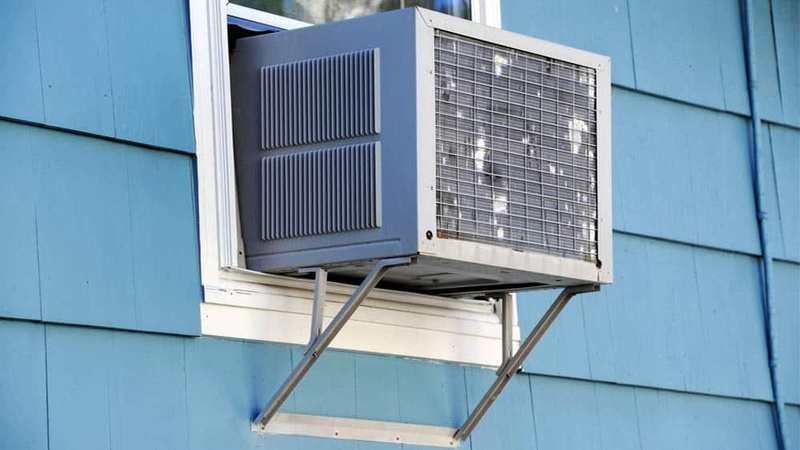
The process of installing a window AC unit is more complicated than the process of installing a portable one.
A window air conditioner has to be raised and inserted in an open window frame. They are heavy (mid-size models are often 4060 lbs, large ones 80100 lbs), and therefore require two people to safely install. You should open the window, place the AC on the sill, and then you should pull out the side panels to cover the gaps, and in some cases, you should screw brackets or supports to make the unit stable. Installation is also important, a poorly installed window AC may fall out of the window (a very dangerous situation). The majority of the models come with mounting hardware such as brackets and foam seals and an experienced person can install a window unit in approximately 2030 minutes. The standard window ACs might not fit in the homes of homeowners with very small or oddly shaped windows; they are usually designed to fit in the double-hung windows or sliding windows of a specific width and height.
By contrast, portable air conditioners are very easy to install. A portable unit is on the floor, and thus there is no heavy lifting up to the height.
Installation is primarily the connection of the exhaust hose to the unit and the insertion of the end of the hose into a window kit (a narrow panel which fits into the window opening). The window kit tends to adapt to the different sizes of windows (hung or sliding windows) and just requires an opening of approximately 4-6 inches in height or width of the hose vent. You just slide the window kit in, shut the window on it, and maybe put a bit of padding or strapping around it to hold it in place, and that is usually all that is necessary, no drilling or permanent mounting is usually necessary. It can be set up in 10 15 minutes initially. When the kit is installed, the portable AC can be relocated and re-vented to a different room with ease by just relocating the hose and panel. This portability implies no permanent set-up, which is a major advantage to renters or people who are not able to make adjustments to their house.
With that said, the installation of the portable window kit still needs a window (or any other outlet such as a sliding glass door or vent hole) to vent out hot air.
In case you intend to operate the portable AC in more than one room, you may buy additional pieces of the window kit to each room to make it convenient. In comparison, relocating a window AC unit to another room would mean dismounting it and mounting it on another window, which is a much larger inconvenience. Moreover, when a window AC is installed, it cannot be used as a ventilation or a view window until the unit is taken out. The window panels of portable AC can be removed within seconds whenever you need to close the window. In general, portable ACs are the best in terms of installation since they are easy and fast to install. Window units require more work and attention to install safely, but it is usually a seasonal one-time job.
Portability and Space Usage
The characteristic strength of a portable air conditioner is portability. These units are placed on caster wheels and you can roll them across the rooms as and when required.
In case you desire to cool various parts of your house at various times (say your home office during the day and bedroom at night), a portable AC can be transported with you wherever you go, you only need to change the vent hose to the relevant window every time. Such mobility can do away with the purchase of a number of AC units. But keep in mind that portable is relative, these units can still weigh 50-80 lbs, so you can roll them but it takes some strength to pick one up and carry it up stairs or other obstacles. Nevertheless, you can move a portable AC anywhere in comparison to a fixed window unit. Window ACs are literally fixed in one place after being installed; they remain there in the respective window until you take them out.
Another factor is the space utilization within the room. A portable air conditioner will occupy part of the floor in your house.
Don’t Overpay for HVAC Services – Call 888-894-0154 Now to Compare Local Quotes!
The unit itself is roughly the size of a small pedestal fan or dehumidifier usually approximately 1 to 2 feet on a side at the base and 2 to 3 feet tall. You will have to position it several inches away of walls or furniture so that airflow is not blocked. The exhaust hose is also space consuming and can be a bit cumbersome, particularly in a small room, being typically 4-5 inches in diameter and 4 to 7 feet long. You may be having a plastic hose that winds its way to the window, which is not very pretty and may be a slight hindrance (you would not want to stumble over it or have to go around it all the time). This loss of floorspace may be a disadvantage in a cramped room.
In comparison, a window air conditioner does not take up your floor space. It is placed in the window frame and the chassis is hanging out.
In the room, there is only the front grille of the AC sticking out a little bit through the window, normally not more than a foot into the room. This is a major plus in small rooms, where you can hardly afford to lose any square feet. You do not have any hose equipment running across the room too. The price you pay is that you lose the use of the window and some natural light. The AC will cover part of the window (how much will depend on the size of the unit; a standard window AC could cover the bottom sash completely). Portable ACs require only a small window opening where the hose panel will be put and the remaining part of the window will be available to allow light. When it comes to maintaining a clutter-free layout of your room, window ACs do not take up space whereas portables need a device to be accommodated in the room.
The advantage of portables on the positive side is that when you are not using it you can roll the unit into a closet or corner to make it out of the way.
You may even put it away in the cooler months altogether. In the case of a window unit, in case you want to get back your window, you have to undergo the uninstallation process. A lot of individuals keep window ACs throughout the year (or cover them with an outdoor cover during winter) and this implies that window is literally taken up by the appliance all the time. In short, portables are flexible and multi-room (one room at a time), but occupy floor space; window units are fixed, occupy no floor space, but at the expense of window space.
Energy Efficiency
The window AC units tend to be more energy efficient than portable ones.
The efficiency is usually expressed in terms of the EER (Energy Efficiency Ratio) that is the BTU cooling output divided by the power input (watts). The greater the EER, the more cooling you will get per watt of electricity. All room ACs (window and portable) must meet federal standards, which means that they must have a minimum EER of approximately 8.0. Most window air conditioners can easily surpass this; the efficient ones have EERs of 10 or 11 and some newer inverter-style window ACs even more. Portable air conditioners however, do not always achieve those high efficiency figures because of their design. Indeed, no portable AC unit has received Energy Star labels by the U.S. Environmental Protection Agency, but there are many Energy Star-certified window ACs. This means that portable units are not energy-efficient on average.
The efficiency difference is mostly due to the way portables deal with heat removal.
The single-hose type of portable AC is the most sold one, as they utilize already cooled indoor air to cool the condenser and then expel that heated air outdoors through the hose. Not only does this allow some heat to creep back in, but it also forms a small vacuum in the room (as air is being pushed out). That vacuum draws in warm air elsewhere in the house or through cracks under doors and the AC must also cool this. It is a vicious circle which consumes energy. This is countered by the dual-hose portable designs which use a second hose to pull in outside air to cool the condenser, making them more efficient. Dual-hose models are usually better in EER and cooling ability than single-hose models, but are also usually more costly and still not quite as efficient as a window unit.
The window AC units are more efficient in nature since the component that releases the heat (the condenser coil and fan) is not in the room.
They absorb the external air to cool the condenser and simply blow all the hot air out. There is no adverse indoor air pressure and no long hose that emits heat inside. Basically, a larger proportion of the electricity is used in cooling the room, instead of combating losses. Window ACs always use much less power to produce the same cooling effect. To homeowners, this implies cheaper electric bills and a greener option when choosing a window unit.
It is notable that new technologies are enhancing efficiency in the two categories.
The gap is narrowed somewhat by some high-end portable ACs now having inverter compressors (which adjust speed and save energy) and improved insulation of the hose. In the meantime, window ACs have experienced the innovation of the U-shape design which enables the window to close between the indoor and the outdoor side, which helps in better sealing and noise reduction. Nevertheless, at present, in case energy efficiency is one of the primary concerns, a window AC unit is a better option. The savings may be very evident in your monthly utility bill, particularly when you are using the most during the summer.
Noise Levels
Air conditioners are noisy by their nature, whether it is the sound of the compressor or the sound of fans.
The sound level of portable and window ACs is literally within the same range, however, the design of these two types of ACs can influence what you hear. Portable ACs put all their working components (compressor, fan motors) in the same room with you. Window ACs, however, leave the compressor and condenser fan suspended outside the window (outside the house) and only the blower fan and controls are inside. Overall, this implies that a window AC may be a little quieter inside than a portable since the most noisy element, the compressor, is a little more distant. One comparison showed that window units were on average 2 decibels quieter than portables, a small but occasionally noticeable difference.
Don’t Overpay for HVAC Services – Call 888-894-0154 Now to Compare Local Quotes!
The real noise output depends on model.
Most typical room ACs generate about 50-60 dB of noise on the low setting (approximately the volume of a typical conversation or background music). It may reach the mid-60 dB range on high fan levels or when the compressor turns on. Portable and window units can be noisy to the point of being annoying when you are a light sleeper or when you are watching TV and do not want to turn up the volume. The manufacturers may give a dB rating, the lower the better in case noise is an issue. Newer window AC designs (such as inverter types and U-shaped window units) claim to operate as low as ~42-48 dB on low fan, and are therefore particularly good in bedrooms.
Portable AC noise: Since it is standing in the room, you may hear more of the vibration and fan noise first hand.
Whooshing sound can also be added by the exhaust airflow through the hose. Portables however tend to be insulated in the cabinets and some damping of the noise as they are aware that everything is inside. When put on a hard floor, the vibrations may be transferred; a small rug or mat may assist. The portability implies that you may place the unit farther away (assuming the hose will permit) to have less direct noise, but the position of a window unit is fixed.
Window AC sound: A window unit may be noisy in the form of the chassis rattling when not firmly fastened or the fan blowing air into the room.
Part of the unit is outdoors and hence some of the noise is deflected outwards. You may be putting more noise outside (or on the side of a neighbor) than inside, in an upstairs window, as an example. However, the part of the unit in the room will continue to hum steadily. Additional rattle will be reduced by proper installation (gaps sealed, any loose panels tightened). There is one advantage of window units that the heavy compressor vibrations are mostly out of the wall. Practically, both of them are referred to by the users as the machines of white noise in the background.
Comparing, it is safe to say that neither of the types is really quiet, you will feel that it is running.
In the case where noise is a major concern (as in the case of a bedroom AC), you may seek special quiet models (some window units are sold as ultra-quiet). Otherwise, they will be equally noisy, and in most cases, window units will be slightly less noisy. As a homeowner, one should consider looking at decibel ratings or user reviews that concentrate on noise of the particular model you are considering, be it portable or window.
Maintenance Requirements
Every air conditioner needs a certain maintenance to work effectively. The good news is that neither portable nor window units are quite challenging in the maintenance department, but there are some differences in what is required.
Filter cleaning: Portable and window ACs also contain air filters that collect dust and require cleaning.
In the cooling season, the filter should be checked and cleaned approximately once a month (more often in case of constant use of the air conditioner or dusty conditions). It is easy to clean: most of the time, you just pull out the plastic mesh filter and either vacuum it or wash it with water and allow it to dry before putting it back in. An unclogged filter assists in the flow of air and cooling capacity. Failure to maintain the filter may result in poor cooling or even the coils freezing.
Draining water: This is one of the main areas that the two types differ.
A window AC unit is made to send the condensate (the water that is created by dehumidifying the air) outside. The water either drains out the back or is thrown against the condenser coil (most units use the fan to evaporatively sling water to increase efficiency), so in most cases you do not need to manually remove water on a window unit. You may find that water is dripping outdoors in humid conditions and this is normal. Portable ACs also dehumidify the air, but as the whole device is inside, they accumulate the condensate inside the device. Most modern portable models are self-evaporating, i.e. they can re-evaporate and blow much of that moisture out the hose. But in extremely wet weather or during long runs the inner tank or tray may be filled. When this occurs, the unit will tend to turn off and show that it requires draining. A portable AC requires the homeowner to occasionally remove the condensate water by rolling it to a drain, adding a small drain hose, or manually emptying a drain pan. This is a matter of frequency, which is dependent on humidity; you may never have to drain in a dry area, but in a muggy basement you may have to do it every few hours. It is an additional maintenance procedure of portables that window units lack (other than ensuring that the drain hole of the window unit is not blocked with debris).
General cleaning: Every season it is prudent to do a more thorough cleaning of the AC.
In the case of a window unit, this may mean taking it out of the window (or cleaning in place where possible) to brush or vacuum the condenser and evaporator coils which may become dusty (or even moldy) with time. It can run efficiently by making sure that the exterior fins are free of dirt or leaves (in case of window ACs). In the case of portable ACs, you can normally take off a panel to reach the coils to clean them gently too. Also, clean the outside grilles of both kinds by wiping them to remove any dust. Clean the slide-out drip tray (if the unit has one) to avoid mold.
Off-season storage: Portable air conditioners are also good in that you can store them away during off-season.
You must drain all the water, put the unit on fan-only to dry the inside, clean the filter and then coil the hose before storing it. Keep it in a dry place to prevent mildew. Window AC units which are not permanently left in place can be removed and stored as well but this is a larger task involving the heavy lifting we mentioned in installation. In case you leave a window AC in over winter, you must cover the outside part of it with a protective cover to prevent rain and insulate it slightly. In addition, seal all vents and openings to avoid cold drafts. Therefore, the seasonal covering or removal may be part of the maintenance of a window unit, but the maintenance of a portable is more about the water and keeping it clean, then putting it away when the weather turns cool.
Both types do not normally need professional service unless there is a problem (e.g. a refrigerant leak, or a faulty thermostat, neither of which is common).
Motors and fans tend to be sealed. All you need to do is to listen to any strange sounds and make sure that the electrical cord and plug remain in a good condition. To conclude, portable ACs need slightly more manual care in terms of draining water, whereas window ACs need safe seasonal care, but in general, daily care of both is nothing more than keeping them clean and dry.
Aesthetic Impact

The homeowners usually think of the impact that an AC unit will have on the appearance of their house, both internally and externally.
Aesthetically, window air conditioners are usually perceived to be more disruptive to the look of a house. A window unit may interfere with the facade since it is mounted outward on the outside of the house. So many homeowner associations (HOAs) and apartment complexes prohibit the use of traditional window AC units because of this reason they find them unattractive or not in line with the look of the building. A window AC is quite conspicuous, as seen through the street; you observe a metal box sticking out of a window, and there is a condensate water dripping down the siding. This will certainly take away curb appeal and several window units on a building can make it look cluttered. Then there is the issue of dripping water that leaves stains on the walls and that a poorly installed unit may fall, as discussed above, which is not only a safety concern but also a liability and aesthetic concern (a fallen unit may damage the property).
The portable air conditioners are less protruding on the outside.
The only thing that can be seen outside is the small window vent of the exhaust hose which is normally a thin panel that does not stick out. It may be barely visible, like a closed window with maybe a little bit of space to the panel. This implies that in an external perspective, portable ACs maintain the appearance of your house in a much better way. A portable unit is a more amicable choice in case you want to preserve the architectural look of your house or follow the HOA regulations. Indeed, there are individuals who actually choose portables due to the fact that their HOA does not allow window units.
Within the house, the aesthetic effect is turned around a little.
A window AC is visible but it is hidden at the window. It may obstruct certain view and light but it does not take over the interior decor. The front grille of most window units is fairly plain and the units are low in the window. You may have curtains or blinds about them (but you would not draw the window blinds over it when you were using it). They are utilitarian in appearance, but not enormous.
A portable AC is however a new device in the room. It is a large rectangular machine which will be somewhere on your floor.
In case you are quite a fussy person in terms of your interior design, a portable AC may prove to be an eyesore or something you have to decorate around. Other brands have attempted to make them more sleek (by providing black or silver models, or rounded edges), but it can not be denied that a portable AC is as big as a small piece of furniture. It is also attached to the window by a thick hose, which makes it a bit industrial. You may do creative placement, perhaps partially concealed by a sofa or in a corner, but you should not block the clearance to allow airflow. Therefore, a portable AC may break the appearance of a minimalist or well-designed room more than a window unit.
With that said, the indoor presence of the portable AC is only in the hot season. When it is not required, you can take it out.
A window AC is either left up all year round or leaves an open window frame when removed. In case you are living in a historic or a well-designed house, you may not want to cut holes in the windows or display AC boxes. Portable models allow you to preserve the outside and take out the appliance when visitors arrive or summer is over. New window AC designs (such as U-shaped or saddle units) are also less obtrusive, but other than that, the rule of thumb is that portable ACs do not affect the exterior as much, and window ACs do not waste interior space and visibility. This may be a factor that may determine your decision depending on whether you are more concerned with the exterior appearance or the interior design.
Suitable Room Types
Not every room is equally suited for a window AC or a portable AC. The type of room and its features (size, window type, usage) will affect which coolin

How to Get the Best HVAC Prices
- Firstly, keep in mind that installation quality is always the most important thing for residential HVAC project. So never sacrifice contractor quality for a lower price.
- Secondly, remember to look up the latest rebates as we talked above.
- Thirdly, ask for at least 3 bids before you make the decision. You can click here to get 3 free estimates from your local contractors, and this estimate already takes rebates and tax credit into consideration and filter unqualified contractors automatically.
Lastly, once you chose the right contractor, remember to use the tactics from this guide: Homeowners Tactics When Negotiating with HVAC Dealer to get the final best price.