For most homeowners, a compact condensate pump that combines quiet operation with sufficient lift is the best solution for removing mini split AC drainage where gravity drain is not available. Below are five pumps chosen for strong lift, low noise, or compact installation: Aquastrong (best for tight installs), GuardFlow 65ft (best for long vertical runs), Cleartide (best for small ceilings), Peakur (best for higher flow needs), and TURBRO (best for maximum head). The table summarizes key specs to help compare at a glance.
| Product | Best For | Key Spec |
|---|---|---|
| AQUASTRONG Mini Split HVAC Condensate Pump | Tight installations and quiet bedrooms | 9.6 GPH, 33 ft head, 20 dB |
| GuardFlow Mini Split Condensate Pump (65 FT) | Long vertical lift and ETL-certified installs | 40 L/H, 65 ft lift, ≤20 dB |
| Cleartide Mini Split HVAC Condensate Pump | Small spaces and separated reservoir layouts | 10.6 GPH, 33 ft head, 23 dB |
| Peakur Mini Split Condensate Pump | Higher continuous flow with long lift | 11 GPH, 65 ft head, <19 dB |
| TURBRO Mini-Split Condensate Pump | Maximum head in tight footprints | 10.5 GPH, 66 ft head, 19 dB |
AQUASTRONG Mini Split HVAC Condensate Pump
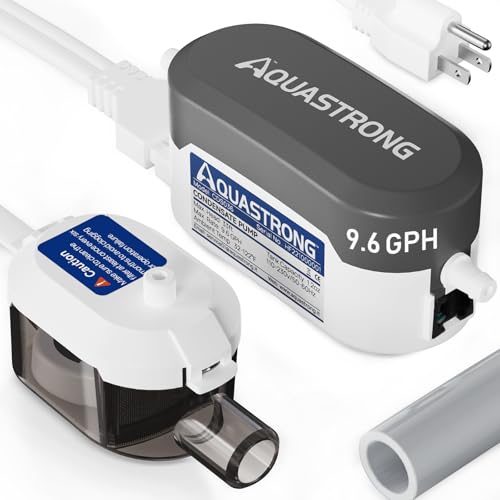
Features listed: thermally protected motor, ultra-silent operation (~20 dB), max flow 9.6 GPH, max head 33 ft, reliable hall switch for automatic operation, hi-level safety switch wiring (NC & COM for appliance; NO & COM for alarm), removable tank and filter, includes inlet/outlet adapters and tubing options.
Best for homeowners who need a compact, quiet pump that fits inside line set covers or above ceilings. Choose this if you need low-noise drainage and a safety switch that can shut down HVAC equipment or trigger an alarm.
Caution: The 33 ft max head limits use for tall vertical runs; choose a higher-head unit if you must push condensate more than about 30 ft vertically.
GuardFlow Mini Split Condensate Pump, 65 FT Lift

Features listed: designed for mini split and ducted HVAC, supports wall-mounted evaporators, ultra-quiet ≤20 dB, vibration damping, fully potted motor, automatic float switch operation, suitable for residential and light commercial systems.
Best for installations that require a balance of quiet operation and higher lift for wall-mounted indoor units. Choose this if you need a pump rated for bedroom or office use where noise matters and a reliable float switch is preferred.
Caution: Float switch designs can stick in dirty water; plan for periodic reservoir and filter cleaning as recommended for float-based pumps.
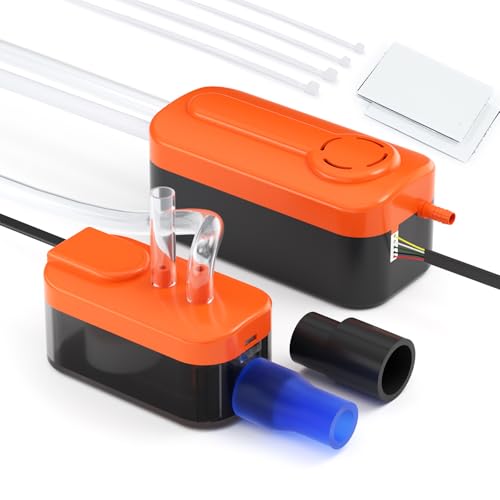
Cleartide Mini Split HVAC Condensate Pump
Don’t Overpay for HVAC Services – Call 888-894-0154 Now to Compare Local Quotes!
Features listed: thermally protected motor, quick draining with max flow 10.6 GPH, max head 33 ft, hall switch for auto operation, separated reservoir and motor for tight spaces, operates at ~23 dB, overflow safety signal wiring included.
Best for small ceilings or tight evaporator cavities where separating the reservoir from the motor saves space. Choose this if you need a compact layout and an overflow safety signal to protect finished ceilings and living areas.
Caution: The listed noise level is 23 dB, higher than some ultra-quiet models; avoid this pump if absolute minimum noise <20 dB is required.
Peakur Mini Split Condensate Pump, Universal

Features listed: designed for HVAC and dehumidifiers, integrates standalone pump and tank with floating circuit, automatic collection and expulsion, strong quiet operation with flow 11 GPH, max head 65 ft, noise <19 dB, power 100-240V AC, fully potted motor, continuous rated.
Best for buyers needing higher continuous flow with a long vertical lift. Choose this if your installation requires pumping condensate up to long ceiling voids or through long runs while keeping noise below ~19 dB.
Caution: Larger physical dimensions (listed length 280 mm) may limit placement in very tight cavities; verify clearance before selecting this unit.
TURBRO Mini-Split Condensate Pump, High Head

Features listed: maximum head 66 ft, 10.5 GPH max flow, quiet operation ~19 dB, float switch safety detection, compact footprint that fits ceilings and line set covers, recommended signal cable for added safety to shut off AC or trigger alarm.
Best for installations requiring the maximum vertical head in a compact pump. Choose this if you must route condensate vertically through tall walls or multiple ceilings while keeping noise at or below 19 dB.
Caution: Maximum head ratings are performance statements; confirm your total vertical and horizontal run length and fittings to ensure the pump can maintain required flow in your configuration.
Buying Guide
How high does the pump need to lift condensate?
Check the vertical distance from the condensate reservoir to the point where the drain exits (roofline, condensate line, or remote drain). Use the pump’s max head rating as the first filter. If vertical distance plus friction losses from tubing and fittings approaches the pump’s head limit, choose a higher-head unit or reduce run length and fittings.
How loud is the pump and where will it run?
Noise is measured in dB(A) at 1 meter in the product specs. For bedrooms and offices pick pumps rated ≤19–20 dB. If your pump sits inside a ceiling cavity near a living space, prioritize vibration damping, potted motors, and lower stated dB levels.
Do I need a float switch, hall switch, or capacitive sensor?
- Float switch: common and automatic, but can stick if reservoir gets dirty.
- Hall switch: magnetic/hall designs provide reliable automatic switching with fewer moving parts.
- Capacitive sensor: solid-state detection with no moving parts; useful for long-term durability in some units.
Choose the detection type that matches maintenance willingness and water cleanliness.
Should I require an overflow safety switch or alarm wiring?
Always consider a safety signal lead if your AC is above finished spaces. Many pumps provide NC/COM or NO/COM terminals to shut down the HVAC unit or trigger an alarm at high water levels. Use these connections when possible to prevent water damage.
What tubing and fittings are required?
Match pump outlet barb size to your vinyl or PVC tubing (common sizes: 1/4″, 3/8″, 6mm). Look for included adapters and anti-siphon fittings. Anti-siphon protection prevents backflow when the pump stops.
Where can I mount the pump?
Options include inside line set covers, above ceilings, inside wall cavities, or in closets. Confirm the pump’s dimensions and mounting provisions. If the pump separates reservoir and motor, it is easier to fit into narrow cavities.
How often should pumps be maintained?
Inspect the reservoir and filter on a schedule (quarterly or per manufacturer) to prevent float or sensor issues. Clean tubing and anti-siphon devices if you notice reduced flow. Pumps with removable tanks and visible filters simplify maintenance.
FAQ
What is the difference between flow (GPH) and head (ft)?
Flow (GPH) is how much water the pump can move per hour at low head. Head (ft) is the maximum vertical lift the pump can push water. Higher head usually reduces flow; choose based on vertical distance and required flow.
Can I use any condensate pump with my mini split?
Use pumps specified for HVAC or mini split applications that match voltage, max head, and discharge tubing size. Confirm the pump’s compatibility with your unit’s condensate rate and placement constraints.
Don’t Overpay for HVAC Services – Call 888-894-0154 Now to Compare Local Quotes!
Are solid-state sensors better than float switches?
Solid-state (capacitive) sensors have no moving parts and can be more durable in dirty water. Float switches are common and reliable with proper maintenance. Choose based on expected operating conditions and maintenance willingness.
Do I need an anti-siphon device?
Yes, anti-siphon devices prevent backflow when the pump stops and protect the indoor drain pan. Many pumps include anti-siphon connectors; install them per instructions.
How do I reduce pump noise?
Choose pumps rated ≤19 dB, apply vibration-damping mounts or pads, and avoid rigid mounting directly against thin ceilings or drywall. Fully potted motors and soft-start electronics reduce vibration and noise.
What safety wiring should I install?
Connect the pump’s safety switch (NC/COM or NO/COM) to your HVAC control or alarm system when possible. This enables automatic shutdown or alarm activation on high water to prevent overflow.

How to Get the Best HVAC Prices
- Firstly, keep in mind that installation quality is always the most important thing for residential HVAC project. So never sacrifice contractor quality for a lower price.
- Secondly, remember to look up the latest rebates as we talked above.
- Thirdly, ask for at least 3 bids before you make the decision. You can click here to get 3 free estimates from your local contractors, and this estimate already takes rebates and tax credit into consideration and filter unqualified contractors automatically.
Lastly, once you chose the right contractor, remember to use the tactics from this guide: Homeowners Tactics When Negotiating with HVAC Dealer to get the final best price.