This guide identifies five portable and floor-model air conditioners suited for different room sizes and buyer needs. If you want a unit for a large living area, choose higher BTU models; for bedrooms or small apartments, select compact units with quieter operation. The selections below include models best for energy saving, easy installation, high cooling capacity, small rooms, and simple maintenance.
| Product | Best For |
|---|---|
| Amazon Basics 4-In-1 Portable Air Conditioner | Large rooms and 4-in-1 function buyers |
| DuraComfort Portable Air Conditioner | Users who want dual-motor performance and window kit |
| Humhold 14000 BTU Portable Air Conditioner | Very large rooms up to 700 sq.ft and strong dehumidifying |
| BLACK+DECKER 8,500 BTU Portable AC | Small rooms, dorms, or bedrooms |
| AKIRES 10000 BTU Portable Air Conditioner | Mid-size rooms needing quiet sleep mode and self-evaporation |
Amazon Basics 4-In-1 Portable AC

Features listed: 4-in-1 functions (Cool/Heat/Dry/Fan-Only), remote, timer, sleep mode, auto swing, 13,500 BTU (ASHRAE), cools up to 550 sq ft, energy saving.
Best for buyers who want a multi-function floor-model unit that can cool large rooms and provide heating when needed. It was selected for its high ASHRAE BTU rating and listed 4-in-1 functionality, which suits year-round use.
Caution: The product listing references an ASHRAE BTU value; ASHRAE and SACC numbers differ and impact real-world cooling—choose based on your room size and expected performance.
DuraComfort Dual-Motor Portable AC

Features listed: Dual motors, 14,000 BTU (ASHRAE) / 10,000 BTU SACC, cools up to 450 sq ft, includes window kit for easy installation.
Best for buyers who prioritize faster cooling and want a window kit included for setup. It was selected because the dual-motor design aims to improve airflow and the listing specifies both ASHRAE and SACC ratings for clarity on cooling capacity.
Caution: ASHRAE and SACC rating differences affect expected coverage; compare the listed SACC value to your room size before choosing.
Humhold 14000 BTU Portable AC
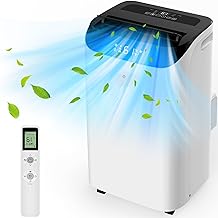
Features listed: 14,000 BTU (ASHRAE) / 10,000 BTU (SACC), cools up to 700 sq.ft (claimed), 3-in-1 cooling/fan/dehumidify, dehumidify capacity up to 95 pints/day, front LED display, remote control.
Choose this if you need a high-capacity unit for very large spaces and a strong dehumidifier function. It was selected for its high ASHRAE BTU number and large claimed coverage, along with a strong dehumidification rate noted in the listing.
Don’t Overpay for HVAC Services – Call 888-894-0154 Now to Compare Local Quotes!
Caution: The listing gives both ASHRAE and SACC numbers and a large coverage claim; verify the SACC rating and your room layout because real-world coverage varies with insulation and ceiling height.
BLACK+DECKER 8,500 BTU Portable AC

Features listed: 8,500 BTU (5,100 BTU SACC), three-in-one unit (AC, dehumidifier, fan), suitable for rooms up to 350 sq. ft., top-mounted control panel with LED display, full-function remote, window kit included.
Best for small rooms, dorm rooms, or bedrooms. It was selected for its clear small-room coverage and compact feature set that combines cooling, dehumidifying, and fan functions tailored to smaller spaces.
Caution: The SACC value (5,100 BTU) is significantly lower than the ASHRAE number; avoid this model if your room is larger than the listed coverage or poorly insulated.
AKIRES 10000 BTU Portable AC

Features listed: 10,000 BTU ASHRAE (6,000 BTU SACC), cools up to 450 sq.ft, 3-in-1 modes (cooling, fan, dehumidify), self-evaporating system, drainage ports for continuous drain, sleep mode under 50 dB, 24-hour timer.
Better for bedroom or mid-size room buyers who want quiet operation and reduced drainage maintenance. It was selected for the self-evaporating system and sleep mode claimed under 50 dB, which are useful for overnight use.
Caution: The SACC value is lower than ASHRAE; for accurate sizing use the SACC rating and room conditions rather than the higher ASHRAE number.
Buying Guide
How Many BTUs Do I Need?
BTU ratings indicate cooling capacity. Use the SACC (Seasonally Adjusted Cooling Capacity) number when available for real-world sizing. For bedrooms and small rooms, choose lower SACC values (e.g., ~5,000 SACC). For mid-size rooms, target ~6,000–10,000 SACC. For large living spaces, choose higher ASHRAE/SACC numbers but rely on SACC if provided.
What Is The Difference Between ASHRAE And SACC?
ASHRAE ratings are laboratory numbers and typically higher. SACC reflects seasonal adjustments and is more representative of actual performance. Prefer models that list both so you can compare expected real-world cooling.
Window Kit Versus Through-the-Wall Installation?
Most portable floor models use a window kit for exhaust. A window kit is easier for renters and temporary installation. Through-the-wall requires a permanent opening and professional installation, but can improve exhaust sealing and efficiency.
How Important Is Dehumidification?
Dehumidifier capacity matters in humid climates. Listings that provide pints per day or liters per hour give a clear indicator. If humidity is a primary issue, choose models with higher dehumidify rates and continuous drain options.
Noise And Sleep Mode Considerations
Look for listed decibel levels or a dedicated sleep mode. Units with sleep mode and claimed low dB are better for bedrooms. If listing lacks noise data, check for fan speed levels and “sleep” in the features to estimate quieter operation.
Energy Use And Efficiency
Energy-saving features and timers help reduce runtime. Compare listed features like “energy saving”, timers, and programmable modes. Efficiency also depends on correct sizing: an oversized unit cycles frequently and wastes energy; an undersized unit runs continuously and may still not reach target temperature.
Drainage Options And Maintenance
Self-evaporating systems reduce manual draining. Models with drainage ports allow continuous drain when needed. Removable filters are common; confirm filter access for cleaning to maintain airflow and performance.
When To Choose 3-in-1 Versus 4-in-1?
3-in-1 units typically offer cooling, fan, and dehumidify. 4-in-1 adds heating. Choose 4-in-1 if you need year-round heating and cooling from one unit. If year-round heating is unnecessary, a 3-in-1 can be simpler and lower cost.
FAQ
Can a floor-model portable AC cool an entire house? No. Portable units are intended for single rooms or open areas. Use multiple units or a central system for whole-house cooling.
How do I size a portable AC for my room? Use the unit’s SACC cooling capacity and compare to your room square footage. Consider ceiling height, insulation, sun exposure, and heat-generating appliances when sizing up.
Do portable ACs need venting? Yes. Portable ACs require exhaust venting (usually through a window kit) to expel hot air. Proper venting improves efficiency and performance.
Don’t Overpay for HVAC Services – Call 888-894-0154 Now to Compare Local Quotes!
Is the ASHRAE BTU number reliable? ASHRAE provides laboratory-based BTU ratings. Use SACC when available for more realistic performance expectations in typical home environments.
How often should I clean filters? Check and clean filters every 1–3 months depending on use and indoor air quality. Regular cleaning maintains airflow and efficiency; product listings typically describe filter access.
Can these units dehumidify without cooling? Many models include a dehumidify-only mode. Check the product’s listed functions to confirm availability of a dedicated dehumidify setting.

How to Get the Best HVAC Prices
- Firstly, keep in mind that installation quality is always the most important thing for residential HVAC project. So never sacrifice contractor quality for a lower price.
- Secondly, remember to look up the latest rebates as we talked above.
- Thirdly, ask for at least 3 bids before you make the decision. You can click here to get 3 free estimates from your local contractors, and this estimate already takes rebates and tax credit into consideration and filter unqualified contractors automatically.
Lastly, once you chose the right contractor, remember to use the tactics from this guide: Homeowners Tactics When Negotiating with HVAC Dealer to get the final best price.