Portable air conditioners, having a 10,000 BTUs capacity are ideal in bringing the cool to medium-sized spaces.
They are neither too inefficient nor too powerful to handle most of the situations.
The following guide is a compilation of the top 10,000 BTU portable ACs. This has both single-hose and dual-hose.
They provide robust cooling capabilities, are energy efficient, are smartly controlled and are low-noise.
The following are our top recommendations on how to keep cool and comfortable, whether it be super-quiet inverter models or the most affordable solutions.
Here is a quick comparison of our top picks, and then we get into the nitty-gritty of reviews and comprehensive buying guide.
| Portable AC Model | Hose Type | Cooling Area | Noise Level | Smart Controls |
|---|---|---|---|---|
| Whynter ARC-102CS 10,000 BTU | Single | Up to 300 sq ft | ≤ 51 dB | No |
| Frigidaire FHPC102AC1 10,000 BTU | Single | Up to 450 sq ft | 49–52 dB | No |
| LG Dual Inverter 10,000 BTU (DOE) | Single | Up to 450 sq ft | 44–53 dB | Yes (Wi-Fi) |
| Midea Duo Smart Inverter 12,000 BTU (10k SACC) | Dual | Up to 550 sq ft | 42–51 dB | Yes (Wi-Fi) |
| Honeywell HF0CESVWK6 10,000 BTU | Single | Up to 450 sq ft | ≈ 52 dB | Yes (Wi-Fi) |
| Black+Decker BPACT10WT 10,000 BTU | Single | Up to 450 sq ft | ≈ 53 dB | No |
| SereneLife SLPAC10 10,000 BTU | Single | Up to 300 sq ft | ≈ 56 dB | No |
Top 10000 BTU Portable Air Conditioners – Reviews
#1 Whynter ARC-102CS 10,000 BTU Portable Air Conditioner

Whynter ARC-102CS portable air conditioner has a high BTU of cooling and it is effective in cooling even rooms that are hot to the point of suffocation. It can cool rooms up to 300 square feet and though it is a single-hose unit, it is powerful and designed enough to cool a wide range of spaces more effectively than most other portable air conditioners.
It also has dehumidifying capabilities that have the ability to take nearly 70 pints of water out of the air in a day and as a bonus it will blow some air around. As it does all that, it also has some good features to make air that passes through it a bit cleaner as well.
Energy-saving cooling: The Whynter ARC-102CS ranks among the most energy-efficient cooling units in its category (with a Combined Energy Efficiency Ratio (CEER) of about 6.9, which translates to more cooling per watt of electricity than most of its rivals).
The practical implication is that there is reduced consumption of energy and possibly reduced electric bills. Its quiet operation is also commended by the users, as its noise level is about 51 dB or less on low, and it is easy to sleep or work with the unit being operated. Its controls are simple with an LED display and full-function remote. It does not have smart Wi-Fi, but the ARC-102CS is concentrated on effective and consistent cooling. On the whole, this Whynter model is a great option when it comes to powerful cooling and efficiency in a small package that does not offer a lot of additional features.
Don’t Overpay for HVAC Services – Call 888-894-0154 Now to Compare Local Quotes!
#2 Frigidaire FHPC102AC1 10,000 BTU Portable AC

Frigidaire FHPC102AC1 is a reliable 10,000 BTU portable air conditioner that boasts of balanced performance and quiet comfort. It is a one hose system that is able to cool rooms of up to 450 sq. ft. (suitable to medium sized rooms or apartments).
Its raw cooling power is only a bit lower than the best-performing Whynter at ~6,500 BTU Seasonally Adjusted Cooling Capacity (SACC), but it is even more efficient in cooling mode. The unit is made in a streamlined, compact design and has easy rolling casters so it is easy to move it around the house.
Good sound, good comfort: Another outstanding aspect of the Frigidaire FHPC102AC1 is its low noise level which is approximately 49 dB on low fan speed (up to ~52 dB on high). It is a silent operation which will not interfere with sleep or conversation as Frigidaire is known to be comfortable.
It has several settings with a Dry (dehumidifier) mode and a Sleep mode to provide a gentle cooling at night. Although it lacks the in-built Wi-Fi, it comes with a full-function remote and a user-friendly digital control panel. It also has a 24-hour programmable on/off timer and a removable, washable filter (with an in-built clean filter indicator) to maintain efficient running of the unit. All in all, the Frigidaire FHPC102AC1 is an efficient, quiet, and well-built unit that is a good option in a household where reliability and convenience of use are the priorities.
#3 LG Dual Inverter 10,000 BTU Portable Air Conditioner (LP1419IVSM)
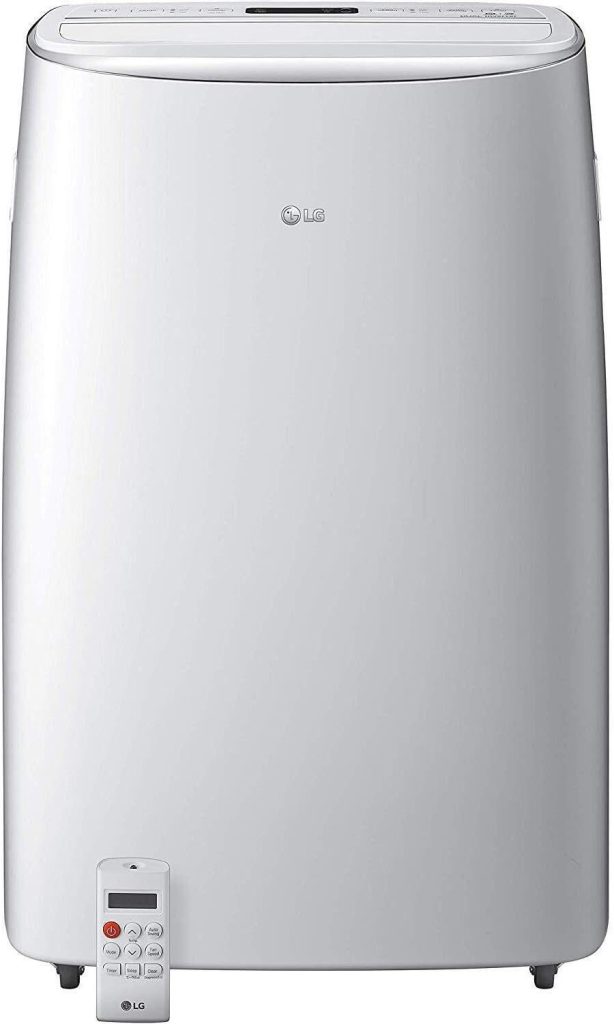
The dual inverter portable AC by LG is probably the quietest and energy efficient 10,000 BTU-class portable AC available in the market. This model (with a DOE rating of 10,000 BTU, or about 14,000 BTU ASHRAE) uses a DUAL Inverter Compressor that is able to speed up and slow down, unlike the traditional units, which turn on and off.
The outcome is high cooling capabilities of rooms as large as ~450 sq. ft. and up to 40 percent energy savings over non-inverter models. Some of its versions are even Energy Star certified. The inverter technology also implies that the LG is more silent in its operation, with noise level as low as 44 dB on its quiet Sleep mode, which is nearly a whisper. It runs at around low-50s dB even in full power, which is one of the least intrusive units in the market.
Intelligent capabilities and design: This LG portable AC has an in-built Wi-Fi and can be controlled using a smartphone through the LG ThinQ app. You can turn it on/off, switch temperatures, switch modes or even set schedules directly through your phone, or you can use voice commands with Alexa/Google Assistant.
These smart controls bring in the element of convenience, where you can cool your area even before you enter the room. It also has 3-in-1 (cooling, fan-only and dehumidify) operation and other handy features such as auto-swing louver to enhance air distribution and LCD remote. It weighs about 70 lbs, which is a little heavier than some of the others (due to the inverter hardware and dual-hose style internal design), but it has heavy duty casters to move around.
The LG dual inverter 10k BTU model is one of the best choices, in case you are willing to pay more to get the best performance and the lowest noise level.
#4 Midea Duo Smart Inverter 12,000 BTU (10,000 BTU SACC) Portable AC

The Midea Duo is a breakthrough portable AC that combines a high performance inverter compressor with an innovative dual-hose system. Despite being branded as 12,000 BTU (ASHRAE), its DOE/SACC rating is approximately 10,000 BTU, which definitely makes it fall under this category.
The Midea Duo has the ability to cool rooms as large as 550 sq. ft. faster and more efficiently than most single-hose systems due to its dual-hose system (one hose is used to intake and one is used to exhaust) and inverter technology. It is also famous with regard to ultra-quiet operation, down to ~42 dB on the lowest setting, which is library-level quiet. It is also at the 50 dB range of noise even when the fan speeds are higher, which is comfortable to use at home without causing disturbances.
High-tech cooling: Midea Duo has smart Wi-Fi controls, and it is compatible with Alexa/Google Assistant, which means it can be controlled with a smartphone or by voice. The schedules or settings can be set remotely, which is a convenient feature of a large portable unit.
The inverter compressor also keeps the compressor running at the right speed, thus the Midea Duo does not have to constantly turn on and off like a conventional AC to create temperature fluctuations and energy wastage. This model is excellent in lowering the room temperature and maintaining it. It also acts as a dehumidifier and fan when required and has an automatic evaporation system such that you do not have to drain water frequently.
Remember, the unit is rather big (approximately 70-80 lbs) because of the heavy-duty internal parts and the two-hose system, but it has handles and casters to move it around. The Midea Duo is one of the most recommended 10,000 BTU-class air conditioners, and it is one of the best options in case you require quiet, fast cooling of a large area.
#5 Honeywell HF0CESVWK6 10,000 BTU Smart Portable AC

The 10,000 BTU Smart Portable Air Conditioner (model HF0CESVWK6) by Honeywell is a stable product by a well-known brand, and it has an excellent combination of cooling capabilities and connectivity.
This one-hose AC has a capacity of up to 450 sq. ft. and has Wi-Fi connectivity to be used with the Honeywell Air Comfort app. It is possible to turn it on/ off, adjust temperatures, and even put it on comfort or dehumidify mode or do so using voice commands through Amazon Alexa, all through your phone. This is quite convenient since one does not have to walk to the unit to change settings.
Silent and secure: The Honeywell HF0CESVWK6 operates at 51-52 dB of noise at low fan speed, which is close to the volume of a regular conversation, and therefore it will be considerate in a bedroom. At high it is like a fan on high (low to mid 50 dB).
Honeywell is also focused on safety and durability: there is a thermal overload protection to the compressor (it prevents overheating) and the dual filtration system (a washable dust filter and a second filter) to trap the particles, which contributes to the extension of the life of the AC. The filters are simple to reach and clean. It is also more environmentally friendly as this model incorporates the R-32 refrigerant that is less harmful to the environment. It has a simple to install window vent kit and caster wheels that glide easily.
Although it is not an inverter unit, the smart features and quiet, steady performance of Honeywell make it a good competitor, particularly to the users who want the convenience of Wi-Fi control in a 10k BTU portable AC.
#6 Black+Decker BPACT10WT 10,000 BTU Portable Air Conditioner

The Black+Decker BPACT10WT is a highly-rated low-cost 10,000 BTU portable air conditioner that provides simple cooling of small and medium-sized rooms. This model has been a best-seller because it is easy to operate and it is at a low price range.
Don’t Overpay for HVAC Services – Call 888-894-0154 Now to Compare Local Quotes!
It is a single-hose model with a capacity of up to 450 sq. ft. (however, in practice it works best in rooms < ~300 sq. ft., particularly in the warmer climates). Installation is easy, too, it takes only a few minutes to vent the exhaust hose out a window with the slider kit provided, plug it in, and adjust the desired temperature.
The BPACT10WT offers the basic needs of 3 modes, including cooling, fan-only, and dehumidification. Its noise level is similar to that of other non-inverter portables (you will notice it in the background, but most people find it acceptable to use it in their everyday life) at about 50 55 dB on low to mid fan.
Lightweight and compact: This Black+Decker model weighs approximately 52 lbs, and has built-in handles and castor wheels, which makes it easy to transport to cool down any area you want.
It has an LED screen with touch buttons on the top panel and has a remote control to make it convenient. It lacks smart Wi-Fi and other energy-saving technology, but it has a 24-hour timer and a sleep mode to automatically set the temperature at night. It has a self-evaporative system, which mostly deals with condensate, i.e. under most circumstances you will not have to drain water manually (except in very humid environments).
The cooling capacity of the BPACT10WT (approximately 5,500 BTU SACC) is slightly less than the high-end models, and therefore it may take a bit longer to cool a room; but when the room is cool, it keeps it cool. All in all, the Black+Decker is a proven, no-frills, effective portable AC at a reasonable price that does the trick with many consumers.
#7 SereneLife SLPAC10 10,000 BTU Portable AC Unit

The SereneLife SLPAC10 is a small 10,000 BTU (6,000 BTU DOE) portable air conditioner, which is frequently commended on its easy installation and portability. It is a good choice of people who require a small AC that can be relocated regularly.
The SLPAC10 can be used in rooms of about 250-300 sq. ft. (bedrooms, small living rooms, or garages). Among its features is the fast and easy window installation kit – the window panel that comes with it and the hose interface is usually easier to set up than most of the competitors, removing much of the pain of the installation process. Weighing approximately 4647 lbs, this SereneLife model is lighter than most of its peers, thus easier to lift or roll to another room when the need arises.
Small cooling device: Performance-wise, the SereneLife is a dependable cooler of its stature, but not the most powerful one in the segment.
It will gradually reduce the temperature within a room, and it has an auto-swing air vent to assist in the distribution of cool air. It is not very loud, with the noise level of about mid-50s dB at high fan speed, which is good, but not as quiet as the inverter models. The control panel is easy to operate, which has three modes (cool, fan, dry) and the digital thermostat. It also has a remote.
The standard model lacks Wi-Fi and smart integration, but this is all about affordability and simplicity. Most of the conditions have a self-evaporating operation, and therefore, you do not have to empty water often with the SereneLife.
In sum, the SereneLife 10,000 BTU is a good choice of an inexpensive, small-size AC unit to a small room. It is particularly attractive to renters or any other person who may have to put the unit away during the off-season since its smaller size occupies less space when not in use.
10000 BTU Portable Air Conditioner Buying Guide
The decision of the best 10,000 BTU portable air conditioner should be made based on a number of factors other than cooling power. This is a comprehensive guide to buying your portable AC unit to know what to look out and to make sure you get the best out of your unit:
The cooling capacity of the AC is shown by the 10,000 BTU rating. Generally, 10k BTU portable air conditioner is appropriate in medium-sized rooms.
The manufacturers tend to state coverage areas of these units as approximately 300 to 450 sq. ft. In practice, the area of effective use is conditional on such factors as height of the ceiling, insulation, exposure to sun and ambient heat load.
It is prudent to select an AC that is appropriate to the size of your room: an under-sized unit (using too few BTUs in a large area) will continually run without effectively cooling, and an over-sized unit (using too many BTUs in a small room) can short cycle and increase humidity (the AC is too powerful and shuts off before it can dehumidify).
Don’t Overpay for HVAC Services – Call 888-894-0154 Now to Compare Local Quotes!
Cooling Capacity and Room Size
Remember that BTU comes in two standards, the old ASHRAE rating and the new DOE SACC (Seasonally Adjusted Cooling Capacity) rating. DOE SACC is typically lower and more realistic indicator of performance, as it takes into consideration heat loss through the hose and other considerations.
To take an example, most of the so-called 10,000 BTU portables have a SACC of approximately 6,000-7,000 BTU. Comparing models, one can also be helpful to verify the SACC or DOE value, the higher the SACC the more actual cooling power. The above top picks also have one of the highest SACC ratings in the 10k category (such as Whynter 7,000 BTU SACC and Frigidaire 6,500 BTU SACC) and this is one of the reasons why they cool effectively.
Hint: In case your room is highly exposed to the sun (south-facing windows) or electronic equipment that produces heat, you should consider a more powerful model or a more efficient one.
And when you are at the edge of the coverage of a 10k BTU, then you can think of getting a 12,000 BTU one as a backup. The right size will make sure that your AC will be able to cool your space without any problems and without consuming too much energy.
Single-Hose vs. Dual-Hose Units
The portable ACs are available in two types of venting, which are single-hose and dual-hose. Single-hose air conditioner has only one hose that removes hot air out of the room to the outside.
It removes substitute air out of your house (which ultimately attracts some hot air through cracks or other rooms). This may cause a little negative pressure in the room and is somewhat less efficient, since some cooled indoor air is forced out. Single-hose designs are, however, easier, lighter and more typical of the 10,000 BTU size.
Dual-hose portable air conditioners possess two distinct hoses one of which takes the outside air to cool the condenser of the unit and the other one releases the hot exhaust air back out.
This eliminates the need to use cooled indoor air to cool the condenser and therefore dual-hose units are more efficient and usually quicker to cool. As an example, Midea Duo and certain Whynter models employ some type of dual-hose system and can cool a room faster and cover a larger area with the same BTU rating.
The trade-offs: dual-hose units may be heavier, a little more complicated to install (two hoses in the window panel rather than one) and occasionally more expensive.
What to select? A dual-hose portable AC should be considered in case energy efficiency and fast cooling under difficult circumstances (such as extremely hot weather or larger rooms) are the priority. They are great because they do not have to work against the vacuum effect that can be caused by a single-hose.
But, in case you have a smaller room or intend to move the AC between the rooms frequently, then the single-hose unit will be lighter and easier to handle. Most single-hose units work quite well in a normal residential environment, particularly the more expensive ones.
We also added some variety to our list: the Whynter, the Frigidaire, the LG, etc. are all single-hose and high-efficiency, whereas the Midea Duo is a dual-hose inverter model to be used to the fullest.
The portable ACs are not as energy-efficient as the other types of AC, although there is a difference between the models. The Energy Efficiency Ratio (EER) is used to show efficiency or the more recent Combined Energy Efficiency Ratio (CEER)
Energy Efficiency (EER/CEER and Inverter Technology)
All the units in our top picks list are chosen in terms of good efficiency. Such models as Frigidaire and Whynter have CEER of ~6.5-6.9, which is higher than average in this category.
However, the actual game changer is inverter technology. Portables with inverters (such as the LG and Midea Duo) are able to adjust the speed of their compressor to consume only as much power as necessary at any one time, instead of turning on full blast every time. This saves a lot of energy (LG boasts of up to 40 percent less electricity consumed by its dual inverter model) and makes the cooling more stable.
Inverter models could be more expensive to buy, but could be more economical in the long term with reduced operating costs, particularly when you are going to use the AC quite often.
When you go shopping, the CEER number should be on the specification sheet which provides a standardized measure of efficiency with regard to standby power etc.
You can also take into account convenient features that enhance efficiency: programmable timers (so that the AC is turned on only when necessary), thermostat precision (so that the thermostat does not over-cool), and the presence of a sleep mode or eco mode in the unit.
An efficiency factor is also to use the correct size AC (see sizing above) an overmatched one running constantly is going to consume a lot of power.
Finally, make sure the window installation is sealed well enough – the gaps around the window kit will allow the hot air to enter and any AC will have to work extra hard.
Noise Levels
There is no way that portable air conditioners can be silent, there is the fan, the compressor and air passing through the unit.
The level of noise is in decibels (dB). To give some context, a quiet library is about 40 dB, a normal conversation is approximately 50-60 dB and a vacuum cleaner is 70+ dB. The sound of most 10,000 BTU portable air conditioners ranges between 50 and 56 dB on their low or medium fan speed. It may peak a little higher than that at high fan or when the compressor is first turning on.
In case a quiet portable AC is a priority to you (in a bedroom or office), consider the models which are specially designed to produce low noise.
The LG Dual Inverter and Midea Duo are the exceptions in our list, because they can operate at 42-44 dB on their lowest setting, which is very quiet indeed on a portable and all due to their inverter technology and sound-dampening design. The Frigidaire model is also very quiet ~49 dB on low.
As a rule, the dual-hose units are slightly noisier than the single-hose, but the Midea Duo is an exception to this rule as it is very quiet thanks to advanced engineering.
To minimize noise: where possible use the lower fan speeds (at night, etc) and where possible use sleep modes (which usually decrease fan speed or allow a slightly higher temperature so that the compressor does not run as often).
The positioning may also be important: putting the unit on a rug or a foam pad may slightly absorb the vibrations (but make sure you do not obstruct the airflow).
Lastly, maintain the unit in good condition, a clogged filter or a dirty fan blade may cause the AC to be louder. The noise level of all the models we selected is quite reasonable and will not cover your TV or conversations, although, in case you are very sensitive to noise, it is better to select the models with inverter or the Frigidaire, which is more focused on quiet operation.
Smart Features and Controls
Most of the new portable ACs are equipped with smart controls that render them easier to use. Wi-Fi units can be linked to your home network and can be controlled by a smartphone app or voice control in case they are compatible with virtual assistants such as Amazon Alexa or Google Assistant.
In our favorites, the LG, Midea, and the Honeywell models are all Wi-Fi enabled. It implies that you can program your air conditioner to come on before you arrive home, adjust the settings when you are anywhere in the house or even use voice commands such as Alexa, turn off the air conditioner when you are about to leave.
Comparing smart features, make sure to check the app functionality, it may be more or less basic, but some apps offer full control and scheduling.
Also, think of whether the smart feature is a must-have or a nice to have. You may not require Wi-Fi in case you intend to operate the AC manually or using the remote that comes with it.
However, in case you are fond of the concept of automation (such as creating IFTTT triggers or connecting the AC to other smart home devices), then a smart portable AC is the right choice.
Keep in mind, however, that you can always get around the lack of smart AC by using a smart plug to switch a non-smart AC on and off, but that would not allow you to control the modes and temperature remotely (because once powered on with a smart plug, the AC would require its buttons to be pressed, unless it has an auto-restart to the previous settings).
Besides Wi-Fi, consider the design of the control panel and remote control as well. Digital thermostat display and remote will be present in all the reputable models.
Others may have extra features such as a full-function remote with an LCD display, or even an in-built temperature sensor in the remote (so the unit will continue to cool until the temperature sensor location is at the desired temperature).
Such minor details are capable of improving user experience. The Honeywell and Frigidaire models, in their turn, are equipped with simple remotes and interfaces, whereas the LG and Midea applications introduce one more level of control possibilities.
Finally, smart features are all about convenience, and they will not have a direct impact on the cooling performance, so you should decide on them depending on how convenient you want your experience to be.
Ventilation and Maintenance
Any portable AC requires proper venting to perform well. Hot air should always be vented outside with the help of the window exhaust kit.
Make sure that the hose is long enough to stretch out without having excessive amounts of kinks or bends because that will limit the airflow and the performance. The majority of hoses are approximately 4 to 5 feet; it is more preferable to put the unit nearer to the window (but with at least some slack).
And, where possible, do not use extensions to lengthen the hose, the longer the hose is, the more the unit has to work to force out hot air.
The above comparison has all the units with a window kit that fits most standard vertical or horizontal slider windows. When you have a casement (crank) window or must vent a sliding door, you may have to become creative or buy special kits.
Portable ACs are usually easy to maintain: the air filter should be cleaned regularly (this is often possible through a side or back panel). A dirty filter may not only block airflow and make the unit cool less, but also make it louder.
Most of them have filters that can be washed under tap water. There are units (such as the Frigidaire) that have filter check indicator lights to remind them. Also, in very humid climates, the internal condensate tank can overflow, most ACs will turn off and alert you by a light or alarm that they have to be emptied.
To reduce this most of our top picks have auto-evaporation technology but be aware that you may need to empty water (through a drain plug at the bottom) on occasion when the humidity is very high or when running in dehumidifier mode without exhaust.
It is advisable to empty any remaining water, clean the filter and run the unit on fan only to dry it out after the end of the season.
This avoids mould or mildew in storage. Keep the unit in a dry cool place.
Proper maintenance of your portable AC will prolong its life expectancy, as most can go up to 5-10 years. Also, look at the warranty: the majority of them include 1-year standard warranty on the unit (and some might include longer on the compressor).
It is always advisable to keep the receipt and record the product (in case it is necessary) in case you need warranty service.
Cost Considerations
Where we are not going to mention specific prices here (as they can vary and deals come and go), generally 10,000 BTU portable air conditioners will cost on the low end about 300 dollars and on the higher end, with more advanced models, 600 dollars or more.
The price usually has a correlation with features and efficiency: single-hose without smart features and basic are lower-priced, whereas the dual-hose or inverter with Wi-Fi are on the high-end.
Also take into account the long term operating cost when budgeting, an inverter unit may save you money in the long run through reduced energy bills.
And allow any extras such as window seal foam, extension panels (if you have a very wide window) or a storage cover (some people buy covers to keep dust off in winter).
Each of the reviewed models can be purchased on Amazon, which usually implies that you can use the benefits of a quick delivery or seasonal sales.
It is always good to read the latest customer reviews of any model you select, to get any new feedback or any small problems (for example, sometimes people will write how well the AC is still working after one summer, etc.).
On the whole, it may be worthwhile to invest in a good portable AC to get the comfort. Taking into account the above factors cooling capacity, hose type, efficiency, noise, smart features, and maintenance, you will be ready to choose the unit that suits you the most and spend the whole summer in the cool and comfortable place.

How to Get the Best HVAC Prices
- Firstly, keep in mind that installation quality is always the most important thing for residential HVAC project. So never sacrifice contractor quality for a lower price.
- Secondly, remember to look up the latest rebates as we talked above.
- Thirdly, ask for at least 3 bids before you make the decision. You can click here to get 3 free estimates from your local contractors, and this estimate already takes rebates and tax credit into consideration and filter unqualified contractors automatically.
Lastly, once you chose the right contractor, remember to use the tactics from this guide: Homeowners Tactics When Negotiating with HVAC Dealer to get the final best price.