There are several types of air conditioners that can be used domestically and each type is adapted to various needs of homeowners. This comprehensive guide demystifies all the big home ACs choices — including whole-house systems such as central or geothermal systems, to single-room systems such as window and portable ACs. It describes the working of each of them and compares their prices, effectiveness, installation, and noise.
To give an easy comparison of these types of AC, the table below will give us a brief overview of these ACs
| Type | Average Price | Energy Efficiency | Installation Complexity | Noise Level |
|---|---|---|---|---|
| Central AC (Split-System) | $1,500–$4,000 | Medium | High (professional install with ducts) | Medium |
| Ductless Mini-Split | $600–$20,000 | High | Medium (professional install) | Low |
| Window Unit | $150 – $800 | Low | Low (DIY friendly) | High |
| Portable Unit | $100–$500 | Lowest | Low (DIY friendly) | High |
| Hybrid (Dual Fuel) | $6,000–$12,000 (installed) | High | High (professional install) | Medium |
| Geothermal System | $15,000–$30,000 (installed) | Very High | Very High (major excavation) | Low |
| Smart AC (IoT-enabled) | Varies (~$300–$800 for smart room unit) | Varies | Varies | Varies |
Central Air Conditioners (Ducted Split-Systems)
Central air conditioners are used to cool down the whole house through a system of ducts and vents. A central AC system is usually of a split-system design: an outdoor unit (containing the condenser and compressor) and an indoor unit (containing the evaporator coil) are linked together by refrigerant lines.
An indoor unit is typically combined with a furnace or air handler that forces cooled air into ducts and to every room. Other households have a packaged central AC instead, where all the parts are contained in a single outdoor cabinet (usually on a roof or slab) which is connected to the ducts. Even the packaged units can have heating coils or a gas furnace installed in the same unit so that it can act as a complete HVAC system.
Central AC is the most popular cooling system in the American household that is associated with even cooling within the house.
This kind provides the whole-house comfort as all the rooms attached to the ducts are automatically cooled.
The current central AC units are available in different capacities and efficiency ratings (SEER values), which enable the homeowner to select the ones that are very efficient to save on energy bills.
But it is costly and intrusive to install, unless the house is already fitted with ducts — duct retrofitting is disruptive and costly.
Central systems are also more expensive to purchase than room AC units (average cost ~$1,500–$4,000 just the unit), not to mention the cost of the labor to install.
Advantages:
Don’t Overpay for HVAC Services – Call 888-894-0154 Now to Compare Local Quotes!
- Equally cools several rooms, reducing the temperature and the humidity of the whole house
- Quiet use – the only thing that is visible inside is vents, the noisy compressor unit is outside
- It can be combined with heating (same ducts) and be operated by a single thermostat to make it convenient
Disadvantages:
- Expensive and complicated installation, particularly when ducts have to be installed in an older house
- Consumes much energy in cooling down a whole house and this may increase the electricity bills
- In case ductwork develops leaks or problems, the efficiency of cooling goes down and repairs are required
- Outdoor condenser unit can be regarded as ugly (but it can be concealed by landscaping)
Split-System vs. Packaged Central AC Units
The majority of residential central ACs are split-systems, having different indoor and outdoor units as explained above.
The design is effective in majority of single-family homes. The packaged AC units, on the other hand, integrate the compressor, condenser and evaporator into a single outdoor box. The cool air is passed through the short ducts to the house through that outdoor unit. In warmer areas and in houses without basements, packaged units are typical or they can rest on a flat roof.
They conserve internal space and may not be as efficient in extremely hot climates (because everything is exposed to the elements in the heat).
The packaged systems usually contain heating elements or even a small gas furnace and thus it is a small dual purpose unit.
Ductless Mini-Split Air Conditioners
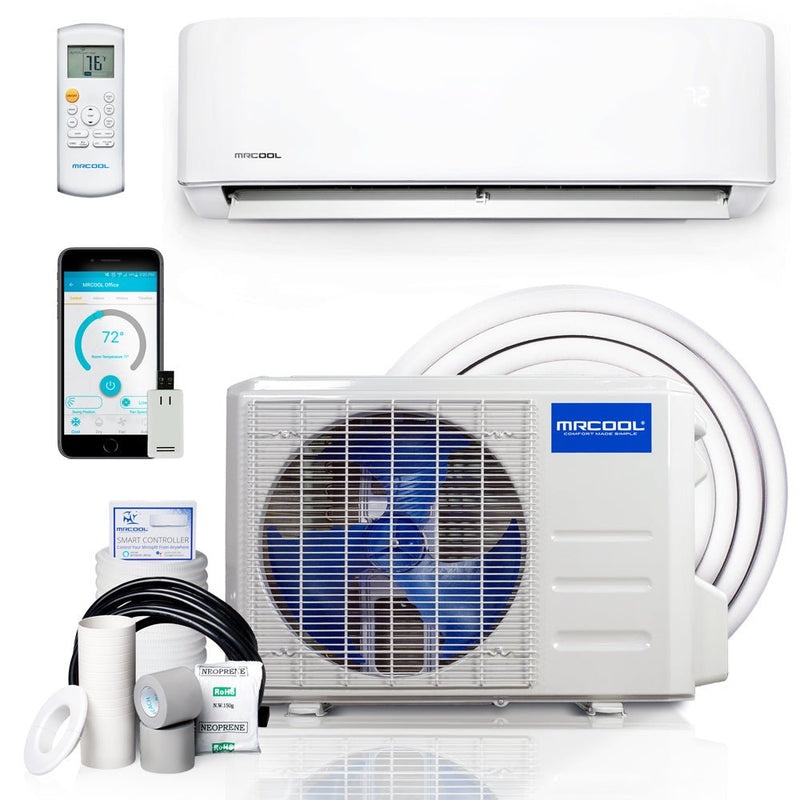
Ductless mini-split air conditioners are zoned and do not require ductwork. A mini-split system is an outdoor unit (compressor/condenser) and a slim indoor unit (air-handler) that is mounted on the wall or ceiling of the rooms to be cooled.
The outdoor and indoor parts are linked with the refrigerant tube and power cables via a tiny hole in the wall. The indoor units cool the surrounding space (zone) and are fitted with their thermostat or remote control, which enables the individual control of temperature in the various rooms.
This makes the ductless systems highly adjustable to cool down certain parts of the house when necessary.
Mini-splits are the perfect solution to houses that do not have ducts or new additions and renovated areas.
It is easier to install compared to central AC due to the fact that it only involves mounting the units and installation of a conduit through the wall without the need to construct major ducts.
Such systems are characterized by their energy efficiency. In fact, mini-splits are very energy efficient compared to window or portable units and even more efficient than most of the central systems.
Most ductless systems have high SEER ratings (20+) that can be converted to reduced running costs.
They also give heating during winter, in case they are heat pump models, which give the whole year round climate control.
Advantages:
- Targeted flexible cooling: Units may be installed in any room without renovation and are ideal in older houses or additions that lack ducts.
- Individual room control allows you to adjust the temperature in different zones, which can be more comfortable and even energy-saving, since you do not need to cool the rooms you do not use.
- Extremely silent when operating inside (the noisy compressor is located outside) and very efficient because no energy is wasted in long ducts
Disadvantages:
- An indoor unit only cools its immediate vicinity; several indoor units are required to cool an entire house and this can be quite expensive in large houses.
- Greater initial price per BTU of cooling than central or window ACs, particularly when a large number of indoor units are needed
- Indoor units are wall-mounted and can be seen, and not everyone will like it aesthetically (there are floor-mounted or ceiling cassettes types)
- Professional installation is necessary to work with refrigerant lines and mounting
Single-Zone vs. Multi-Zone Mini-Splits
Ductless systems are available in single zone and multi zone.
A single-zone mini-split consists of one indoor unit linked to one outdoor unit, and it is the best solution to cool a single room or an open space. Multi-zone mini-split systems can have a single outdoor unit connected to multiple indoor units (usually 2-8), so that a multi-room or small house can be cooled.
The multi-zone systems offer a tailored approach to ductless whole-home cooling, and the cost of the outdoor unit and installation grows with each zone. The homeowner can begin with one or two zones and can add more later in case the outdoor unit is capable of it.
In the case of a multi-zone system, one should make sure that the outdoor compressor is of the right size and that the indoor units will be located in a way that covers every important living area
Don’t Overpay for HVAC Services – Call 888-894-0154 Now to Compare Local Quotes!
Window Air Conditioners (Window-Mounted AC)
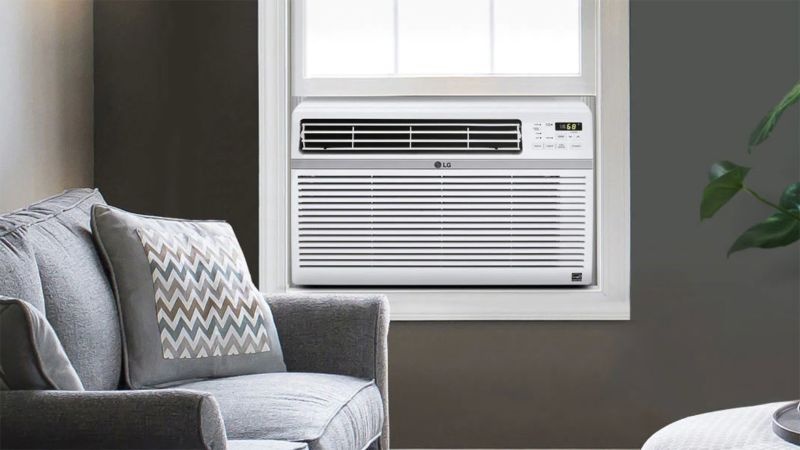
Window air conditioners are compact units that are meant to cool one room.
Everything (compressor, condenser, evaporator, fans) is fitted in a single box which is placed in a window opening or a slot in the wall. Hot air is exhausted to the back (outside the window) and cooled air is blown into the room through the front of the unit. There are different sizes of window ACs (cooling capacities) and thus they can be used to cool a small bedroom, a large living room or anything in between.
They are among the most widespread and cheapest kind of air conditioners to be used at home, and they are usually applied as a temporary measure to apartments or individual rooms.
It is easily installed: the unit is placed in an open window (or a specially cut hole in a wall), panels or brackets included are used to fix and seal the sides. Window ACs are widely used by renters and homeowners that require spot cooling because they are cheap (usually between 150 and 800 dollars per unit) and simple to install. Contemporary window units can have digital controls or remote controls and some even have smart capabilities or Wi-Fi.
But only one room or area is cooled by a single unit, and therefore a lot of units would be required to cool a whole house. They also cover the window when they are in position and this may block the view or natural light.
Advantages
• Inexpensive initial cost and simple installation – no specialists are needed; the units are plugged into a standard electric outlet.
• Efficient to cool down a single room or a small area; you only need to install them where they are required, and this saves on energy as opposed to using central AC to cool the entire house.
• Washable filters that can be removed easily and easy maintenance.
• Units are able to be stored or swapped in and out
Disadvantages
• Cools only the room where it is installed; does not work with open floor plans or multiple room cooling without multiple units.
• May be noisy in operation and may vibrate in the window frame which may be disturbing in bedrooms.
• Blocks the view and light through the window when it is installed, and it does not allow that window to be opened to allow ventilation.
• All windows do not have a place to fit a unit – casement or very narrow windows might need a special model or a through-wall installation.
Through-the-Wall Air Conditioners
The through-the-wall air conditioner is a close relative of the window AC.
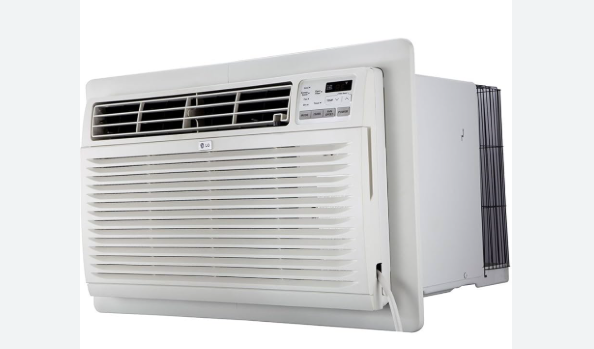
These units are basically the same kind of self-contained AC, only that they are not placed on an open window, but rather they are inserted in a sleeve that is permanently attached in an exterior wall.
Through-the-wall ACs are also common in apartments or older houses where it is undesirable to lose a window, or where a more permanent secure installation is desired. They are mounted by making a hole in the wall (typically between wall studs) and venting the back of the unit. A lot of window AC types are also convertible to through-wall units provided a wall sleeve is employed.
Through-the-wall units are a little bit more efficient and air-tight, as they are sealed in the hole in the wall (no cracks around a window). Nevertheless, one needs to be installed by drilling a hole in the wall and in many cases a special electrical circuit, so most people recommend a professional installation.
A through-wall AC once installed can achieve the same cooling capacity as a window unit but does not take a window.
Portable Air Conditioners (Freestanding AC)
Portable air conditioners are freestanding units on wheels that cool a single room.
Don’t Overpay for HVAC Services – Call 888-894-0154 Now to Compare Local Quotes!
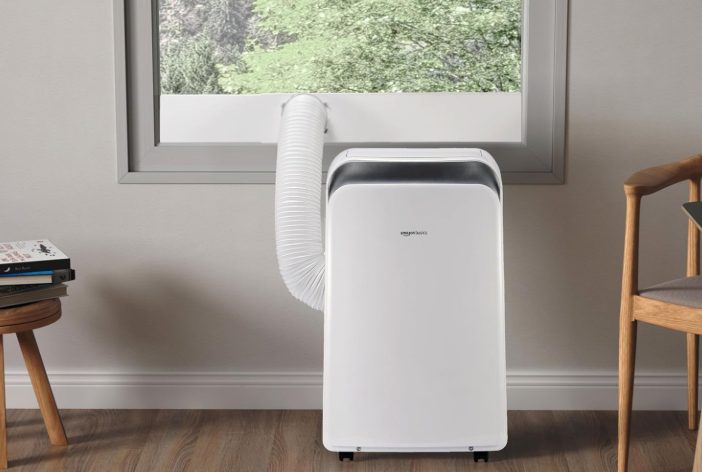
A portable AC has all the cooling parts contained in one indoor unit about the size of a tall dehumidifier. It uses a flexible exhaust hose to vent heat outside through a window or sliding door. The unit pulls warm air in, cools it through evaporator coils, and blows the chilled air back into the room. Any surplus heat is expelled via the hose to the outdoors.
Most portable units also condense moisture out of the air and either vent it with the exhaust or collect it in a tank that must be emptied
Installation is straightforward: simply roll the unit into place, plug it in, and attach the exhaust hose to the window kit supplied with the unit. Because no permanent installation is required, these units are ideal for temporary cooling or in spaces where window ACs cannot be installed. Portable models are somewhat more expensive than comparable window units, but they remain affordable.
Most cost between $100 and $500.
You can easily wheel the unit from room to room or store it away during cooler months, adding seasonal flexibility. This makes it perfect for renters or spaces with intermittent cooling needs.
Advantages:
• Portable and simple to install – one of the few types of AC that do not have to be installed in one location. Perfect for renters or short-term needs
• No heavy machine to hoist up to a window; can be moved about and used in different rooms (though not at the same time)
• No interference with the actual window (only a small vent panel), so you still get some light and view. You can also remove the vent kit when it’s not in use
• Additional utility is provided by some models that can be used as dehumidifiers or as heaters in heat-pump portable units
Disadvantages:
• Less efficient at cooling than window or split ACs of the same size, since the indoor compressor can radiate heat back into the room; single-hose models may generate negative pressure, drawing in warm air from other areas.
• Can be rather noisy, as both the compressor and the fan are located in the room
• The exhaust hose must be attached to a window, which can be clunky and partially obstruct the opening, and the hose length may limit where you can place the unit
• Usually only works well in small to medium-sized rooms; cooling larger open spaces or whole homes would require multiple units
• In humid climates, you will need to empty collected water tanks occasionally or ensure the self-evaporation system functions properly
Single-Hose vs. Dual-Hose Portable ACs
Portable air conditioners are of two major designs, which are single-hose and dual-hose.
A single-hose portable AC has one hose to release hot air into the outside. It draws room air through it to cool the internal condenser and the subsequently heated air is forced out through the window hose.
This has the effect of creating a small amount of negative pressure in the room (as air is being sucked out) so warm air leaks in around the room, making it a little less efficient. A dual-hose portable AC, by contrast, contains two hoses: one to pull air in the outside to cool the compressor, and a second hose to push the hot air out. In this manner, the unit does not cool itself with conditioned indoor air.
The dual-hose models have a tendency to cool a room quicker and more effectively than a single-hose model, particularly in a large room or over a long period of time. Nevertheless, the dual-hose units can be a bit costly and heavier.
When selecting a portable AC, the size of the room and the value of the efficiency increase in a dual-hose model to you should be taken into consideration
Smart Air Conditioners (Wi-Fi Enabled AC Units)
Smart AC (Wi-Fi enabled AC Units)
Smart air conditioners can be any type of unit—window, portable, ductless mini-split or even central systems equipped with smart thermostats—and allow remote and automated control via Wi-Fi or other smart interfaces
They let you control settings through a smartphone app or voice assistant, and often include advanced programmability such as scheduling, geofencing (automatically turning off when you leave home), temperature-range limits, and energy-use reporting. This helps maximize efficiency and comfort without manual intervention.
Most smart ACs integrate with voice assistants like Amazon Alexa or Google Assistant, fitting seamlessly into a smart-home setup
You can either buy a unit with built-in smart capabilities or retrofit an existing AC with an aftermarket smart controller
Many manufacturers now offer smart window and portable ACs that are only slightly more expensive—an 8,000 BTU smart window AC may cost roughly $30–100 more than its non-smart counterpart. If you already own an AC with an IR remote, you can add a smart controller for around $70–130. This lets you upgrade to smart control without replacing the entire unit. Newer ductless mini-splits often offer optional Wi-Fi modules as well.
Upgrading adds convenience without major investment
Advantages:
- Ease of use and control: you can check and adjust your home’s cooling from anywhere, turning the AC on before you arrive or off when you forget
- Advanced scheduling and automation prevent waste by switching off when the set temperature is reached or no one’s home
- Integration with smart-home ecosystems (Alexa, Google Home, etc.) enables voice control and routines (e.g. a “Good night” sequence that powers down all ACs)
- Smart apps provide energy usage data, filter-cleaning reminders and diagnostic alerts for maintenance and efficiency
Disadvantages:
- Addiction to Wi-Fi and apps—when your internet is off or the service/app is not working, you may lose the

How to Get the Best HVAC Prices
- Firstly, keep in mind that installation quality is always the most important thing for residential HVAC project. So never sacrifice contractor quality for a lower price.
- Secondly, remember to look up the latest rebates as we talked above.
- Thirdly, ask for at least 3 bids before you make the decision. You can click here to get 3 free estimates from your local contractors, and this estimate already takes rebates and tax credit into consideration and filter unqualified contractors automatically.
Lastly, once you chose the right contractor, remember to use the tactics from this guide: Homeowners Tactics When Negotiating with HVAC Dealer to get the final best price.