Best through-the-wall air conditioners provide steady cooling without blocking a window. For small rooms choose 8,000 BTU models like the Whirlpool or TCL for efficient, targeted cooling. For larger spaces choose higher-capacity units such as the LG 11,800 BTU or Frigidaire 12,000 BTU for broader coverage. For smart-home control choose the TCL 8,000 BTU model. The list below compares cooling capacity, coverage, and ideal buyer types to help you match a through-the-wall AC to your space and installation needs.
| Product | BTU / Coverage | Best For |
|---|---|---|
| LG 10,000 BTU Through the Wall AC | 9,800 BTU · Up to 440 sq ft | Apartments needing efficient refrigerant |
| Whirlpool 8,000 BTU Through the Wall AC | 8,000 BTU · Up to 350 sq ft | Medium rooms and universal sleeve fit |
| TCL 8,000 BTU Smart Through-The-Wall AC | 8,000 BTU · Up to 350 sq ft | Smart-home users and voice control |
| LG 11,800 BTU Through the Wall AC | 11,800 BTU · Up to 530 sq ft | Larger rooms and higher-capacity needs |
| Frigidaire 12,000 BTU Wall AC | 12,000 BTU · Up to 550 sq ft | Large rooms needing quieter operation and ionizer |
LG 10,000 BTU Through the Wall Air Conditioner

Features include energy efficient R-32 refrigerant with an EER of 10.7, 3 cooling speeds, 3 pre-programmed modes, Dry mode removing up to 2.9 pints/hour, 4-way air deflection, and an Energy Saver mode that keeps the fan running while the compressor cycles off. The unit is designed for through-the-wall installation and is not properly vented for standard window use.
Best for renters or homeowners who want a more efficient refrigerant and flexible airflow in medium-to-large rooms. Choose this if you prioritize energy efficiency and a unit rated to cool up to 440 sq ft.
Caution: This model requires a proper through-wall sleeve and is not intended for standard window installation.
Whirlpool 8,000 BTU Through the Wall Air Conditioner

Features include 8,000 BTU cooling capacity for up to 350 sq ft, an attached 5.9-ft LCDI 3-prong plug for 115V outlets, 8-way directional louvers, 3 fan speeds, 4 operation modes, a temperature range of 62–86°F, and a universal fit size that fits sleeves 24.5″–27″ wide. A trim kit and rear grille are included for finishing the installation.
Best for buyers who need a mid-size room solution with a universal sleeve fit and flexible airflow. Choose this if you want a straightforward through-the-wall unit that fits common sleeve sizes and includes finishing components.
Caution: Verify sleeve width and wall thickness before purchase; measurements are required to confirm fit despite the advertised universal size.
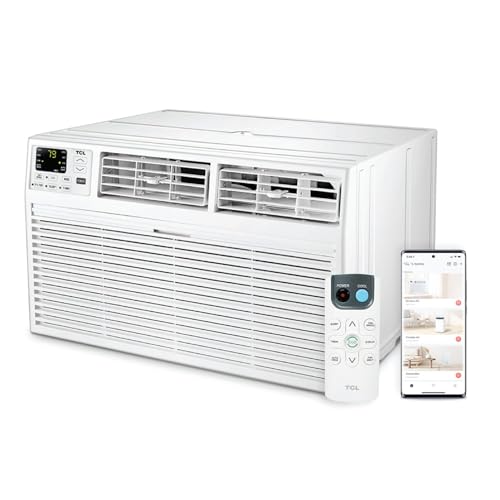
TCL H8T9E1-A 8,000 BTU Smart Through-The-Wall Air Conditioner
Don’t Overpay for HVAC Services – Call 888-894-0154 Now to Compare Local Quotes!
Features include 8,000 BTU cooling up to 350 sq ft, a built-in dehumidifier (Dry Mode) to reduce moisture, and compatibility with Amazon Alexa and Google Assistant for voice control. The unit offers remote control and is positioned for medium-sized rooms like bedrooms, living rooms, or offices.
Best for smart-home users who want voice or app control and basic dehumidification. Choose this if you prioritize remote access and smart assistant compatibility to integrate the air conditioner into routines and voice commands.
Caution: Smart features require network setup and compatible smart-home accounts; network reliability affects remote control response.
LG 11,800 BTU Through the Wall Air Conditioner

Features include R-32 refrigerant with an EER of 10.6, through-the-wall design not intended for window venting, dimensions of 24″ W x 20.1″ D x 14.4″ H, and 3 cooling speeds with 3 pre-programmed modes. The unit is rated to cool rooms up to 530 sq ft using a turbo fan and 4-way deflection for directional airflow.
Best for larger rooms or open-plan areas that need higher capacity cooling and efficient refrigerant performance. Choose this if you need to cool up to about 530 sq ft and prefer a universal through-the-wall design that fits most sleeves.
Caution: Requires a properly sized through-wall sleeve and sufficient wall opening; confirm sleeve compatibility before ordering.
Frigidaire 115V 12,000 BTU Wall Air Conditioner
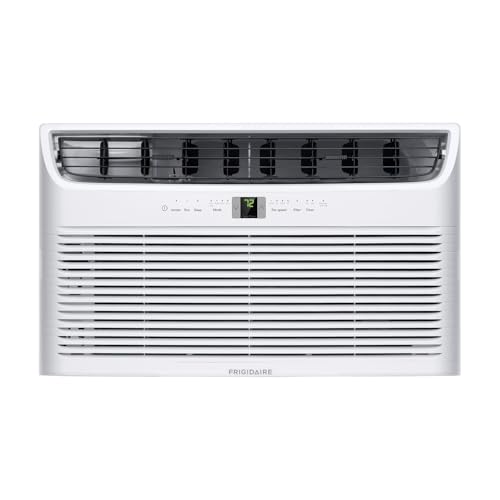
Features include 12,000 BTU cooling up to 550 sq ft, a built-in air ionizer to reduce airborne particles, 3 fan speeds, dehumidifier and fan modes, and a remote control. The unit is described as quiet and energy efficient for wall-mounted home cooling.
Best for large rooms and buyers concerned with indoor air quality because of the built-in ionizer. Choose this if you need maximum cooling capacity in a through-the-wall format and want additional air-cleaning features.
Caution: Air ionizers reduce some airborne particles but are not a substitute for filtration systems; consider ventilation and filter maintenance for overall air quality.
Buying Guide: How To Choose A Through-The-Wall Air Conditioner
What BTU Do I Need For My Room?
Calculate room area in square feet and match BTU to size. Typical guidance: 8,000 BTU covers ~300–350 sq ft, 10,000 BTU covers ~400–450 sq ft, and 12,000 BTU covers ~500–550 sq ft. Choose a slightly higher BTU for rooms with high ceilings, strong sun exposure, or poor insulation.
Do I Need A Wall Sleeve Or Special Wiring?
Many through-the-wall units require a compatible sleeve and a proper wall opening for venting. Verify sleeve dimensions and whether a sleeve is included. Confirm electrical requirements; most listed units operate on 115V and plug into a standard receptacle, but check amperage and plug type.
Should I Prioritize Energy Efficiency Or Features?
Energy efficiency impacts operating cost over time. Look for EER values provided by the manufacturer and refrigerants like R-32 for improved efficiency. Feature trade-offs include smart controls, dehumidifier modes, and air ionizers. Choose features that match how you use the room (e.g., smart control for remote scheduling).
How Important Is Noise Level?
Noise specifications vary by model. If the unit will be used in a bedroom or study, prioritize models described as “quiet” or with lower fan speeds and sleep modes. Multiple fan speeds allow lower-noise operation during sleeping hours.
What Installation Considerations Matter?
Installation factors include sleeve fit, wall thickness, exterior access for condensate, and proper sealing to avoid drafts. Some units come with trim kits and rear grilles to finish the look; confirm what hardware is included. Professional installation can ensure proper support and electrical safety.
Do Smart Features Add Real Value?
Smart controls (app, Alexa/Google) add convenience for remote control and scheduling. They require Wi‑Fi setup and compatible smart-home services. Choose smart units if voice control or app automation is important; choose simpler models if you prefer basic remote and manual control.
FAQ
- Can a through-the-wall AC be used in a window opening? No. Through-the-wall units are designed with rear venting and require a wall sleeve and exterior clearance; they are not properly vented for standard window installations.
- How do I size a ventilation sleeve? Compare the unit’s listed dimensions and the sleeve size requirements. Manufacturers often list compatible sleeve widths or include a sleeve and trim kit; measure wall thickness and opening before purchase.
- Are built-in dehumidifiers effective? Dry or dehumidifier modes remove moisture at manufacturer-stated pints per hour. They help reduce humidity but are not a replacement for a dedicated whole-house dehumidifier in high-humidity climates.
- Do these units need special electrical circuits? Many through-the-wall units run on 115V and plug into standard outlets, but check amperage and ensure the circuit is not overloaded by other heavy appliances.
- How often should filters be cleaned? Filters should be checked and cleaned regularly, typically every 1–3 months depending on usage and indoor air quality. Follow the manufacturer’s maintenance instructions for best performance.
- Will an air ionizer replace an air purifier? No. An ionizer can reduce some airborne particles, but it does not replace filtration systems designed to capture allergens and fine particulates. Consider supplemental filtration for allergy or asthma concerns.

How to Get the Best HVAC Prices
- Firstly, keep in mind that installation quality is always the most important thing for residential HVAC project. So never sacrifice contractor quality for a lower price.
- Secondly, remember to look up the latest rebates as we talked above.
- Thirdly, ask for at least 3 bids before you make the decision. You can click here to get 3 free estimates from your local contractors, and this estimate already takes rebates and tax credit into consideration and filter unqualified contractors automatically.
Lastly, once you chose the right contractor, remember to use the tactics from this guide: Homeowners Tactics When Negotiating with HVAC Dealer to get the final best price.