If you need a vehicle air conditioner that runs on 12V DC power, these units provide mobile cooling solutions for RVs, trucks, vans, and campers. Choose a split unit if you want quieter cabin operation, a rooftop model for easy installation and integrated weatherproofing, or a low-profile rooftop AC for limited roof clearance. The selections below highlight who each model is best for and one limitation to watch for.
| Model | Type | Key Specification | Best For |
|---|---|---|---|
| 12V DC air conditioner, truck split 9000BTU | Split | 9000 BTU, ~850W, 60–70A | Big batteries, extended parked cooling |
| 12V RV split 9000BTU | Split | 9000 BTU, 800W, starting 75A | Heavy-duty enclosure, excavation or truck use |
| 12V Rooftop 10000 BTU Heating & Cooling | Rooftop (with heat) | 10000 BTU, 960W, 30–50A | Travelers wanting heating plus cooling |
| 12V RV 8530 BTU Non-Ducted | Rooftop non-ducted | 8530 BTU, 45 dB, refrigerant not prefilled | Standard sunroof-sized RVs needing quiet AC |
| OutEquipPro 10000 BTU Rooftop | Low-profile rooftop | 10000 BTU, battery-powered estimates listed | Off-grid users with large battery banks |
12V DC Air Conditioner, Truck Split 9000BTU

Features listed: DC 12V power supply that runs from the vehicle battery without engine start; approximately 850 watts power draw; current requirement 60–70A; cooling capacity 9000 BTU; indoor unit noise as low as 40 dB; five air outlets with 360° rotation. The manufacturer recommends battery capacity above 200AH.
Best for buyers who need a split system that minimizes cabin noise and can run while parked. Choose this if you have a large battery bank (200AH+) and want even airflow around the cabin. Avoid this if your battery capacity or alternator cannot support 60–70A continuous draw.
Caution: Requires substantial battery capacity and correct wiring to safely supply 60–70A continuous current.
12V RV Air Conditioner, Split 9000BTU

Features listed: 12V battery-powered operation; power ~800W with 9000 BTU cooling capacity; starting current 75A; air volume 450 m³/h; shell built from thickened hard material with ventilation holes for heat dissipation.
Best for users who need a rugged, heavy-duty enclosure that resists deformation and offers strong airflow. Choose this if the unit will be used in construction vehicles, excavators, or trucks that require durable housing. Also better for buyers who can accommodate a higher starting current.
Caution: The listed starting current of 75A means peak draw may be high at startup; ensure wiring and fusing match that requirement.
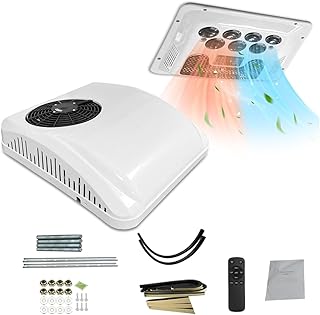
12V Rooftop Air Conditioner 10000 BTU Heating & Cooling
Don’t Overpay for HVAC Services – Call 888-894-0154 Now to Compare Local Quotes!
Features listed: 10000 BTU cooling plus heating function, brushless compressors, power consumption 960W, rated current 30–50A, installs into a skylight with minimum roof opening dimensions specified; ABS weatherproof outer shell.
Best for buyers who want both heating and cooling in a single rooftop installation. Choose this if you have a standard roof skylight and want weatherproof housing with brushless compressors for efficiency. Better for campers who value a combined heat mode rather than separate heater appliances.
Caution: Installation requires a compatible skylight size and proper roof sealing; confirm roof cutout dimensions before ordering.
12V RV Air Conditioner 8530 BTU Non-Ducted

Features listed: Non-ducted rooftop unit sized for many caravan sunroofs (dimensions and sunroof size ranges specified); cooling and heating capabilities; seven adjustable vents with 360° rotation; running noise about 45 dB; refrigerant not prefilled—requires R134A 380g before use.
Best for owners of RVs with standard sunroof sizes who want a quieter rooftop solution. Choose this if you need an easy-to-install non-ducted unit with adjustable vents for directionality. Avoid this if you cannot add refrigerant locally or prefer a precharged unit.
Caution: Refrigerant must be added before first use; shipping restrictions mean the unit is shipped without refrigerant included.
OutEquipPro 12V 10000 BTU Rooftop Air Conditioner
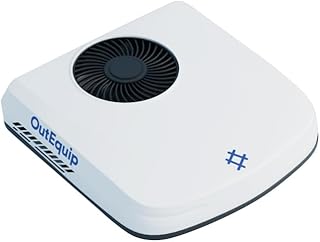
Features listed: 10,000 BTU cooling, described as low-profile and battery-powered; the product notes estimated run times of about 8 hours with a 480Ah battery and 10 hours with a 600Ah battery; UV-stabilized ABS construction and reinforced condenser components for durability.
Best for off-grid travelers who have large battery banks and need a low-profile rooftop unit. Choose this if you want a battery-powered solution with longer run-time estimates and durable exterior materials. Better for applications where roof clearance is limited.
Caution: Run-time estimates depend on battery health, inverter or DC wiring losses, and exact operating conditions; verify battery capacity and system wiring before relying on the stated hours.
Buying Guide: How To Choose A 12V DC Air Conditioner
How much battery capacity and current do I need?
Calculate continuous current draw (listed as running amps) and starting current (peak startup amps). Continuous draws in these models range roughly 30–70A. For multi-hour parked operation, larger battery banks (200Ah or greater) or dedicated deep-cycle batteries are recommended. Also verify wiring gauge, fuses, and alternator charging capacity.
Which is better: split system or rooftop?
- Split systems: better for lower cabin noise because the compressor or condenser is remote. Choose this for quiet sleeping and when you can mount two units (interior and exterior).
- Rooftop units: easier single-point installation and weatherproof shells. Choose rooftop when you prefer an integrated, compact installation or need a heating function with combined unit.
Do I need refrigerant added before use?
Some models ship without refrigerant to comply with transport rules. Check product details: if refrigerant is not prefilled, you must arrange professional charging with the specified refrigerant type (e.g., R134a) and the listed fill amount.
How important is noise level?
Noise ratings (e.g., 40–45 dB) indicate quieter operation suitable for sleeping. Split units often achieve lower cabin noise. If quiet overnight operation matters, prioritize models with listed low dB values and multiple adjustable vents to reduce perceived noise.
What about installation and roof size?
Measure sunroof or roof opening dimensions carefully for rooftop units. Non-ducted models often specify minimum and maximum sunroof sizes. Split systems require routing refrigerant lines and electrical wiring between the indoor and outdoor components.
What wiring, fuses, and safety items are required?
- Use appropriately sized wiring to handle continuous and startup currents (consult electrician or product manual).
- Install a fused disconnect near the battery to protect wiring.
- Consider shore power or inverter specs if switching between DC and AC sources.
What about heating and compressor type?
Some units include heating capability and brushless compressors for efficiency. Choose heater-equipped units if you need year-round climate control. Brushless compressors can offer improved efficiency and longevity compared with brushed designs.
FAQ
Can a 12V DC air conditioner run directly from a vehicle battery? Yes, but only if the battery bank and wiring are sized to handle the listed continuous and startup currents; many manufacturers recommend large deep-cycle batteries for multiple hours of run time.
What happens if refrigerant is not prefilled? The unit must be filled by a qualified technician with the specified refrigerant (e.g., R134a) and the correct charge amount before operation; do not operate without proper charge.
How do I estimate runtime from a battery? Convert battery amp-hours (Ah) to usable capacity, account for inverter or DC losses, then divide by the unit’s running amps. Manufacturer estimates are useful but depend on actual battery condition and ambient load.
Is a split system quieter than a rooftop unit? Typically yes. Split systems place the compressor or condenser externally and can reduce interior noise, making them better for sleep-sensitive users.
Don’t Overpay for HVAC Services – Call 888-894-0154 Now to Compare Local Quotes!
Do I need a professional for installation? Professional installation is recommended for refrigerant charging, roof penetration and sealing, high-current wiring, and ensuring correct compressor startup protection.
Can I use solar to supplement a 12V air conditioner? Solar can help but must be sized to supply the necessary daily energy plus battery storage. Large 12V AC loads often require significant solar arrays and battery banks to run for extended periods off-grid.

How to Get the Best HVAC Prices
- Firstly, keep in mind that installation quality is always the most important thing for residential HVAC project. So never sacrifice contractor quality for a lower price.
- Secondly, remember to look up the latest rebates as we talked above.
- Thirdly, ask for at least 3 bids before you make the decision. You can click here to get 3 free estimates from your local contractors, and this estimate already takes rebates and tax credit into consideration and filter unqualified contractors automatically.
Lastly, once you chose the right contractor, remember to use the tactics from this guide: Homeowners Tactics When Negotiating with HVAC Dealer to get the final best price.