The geothermal heat pump systems (also known as ground-source heat pumps) utilize the constant underground temperature to offer efficient heating and cooling to homes. Such systems involve the burying of a network of pipes (ground loops) and the installation of a heat pump unit that moves heat to and fro the earth.
Average residential geothermal systems in the U.S. can cost tens of thousands of dollars to install, commonly between approximately 15,000 and 30,000 dollars or more with equipment and drilling. The upfront cost is high, but the operating cost of geothermal heat pumps is much lower than the traditional HVAC, and the federal tax credit (30% through 2032) helps to cover the initial cost.
The costs of geothermal heat pumps are broken down in detail below by system size, brand, installation factors and running costs.
Geothermal Heat Pump Costs By System Size

Geothermal heat pumps are rated in tons of capacity with 1 ton = 12,000 BTU/hour of heating/cooling capacity. Residential systems are typically 2 to 5 tons depending on the heating load of the home. In most cases, the bigger tonnage systems are more expensive to buy and install.
The average total installed costs are approximately 4,000-8,000 dollars per ton (including the heat pump unit and the installation of the ground loop). The heat pump unit itself is usually only 20-40 percent of the total cost and the remainder is the ground loop drilling/trenching, piping and labor. The approximate cost ranges of geothermal systems of 2 to 5 tons, including the heat pump equipment and installation are indicated in the table below:
| System Size | Heat Pump Unit Cost | Total Installed Cost |
|---|---|---|
| 2 ton (24,000 BTU) | $3,500 – $5,000 | $8,000 – $16,000 |
| 3 ton (36,000 BTU) | $4,000 – $6,000 | $12,000 – $24,000 |
| 4 ton (48,000 BTU) | $5,000 – $7,500 | $16,000 – $32,000 |
| 5 ton (60,000 BTU) | $6,000 – $7,500 | $20,000 – $40,000 |
The average 3 ton geothermal system may cost between 12,000-24,000 installed and a 5 ton system may cost between 20,000-40,000 installed as indicated above. Smaller 2-ton systems (enough to power well-insulated smaller homes) tend to cost between 8,000 and 16,000 installed.
These are ranges based on a typical closed-loop installation. The costs per ton are expected to be higher on the upper end of the scale of smaller systems (because of the fixed costs of set up) and on the upper end of the largest systems (because of the possible complexity of drilling or multiple units). It should be mentioned that these numbers are pre-incentive, homeowners can now receive a 30 percent federal tax credit on geothermal installations, which in effect makes the net cost about a third less.
Geothermal Heat Pump Cost By Brand
Some of the large manufacturers that provide residential geothermal heat pump systems include WaterFurnace, Bosch, ClimateMaster and Trane.
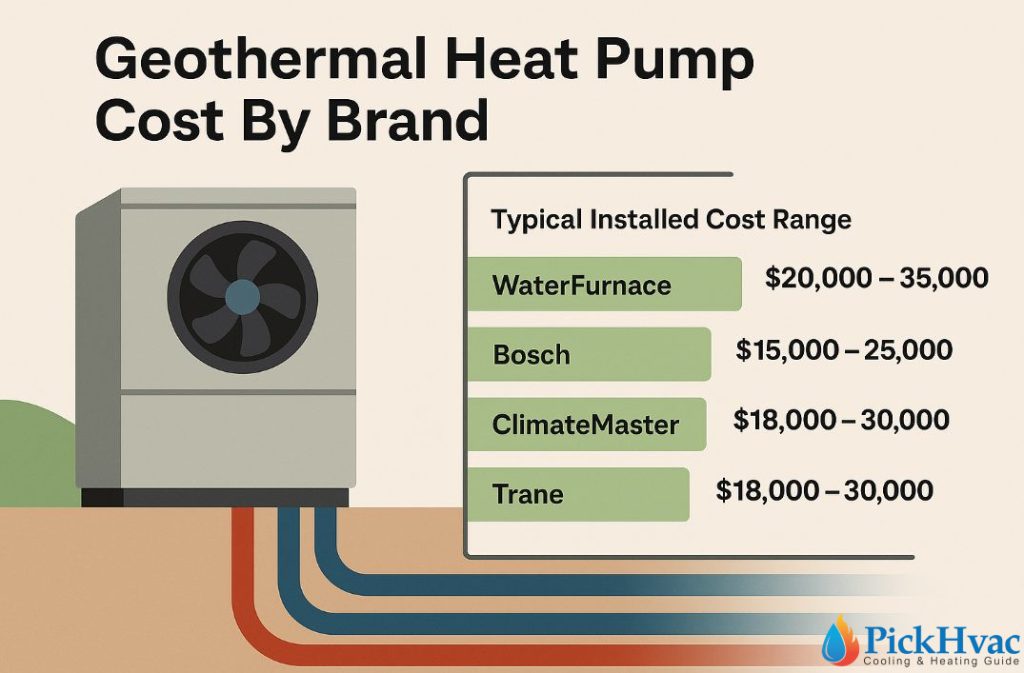
Although all geothermal systems are based on the same principle, there exist certain differences in costs between brands, with the price of the heat pump unit, its features and efficiency being the primary factor. The installation cost of the ground loop will be the same irrespective of the brand and therefore the difference in the total installed cost is mainly due to the equipment and dealer prices.
Brands that specialize in geothermal equipment such as WaterFurnace and ClimateMaster have high-efficiency, feature-rich systems, and thus their prices may be at the upper end of the spectrum, whereas Bosch (which acquired Florida Heat Pump line) tends to have more value-oriented systems.
Don’t Overpay for HVAC Services – Call 888-894-0154 Now to Compare Local Quotes!
Geothermal units sold by Trane (under the brand name of EnviroWise or similar) are generally comparable to other high-end brands; indeed, certain Trane models have been produced by other geothermal OEMs. The following table is a comparison of estimated cost ranges of a typical 3-4 ton residential system of popular brands (equipment + installation):
| Brand | Typical Installed Cost Range | Notes |
|---|---|---|
| WaterFurnace | $20,000 – $35,000 | Premium efficiency (e.g. 5 Series, 7 Series); often highest upfront cost |
| ClimateMaster | $18,000 – $30,000 | Established geothermal brand with competitive pricing relative to WaterFurnace |
| Bosch | $15,000 – $25,000 | Formerly Florida Heat Pump (FHP); known for solid performance at mid-range cost |
| Trane | $18,000 – $30,000 | Mainstream HVAC manufacturer; geothermal units comparable to other high-end brands |
These price levels presuppose a typical closed-loop ground installation in an average-sized house. Practically, the real prices will be determined by the model and features selected in the line of each brand.
As an example, a flagship variable-speed WaterFurnace 7 Series system may be at the higher end (or above) this scale, but a basic two-stage WaterFurnace 5 Series or ClimateMaster unit may be at the lower end.
The table indicates that there is a lot of overlap in price among the major brands, the distinction between, e.g., ClimateMaster and WaterFurnace may be a matter of a few thousand dollars in equipment. The systems offered by Bosch are a little cheaper in terms of the initial unit cost, which can result in the overall installation being slightly less expensive in case the factors of the installation are the same.
It is prudent to seek several quotes on various brands of geothermal installers that are certified to ensure that dealer incentives and local competition do not influence the pricing. Each of these brands provides efficient, reliable heat pumps; in many cases the quality of the installation and proper sizing will have a greater effect on performance and savings than the brand.
Factors Affecting Geothermal Installation Costs
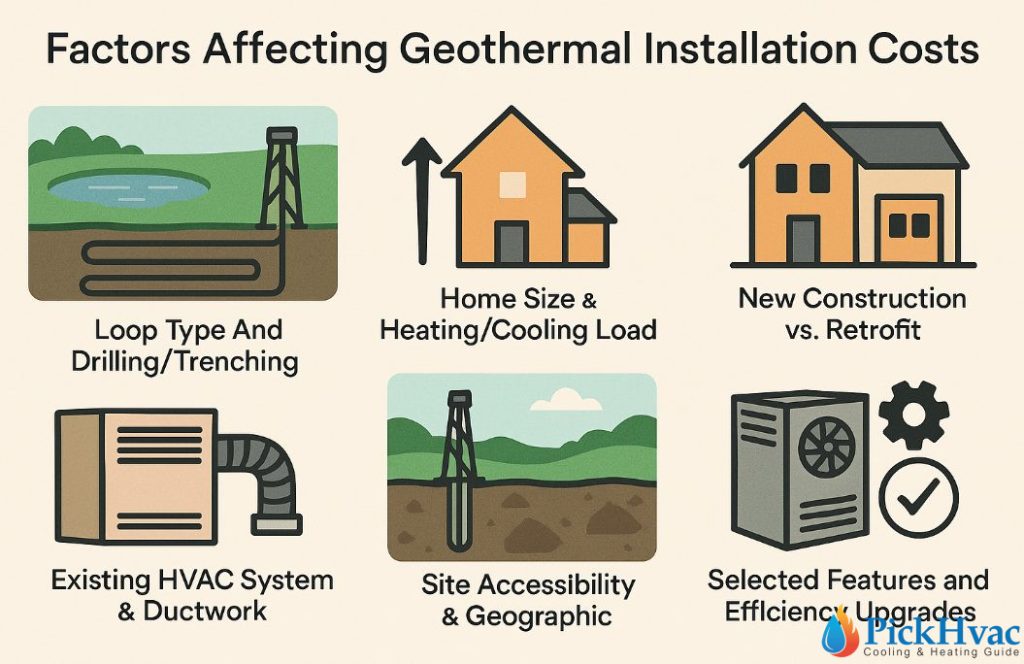
The installation cost of a geothermal heat pump may range significantly depending on many site-specific and system-specific factors. These factors can be used to explain the wide cost ranges mentioned above. These are some of the main variables affecting the cost of geothermal installation:
- Loop Type and Drilling/Trenching: The type of ground loop design is significant in cost. The most economical system is usually a horizontal closed-loop system (pipes laid in trenches 410 feet deep) when there is sufficient land, costing on average of $15,000-$34,000 installed on a residential system. A vertical closed-loop system (pipes in deep boreholes ~100-500 feet deep) is more costly – typically costing about $20,000-$38,000 installed, because of the drilling expense. Where a property has an appropriate pond or lake, a pond/lake loop may be less expensive (about $10,000-$32,000) because little excavation is required. A pumping groundwater open-loop system is also cheaper to install (approximately $10,000 to $28,000), however, it is only applicable where clean well water is in abundance and local codes permit it. Overall, vertical well drilling is more expensive than horizontal loops that can be laid in the open ground, but they are less expensive and need a large yard (approximately 0.25 to 0.75 acres of land per average house). The conditions of the soil/rock also count, drilling in hard rock or digging through hard soil will add to labor and equipment expenses.
- Home Size and Heating/Cooling Load: The larger the home or the greater the heating/cooling load, the larger the heat pump system (more tonnage) and the longer the loop field, both of which are more expensive. A crude rule of thumb is approximately 4,000 to 8,000 dollars per ton of capacity, thus a 5-ton system in a large house may cost approximately two times the price of a 2.5-ton system in a small or well-insulated house. Installers will do a Manual J load calculation to determine the size of the system by the square footage of the home, the level of insulation, climate and design temperature. In case the house is energy efficient or smaller, a smaller (and cheaper) geothermal unit can be fitted.
- New Construction Versus. Retrofit: It is much less expensive to install geothermal during new construction than to retrofit an existing house. New construction installations are estimated to be 20% to 40 percent cheaper. The reason is that excavation may be performed prior to landscaping and the system (ductwork, etc.) is easier to incorporate during the construction. During retrofit, the contractor might have to go around the existing structures and replenish the landscaping, which increases the cost.
- Current HVAC System And Ductwork: Geothermal heat pumps typically are central systems which utilize ductwork to circulate air (in the case of water-to-air units). In case a house already has an appropriate duct network (furnace or central AC), the geothermal unit can be frequently used. Nevertheless, when the ductwork is either old or inadequate, it might require repairs or expansion to accommodate the airflow. Changes in ductwork are usually an additional expense (an average of $1,400 to $5,600 on large scale duct replacement). Homes without ducts (e.g. baseboard heat) may need to install ducts or install a water-to-water heat pump with radiant floors, which can increase costs. It may require further infrastructure modifications due to incompatibility with the current systems (such as ductless systems or boilers).
- Accessibility And Geography Of Site: The accessibility of the site to drilling rigs or excavators may influence the cost of labor. Contractors can also increase the price of the additional effort in case the property has tight access, rocky terrain, or other equipment difficulties. Likewise, the transport cost of crews and machinery may be more in the remote rural areas. The design of loops is also affected by geography, e.g. vertical loops may be the only choice in an urban or rocky environment where horizontal trenches cannot be dug, although vertical drilling is more expensive.
- Loops Depth And Climate: Geothermal loops have to be laid below the frost line. In the colder northern regions, this implies deeper trenches or wells, which may raise the cost of excavation. The colder climates also tend to need bigger loop fields to provide heating. The downside is that extremely hot weather may need a loop that is a little bigger to cool. System efficiency may be slightly affected by local ground temperature (typically 45°F 70°F in the U.S., depending on location) but is more often determined by the load of the home. In the event that very deep drilling is required, well drilling costs are normally charged on a per foot basis, i.e. about 5 to 40 dollars per foot of geothermal wells, thus deep wells will increase the cost directly.
- Installer Rates And Permits: The labor rates are different in different areas and different installers. The geothermal contractors who are highly experienced may be costly but may be more efficient as well. Never use an unqualified installer (preferably IGSHPA-certified) to install the system properly. Most regions also have permit fees a geothermal installation permit may cost between approximately 100 to 650 dollars and is usually done by the contractor. These permit charges are normally a minute percentage of the total yet they add to the budget.
- Chosen Options And Energy Savings: The actual heat pump unit has a number of efficiency ratings and choices. Two-speed or variable-speed compressor, variable fans, and advanced controls are more expensive than basic single-stage units. As an example, a high efficiency variable-capacity unit may be thousands of dollars more expensive than a standard unit of the same tonnage. Selecting a high-quality brand or model will raise the cost of equipment (but it can be more efficient). Replacing the current geothermal units with variable-speed geothermal units and other efficiency improvements may increase the cost, but the units are more energy efficient. Customers are advised to consider the increased initial investment in terms of possible energy savings. And optional extras such as built-in hot water production (desuperheaters) are also costly, usually an extra $1,400 to $3,000+ to have a hot water assist option that uses waste heat to heat domestic water.
- Landscaping And Restoration: The yard is bound to be disturbed by installing ground loops. Following a horizontal loop installation, e.g. the trenches must be filled in and the yard regraded. Re-seeding of lawn, replacing sod, or repairing landscaping features may be expensive. The cost of landscape restoration may be about 4 to 12 dollars per square foot to replant grass and restore the area. Should large scale landscaping, fencing or hardscaping be involved and have to be removed and replaced, this can be costly. Vertical installations have less surface impact (only boreholes), although there can be some yard repair at the locations where drilling equipment was moved or where pipe headers are buried.
- Incentives And Rebates: This is not a factor of cost that adds to the price, but it is important to mention that incentives have a huge impact on the net cost. The federal government now provides a 30 percent tax credit on geothermal heat pump installations (which is available at 30 percent until 2032, and then decreases after that). Renewable energy systems also have rebates or low-interest financing in many states, utility companies or local programs. These incentives have the potential to make the cost to the homeowner much lower. An example would be a system that cost 30,000 dollars and would be reduced to 21,000 dollars following the 30 percent federal credit. Budgeting geothermal, homeowners are advised to research and factor in existing incentives, which are usually found with the assistance of installers.
Due to the above, the quotes of geothermal installation may differ significantly. In a particular house, the ground loop system can be the largest cost variation, e.g. a shallow horizontal loop versus deep drilling can be tens of thousands of dollars.
A good geothermal contractor should be brought in to assess the property to see what is the best and most cost effective method (horizontal vs vertical loop, etc.). Correct sizing and loop length will not only ensure optimum performance but will also prevent the waste of money, e.g. an oversized system or over-drilling. The initial cost is quite high, but a lot of homeowners view geothermal as a long-term investment that will pay off in the long run by saving on energy costs, industry statistics indicate that the extra cost of a geothermal heat pump can be recovered in 5 to 10 years.
Geothermal Heat Pump Operating Costs
Among the greatest benefits of geothermal heat pumps are that they have a low monthly operating cost as compared to the traditional heating and cooling systems. Geothermal systems can provide 3 to 5 units of heat per 1 unit of electricity used (coefficient of performance of 3 to 5), because they transfer heat with electricity (and do not burn fuel).
This efficiency is very high in practice and it results in very low utility bills:
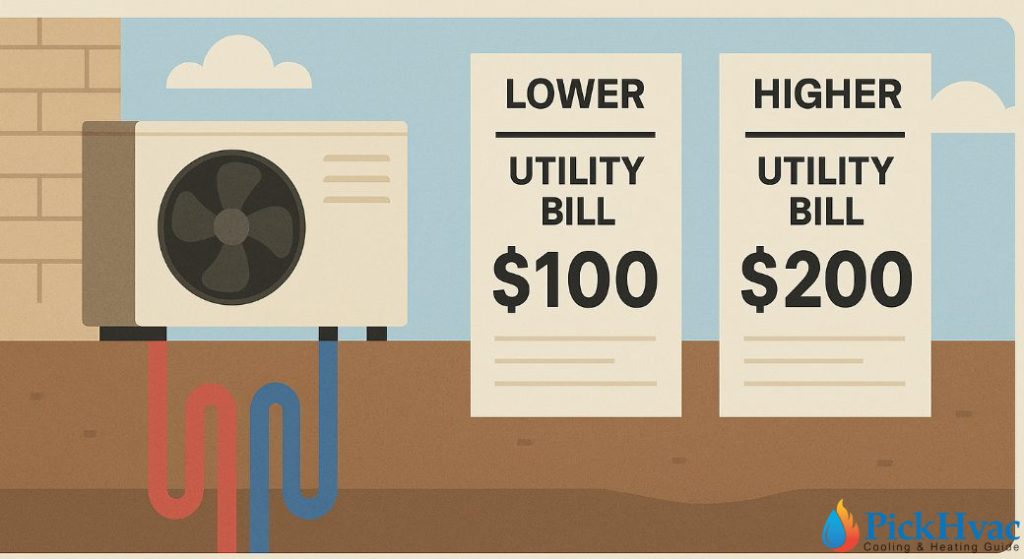
Normal Heating/Cooling Expenses: In a well-sized residential geothermal system, the monthly expense of heating and cooling with electricity is typically between 100 and 200 dollars. This takes care of the majority or the entire heating and cooling of a home. In comparison, traditional HVAC systems (such as furnaces or electric resistance heat) are usually more expensive on a monthly basis.
It is estimated that geothermal may be up to 25 percent to 65 percent less expensive to operate than conventional HVAC or even conventional air-source heat pumps. The actual costs vary, but a significant number of homeowners have reported that their geothermal system saved them a fortune in winter heating costs as compared to fuel oil, propane or electric baseboard heat. Geothermal heat pumps also offer central air conditioning during summer with efficiencies that may also reduce cooling costs.
Nevertheless, the real running expenses are subject to a number of factors. The cost of a geothermal heat pump to operate each month is affected by the following factors:
- Electricity Rates: Geothermal systems require electricity to operate the heat pump compressor and circulation pumps. The savings in cost are based on moderate electricity prices. In regions where the electric rates are high (e.g. some regions in California or the Northeast), the monthly costs will be at the higher end of the scale of 100-200 or higher. Geothermal system can be very cost effective to operate in regions where electricity is less expensive. It remains considerably less expensive per BTU of heat than electric resistance heating, but the precise savings over a gas furnace will also be a matter of local gas vs. electric prices.
- Climate And Usage Patterns: The climate of the area influences the level of work that the system has to do. With a very cold winter climate, the geothermal heat pump will operate many hours and in extreme cold spells the auxiliary backup heat (electric resistance elements in the unit) may come on when the geothermal loop is overwhelmed. The backup/resistance heat is far less efficient and may increase the monthly bill significantly (it may cost twice as much to operate as the heat pump itself). A properly designed system in a cold climate is sized to use as little backup heat as possible, but in subzero cold snaps some use can be made.
- The system can run less in warmer climates, or in spring/fall. Likewise, thermostat settings are a factor, too, because a house that is kept very warm (say 75F in winter) will use more energy and run more than one set at 68F.
- Home Insulation And Efficiency: The operating costs are directly related to the home energy efficiency (insulation, air sealing, windows, etc.). The geothermal heat pump in an energy efficient, well-insulated home will not have to cycle as frequently and it will use less electricity than the same heat pump in a drafty, poorly insulated house. The energy required to heat/cool the home can be minimized by 5-30 percent through improvements to the insulation and sealing of the home and this will reduce the running time of the system. Basically, the efficient geothermal system is maximized by a tight building envelope.
- On the other hand, a home with a lot of heat loss will require the geothermal unit to operate almost continuously during the worst of the winter, using more electric power (but probably at a lower cost than other heating sources).
- System Sizing And Design: A geothermal system that is appropriately sized must be able to satisfy almost all of the heating load without depending so much on the backup heat. In case a system is undersized to the home, the electric resistance backup heat strips will come on often, increasing energy consumption and expenses. On the other hand, an over-sized system may short-cycle and fail to operate at optimum efficiency.
- This is the reason why proper sizing (through Manual J calculations) is essential. The geothermal heat pump will operate continuously at its maximum efficiency when it is sized appropriately. The ground loop is also designed by installers to suit the load, an undersized loop may result in reduced entering ground temperatures during winter and hence reduced efficiency. All these design aspects guarantee the low operating cost as anticipated. Another way to increase efficiency during part-load conditions and further minimize power consumption is to select a variable-speed or dual-stage unit.
- Maintenance And Upkeep: Geothermal systems do not require a lot of maintenance, although maintaining the system in a good condition can help maintain efficiency. The homeowners are supposed to change or clean air filters and make sure that the coils are clean. The system can be maintained at its best by annual professional check-ups (which cost approximately 150-350 dollars per year in service plans).
- Although maintenance costs are a minor annual cost, it contributes to the maintenance of the high performance which in turn maintains low electricity consumption. The ground loop part is extremely low-maintenance (and is usually covered by a 50+ year warranty), and the heat pump unit is inside and not exposed to weather, so it is relatively long-lived with little efficiency loss with care.
To conclude, geothermal heat pump can reduce the monthly heating and cooling bill by an enormous margin. Geothermal is reported by many U.S. homeowners to have total winter electric bills in the low hundreds of dollars compared to several hundreds or more with older furnaces or electric heat. The cost of geothermal is very high to install but over a period of one year, the savings on utilities make geothermal one of the most economical HVAC systems.
In considering the economics, the initial investment and the operating costs should be considered: geothermal can provide 30% to 60% annual energy savings to HVAC systems over conventional systems. Such savings combined with incentives available can result in a high financial payback during the life of the heat pump (20+ years for the unit and 50+ years for the ground loop). To homeowners who want to have an environmentally friendly and cost effective heating/cooling system, the above detailed costs are important in making an informed choice of geothermal heat pumps.

How to Get the Best HVAC Prices
- Firstly, keep in mind that installation quality is always the most important thing for residential HVAC project. So never sacrifice contractor quality for a lower price.
- Secondly, remember to look up the latest rebates as we talked above.
- Thirdly, ask for at least 3 bids before you make the decision. You can click here to get 3 free estimates from your local contractors, and this estimate already takes rebates and tax credit into consideration and filter unqualified contractors automatically.
Lastly, once you chose the right contractor, remember to use the tactics from this guide: Homeowners Tactics When Negotiating with HVAC Dealer to get the final best price.