Excessive moisture in small spaces of the house may cause mold, musty smell and discomfort. Luckily, small dehumidifiers can provide home owners with a simple solution to the problem of excess moisture in closets, bathrooms, bedrooms, RVs and other tight places.
These small units are silent, energy saving and easy to operate. The following is a speedy comparison of the five best small dehumidifiers that we have found to suit the needs of different homeowners, and after that, we will have in-depth reviews and a buying guide that will help you select the best one.
| Dehumidifier | Tank / Removal | Ideal For | Key Features |
|---|---|---|---|
| Eva-Dry EDV-1100 Electric Petite | 16 oz tank ~8 oz/day | Small rooms (up to ~120 sq ft) | Ultra-quiet Peltier, auto shut-off, very lightweight |
| Pro Breeze Mini Dehumidifier | 16 oz tank ~9 oz/day | Small bedrooms, RVs (up to 215 sq ft) | Compact & portable, whisper-quiet, energy efficient |
| Pure Enrichment PureDry Deluxe | 1.5 L tank ~17 oz/day | Bathrooms & medium small spaces | High moisture removal, 2 fan speeds, timer function |
| Tenergy Sorbi 1000ml | 1.0 L tank ~25 oz/day* | Closets & small bedrooms | Dehumidifier + HEPA air purifier, touch controls, very quiet |
| Eva-Dry E-333 Wireless Mini | N/A (desiccant) 4–6 oz / 20–30 days | Tiny spaces (closets, safes, RV) | Cordless rechargeable, 100% silent, spill-free design |
*Removal rate for Tenergy Sorbi is in ideal conditions (86°F, 80% RH).
Top 5 Small Dehumidifiers Reviewed
#1 Eva-Dry EDV-1100 Electric Petite Dehumidifier – Best Overall Compact Unit
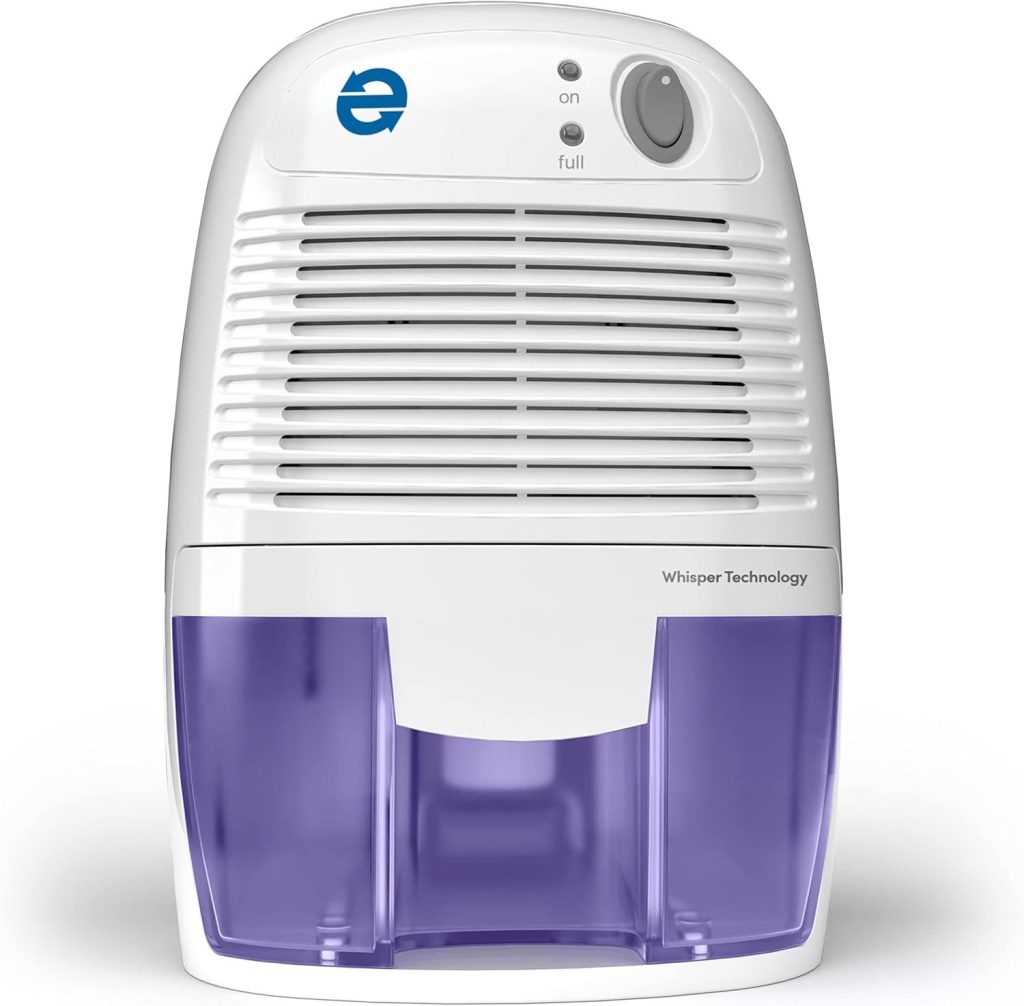
The Eva-Dry EDV-1100 Electric Petite is a very well-reviewed mini dehumidifier with a reputation of being efficient and easy to use. Although it is very small (only 6 x 5 inches and approximately 1 lb), this unit is powerful when it comes to eliminating moisture. It applies thermo-electric Peltier technology to silently remove moisture in the air.
During testing, the EDV-1100 performed among the best of mini dehumidifiers, and it was able to help dampen a small room significantly. It is perfect to keep the room dry (up to approximately 100-120 square feet) and does not occupy much space and does not produce noise.
This Eva-Dry model comes with a 16-ounce removable water reservoir and will automatically turn off when the tank is full so as to avoid any overflow. There is an indicator light that appears to warn you that you need to empty the tank. The fact that it is whisper-quiet (no louder than a computer fan) and generates minimal heat, which makes it appropriate to use it all the time even during the night, is appreciated by the users.
It also has an automatic restart, and therefore it will restart dehumidifying once it is emptied or any power failure. In general, EDV-1100 is a high-feature, dependable mini dehumidifier that can provide homeowners with a convenient plug-and-play device to fight humidity in small spaces.
#2 Pro Breeze Electric Mini Dehumidifier – Compact and Portable for Small Rooms
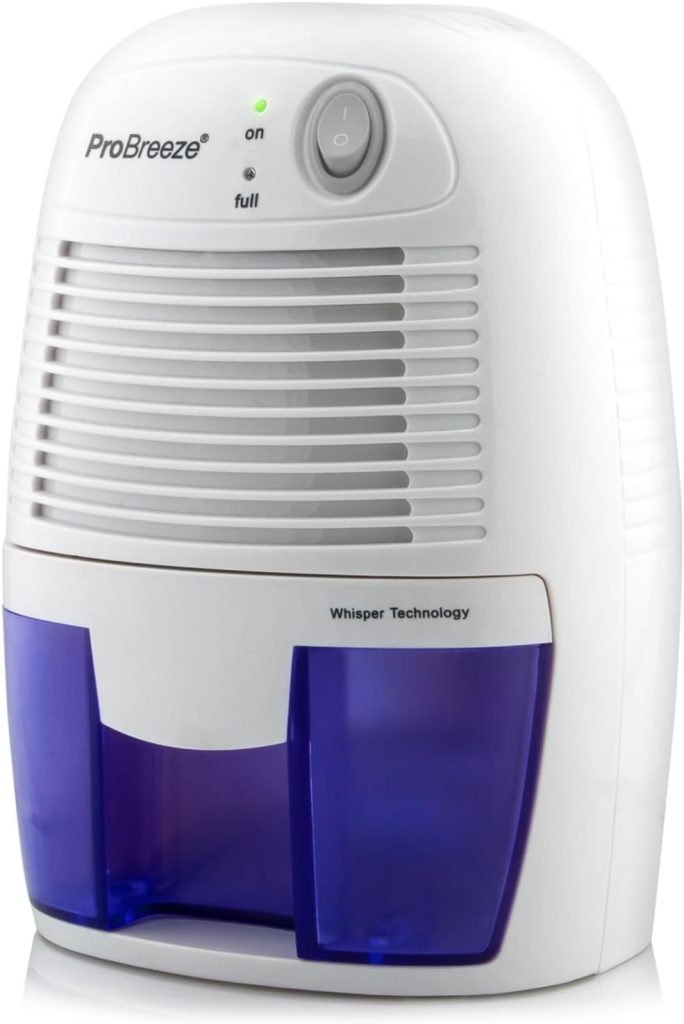
In case you require a portable dehumidifier that you can carry around the house or carry with you, the Pro Breeze Electric Mini Dehumidifier is one of the best. This is a very small (about 8.5 x 6 x 5 inches) and lightweight (about 2 pounds) popular unit, which is easy to carry and put on a shelf, a countertop, or even in an RV.
Although it is small, the Pro Breeze has the capacity to collect as much as 9 ounces of moisture a day in a highly humid environment and can hold it in its 16 ounce (500 ml) water tank. It is most effective in rooms that are no more than 215 square feet, e.g. small bedrooms, bathrooms, or RV interiors, and it maintains humidity at a reasonable level and eliminates condensation on windows.
The Pro Breeze mini dehumidifier works on the same whisper-quiet Peltier technology as the Eva-Dry, i.e. it does not have a noisy compressor. It is energy efficient and consumes approximately 20-40 watts which means that homeowners can leave it on 24/7 without incurring much energy cost. An LED indicator comes on when the reservoir is close to full and the unit automatically switches off, which is a crucial feature when one wants to operate the unit without worrying about it.
Due to its portability, this model is popular among users who want to travel with it or move between a damp bathroom and a bedroom whenever necessary. All in all, the Pro Breeze is a highly effective moisture remover considering its size, and it is simple to use (only one button) and quiet, which makes it an easy to use solution to any humid small area.
#3 Pure Enrichment PureDry Deluxe Dehumidifier – High-Capacity Choice for Bathrooms
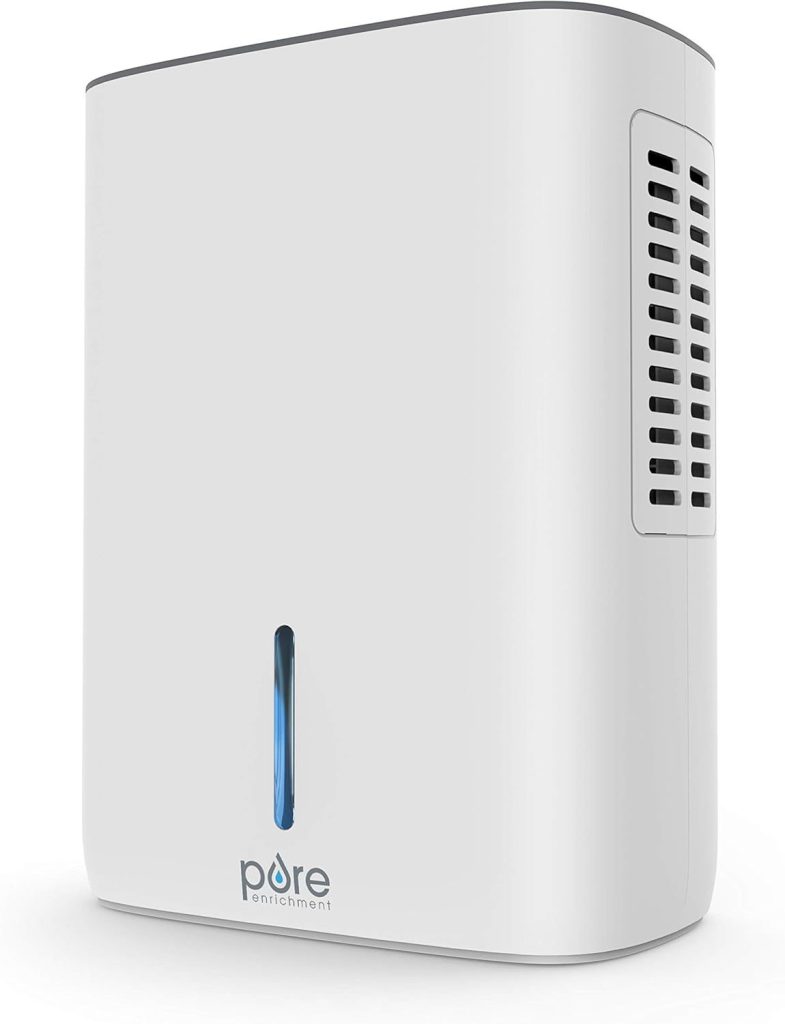
The Pure Enrichment PureDry Deluxe is a better choice in slightly larger small rooms or extremely wet places such as the bathroom, as it has a larger tank and can dry moisture quicker. It has a 1.5 liter (50 oz) water tank and is able to produce up to ~500 ml (17 ounces) of water per day out of the air, much more than the average mini units.
This is why it is good in bathrooms, laundry rooms or kitchens where humidity rises during showers or cooking. The PureDry Deluxe is still small and countertop friendly, and its sleek appearance can be easily integrated into the home decor, despite the increased capacity.
The PureDry Deluxe has two fan speeds (standard and turbo) and optional timer (4 or 8-hour shutoff) which provides homeowners with more control over the operation which is not common in smaller dehumidifiers. It can dry more quickly on its high speed which is handy in a steamy bathroom after a shower and the low speed is very quiet and ideal to keep running in a bedroom or office.
It also automatically switches off when the tank is full and a transparent tank allows you to check the level of water easily by a glance. This unit lacks an in-built humidistat to maintain a certain level of humidity, but its advanced humidity control functions (high/low mode and timer) allow adjusting its application to your requirements. On the whole, the Pure Enrichment PureDry Deluxe is a potent mini dehumidifier that homeowners require a little more moisture-removing power and capacity in a tiny package.
#4 Tenergy Sorbi 1000ml Air Dehumidifier – Dual Moisture Remover and Air Purifier
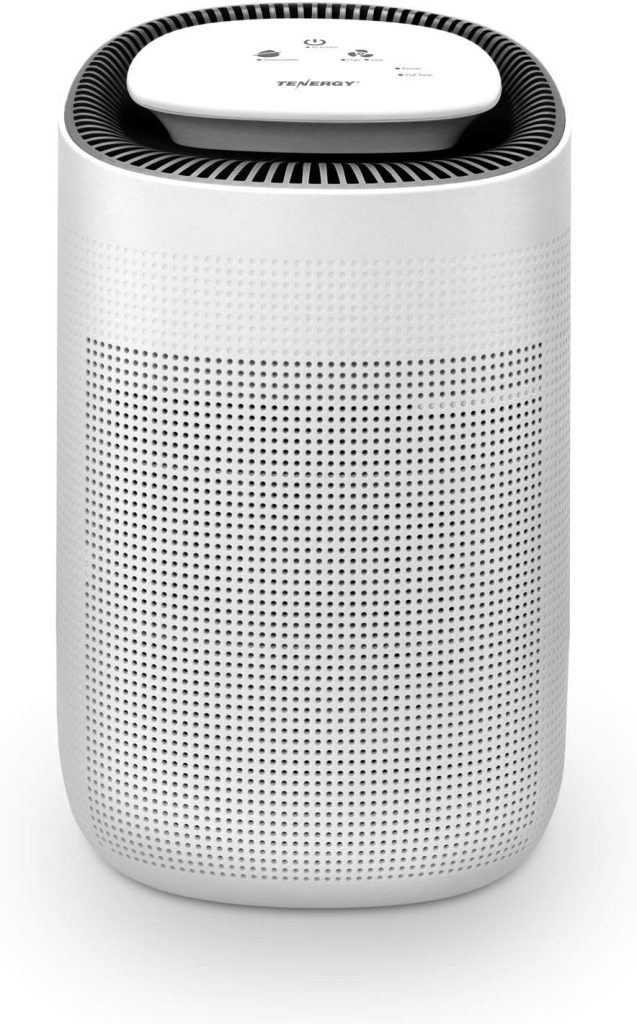
The Tenergy Sorbi is a special 2-in-1 device that does not only decrease the humidity but also purifies the air. It is a 1000 ml (34 oz) dehumidifier that has an inbuilt True HEPA filter air purifier. It implies that it will draw moisture out of the air (up to 750 ml per day under optimal conditions) and at the same time trap allergens such as dust, mold spores and pet dander.
Sorbi is perfect in small rooms, closets, or nurseries where you would like to solve the problem of excessive moisture and air quality. It is designed in a modern way and has touch controls at the top, which enable you to alternate between two fan speeds. It is very quiet and unobtrusive, even though it has a fan and a HEPA filtration system, and is about as loud as other Peltier dehumidifiers (only a soft hum).
The 1.0 liter tank of this unit will automatically turn off the dehumidifier when full and an LED light will come on. The filter that the Sorbi uses adds an additional maintenance (the H13 HEPA filter is to be changed every 6 months or when needed), but the advantage is that it catches microscopic pollutants and assists with musty smells that are typical of humid conditions.
This feature can be useful to homeowners who have mild mold or allergy issues. The two-in-one feature renders the Tenergy Sorbi a perfect choice in such places as a closet that is likely to have mildew (keeping clothes dry and fresh) or a small bedroom where both the purity of the air and comfort are of importance. All in all, it is a multifunctional device that makes the most out of a small dehumidifier and keeps your space dry and your air clean simultaneously.
#5 Eva-Dry E-333 Wireless Mini Dehumidifier – Best Cordless Option for Closets and Safes
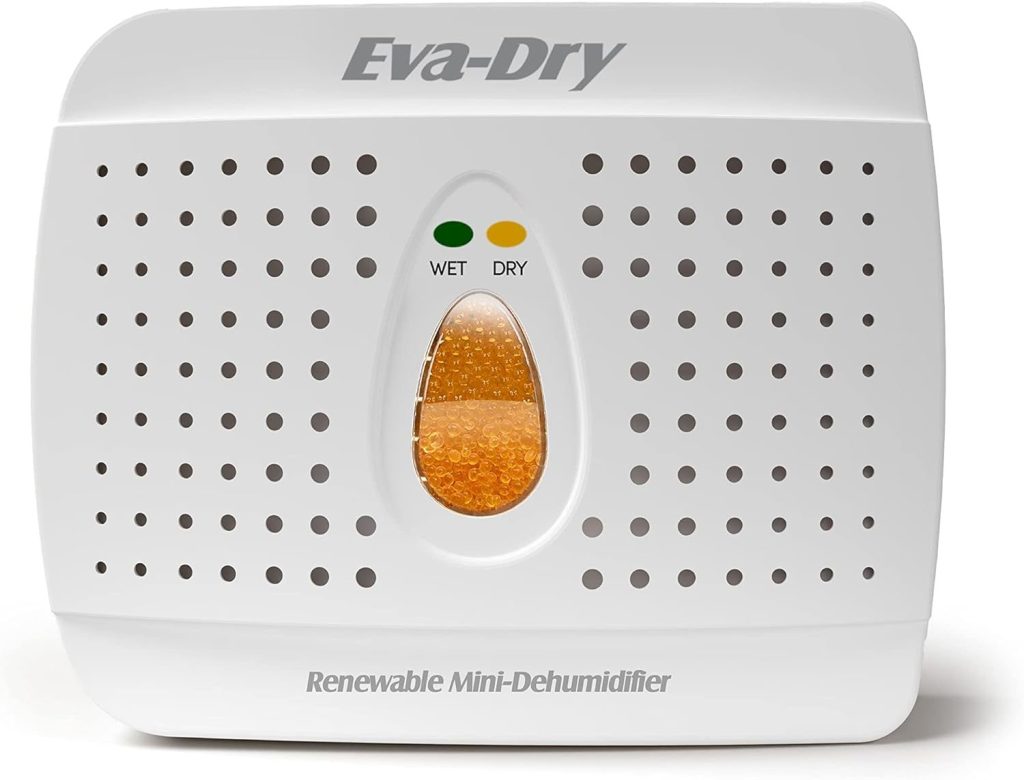
Not every dehumidifier requires connection to the power source. The Eva-Dry E-333 is a renewable desiccant dehumidifier, which is battery and cord-free, and thus ideal to use in confined areas where there is no power or where noise is a major consideration. This small gadget (approximately 6 x 4 inches) has special moisture-absorbing silica gel beads that draw moisture out of the air at all times.
It has the capacity to take approximately 4 to 6 ounces of water before the beads are saturated. A window on the unit turns color (orange to green) to indicate to you that it is full. To recharge, you just plug the E-333 into a power outlet in a well-ventilated place and leave it there 10-12 hours, which warms and dries up the desiccant to be used again. The charges have a lifespan of about 20-30 days in a small area of 333 cubic feet (e.g. a closet, gun safe, cabinet, or drawer) before they have to be renewed.
The simplicity and the fact that it is 100 percent silent is the beauty of the Eva-Dry E-333. No motor, no fan and no light when it is working, it is really set-and-forget. This is perfect to store clothes, documents, ammunition or electronics in a safe and dry way without any chance of spill or noise.
Most homeowners put them in closets to avoid musty odors or in gun safes to avoid rust. It also comes in handy with RVs or boats when in storage, you can leave a couple of these units in the vehicle to prevent mold and mildew without having to have the vehicle powered. The E-333 is non-toxic, child/pet safe and being renewable, you will not be purchasing refills (the beads will last up to 10 years of use). Although it will not quickly dehydrate a wet zone, it is a great preventative dehumidifier to keep a low humidity in a tight area. In the case of the small areas where an electric dehumidifier is not feasible, the Eva-Dry E-333 is a reputable and environmentally friendly solution.
Buying Guide: Choosing the Right Small Dehumidifier
Compact dehumidifiers are available in large numbers in the market and selecting the right one to suit your requirements requires knowledge of their capacities, features and limitations. Compact dehumidifiers are excellent when it comes to localized moisture control, yet they do not resemble large models in a number of aspects.
This purchasing guide will take you through the considerations that you need to make as a homeowner who wants to dehumidify a closet, bathroom or any other small room.
Room Size and Capacity
The first one is the space size and its dampness. The typical size of the area that small dehumidifiers are most effective in is less than 200 square feet (or equivalent enclosed space). A small bedroom, bathroom, or RV can be fitted with a mini unit of 16 oz tank. Manufacturers will usually give coverage in square feet or cubic feet, take this as a general guideline, but do not expect to get the same coverage as they do.
A small dehumidifier will take a long time to remove moisture, thus in a bigger room it might not make a big difference. In case you have a medium room which remains extremely humid, you may have to operate several small units or think of an increase in capacity.
Dehumidifier capacity is usually measured by the amount of moisture that it is able to remove in a day. The smallest thermo-electric units may eliminate about 4-8 ounces a day under normal conditions, but a slightly larger unit (with two Peltier modules or a more powerful fan) may eliminate 15-20 ounces a day. Remember that these ratings are typically at high humidity (80%+) and warm temperatures (~86 o F).
When the environment is cooler or less humid, the amount of actual water collection will be less. These small units will be enough provided that you are only interested in keeping your clothes dry and avoiding mustiness. But when you have a very wet small basement to dry out or a large area to dehumidify, you may require a so-called small compressor-based dehumidifier (usually rated at 20-30 pints per day). They are physically bigger and louder, yet they can cope with medium-sized rooms much better than the mini devices.
Water Tank Size and Drainage
The size of the tank or reservoir will define the duration that the dehumidifier can operate before you have to empty it. Small electric units normally have tanks of 2 liters and up to around 12 ounces. A bigger tank is comfortable since it can be used to have a long run time, which can be several days, particularly when the device draws a lot of moisture.
To give an example, a 500 ml/day removal rate on a 1500 ml tank (such as the PureDry Deluxe) would imply that you may only empty it every 3 days under constant use. In the meantime a 500 ml tank on a mini unit with a removal of 250 ml/day will be filled in approximately two days. Think about your application: when you put it somewhere that you do not go very often (an attic or vacation RV), then a larger tank or a method of automating the draining is a good idea so that it does not turn off too often.
The majority of small home dehumidifiers lack the possibility of continuous drain hose, because they are designed to be convenient and portable. They depend on your manual draining of the tank. Look out for an auto shut-off (nearly all good models have this) which switches the machine off once the tank is full so that there is no overflow. This is essential to mental peace.
It is also helpful to have a clear or transparent tank so that you can have a glance of the water level. In case you require constant drainage (e.g. you want to use a dehumidifier in a basement drain or sump), you might have to consider bigger models that specifically allow a drain hose. One workaround in the small category is to empty the unit regularly or place it on a shelf where gravity can be used to feed a tube in the tank to a drain (some clever users have improvised this where the tank has a removable plug). However, in most cases, you should expect to manually empty such devices on a regular basis.
Noise Level
Low noise output is one of the major benefits of mini dehumidifiers. They are very quiet to run and instead of a compressor, they usually have a Peltier heat pump and a small fan. The majority of them produce a low fan-like sound (like a computer fan or soft white noise) that is less than 50 decibels. This is so quiet that most individuals can sleep through it and hence they are good in bedrooms.
In case you are very sensitive to any sound or require utter silence (such as a home office when on the phone or a nursery when the baby is napping), then the quietest would be a desiccant dehumidifier, such as the Eva-Dry E-333, which is completely silent because it does not have any moving parts.
Comparing electric models, look at user reviews or specs on the decibel level where possible. An average mini unit could be about 35 dB. Our electric models all are whisper quiet by appliance standards. On high fan speed, the PureDry Deluxe will be a little louder than on low, but much quieter than a full-size dehumidifier or a bathroom vent fan.
The fan of the Tenergy Sorbi, although it has a HEPA filter to draw air through, is very quiet on low. Overall, the noise should not be a deal-breaker when it comes to small dehumidifiers, as they are meant to be used at home, where the loud noise would be unacceptable. Simply do not get any low-quality units in which the fans may rattle; all the popular brands (Eva-Dry, Pro Breeze, Pure Enrichment, etc.) focus on silent operation in their models.
Energy Consumption
The other advantage of small dehumidifiers is that they have small energy consumption. Thermo-electric (Peltier) dehumidifiers normally use between 20 and 75 watts, depending on the size and model. This is a small part of what larger compressor units consume (which may be 300+ watts). To homeowners, this implies that you can keep a mini dehumidifier running all the time without a massive effect on your electric bill, usually only a few cents a day.
They do not have Energy Star certification (the program is largely limited to larger dehumidifiers), but by the fact of their low power, they are already cheap to run. The Pro Breeze, as an example, consumes approximately 36 watts; 24 hours a day, that is approximately 0.864 kWh per day, which in most places will cost less than 0.15.
It can be mentioned, though, that the energy efficiency of these small units is not high in terms of moisture removed per watt. They take out relatively small quantities of water, so in case you had a big humidity issue, a larger unit would possibly be more efficient in using energy to dry the area.
With that said, the absolute energy consumption is so small in the case of the intended small-scale application that it is not normally an issue. When you are green-minded or off-grid (e.g. you want to run a dehumidifier in an RV on battery power), every watt counts.
When this happens, it might be attractive to have a device such as the Eva-Dry E-333 that consumes zero electricity to operate, all you need to do is to recharge it by plugging it in. To conclude, mini dehumidifiers are extremely cheap to operate and a few watts difference between the models will not make a big difference to most homeowners.
Auto Shut-off and Indicators
Make sure that a small dehumidifier is equipped with an auto shut-off when the tank is full. This is a feature in all the products reviewed above. It is a necessity since small tanks may easily get full in a humid environment and you do not want the water to spill on your shelf or floor.
In addition to shut-off, there will be some kind of indicator (typically an LED light that either changes color or turns on) that will tell you when the tank is full and needs to be emptied. Other models, such as the Eva-Dry EDV-1100, even have an auto-restart, i.e. when you empty the tank and put it back in, the unit will automatically restart (useful in case it has switched off during the night; you do not need to remember to turn it on again).
Other types of indicator are found in desiccant units such as the Eva-Dry E-333, which has a color-changing window that indicates when the moisture-absorbing beads are saturated (green indicates it is time to recharge, orange indicates dry and active). It is an inactive system but efficient in its application.
No shut-off is necessary because there is no continuous process going on, the beads just quit absorbing when they are full. All you have to do is to recharge it when the indicator indicates that it is exhausted.
More expensive small dehumidifiers may have additional indicators or warnings, e.g. a blinking light or even an audible warning when the tank is full, or a display that indicates the current humidity (but these are unusual in this size range). Most minis go basic with a light.
Ensure that the indicator light is in a place that is visible on the unit in case you want to tuck it in a corner. Also bear in mind that in a dark bedroom you may find that you want to cover the indicator LED of a small dehumidifier because it is too bright at night (a piece of tape will do the trick) – a small point, but worth mentioning to those who are sensitive to light.
Extra Features and Design
While small dehumidifiers are generally straightforward devices, some offer bonus features that could sway your decision:
- Fan Speeds: Having a two-speed fan (such as the PureDry Deluxe or Tenergy Sorbi) is a nice feature because you can select a lower speed to be quieter or a higher speed to circulate more air to remove more moisture. Such versatility can come in handy when you desire a turbo mode to dry quickly after a shower and a quiet mode to use at night.
- Timer Function: There is an in-built timer that allows the unit to run a fixed number of hours and then switch off. It is convenient when you do not want to run it, e.g. when you are at work or when it is the most humid time of the day. It is able to conserve energy and prevent the tank being filled up when you are not around to empty it.
- Air Purification: Some units have a HEPA or other air filter to act as an air purifier as well, as was the case with the Tenergy Sorbi. This can be used to minimize the mold spores and dust mites in a wet room. Remember that you will have to change filters on a regular basis, and this is an additional maintenance procedure and expense.
- Night Lights or LEDs: Some of the newer mini dehumidifiers have built in night lights or color changing lights (to look pretty). As an example, some models of such brands as Afloia are optional with glowing light ring. This may render the unit to be a small night light in a bathroom or a child room. In case you are fond of this concept, seek models that have this feature. Otherwise, make sure that any light can be switched off.
- Auto Defrost: When you intend to use a small dehumidifier in a cooler place (below ~60 o F), make sure that it has an auto-defrost feature. In cold rooms, Peltier dehumidifiers may form frost on the cooling element and this will prevent water accumulation. Some of them are automatic defrost and turn off to melt any ice that has accumulated.
- Design and Aesthetics: These devices may be placed on your dresser, countertop, or in plain view, so their appearance and size do count. Luckily, the majority of them are neutral (white/grey/black) and modern in the look. The Pure Enrichment and Tenergy models, to give an example, are sleek and will not be an eyesore. Think about where you will put it, a small footprint is a must in a small space such as a bathroom shelf. The weight may also be important, in case you have to carry it frequently or travel with it (most are under 5 lbs, the lightest ones are about 122 lbs).
Desiccant vs. Thermoelectric vs. Compressor
Small dehumidifiers come in a few different types of moisture-removing technology:
- Thermo-electric (Peltier) Dehumidifiers: The most popular home use dehumidifiers are the so-called mini dehumidifiers. They have a Peltier module to chill a plate which condenses water out of the air, and a fan blowing air over it. They are small, silent and light in weight, yet with a low capacity. The thermoelectric models that were reviewed (Eva-Dry EDV-1100, Pro Breeze, PureDry Deluxe, Tenergy Sorbi) are all electric. They are perfect in small dehumidification and extremely low maintenance (empty the tank and every now and then dust the air inlet).
- Desiccant Dehumidifiers (Rechargeable): These have a moisture-absorbing substance (such as silica gel beads) which naturally absorbs moisture. The Eva-Dry E-333 is of this kind. They do not need power during absorption; they are refilled by heating them (plugging in) to dry the desiccant so that it can be reused.
- Disposable desiccant dehumidifiers (such as DampRid buckets) are also available, but are more economical in the long run when compared to the reusable ones (such as Eva-Dry). Desiccant dehumidifiers are most suitable in extremely small and confined areas and in places where you cannot attend to an electric dehumidifier on a regular basis. They are slow, and limited in capacity before recharging, but absolutely silent and transportable.
- Compressor Dehumidifiers: In general, compressor-based models are not so small in the same way, even the smallest compressor-based models (which are sometimes referred to as 20-pint or 30-pint dehumidifiers) are significantly larger and heavier, typically floor-standing devices with a refrigerant and compressor similar to a mini fridge. But there are some fringe products sold as small room dehumidifiers that are small but employ a compressor (such as an 8.5-pint/day unit rated to ~200 sq ft).
- They will dry much quicker and in greater quantity than Peltier types, but are noisier (usually a low hum and compressor noise) and consume more power. One of these may be considered in case your needs are marginal, such as a very wet 200 sq ft basement office. Simply remember that they are not as convenient to put on a shelf or to transport and they are more expensive initially. The smaller thermoelectric or desiccant units are sufficient and more livable with most of the home closet/bathroom/bedroom applications.
Placement and Safety Tips
Where and how you use your small dehumidifier will affect its performance and longevity. Here are some tips:
- Proper Airflow: Make sure that the unit is located in a place where air can flow freely through the unit, a few inches away at least from the walls or furniture. Obstructions should not be placed on the intake and outlet vents. You may have to hang or raise a dehumidifier in a closet, where air can circulate around it; and in case it is a desiccant, such as E-333, just be sure it is not buried under clothes.
- Close Doors/Windows: To ensure that a dehumidifier works well, close external doors and windows in a small room. Otherwise, it will be attempting to dehumidify the whole house or the outside. As an example, you can use your small dehumidifier in a closed bathroom after a shower, or close the closet door and put the unit inside. This enables it to dry that enclosed air mass considerably.
- Raising in Bathrooms: When in a bathroom, do not forget that these are electrical devices. Keep them on the counter or shelf where they are not exposed directly to water splashes (not in a shower or on a wet floor). In addition, since bathrooms can become very humid temporarily (steamy), wait; first ventilate heavy steam (with an exhaust fan or opening the door briefly) and then leave the dehumidifier to take care of the remaining moisture.
- Safe in Vehicles: To use in an RV or boat, make sure the dehumidifier is fastened so that it does not tip or slide. Peltier unit has no oil compressor, so it is ok to move it, but you do not want water to spill out of the tank. Before driving, empty it or place it in a dish to add additional spill protection. The cordless ones such as E-333 are leak proof and ideal on the move.
- Operating Temperature: These dehumidifiers can be used in areas that are above approximately 50 o F. In lower temperatures, the efficiency is extremely poor (and Peltier units may freeze). In case you require to regulate humidity in a cold region, then a special low-temperature (desiccant rotor type) dehumidifier may be necessary.
- Child and Pet Safety: Small dehumidifiers are normally safe; most of them are round-shaped and have no sharp corners. Nevertheless, it is prudent to have cords hidden to avoid tripping or pulling. The Eva-Dry E-333 is commonly mentioned as child and pet friendly because it contains no accessible water (the water is trapped in the beads) and no heat during operation.
- The outside of a desiccant unit can become warm during the process of recharging, so do not allow curious fingers to touch it during that process.
Maintenance and Cleaning
To keep your dehumidifier working effectively and hygienically, some basic maintenance is necessary:
- Empty and Clean the Tank: Make sure that water does not stand too long in the tank when it is full. Standing water may cause molds or bacteria and bad smell. Whenever you are emptying the tank, rinse it quickly. It should be washed in soapy water or a weak disinfectant every week or two to avoid the accumulation of slime. Be sure to dry it and reinsert it.
- Clean Intake Grilles and Fans: Over time dust can build up on the air intake or on the heatsink of the Peltier unit, which will reduce efficiency. Disconnect the unit every few months and blow out any dust in vents with a soft brush or compressed air. Others allow the air filters or screens to be removed and cleaned or replaced (as indicated, e.g. the HEPA filter in the Tenergy Sorbi should be changed about every six months).
- Desiccant Renewal: When you use a rechargeable desiccant dehumidifier such as the E-333, be sure to plug it in to recharge it when the indicator tells you it is saturated. Otherwise, it will cease to dehumidify. And allow the unit to cool down completely after recharging before returning it to a closed environment, as it will be warm and dry, and you do not want any remaining heat to increase the temperature in, e.g., a humidor or safe (though it is normally only slightly warm).
- Do not use Oil or Lubricant: The Peltier units and fans are normally maintenance-free. There should be no need to oil any of the components of a small dehumidifier. In case the fan is noisy after several years of operation, it may be because of wear and tear; at this stage, it may be convenient to replace the unit since most mini dehumidifiers are cheap.
- Off-Season Storage: When you are not going to use the dehumidifier during a long period of time (e.g. storing the RV over winter, or a seasonal cabin), empty and dry the tank completely. Leave the unit in a dry room and run it an hour or two to get out any water in it, or simply wipe it out, so that mold does not grow inside.
- In the case of desiccant units, they should be recharged and stored dry or they may be moldy when stored full of moisture.
Small Dehumidifiers for Different Spaces
Homeowners use small dehumidifiers in a variety of places. Here are some common scenarios and tips for each:
- Bedrooms: In bedrooms, the silent operation is essential. Here thermo-electric models will be appropriate, they will gradually lower the humidity during the night without disturbing the sleep. You may also reduce the allergies by maintaining humidity at 50% which makes the room less friendly to dust mites and molds.
- Put the unit at a distance of the bed so that the direct cool airflow or glowing indicator lights do not bother you. A small unit is also capable of guarding clothes in your closets in the bedroom against mustiness.
- Bathrooms: A bathroom dehumidifier can be used to dry up the leftover moisture in the bathroom after taking a shower and avoiding molds on grout and ceilings. In the case of bathrooms, it is better to have a unit that is slightly more capacious (such as the PureDry Deluxe) since bathrooms are very humid.
- Use it in the shower and after shower with the door closed to get the best results. Do not leave it wet and in direct contact with water. It is not a substitute to a ventilation fan but a supplement to it, preferably use both to have a mold free bathroom.
- Closets and Wardrobes: Closets can be a trap of moisture particularly when they are along the exterior walls. A wireless desiccant device is ideal in this case, simply hang or put the Eva-Dry E-333 on a shelf. It will automatically absorb moisture and prevent mildew on clothes, shoes and linens.
- An electric mini unit may be utilized in a bigger walk-in closet in case you have an outlet; however, watch where you place the cords. Leave the door of the closet closed so that the dehumidifier can create a dry micro-climate in it.
- RVs and Boats: These vehicles are prone to be very wet because of the weather outside and poor insulation. A small electric dehumidifier will help to keep humidity low due to cooking and breathing, when you are using an RV, particularly on cool nights when you do not want condensation on the windows.
- Find small and durable models to be used in RVs, and fasten them during driving. Desiccant dehumidifiers are great when an RV or boat is in storage, and you can leave a couple of them inside to absorb moisture over weeks. They do not need any power and can be updated every now and then. This will avoid mold, odor and corrosion during the off-season.
In any situation, keep in mind that a small dehumidifier has its boundaries. It is not intended to be used in flood recovery or in very wet conditions, it is only intended to maintain humidity and light-duty drying. In case you ever get a leak or extreme dampness, then you will require bigger equipment or experts.
However, in the day-to-day moisture control, these small units are a cheap and efficient tool to the homeowners. Taking into consideration your space, the features of the device, and adhering to the good usage practices, you will be able to choose a small dehumidifier that will keep the little corners of your home dry and safe against the humidity-related damages.