In wet basements and warm, humid climates, you need a dehumidifier with a pump to do the heavy lifting of water removal. If you don’t want to lift buckets emptied of water and pour them into a convenient drain, let your dehumidifier do the job. It can pump the water out through a hose to a sink or drain. This makes it a great choice for Oregon-style basements that don’t have a floor drain.

This article reviews the best home and basement dehumidifiers with pump. Our top picks remove moisture efficiently, pump system works without hassle, and the whole setup is energy efficient and easy to use. Below is a table with direct comparison of the models we recommend, followed by review of each model in detail.
We also throw in a buying guide to help you make your choice.
Top 5 Best Dehumidifiers With Pump (Reviews)
#1 Frigidaire 50-Pint Dehumidifier with Pump (Energy Star)
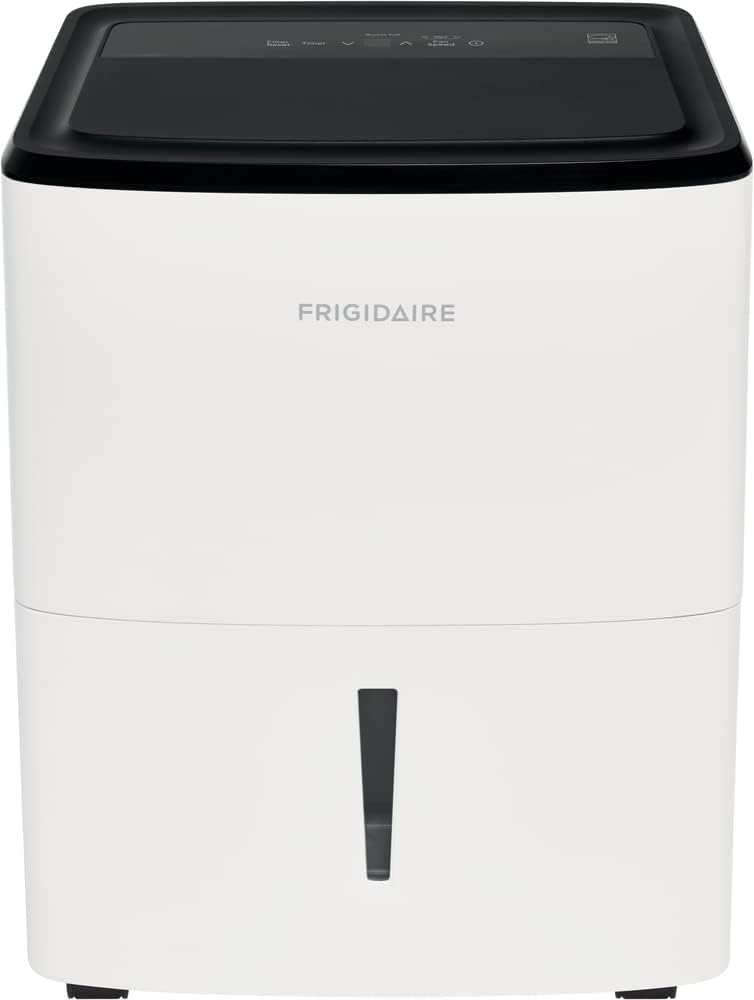
The Frigidaire 50-pint dehumidifier with built-in pump is a great choice for big rooms and basements. It takes out up to 50 pints of moisture a day—formerly rated 70 pints—yet keeps going and going to cover around 4,500 sq. ft.
This dehumidifier removes moisture so well and so fast that you can almost see it happening. Indeed, the first few days we had it, we were emptying the bucket almost every 24 hours despite running it at the “normal” setting.
This unit does not really have an “auto” mode per se; rather, it has a couple of different settings you can choose from.
Frigidaire’s electronic humidistat allows you to set a precise humidity level that the unit maintains by turning on and off as needed
It features three fan speeds (with a low speed that’s quiet enough for everyday use even in a bedroom).
It’s also Energy Star certified (that is, it uses less electricity than most dehumidifiers) and has an easy-to-clean filter.
It’s got a 24-hour timer if you want to set it for specific hours, and it auto-restarts after a power outage if you’ve been using it and the power went off while it was on.
#2 Midea Cube 50-Pint Smart Dehumidifier with Pump
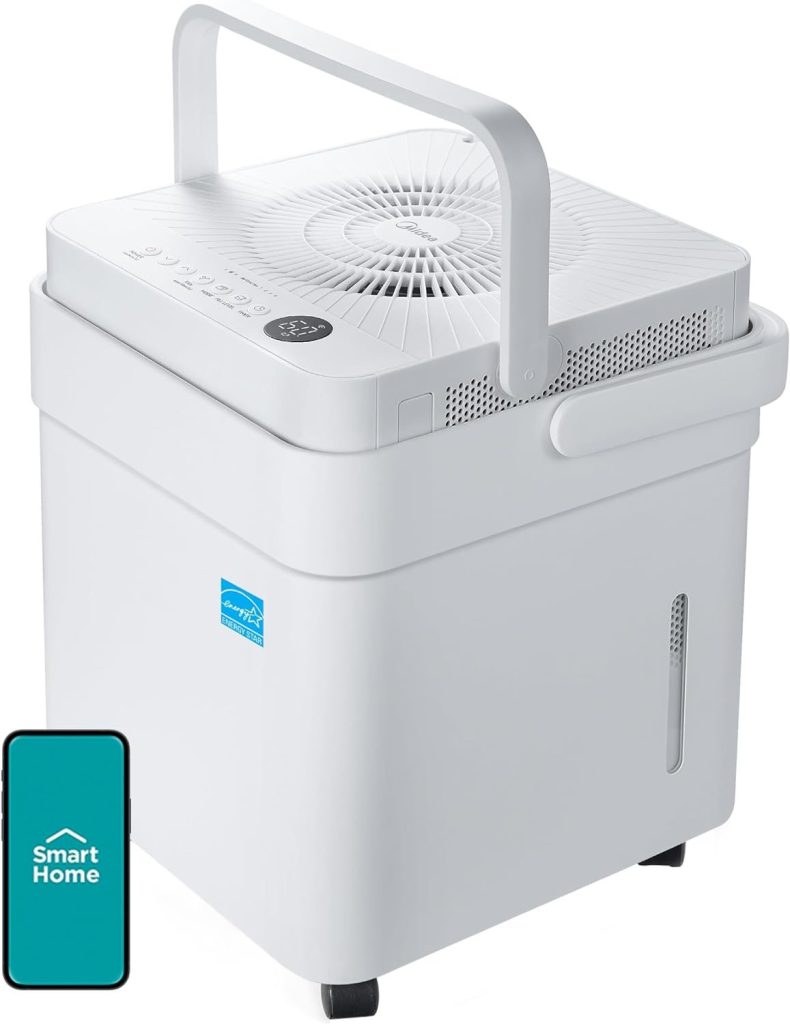
The 50-Pint Midea Cube Dehumidifier stands out for its design. Most dehumidifiers are cube-like in shape, but the Midea Cube literally has a design that’s easy to fit into most spaces.
Smart features include a detachable unit that works with a hose for continuous drainage and an internal pump that lifts water to where you need it to go.
If you don’t need to drain the water from the appliance and have it pump up to 16 feet, the Midea Cube comes with a 4.2-gallon bucket, and you can stack the unit on it in what Midea refers to as “extended mode.”
In standard use, the dehumidifier has a removal rate of 50 pints per day. Midea features its performance in spaces up to 4,500 sq. ft.
This is a Wi-Fi-capable model that works with an Alexa voice assistant and an iOS/Android mobile app, for remote monitoring and control over just how much moisture is in the air.
Energy efficiency is afresh 2023 Energy Star Most Efficient designation among dehumidifiers, so it’s far less likely to bump up your electric bill.
The Midea Cube effectively reduces humidity to safe levels in a home (with a few added smart features you’d expect from the modern devices of today).
If you want to connect your dehumidifier to your Wi-Fi network and have a smart home hub, and if you want a device that has a pump, this is a great choice.
Noise-wise, it’s manageable, and in the event that it’s not doing anything except sitting there, it collapses down to a size that can fit in the average closet.
#3 hOmeLabs 50-Pint Dehumidifier with Pump (4,000 Sq Ft)
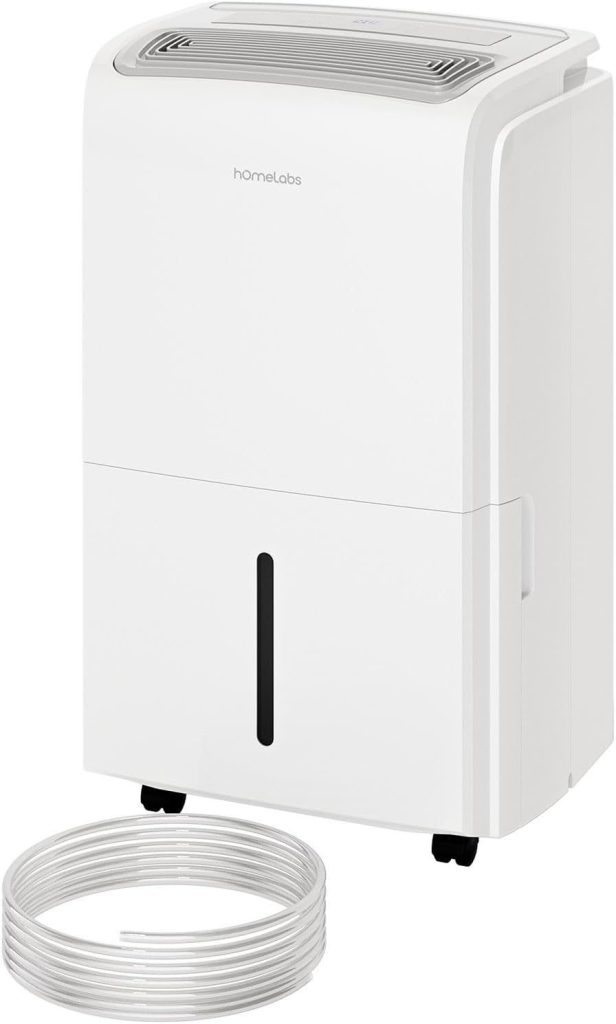
The hOmeLabs 50-Pint Dehumidifier with Pump offers powerful moisture removal at a budget-friendly price.
This is meant for a space of around 4,000 cubic feet and extracts about 50 pints of water from the air per day; it’s perfect for a very large room or a wet basement.
This Energy Star-rated model has a built-in pump and comes with a long drain hose (16.4 ft), and we found that it drained the water port effectively without an umbilical cord getting in the way. We didn’t have to manually empty the bucket, and the water path from the unit to the port was very seamless.
This dehumidifier is very easy to operate because of its digital controls.
You set the desired humidity level, or you can just use one of its preset programs.
One of the presets is called Turbo, and this mode is great for drying out a space VERY quickly.
While we do have our fair share of loud dehumidifiers in this testing, the hOmeLabs model was one of the more silent options we encountered this year.
Not only is it fairly quiet (53 dB on low fan), but it also features cooling and defrosting mechanisms for use in cooler spaces that allow it to run smoothly without making excessive noise.
That about does it for the noise and operation front.
#4 GE 50-Pint Dehumidifier with Built-In Pump
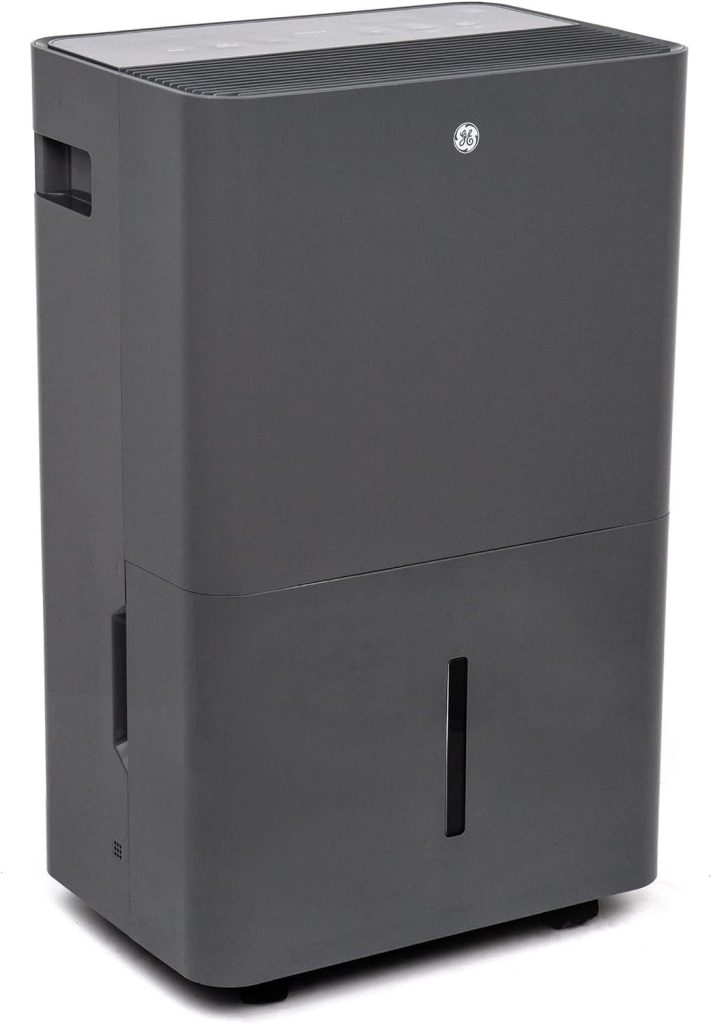
From a reliable kitchen appliance company comes the GE 50-Pint Dehumidifier with Pump, which knocks down excess humidity in basements, garages, or big rooms (up to about 4,000 sq. ft.) with deft efficiency.
Rated to remove 50 pints of moisture per day, it features an internal pump and hose that enable you to drain water automatically to a sink or out a window (with up to ~15 ft vertical rise) if your space lacks a floor drain.
If not, the 1.8-gallon bucket that it sits on will come to your rescue with a full shutoff valve that cuts power to the machine just before an unexpected flood.
The GE dehumidifier has simple electronic controls and an adjustable humidistat that make it easy to set your desired humidity level.
You can manage the performance of this unit, and consequently, the noise, by choosing one of three fan speeds.
If the dehumidifier wasn’t torturing my ears, I probably would have been okay with a slightly less impressive, but still okay, build quality.
This unit is also Energy Star qualified.
#5 TOSOT 50-Pint Dehumidifier with Internal Pump (Super Quiet)
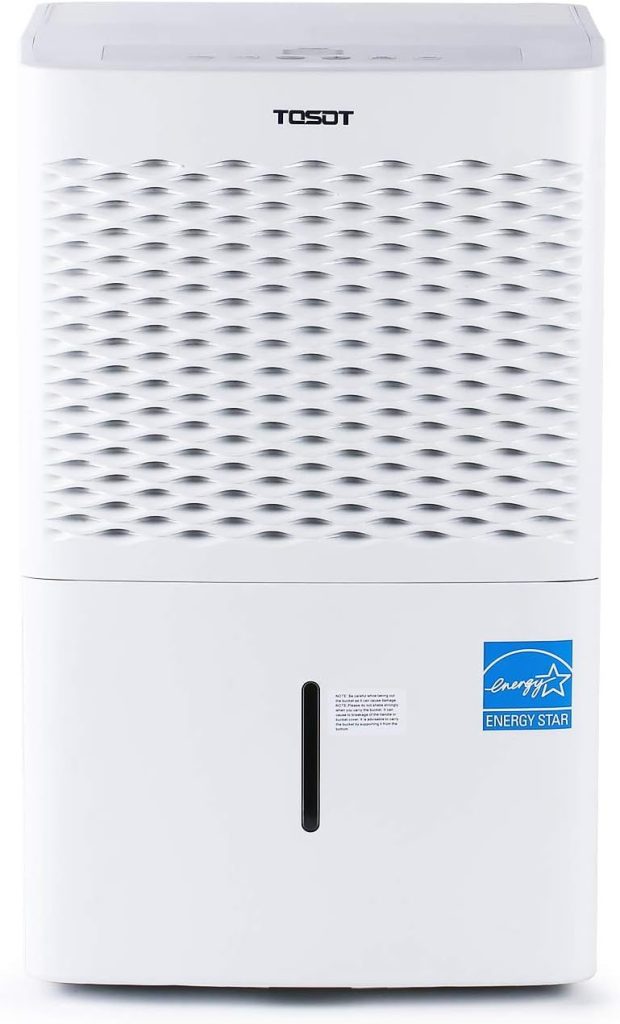
The TOSOT Dehumidifier, which works in spaces up to 4,500 square feet, is very quiet and is of quality design.
It removes 50 pints of water from the air each day, which is way more than enough to keep even a seriously damp house dry.
As a means to continuously not have to empty the tank, it uses a water pump that can push the water up a long way, about 12 to 15 feet, to a sink, or to just about anywhere you want the water to go as long as it isn’t back into the dehumidifier.
Using the hose and the pump is a viable way to have the dehumidifier drain continuously. The only reason that I had it set to not do that at times was so that I could marvel at the dehumidifier itself.
TOSOT’s unit is more quiet than many competitors, running at around 48–50 dB on its low fan setting. This makes it one of the quietest dehumidifiers in its class.
If you’re worried about noise, you could get the TOSOT and not have to hear its fan while it works to remove moisture from the air.
The unit has a digital humidistat, so you can set a target humidity and have it maintain that level with auto cycles.
It has an auto-restart feature in case you lose power, and it has an auto defrost feature which prevents the coils from icing up in cool rooms.
Dehumidifier With Pump Buying Guide
Why Get a Dehumidifier With a Pump?
A dehumidifier with an integrated pump goes one better than standard models. It not only removes moisture from the air but also does something quite remarkable: it transports that same moisture back into the world from whence it came.
The reason you would want a dehumidifier pump is simple. In a regular dehumidifier, when the water tank fills up, the unit shuts off until you empty the tank. Imagine all the places a dehumidifier might be used where a floor drain, or any way to use gravity on a hose, doesn’t exist.
This stops you from having to intervene manually and allows for continuous operation of the dehumidifier.
A pump is very beneficial for basements and crawl spaces. Often, there is not a low drain point in a basement, and it is impractical to carry heavy buckets of water up to the first floor. A pump makes it easy to route the water out of the basement through a basement window or into a utility sink.
From a basic engineering standpoint, a pump should be your go-to for emptying anything nearly horizontal or maintaining a low point in vertical drainage.
Dehumidifiers that come with pumps are more expensive than those that don’t, but the convenience factor is high. They’re perfect for anyone who plans to run a dehumidifier non-stop or in a situation where it would be tough to keep emptying a bucket.
Just remember that a pump is another piece that can wear out over time and necessitates power to function—which might make a user inclined to pick a model that’s well-built and with easily found replacement parts. Those qualities describe the reviewed above well-built and with easily found replacement parts.
Most users feel that the convenience factor and the placement flexibility more than justifies getting a dehumidifier that comes with a pump.
Capacity and Coverage
The capacity of a dehumidifier is usually indicated by the number of pints of moisture it removes daily. The common sizes for home dehumidifiers include a 20-pint, 35-pint, 50-pint, and sometimes a larger 60-pint or 70-pint unit. (Note: Under the older pre-2019 standard, these correspond roughly to 30, 50, and 70 pint ratings.) For basements and large areas, a 50-pint dehumidifier is the most popular choice as it balances power and portability. All the models we reviewed are in the 50-pint class, which generally are rated to cover about 3,500 to 4,500 square feet under moderate conditions.
When deciding on capacity, think about the dimensions and how wet your area is.
Compact spaces (less than 1500 sq. ft.): If your humidity issue is confined to a small bathroom, a dehumidifier with a 20-22 pint capacity might just cut it; a pump is probably superfluous. But even in a small basement, you might want to step it up to a larger unit, especially if it’s very wet.
Medium spaces (1500–3000 sq ft): These can be handled by a 35–40 pint dehumidifier, but if the area is highly humid (e.g. a basement with water seepage), a 50-pint with pump allows more leeway and will dry the space out quicker.
For extensive areas (over 3000 sq ft): Opt for a dehumidifier with a capacity of at least 50 pints per day. You might also think of deploying multiple units for really huge or segmented areas. The stated coverage of a single unit assumes an open space layout and typical 8-foot height. If your underground lair has interior walls, divided spaces, or goes more than twice the height of the average humans, you’ll want to use more than one unit to get adequate moisture removal.
Even in medium-size areas, many homeowners choose a 50-pint unit with pump simply to achieve faster dehumidifying and the convenience of avoiding emptying tanks. In fact, it’s often better to get a higher-capacity unit and have it run less frequently than a smaller unit that has to run nearly nonstop. Also consider the opposite scenario: if your basement is extremely wet (for example, after a flood or if water ingress is a problem), a high-capacity unit or even a commercial dehumidifier will perform much better.
Pump Performance and Drainage Options
Each dehumidifier with a pump has a maximum height to which it can lift the water, and this is called the “lift” height. Most have a lift height of around 15 feet (4.5 meters), which is more than adequate for most homes. Whether you’re pumping from a basement floor to a basement window or a utility sink, your dehumidifier pump should have no problem supplying enough head to carry the water wherever it needs to go.
All of the above assumes that you have set the pump up correctly, which essentially means ensuring that the drainage hose is securely and properly connected to the dehumidifier and that it is routed to the desired drainage point.
Generally, models having pumps feature three ways of draining water from the system:
Internal Pump: The most flexible option, it actively sends water through a hose to a drain location (high or low). Make sure the model you choose includes the pump hose—most do (usually a thin plastic hose of 10–16 feet length).
Drainage by Gravity: All these dehumidifiers also have a gravity-fed drain port. You can attach a standard garden hose to the drain outlet and direct the water to a floor drain nearby. This requires that the hose end be lower than the dehumidifier’s drain outlet. If you have a floor drain or can place the dehumidifier on a shelf above a sink, you can use this method without a pump.
Every unit still has a collection bucket. Even now, you can use your dehumidifier by manually emptying the bucket. The 50-pint unit’s bucket holds just over a gallon. If the unit is operating in as humid an environment as possible, it will fill the bucket in about six hours. If you are using a pump, the water does not fill the bucket completely; your dehumidifier functions like it has no bucket at all.
One suggestion: if you’re using the pump to drain, make sure the drain hose is clear before each use—especially if you’re draining outdoors, where things like algae and debris can clog it. Be sure to route the hose so that it drains completely—no low spots where water could settle if the pump stops pumping—because the pump stops pumping if the water it’s supposed to be draining hits the sensor that says, “OK, you can stop now!” The noise the pump makes when it activates is normal. If using the pump seems too scary, don’t forget that you can still drain by gravity or use an external condensate pump.were ever to fail, you can still use gravity draining or an external condensate pump as a backup.
Energy Efficiency
Dehumidifiers can draw a significant amount of power because they run a compressor (like an air conditioner) to condense moisture.
Selecting an Energy Star certified model is important for efficiency – these units remove moisture with less electricity.
All of our top picks are Energy Star rated, and some (like the Midea Cube) even achieve “Most Efficient” status, meaning they perform at the top tier for energy savings in their class.
To manage energy use, use the humidistat feature – set it to the highest humidity that still prevents issues (for a basement, 50% RH is usually good to inhibit mold). Also make use of timer functions if available to run the unit only when needed, rather than 24/7.
Noise Levels
Noise is a common concern if the dehumidifier will run in an area where you spend a lot of time. 50-pint models typically produce levels around 50–55 dB at high fan speed (about as loud as a normal conversation).
In a basement, noise is usually less of an issue. If it’s a finished living space, look for models with quiet operation (like the TOSOT).
Multiple fan speeds can help with noise – running on a lower fan setting when full power isn’t needed will keep sound levels down.