Camping during extremely warm summer months can be tough, but the right tent air conditioner can keep you comfortable and cool in the sweltering heat. We’ve assembled the best portable AC units—from battery-powered air conditioners to evaporative coolers, and even small window ACs—for tents of every size.
We have selected the best of the best. They are light, efficient, and simple. You could not ask for better partners, whether you are camping far from electricity or only a short haul from an outlet.
Best Battery-Powered Tent Air Conditioners
These units utilize high-efficiency micro compressors to provide real cooling and generally use less power than the average camping generator.
Most are light enough to carry into the backcountry and operate on either built-in batteries or portable power stations.
Keep in mind that battery air conditioners have lower BTU outputs (around 2,000–4,000 BTUs) than plug-in models, so they work best in cooling small to medium tents and are ideal for semipermanent base camps.
Here are our top picks for battery-powered tent air conditioners.
#1 Zero Breeze Mark 2 Portable AC
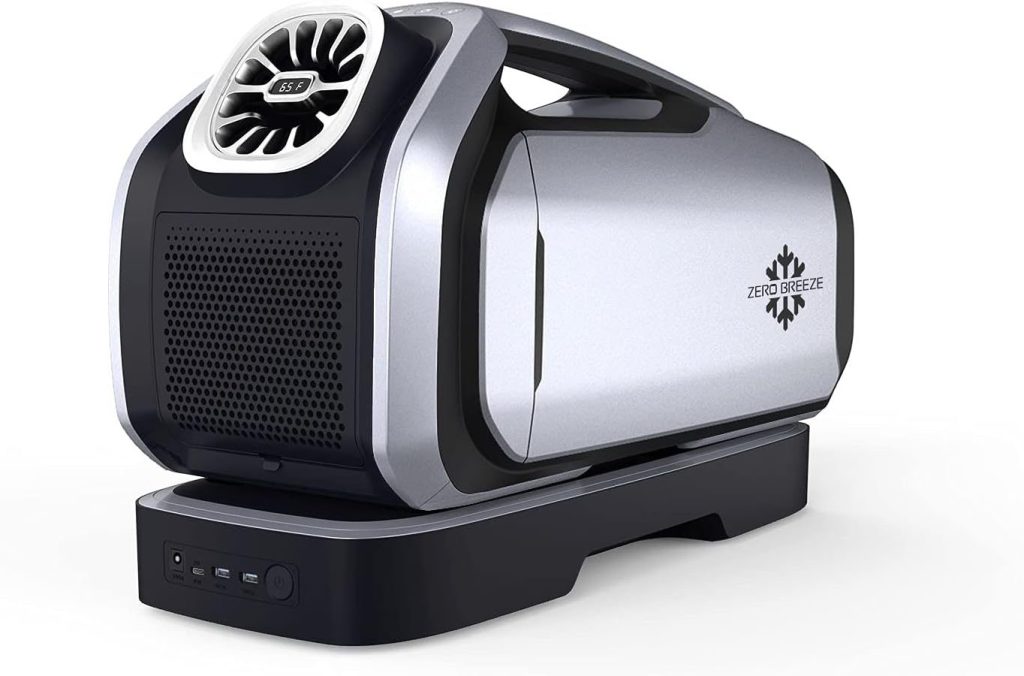
The Zero Breeze Mark 2 is one of the most popular tent air conditioners. As a truly portable, battery-operated AC unit, it provides 2,300 BTUs of cooling. That’s enough to drop the air temperature by as much as 30 °F in a small tent. But unlike the kind of arrangements you’re likely to find at a permanent campground, the Mark 2 can only be used for about 5 hours on a single charge of its lithium battery. And this was a design choice/result of some key features that make the Zero Breeze not just a good product but a great one for remote camping.
Key features:
- Three fan speeds
- A sleep mode (to save power)
- A heating and defrosting mode (for winter camping)
- Only draws ~240W (= super efficient!)
- Comes with flexible ducting to vent exhaust heat out of your tent.
#2 EcoFlow Wave 2 Portable AC/Heater

If you require additional cooling capability (and can accommodate a larger unit), the EcoFlow Wave 2 is a potent portable air conditioner that also functions as a heater.
It puts out 5,100 BTUs of cooling (6,100 BTUs when heating) and is more than sufficient for bigger tents, event canopies, or even small cabins. Unlike most A/Cs designed for camping, the Wave 2 can effectively cool tent space up to about 8–12 person size (with interior dimensions ~150 sq ft).
This comes with a significant cost in weight—the base unit weighs ~32 lbs, and with its add-on battery plugged in, you’re looking at a unit that totals around 49 lbs.
It’s still technically portable (it has handles), but you’ll almost certainly be moving it short distances from your vehicle to the tent.
Key features:
Key features: The EcoFlow Wave 2 is a dual-hose air conditioner, ensuring efficient cooling that pulls in outside air and exhausts hot air separately. Able to drop tent temperature by about 18 °F in just 5 minutes, the unit is powered by a removable battery (roughly 17 lbs) or can plug into a 110–120V outlet or solar generator. A smartphone app allows off-grid remote control via Wi-Fi/Bluetooth. Settings can be adjusted from your sleeping bag, even when you’re not going off-grid. But most of the time, you’ll be going on-grid. If you’re camping out in comfort (and if you’re not lugging the Wave 2 around in your backpack), this tent cooler is easily the most comfortable option for use at any sort of base camp. Just make sure you can power it!
#3 EENOUR QN750 Dual-Hose AC Unit
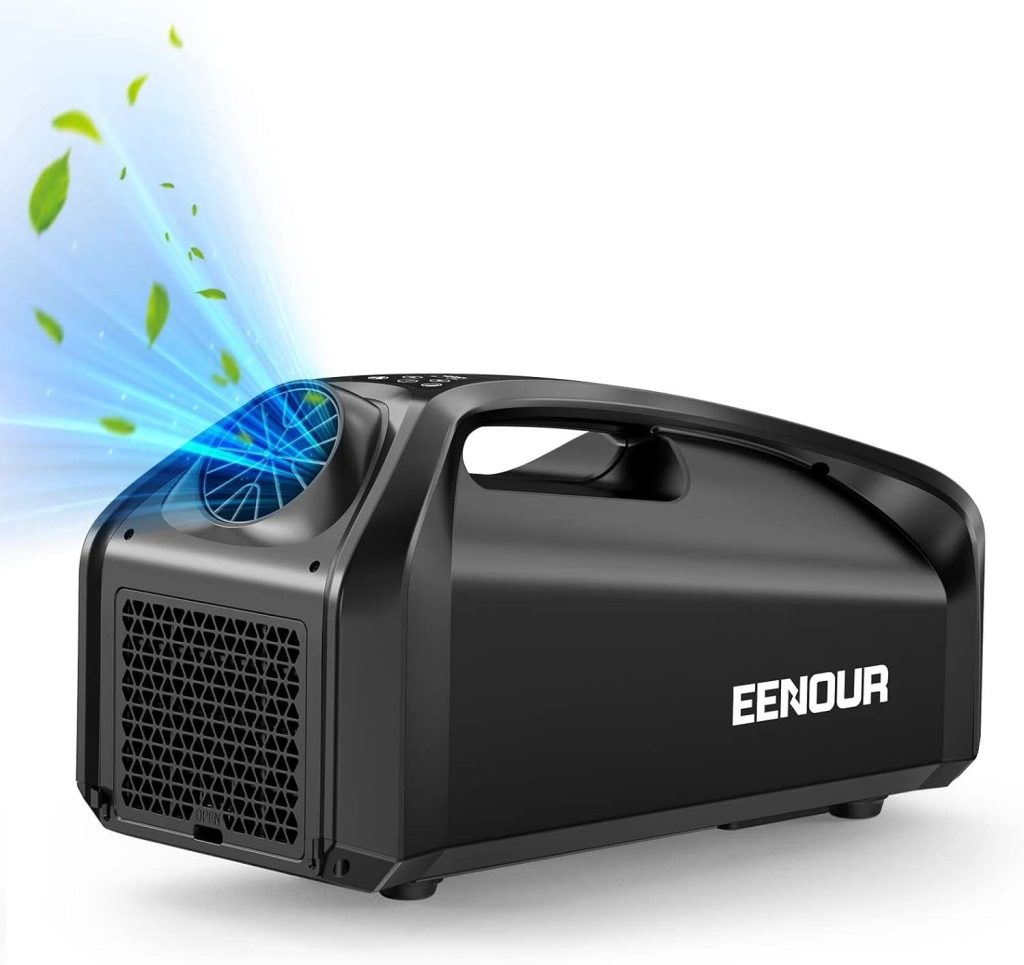
The QN750 EENOUR is a 2,900 BTU portable air conditioner made especially for campers. It features a dual-hose system like higher-end units, which means it pulls in outside air to cool the condenser, then exhausts the hot air, without expelling your tent’s cooled air.
This is way more efficient in the confined space of a tent.
The QN750 weighs about 22 lbs, so it’s still manageable to transport. It has no battery, but it will run on 24V DC power, using an AC adapter, a car outlet, or a portable power station (that’s capable of ~250 W output or more) to run it.
With 2,900 BTUs, EENOUR can cool a small tent or at least the immediate area by 10–15 °F (with users reporting about a 12 °F drop in tent temperature on average). The QN750 is rated to cover around 40–50 sq ft, which means it could do just fine in a 2- to 4-person tent.
The noise level is about 45–58 dB (low to high fan) – so quiet that, unless you’re really light on the oars, you’ll sleep just fine (it’s about as loud as a fan on medium speed).
With a digital control panel, the QN750 allows you to set the temperature (it’s rated to cover from 61 °F to 86 °F) and the fan speeds.
#4 BougeRV 2899 BTU Tent Air Conditioner
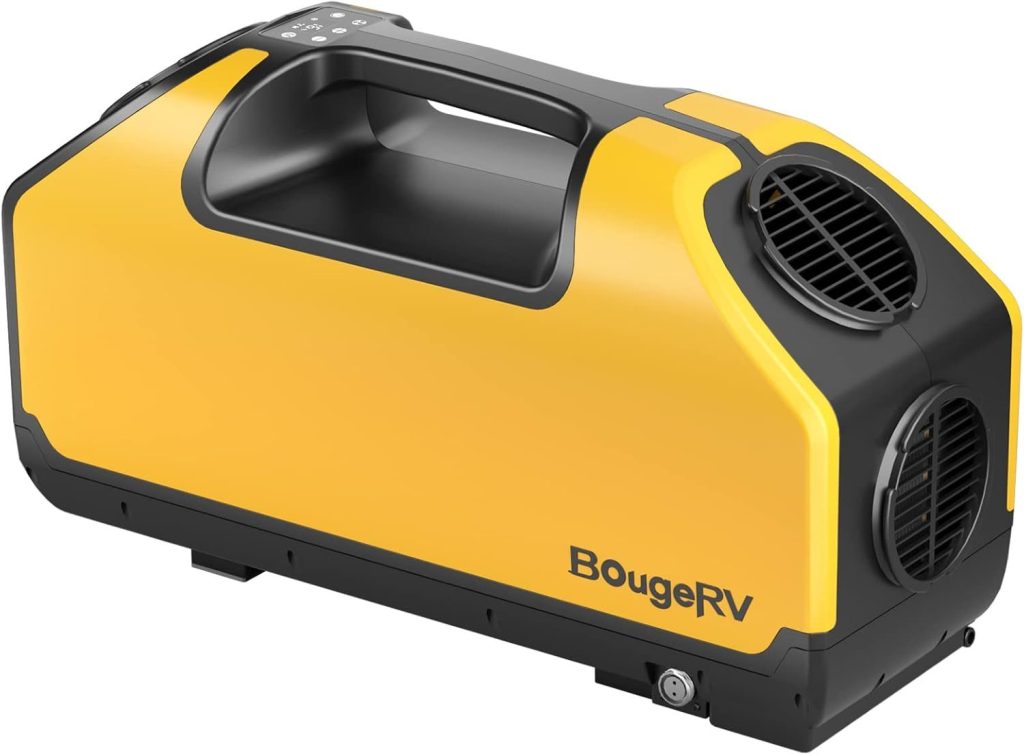
Another capable battery-compatible tent cooler is BougeRV’s portable AC, which delivers about 2,899 BTUs of cooling power.
This unit is known for fast cooling, and thanks to a quality Panasonic compressor, can cool the air down by about 18 °F in just 15 minutes.
The BougeRV AC weighs around 18–20 lbs, making it fairly easy to carry around, and is powered via 24V DC (similar to the EENOUR), so you’ll need a power station or car battery hookup for off-grid use.
Why it’s great for camping: This BougeRV model is designed with outdoor use in mind, and has a durable build that even offers it an IPX4 water resistance rating (meaning it can handle some light splashes or drizzle).
Key Features:
It has three fan speeds, and a quiet sleep mode that can go as low as ~45 dB, so it won’t disturb your campsite at night.
The cooling area is roughly a 6–10 person tent, or about 40–60 sq ft (most 6 person tents are around this size).
Many users pair this unit with a mid-size portable power station to run it for a few hours on hot evenings.
Evaporative Coolers for Tent Camping
Evaporative coolers are a simpler, more energy-efficient way to stay cool in a tent. Also known as “swamp coolers,” these devices work by evaporating water to cool the air. That adds humidity but lowers the air temperature felt on your skin.
These don’t use compressors or refrigerants. That makes them generally lighter, quieter, and lower power draw than true AC units. However, because they work by adding humidity, they’re most effective in dry climates – with low humidity – and for personal cooling, rather than drastically reducing the overall tent temperature.
We picked two evaporative cooling solutions: One is a portable cooler chest for camping, which is good for a personal space. The other is a mini desktop unit.
#1 IcyBreeze V2 Pro Portable Air Conditioner & Cooler
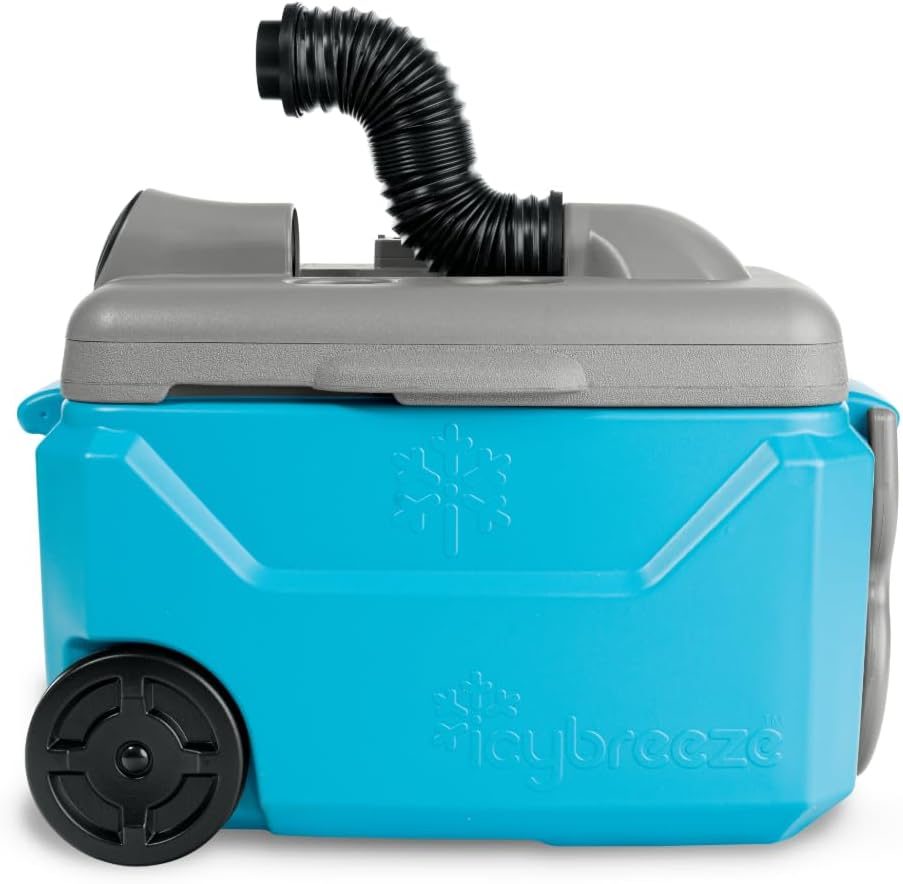
The IcyBreeze V2 Pro is a clever 2-in-1 device: it’s essentially a 38-quart ice cooler that doubles as a powerful, portable air conditioner. It has no compressor; instead, it uses ice and water to create chilled air that blown out through a vent. In actual use, the air coming out can be 30 to 35 degrees Fahrenheit cooler than the stuff in your tent—so if you’re sitting in front of it, you’ll definitely feel cooler.
The cooler lid houses a fan and a radiator coil. You fill the cooler with ice (or ice water); the internal pump circulates cold water to the radiator to chill the air, which the fan then blows into your tent.
Camping use:
The IcyBreeze has a rechargeable 12V battery (6Ah) that provides around 2.5-6 hours of running time. You can also run it continuously from a car’s 12V outlet or a portable 12V power pack.
It has 3 running speeds – and the highest one draws about 45 Watts of power (comparable to a small lightbulb).
The unit does not introduce extra humidity into the tent air; the water is in a closed loop going through a heat exchanger. So even in moderately humid climates, it can be effective (unlike open evaporative pads).
In a tent, the IcyBreeze is best used as a “personal cooler” – you point its adjustable vent (good range of motion and no need to use the 90° axle for side-to-side) at your chair, sleeping bag, or pet’s crate. Or, use it as a space cooler to refresh your immediate area while you enjoy daytime camping activities. (Just keep in mind you’ll need ice to keep it going and a good reason otherwise to not be chilling in your tent.)
#2 Evapolar evaCHILL Personal Cooler
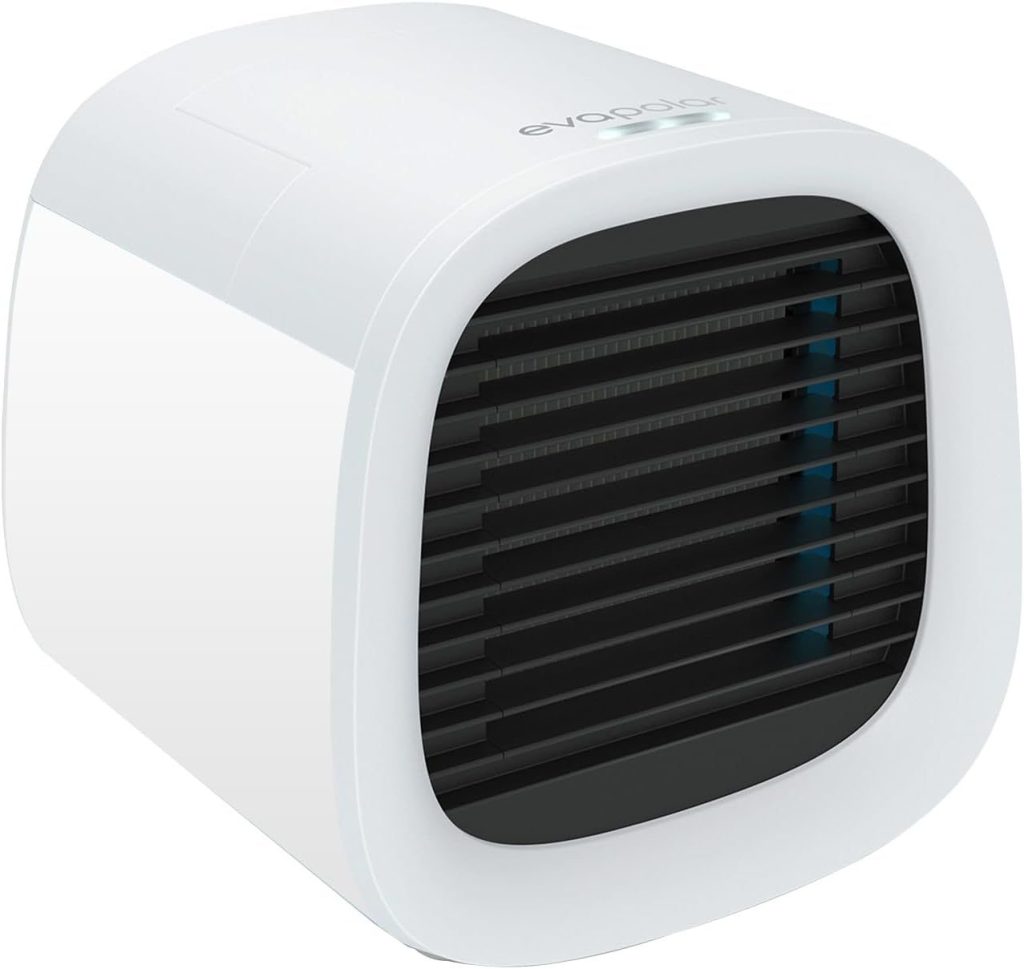
The Evapolar evaCHILL is a palm-sized evaporative air cooler that can sit on a camping table and blow a cool breeze your way. It’s essentially a high-tech version of a mini swamp cooler: inside is a small water reservoir and an evaporative cartridge. You fill it with water, and as the water evaporates from the cartridge, a fan pushes the cooled, humidified air toward you.
It uses about 7.5 Watts of power on the highest setting. Which means you could run it off a portable USB power bank or a laptop’s USB port. And because it’s under two pounds, and has one button for controlling it, there’s really no excuse not to take the evaCHILL along with you on your solo trips into the wild. If you set it up correctly, it could lower the temperature of the air coming into your immediate vicinity by around 5-10 degrees F, which should feel pleasant. In a dry climate (or at a place with low humidity), you should use it without any problems. And as a humidifier, it can certainly help with temperatures and air quality in any kind of a small tent.
Furthermore, you will need to replenish its water reservoir every 4 to 6 hours. At its low fan setting (which is very quiet, under 50 dB), the water can last up to 8 hours. This diminutive cooler is best for a solo camper or for a cooling comfort add-on in a small tent (1–2 person). It won’t replace an A/C unit, but given its simplicity, low cost, and minimal power requirements, the Kulu is a nice little option for backpackers and other ultralight campers trying to lighten their load.
Traditional AC Units for Camping (Window & Portable ACs)
If you plan to camp where you can get 120 volts of alternating current electricity (like from a generator or shore power), you could just use a basic small air conditioning unit to cool your large tent or an outdoor canopy.
These more traditional air conditioners, like window-mounted units and portable ACs, have a higher BTU range (around 5,000 to 8,000) that can more easily cool large family tents or several people hanging out in a space. They’re more of a traditional choice for keeping your living area cool if you plan to camp more comfortably. If you go this route, just remember: these units need to vent hot air outside; a window-mounted AC sticks half outside the tent, while a portable unit uses exhaust ducting out the tent door (or some kind of vent) to keep the living space cool. Many newer tents come with AC port flaps or duct socks to help you accommodate this more vintage-style cooling system.
#1 Frigidaire 5,000 BTU Window Air Conditioner
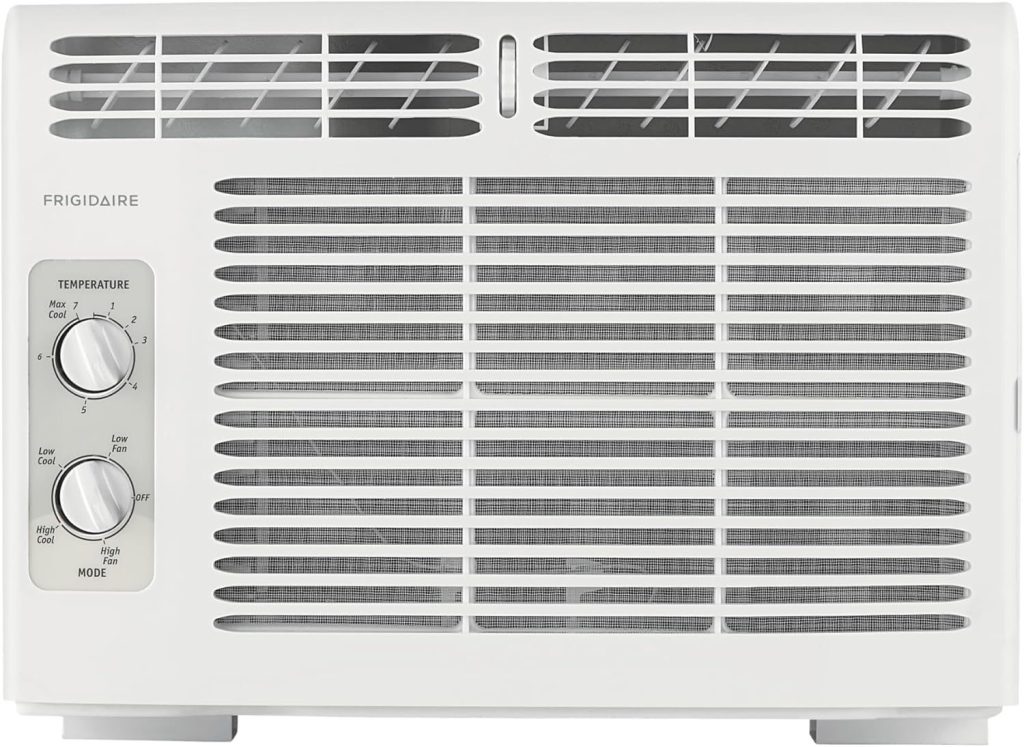
A reliable remedy for cooling a tent is a small window air conditioner, like this 5,000 BTU Frigidaire unit. It’s a compact AC (about 16 inches wide) that is commonly used for bedrooms and can cool around 150–250 sq ft—more than enough for even the biggest cabin tents. The unit weighs ~35 lbs, so it’s decently portable if you have a vehicle. To use a window AC with a tent, you’ll need a tent that has an AC flap or opening. (Some large cabin tents have a zippered slot specifically for AC units near the floor.) Alternatively, campers sometimes cut a hole in an inexpensive tent or create a custom support so the AC can sit with its front face blowing into the tent and its back end outside to vent heat.
Why think about a window AC: For starters, window units are powerful and inexpensive. The Frigidaire can cool a large tent with ease, even in heat and humidity, because it doubles as a dehumidifier. It has mechanical (as opposed to electronic) controls that make it even more reliable for off-grid camping. You can count on it to keep you cool, even at low speed (which is relatively quiet), and because of how energy-efficient it is, you won’t have to worry about draining your generator (or risking running out of power midway through a hot, sticky evening). Even with these powerful, portable 5,000 BTUs at your disposal, you’ll have to plan your chilling logistics carefully, because there’s no such thing as a tent air conditioner that really works unless you’re playing by the rules of hammock hanging and straight-line ventilation. A window air conditioner may be a fast-cooling workhorse, but it’s no replacement for tent space (especially if you’re the one in charge of any and all marmot-style sunbathing that goes on)!
#2 Black+Decker 8,000 BTU Portable AC (Floor Unit)
For those who prefer not to cut holes or if your tent doesn’t have a dedicated AC flap, a portable air conditioner on wheels is another option.
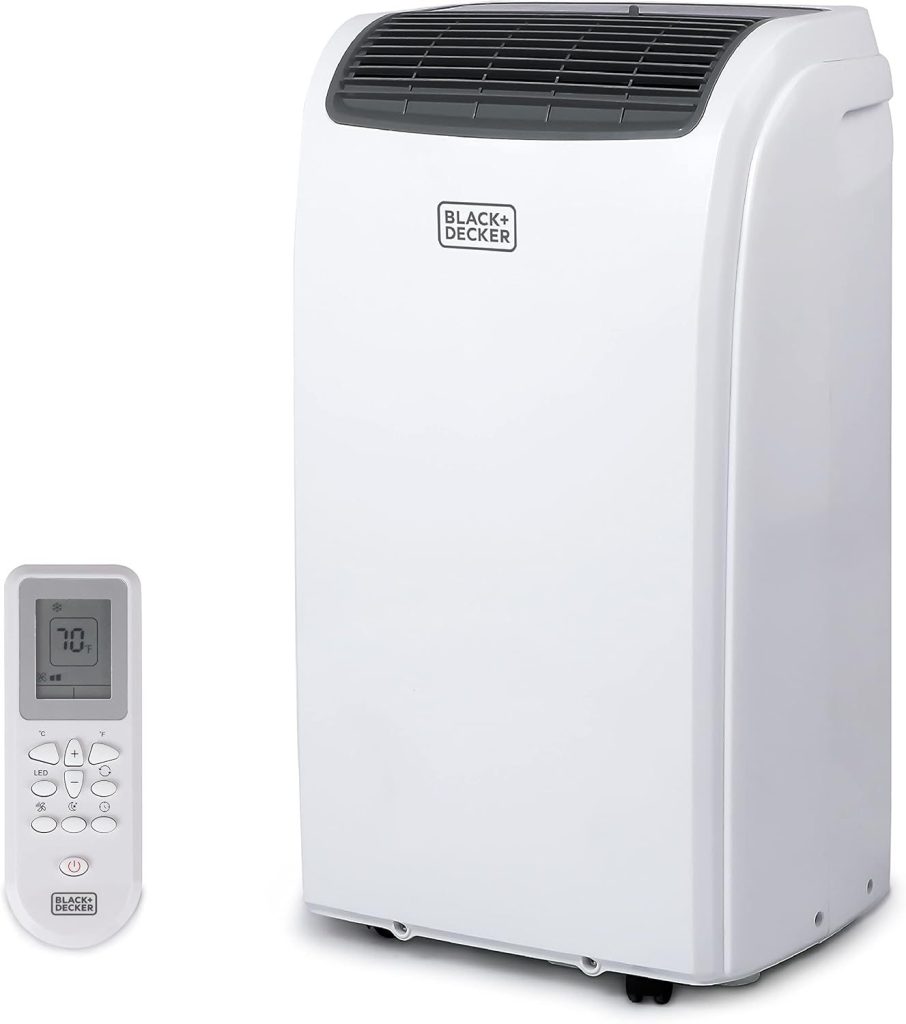
One of the most popular models is the Black+Decker BPACT08WT, which has 8,000 BTU (ASHRAE) of cooling (approximately 5,000 BTU DOE effective) and can cool up to 150 sq ft. It is a self-contained unit that remains completely within your tent, and a flexible exhaust hose that you can run out through a door zipper or vent to blow out hot air.
It weighs about 50 lbs, but since it’s on caster wheels, it’s easy to move on flat ground. Most cabin-type tents have straight zippers to which the exhaust hose can be fitted with a little ingenuity (you may stuff some foam or towels around the gap around the hose). This B+D portable AC will blow and cool the air in your tent once installed; it will also dehumidify, draining condensation into an internal tray or through a drain hose (which you should place correctly). It is digital and has a remote, and it has 3 modes (cooling, fan only, and dehumidify). You can also use the sleep mode at night when you want it to be quieter; this reduces the noise to an approximate of 54 dB, a dull hum like white noise in the background.
One advantage of the unit: since this air conditioner doesn’t need to “straddle” a window, you can use it in any tent as long as you can vent the exhaust. It’s perfect for large canvas tents, event tents, or multi-room family tents where you can place the unit in a central area.
Note: a portable AC needs a stable power supply, about 500-800 watts of constant power to run. It requires a campground hookup or a strong inverter generator (a small 1000W generator may not be able to handle, for example, the startup surge). In conclusion: Black+Decker 8,000 BTU AC is a beast of a camping solution. It’s more cumbersome than the other portables listed, but when properly powered and vented, it can keep even a large tent comfortable in blazing summer heat.
Tent Air Conditioner Buying Guide
The right tent air conditioner for you depends on where and how you are camping and on what kinds of power and resources you have available. Here are the essential factors and types of tent AC solutions broken down for your convenient decision-making.
1. Types of Tent Air Conditioners:
There are three main categories:
Battery-Powered Portable ACs: These are compact units with real compressors (offering genuine cooling in BTUs). They run on batteries or DC power. Use this if: You camp off-grid, have no generator, and need to cool a small tent or specific area.
- Pros: Truly portable, no cord needed, can work anywhere.
- Cons: Lower BTU (usually 2,000–3,500 BTU), limited runtime (2–5 hours on battery), expensive for the cooling provided.
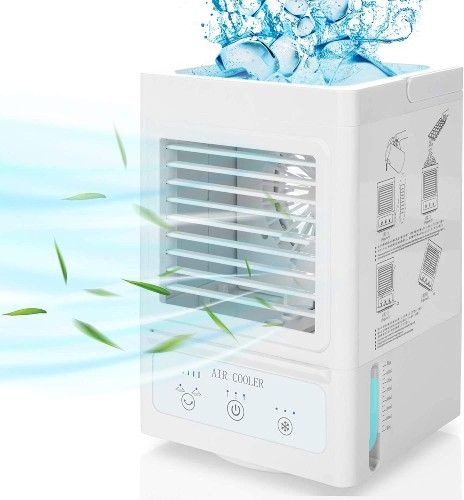
Evaporative Coolers: They use water/ice evaporation to cool the air (increasing humidity). Use this if: You’re in a dry climate or just need a personal cooler.
- Pros: Very low power draw (USB or 12V), lightweight, inexpensive; don’t use a refrigerant.
- Cons: Don’t work well in humid weather; add moisture to the tent (which can be an issue in enclosed spaces); require water or ice refills. They cool you rather than the whole tent environment.
AC-Powered Air Conditioners (Window/Portable): These are traditional units that need 115V AC. Use this if: You camp at sites with electrical hookups or have a generator and want to cool a large tent or multiple people.
- Pros: High BTUs (5,000+ BTUs) can chill sizable tents even in humid heat; can run indefinitely on AC power.
- Cons: Require a heavy power source, are bulkier (30–50+ lbs), need venting outside (some tent modification or port needed).
2. Cooling Capacity (BTUs) & Tent Size:
Make sure the AC has enough cooling power for your particular tent. A general rule of thumb is to size the unit for around 6,000 to 8,000 BTUs for larger family tents that can accommodate 8 or more persons (the tent volume is around 150 cubic feet). For small 2- to 4-person tents (about 30 to 60 cubic feet), you might find that 2,000 to 3,000 BTU units make a noticeable difference in nighttime tent cooling even when the outdoor temps are still really warm. This is because these aren’t just small fans blowing ambient air around, and tent camping on a hot summer evening can be nearly unbearable. You can also use tarp shades or reflective blankets over the tent to improve cooling, but that shouldn’t have to be your go-to solution.
3. Power Source & Runtime:
Power availability is often the deciding factor.
Battery-powered ACs give you freedom from cords, but check their battery life. For example, Zero Breeze’s battery lasts ~5 hours on cooling; EcoFlow’s add-on battery might last 3–8 hours depending on use.
If you need all-night cooling, you may require spare batteries or solar recharging during the day.
Portable Power Stations: These can run small AC units if they have enough capacity and inverter output. For instance, a 240 Wh power station can run a 250 W AC for roughly 0.8–1 hour (240 Wh / 250 W).
For a full night (8 hours), you’d need ~2000 Wh – which is a very large (and costly) battery. So plan realistically: either limit AC use to the hottest few hours or bring a generator.
Generator or Hookups*: A quiet inverter generator of 1000–2000W can run a 5000 BTU AC. Check the AC’s starting watts (some need a higher surge to start the compressor).
Using a generator opens options for the high-BTU units, but remember to place the generator far enough away to avoid fumes and noise, and comply with campsite rules.
Shore power (RV park or cabin outlet) is easiest – just treat it like running an AC at home
4. Ventilation and Setup:
All compressor-driven ACs must discharge hot air from the interior of the tent; otherwise, you’re just relocating heat. Battery systems (e.g., Zero Breeze) use exhaust hoses—that must also not leak back into the tent. Window ACs obviously sit half inside and half outside. Portable compressor ACs generally use a plate installed in a sealable-opening window (or tent door); the plate assists with the next necessary setup step, which is to ensure that the AC has a way to suck in and exhaust air. See next item for ensuring the unit has the necessary airflow.
5. Noise Level:
Most camping AC units range from 45–60 dB (from low fan to compressor on). For reference, 50 dB is like a quiet conversation. Dual-hose units often run quieter since they don’t have to work as hard. Evaporative coolers and fan-based devices are usually very quiet (just the fan noise). If absolute silence is a priority, you might prefer these options over a window AC unit.
Remember that placing the AC outside the tent means the compressor noise gets kept outside – you’ll just hear the whoosh of air inside the tent if you go that route.
6. Climate Considerations:
Consider the standard weather and humidity at your campsite. In hot, dry regions—such as high deserts—an evaporative cooler can work remarkably well; it may well be all you need for daytime comfort. In hot, humid areas—like the southern US in summer—a compressor-type air conditioner is almost a requirement for really effective cooling, because it performs two essential tasks: it reduces the temperature, and it removes a lot of moisture from the air (which is crucial for cooling). If, by contrast, campsite temperatures drop significantly at night, you might only need AC during the early evening before temperatures drop and fans take over.
7. Portability vs. Performance:
How portable an AC unit is and how much cooling it can provide are inversely related. It’s pretty simple, really: The smaller the unit, the less powerful it is—and the less cool it can make anything. A tiny, battery-powered unit is portable, but it barely cools anything. A 5000 BTU or bigger unit, on the other hand (and I can tell you from experience), is not portable and requires a portable generator just to run. So, before you start camping with AC, assess your style: Car camping or overlanding, where provisions and power are manageable? Or desert-walking to seldom-seen tent spots, where only a sno-cone fan can go? Choose your site; then choose your units.
8. Tent Insulation and Layout:
To get the best results from any AC:
Use a Tent with a Rainfly or Canvas: Thicker material retains cool air better. Some campers even drape Reflectix or thermal blankets over the tent (not blocking the AC of course) to reflect sunlight and insulate.
Cover Windows in Daytime: If the sun is beating down, keep tent windows covered (use reflective tarps or emergency blankets) to reduce heat gain. The AC will have an easier job.
Smaller Is Better: Don’t try to cool a huge 12-person tent with a tiny unit. Consider partitioning off the sleeping area with a curtain to focus the cool air where you need it.
Positioning: Cold air sinks. If using a cooler or small AC, elevate it on a table or crate so it blows downward and circulates. For window units, higher placement in the tent wall is actually beneficial (many tents’ AC ports are near ground level though).
Ventilation: Ironically, you don’t want the tent sealed 100% airtight – the AC needs to circulate air. For dual-hose systems, this is less of an issue, but for single-hose portable ACs a slight vent opening can help equalize pressure.