Portable air conditioners are ideal to be used in small rooms . This table list the best portable AC units for small room available in 2025:
| Model | Cooling Capacity(ASHRAE) | Room Size | Hose Type | Noise Level |
|---|---|---|---|---|
| Midea Duo Smart Inverter PAC | 14,000 BTU | Up to 550 sq ft | Dual-hose | 42–50 dB |
| LG 14,000 BTU Dual Inverter PAC | 14,000 BTU | Up to 450 sq ft | Single-hose | 44 dB |
| Whynter ARC-14S Dual Hose PAC | 14,000 BTU | Up to 500 sq ft | Dual-hose | 51 dB |
| BLACK+DECKER 8,000 BTU PAC | 8,000 BTU | Up to 300 sq ft | Single-hose | 54 dB |
| SereneLife 8,000 BTU Portable AC | 8,000 BTU | Up to 250 sq ft | Single-hose | 55 dB |
| Honeywell 10,000 BTU PAC | 10,000 BTU | Up to 450 sq ft | Single-hose | 52 dB |
| De’Longhi Pinguino 12,000 BTU | 12,000 BTU | Up to 400 sq ft | Single-hose | 50 dB |
Detailed Reviews: Top Portable AC Units for Small Rooms
#1 Midea Duo 14,000 BTU Smart Inverter Portable AC
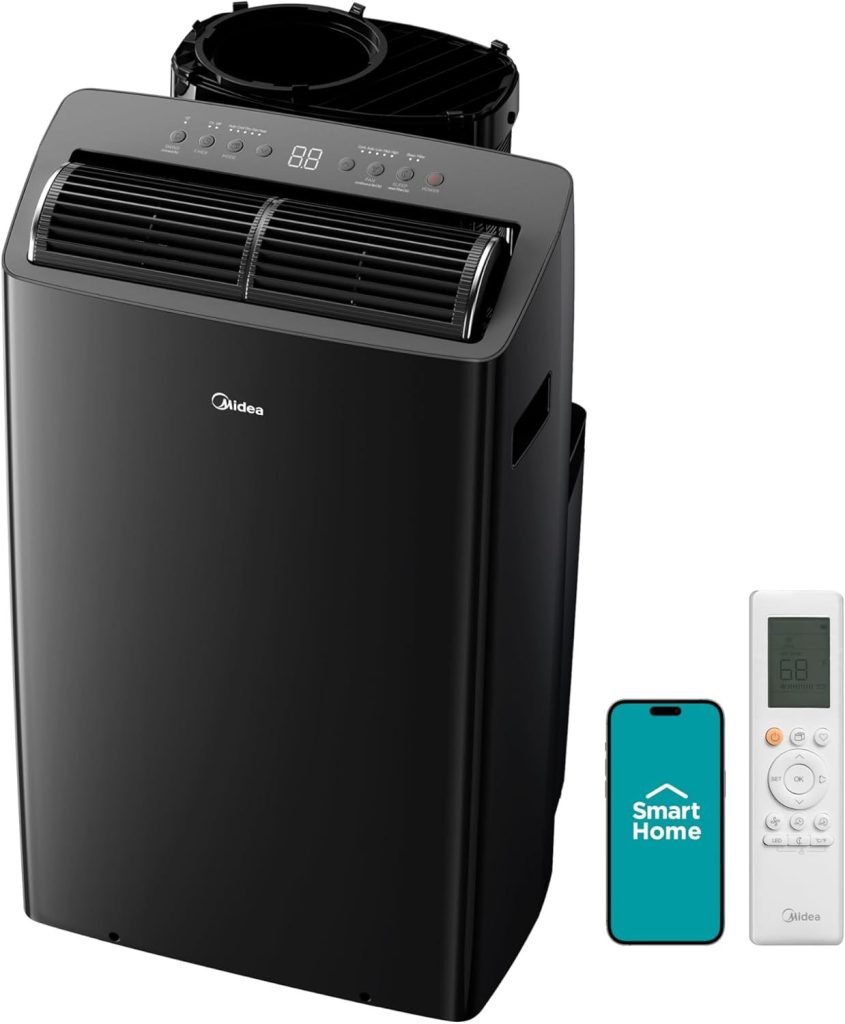
The Midea Duo Smart Inverter is widely regarded as the best overall portable AC for its blend of strong cooling and ultra-quiet operation.
This 14,000 BTU (ASHRAE) air conditioner has a dual-hose “hose-in-hose” design and a variable-speed inverter compressor that allow it to cool small spaces rapidly and efficiently, without the near-constant cycling on and off that you’d get with a cheaper or less powerful unit. It’s rated to cool rooms up to 500–550 sq ft but kept our small test space plenty cool even when outdoor conditions were sweltering.
- Cooling Power: 14,000 BTU (ASHRAE)/12,000 BTU (DOE); suitable for rooms up to 550 sq ft. The outside air is pulled into the condenser by the dual-hose system, thus avoiding the negative pressure that would normally be there and also upping the efficiency of this design.
- Ultra-Quiet Performance: Thanks to the inverter technology, the Midea Duo operates as low as 42 dBA on Quiet mode – practically a whisper. It adapts to the temperature automatically, which means it also adapts to the energy-savings range, which means it minimizes the kind of noise you get in non-inverter products.
- Smart Controls: Built-in Wi-Fi with the Midea Air app and voice control (Alexa/Google Assistant) lets you turn the AC on/off or change settings remotely.
It is possible to arrange for times for when the coolers will be active or to employ the use of an electronically-connected mobile device, such as a smartphone, to serve as a convenient remote-control thermostat. - Energy Efficiency: The inverter compressor and dual-hose setup make this model about 40% more energy-efficient than standard portables.
The seasonal-efficiency (CEER) rating is very good, meaning the appliance will use less electricity and thus cost less to operate during the hot summer months. - Additional Features: 3-in-1 functionality (cooling, dehumidifier, fan-only), an easy-to-install window vent kit, and a washable filter.
It also has an optional Heat mode variant (heat pump) for those who need heat in winter.
Why it’s great for small rooms: The Midea Duo delivers powerful cooling without drowning you out with noise – perfect for bedrooms or home offices where quiet comfort is key.
Its smartness and efficiency make it quite ideal for using daily in a small space over long periods.
#2 LG 14,000 BTU Dual Inverter Smart Portable AC
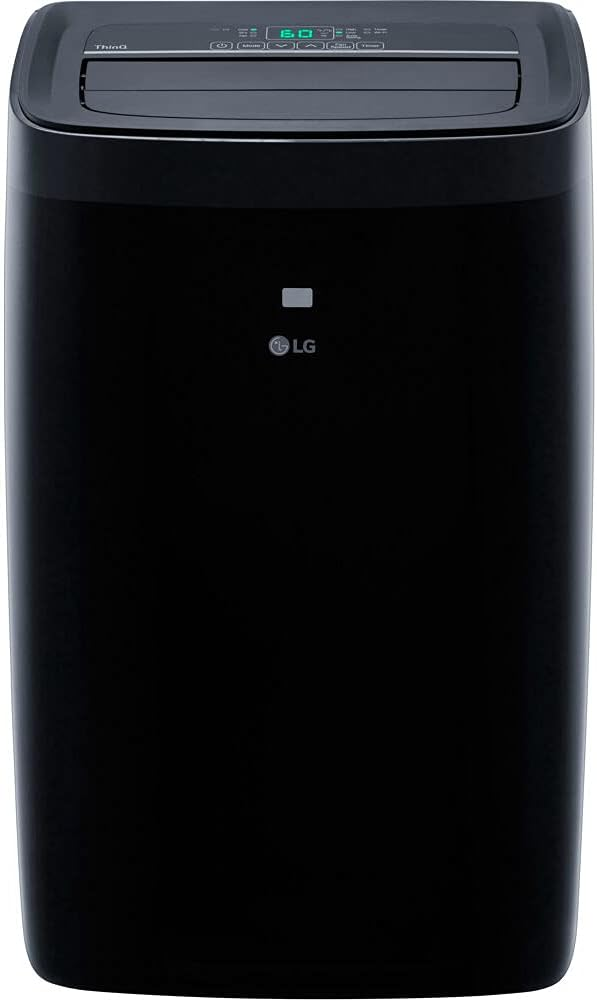
LG’s Dual Inverter portable AC is another top-tier choice known for quiet operation and solid energy savings.
This is a 14,000 BTU (ASHRAE, ~10,000 BTU DOE) unit that uses a twin-rotary dual inverter compressor to modulate the cooling output, which gives the unit better efficiency, as well as reduced noise and draw. It’s rated for spaces up to about 450 sq ft, so it can handle a small room or studio very well. While it’s a single-hose design, the inverter technology makes it much more efficient than cooling systems that do not use inverters.
- Cooling & Capacity: 14k BTU cooling capacity (ASHRAE) – enough for 450 sq ft.
It will swiftly reduce the heat in a tiny chamber and then uphold it uniformly without many on-off cycles. - Low Noise Levels: The LG Dual Inverter is one of the quietest portable ACs in its class.
It functions at approximately 44–53 dB in low-mode, due to its quiet inverter motor. We could barely hear a hum while running tests at the low setting, which made it hard to detect any negative aspects of this product. Reports indicate that even at high fan speed, this unit operates at a volume level that’s comparable to a refrigerator, around 56 dB, and we agree. - Smart Connectivity: Supports LG ThinQ app for full smartphone control and monitoring.
The device can be powered on or off, and the thermostat or fan speed can be adjusted from anywhere. You can also set a schedule. It’s also compatible with Alexa and Google Assistant for voice commands. - Efficient Performance: The dual inverter compressor adjusts speed to avoid wasting energy.
In comparison to non-inverter types, it can cut energy use by as much as 20-30%. It has an automatic eco mode that kicks in and conserves power when the set temperature is reached. - User-Friendly Features: The AC offers 3 modes (cool, dry, fan) and an auto-swing air vent for better air distribution.
- Included is a remote that has every function you could want. It has an LED display and a 24-hour programmable timer, so you can schedule it to turn off overnight or before you wake. There are a few other ways to control the unit, too, but those first two give you the best options.
This LG model is perfect for noise-sensitive settings, like bedrooms. Low means nearly silent cooling, and you won’t need to push it to peak output very often since it’s quite strong for the small space, bedroom or otherwise. A smart app control is bonus accessibility that lets you manage comfort without getting up.
#3 Whynter ARC-14S 14,000 BTU Dual Hose Portable AC

The Whynter ARC-14S is a portable AC that’s renowned for fast cooling and high performance. It’s a 14,000 BTU (ASHRAE, 9,500 BTU SACC) unit that was even rated “Best Overall Portable AC” by Good Housekeeping in 2024. This model can cool up to 500 sq ft, which makes it more than capable of working in small rooms—and it will cool them very quickly. The dual-hose design prevents cool indoor air from being sucked outside, and the fast fan speed further improves efficiency, making this a great pick for high heat.
- Powerful Cooling: The ARC-14S can quickly lower room temperatures thanks to its dual hose system for intake and exhaust. This system, coupled with the unit’s 14,000 BTU capacity, means you’ll be reaching your target (cooling) temperature in no time. Even in small spaces, this air conditioning unit excels; you can pretty much guarantee its cycling nature will work in your favor as it achieves rapid cool-downs without running excessively.
- Quiet Operation: Even with its bulk, this unit keeps a low profile. It runs at 51 dBA on low fan speed, which is such a gentle sound that you might mistake it for the air being pushed through a duct in your wall. At high speed, the unit hums up to the mid-50s dB, comparable to the sound you’d get from a window AC in a comparable room. Either way, you’re hearing something, but not enough to mess with your REM cycle.
- Efficiency & Auto-Drain: The auto-evaporation system of the ARC-14S expels condensate, which means you rarely need to empty a water tank. Its EER is around 10.8 (which is slightly better than many single-hose units). Its R-32 refrigerant and lead-free construction also make it a more eco-friendly choice.
- Air Quality Features: This miniature air conditioner has a washable pre-filter and an activated carbon filter to help it remove dust and odors—quite a nice perk for an enclosed small room. The combination of filters and a dual-hose setup make it able to serve as an effective room dehumidifier (removing up to 71 pints/day of moisture).
- Controls & Extras: Includes a complete remote control and an LCD panel for adjusting temperature (in a 61°F–89°F range) and fan speeds. Allows three modes of operation: Cool, Fan, and Dry. Also features a 24-hour programmable timer. Comes with a storage bag for the window kit, hoses, and filter accessories.
The Whynter ARC-14S is the air conditioner to get if you live in a little room that tends to get very warm or that you need to cool down quickly. It’s also a top choice for people who want the greater efficiency of a dual-hose AC. Just keep in mind that this one is kind of big; if you put it in your room, it will take up a fair amount of space. Still, it operates powerfully and quietly enough that we think it’s worth the trade-off.
#4 BLACK+DECKER 8,000 BTU Portable AC (BPACT08WT)
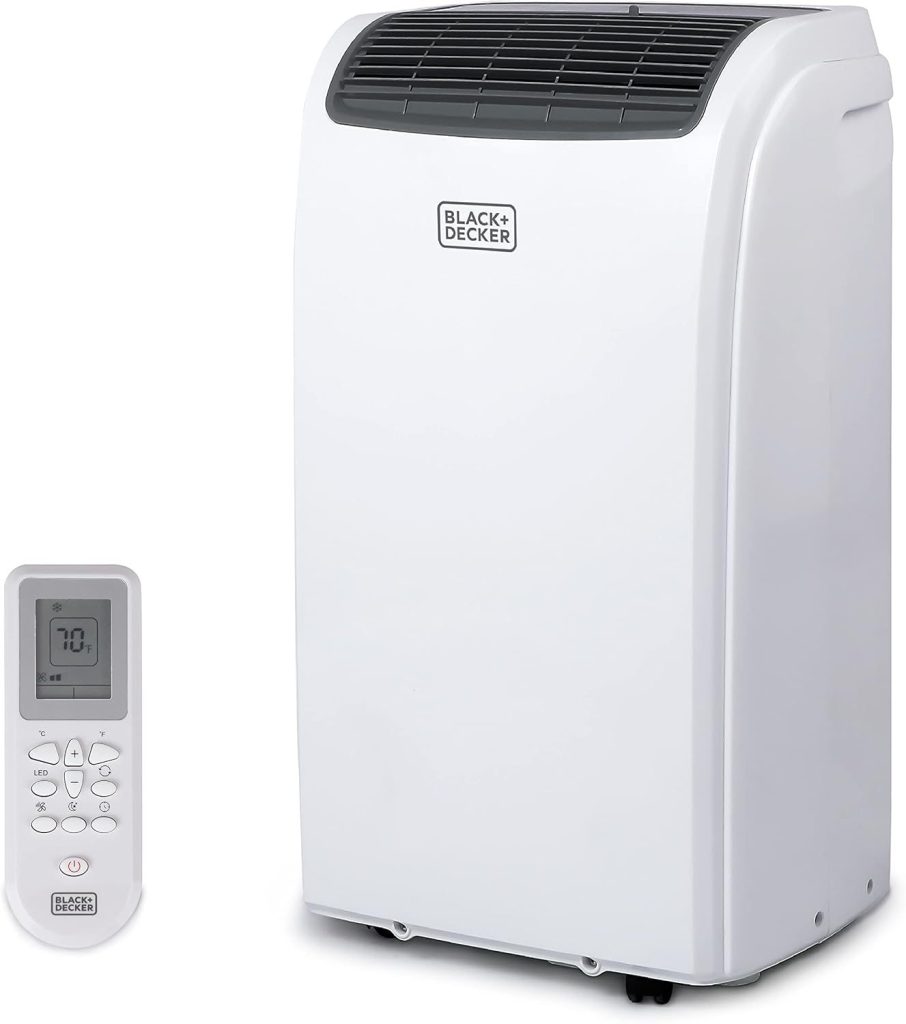
For budget buyers with a small room, the BLACK+DECKER 8,000 BTU portable AC is a reliable solution. This compact unit (model BPACT08WT) is more than just an AC. It’s rated to cool rooms up to ~300–350 sq ft. At only 45-50 lbs, it’s one of the lighter portables and relatively easy to move between spaces.
- Cooling Performance: The cooling capacity is 8,000 BTU (ASHRAE), which is about 5,000 BTU under the new DOE standard. In practice, it can keep a 150-250 sq. ft. room very comfortable; not that there’s any rule that the 8,000 BTU window unit has to only cool areas that size, but for anything up to ~300 sq. ft., it might take a bit longer to cool but will still maintain temperature quite nicely.
- Quiet & Bedroom-Friendly: When set to its low fan speed, this B+D unit operates at approximately 52–54 dB, which for most people is quiet enough to sleep through. At maximum cooling, it can roar at ~70 dB (like a loud fan), but most of the time you won’t need it running at this level. Some users prefer to use the ‘Sleep’ function, which automatically adjusts cooling and fan speed down to almost whisper levels operation for night time.
- Easy Setup: A simple kit for venting windows is included, one that works well for either vertical or horizontal windows (the shortest span for this application is ~19.5″ high). There’s no need for tools to get it installed. Just extend the window panel that slides, attach the hose that leads the exhaust out (this is the single-hose version), and plug the whole thing in.
- Convenient Controls: Included is a remote control with a “Follow Me” thermostat function. The remote senses the temperature where you are and tells the AC to adjust, thus eliminating hot spots far from the unit. The LED control panel is top-mounted and easy to understand. It features a digital thermostat (to 61°F), a Fan mode, and a 24-hour timer. You can control everything from the panel or conveniently take advantage of the remote.
- Dehumidifier Mode: In dry mode, it removes approximately 50 pints of moisture from the air daily; sea air can be quite humid, so that makes us feel clammy. Almost all the water that could be evaporated is expelled through the hose. We also have a drain port for when we really need to be humid-free.
Why it’s great for small rooms: This BLACK+DECKER unit fits the bill if you’re looking for a portable air conditioning unit that doesn’t break the bank but still covers the basics quite well. Its compact build allows it to fit snugly in small areas within your apartment, but it runs easily and efficiently in rooms of up to 200 square feet— making it a mighty little air conditioner in our books.
Add to that how this unit is also super quiet, and you’ve got an efficient portable unit that’s ideal for both your small living space and your small budget.
#5 SereneLife 8,000 BTU Portable Air Conditioner (SLPAC8)
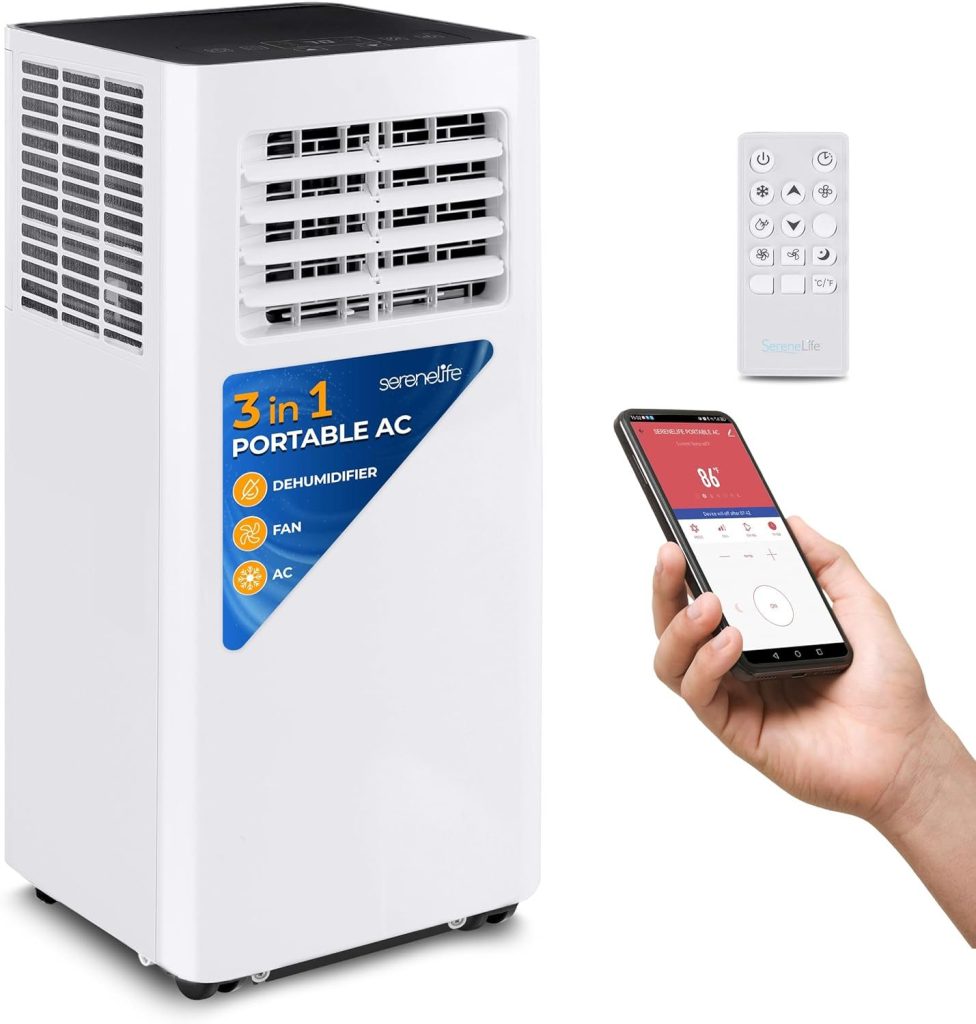
The SereneLife 8,000 BTU portable AC is a small, compact unit touted for its cooling abilities and specifically marketed for small rooms, particularly bedrooms. It earned a top place in many “small room AC” rankings, thanks to its reliable, slim design. With its 8,000 BTU cooling capacity (almost 4,000 BTU DOE), it handles areas about 150–250 sq ft quite nicely, whether that’s a home office, dorm, or bedroom. This model also functions decently as a dehumidifier, and fan, and is known for being one of the easier units to set up and move around.
- Compact Design: At roughly 27 inches high with a slender, lightweight form, the SereneLife can fit in virtually any corner. No one should have trouble setting this up, since it’s designed to go together easily with no special tools or skills required. And once it’s set up, the SereneLife can be moved fairly easily, due to its light weight, caster wheels that actually roll, and built-in carry handles.
- Cooling & Airflow: An 8k BTU air conditioning unit can drop the temperature in small bedrooms down a few degrees in under an hour. It won’t blast icy air like a bigger unit, but it provides steady, comfortable cooling. One nice feature is its automatic oscillating vent—the front louvers can swing to distribute cool air evenly throughout the room, helping eliminate hot spots.
- Quiet Operation: SereneLife designs its units to be quite. This model produces around mid-50s dB on low fan (comparable to a quiet conversation). On high fan, tests measured about 60-61 dB, which is still quite reasonable for daytime use. Many buyers use it in bedrooms overnight on the low wquiet setting without disturbance.
- Easy Installation: The unit has a basic window kit with it and an exhaust hose. It takes just a few minutes to set up. You slide the panel into the gap of your window, connect the hose, and you’re done. The manual that comes with the unit, along with several online videos, makes working with the unit easy to understand. It also has an air filter that can be washed and is removable.
- User Controls: Includes an electronic control panel and a small remote. You set the mode (cool, dehum, fan), target temperature (ranging 64–90°F), and fan speed. There’s also a 24-hour timer for scheduling on/off times. No Wi-Fi means fewer steps in the setup process. Just plug in, press power, and enjoy the clear air.
Why it’s great for small rooms: The SereneLife 8,000 BTU is made just for cooling tiny places—like bedrooms or personal offices—without adding a ton of weight or bulk to the setup. Weighing in at just 52 pounds, this unit is still somewhat heavy, but not overwhelmingly so. It has handles on the side that make it easier to lift and carry, and an air vent on the front that pipes out the cold air. With a quiet design and a price tag well under $400, this room air conditioner is well worth a look if you need something that will keep your tiny space nice and cool.
#6 Honeywell 10,000 BTU Portable Air Conditioner
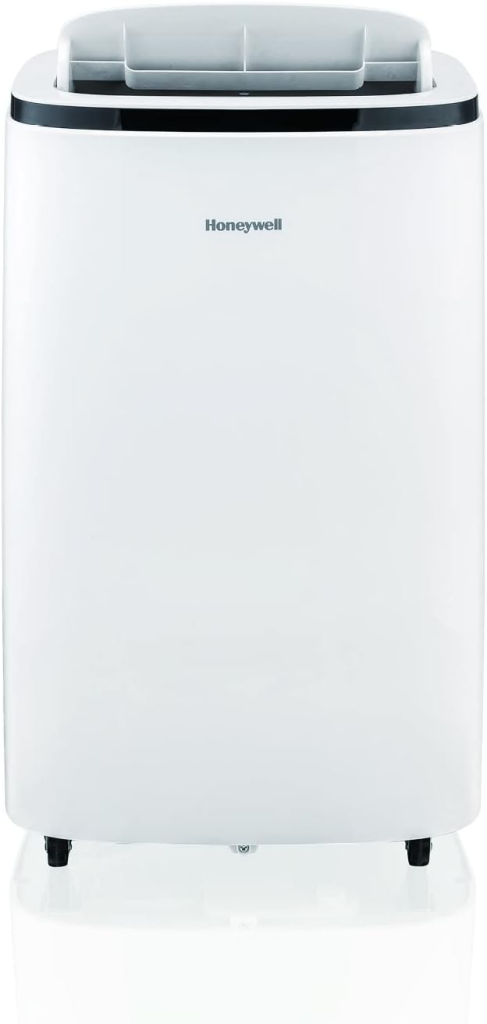
A well-rounded option from a trusted brand, Honeywell’s 10,000 BTU portable AC (model HL10CESWK or similar) cools rooms up to about 400–450 sq ft safely and dependably. This single-hose unit offers three modes: cool, fan, and dehumidifier. Where it stands out, though, is in the details. Two features that might make you more likely to buy this unit are the dual dust filtration system and thermal overload protection—good things to have if you want your AC to last and to not be a fire hazard. All in all, this is a mid-priced portable AC with solid performance, reasonable low noise, and good reliability.
- Cooling Capacity: 10,000 BTU (ASHRAE) portable AC, roughly 6,500 BTU under DOE standards, which comfortably cools small and medium rooms. It’s effective in bedrooms, small living rooms or kitchens, maintaining temperatures in spaces around 200–350 sq ft with ease (and up to 450 sq ft in optimal conditions).
- Quiet Operation: Minimal disruption is the name of the game with Honeywell. Average sound levels during cooling are around 52 dB. This makes the Honeywell likely quieter than the window air conditioner you currently have in your bedroom. It is also better than some portable air conditioners equipped with a traditional compressor in terms of overall sound levels and sleep settings.
- Dual Filtration: This unit employs a two-filter system to guard the life of the AC and enhance the air quality. The first filter is a washable pre-filter that catches the dust and hair in your home, while the second filter – a carbon filter – is used to capture and help reduce odors. The filter reminder light will give you a heads-up when it’s time to clean both of these important filters. Overall, this unit has a pretty impressive maintenance setup.
- Easy Controls & Timer: Set atop the unit is a user-friendly digital control panel. Its LED readout shows the current setting of the unit. A remote control (which is also user-friendly) allows you to adjust settings with the kind of range that can primarily be appreciated from the other side of your living room. A 24-hour timer permits basic automatic on/off cycles.
- Safety and Build: This model’s thermal overload protection is highlighted by Honeywell. This is an extra safety cutoff that prevents the unit from overheating during prolonged use. The user experiences peace of mind, knowing that the unit will not function beyond normal limits. Quality materials were used in constructing the unit. The unit is also backed by a standard one-year warranty and supported by very dependable customer service in the United States. This is one of the better-looking low-profile fan designs, with a simple black-and-white appearance that can fit into various decors.
Honeywell’s portable air conditioner is a very reliable option if you’re going to use the air conditioner a lot. It’s very quiet, it’s very efficient, and it’s very maintenance-friendly. So aside from some stupidly engineered aspects of the add-ons, I really think this is a quality product. And if you want to sleep with this in the same room as you, I think it’s an excellent option.
#7 De’Longhi Pinguino 12,000 BTU Portable AC (Quiet Mode)
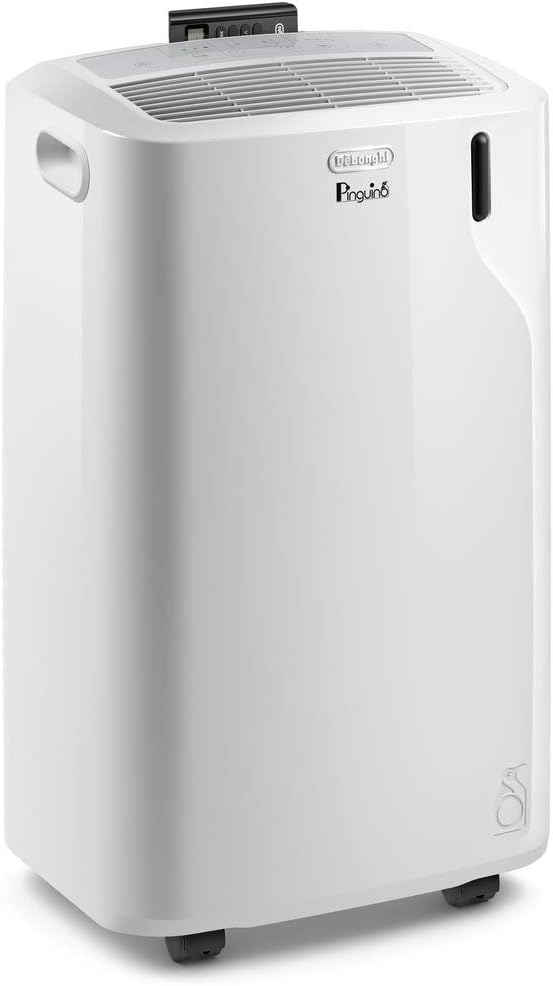
De’Longhi’s Pinguino series is known for its premium cooling and extra-quiet operation.
This model provides around 12,000 BTU of cooling (roughly 6,000 BTU DOE), which is great for small to mid-sized rooms up to 400 sq ft. What makes the Pinguino different is its Arctic Whisper. Because of the “Whisper” feature, which is intended to make the machine running noise softer, this model makes a lot less noise compared to similar machines. The cooling feature doesn’t make noise, but the fan does. If you’re looking for a portable air conditioner that won’t keep you from sleeping or having a conversation, because of the noise it makes, this unit deserves a look.
- Exceptional Quiet Mode: When the Quiet mode is turned on, the De’Longhi can function at approximately 50 dB or less. This is considerably less noisy than most standard portable ACs. Most users find that on the lowest setting, you can’t hear it running except for the nice, cool air. This is a great choice for anywhere that noise is a concern, such as bedrooms, nurseries, or home offices.
- Effective Cooling: Even with its understated presence, this air conditioner puts out a lot of cooling power.
12,000 BTU (ASHRAE) is enough to handle a stuffy small room or a poorly ventilated small room. It uses a single hose but mitigates efficiency loss with smart controls that cycle the fan and compressor optimally.
For example, the Eco Real Feel feature automatically adjusts settings to reach your desired comfort level faster and then reduces power to maintain it efficiently. - Smart Sensing Remote: De’Longhi provides a remote control called “Cool Surround” that contains a temperature sensor. You can place the remote where you are, and the AC will pay attention to that temperature when determining how much cooling is necessary. This is, of course, a more reliable way of ensuring even cooling than asking the AC to estimate room temperature from across the way.
- Multi-Function & Features: This model of Pinguino is a 3-in-1 device: it can cool (AC), dehumidifier (removing up to ~80 pints/day depending on model), and is a fan-only unit. It has motorized air swing louvers to evenly distribute air. The digital interface is easy to use, with an LCD and soft-touch buttons. There’s a programmable timer, and the eco-friendly refrigerant is the R-32. Not all De’Longhi portables have Wi-Fi, but they do have (more or less) something that’s become much more rare in ACs: quiet refinement.
- Build Quality: De’Longhi, a premium brand, uses high-quality parts in its EC models, from the durable wheels that roll over the surface of your floor to the stylish outer shell that you display in your kitchen. Setup is similar to other portable ACs; window kit and exhaust hose are included. And there’s a no-drip recirculation system in this model, which mostly ensures that evaporated water stays in the unit – so under normal use, the owner shouldn’t have to drain the condensate basin by hand very often. (The manufacturer says to expect no more than once every 2-3 weeks.)
Why it’s great for small rooms: If keeping the noise level down is a top priority, then the De’Longhi Pinguino is the way to go. You can chill a small room to a very comfortable temperature, and it almost sounds like it’s not working at all.
Portable Air Conditioner Buying Guide
Cooling Capacity (BTUs) and Room Size
Selecting the proper cooling capacity for your space is critical. Portable air conditioners are rated in BTUs (British Thermal Units), which show how much heat they can take out in an hour. For small spaces, you generally choose from 8,000 – 12,000 BTU units (ASHRAE). As a basic guideline:
- Models with 8,000 BTUs work well in areas that measure from 150 to 250 square feet (e.g., a small office or bedroom).
- Models with 10,000 BTUs manage about 300–400 square feet (a sizeable bedroom or small living room) well.
- Models with a cooling capacity of 12,000–14,000 BTUs can handle square footage of 450–500+ ft. The tiny room over which these models labor might make the room seem cooler than a typical room temperature, but if you go outdoors or venture into another room, you might realize that temperature is more akin to the heat of summer.
Note that there are often two sets of BTU numbers for portable ACs: an older, inflated ASHRAE rating and a newer, usually lower DOE rating. The Seasonally Adjusted Cooling Capacity is the better real-world measure between the two.
For example, a portable AC might be advertised as having 14,000 BTUs, but it’s really more like 10,000 when we look at the SACC. Altogether, these mismatched measures of performance make it all the more critical to consult AC-to-room size charts when selecting a unit.
Nevertheless, don’t go too high: an oversized unit short-cycles (turns on and off frequently) without properly dehumidifying. In a small bedroom, around 8,000 to 10,000 BTUs is usually sufficient. If the room gets a lot of sun, has heat-producing electronics, or is poorly insulated, go toward the upper end of that range.
Noise Level (dB)
Portable air conditioners come with moving parts like compressors and fans, so how much noise they make is an important consideration—especially if you’re planning to use one in a bedroom.
Noise is measured in decibels (dB), and most portable ACs will produce around 50–60 dB on their lowest setting, which is about the sound of a normal conversation.
On high, some can reach 65–70 dB (like a loud fan or background TV).
If you require a tranquil portable air conditioner for a compact space, seek out models labeled as particularly quiet or equipped with a sleep mode/quiet mode. Inverter models are likely to be your best bet because they run the compressor at a reduced speed when operating under lighter loads.
For instance, the LG and Midea inverter units in our top picks can run below ~45–50 dB on low – very gentle white noise.
A dual-hose unit like the Whynter often has a steady whooshing sound (~51–56 dB) that many find easier to tune out than the louder cycling of some single-hose units.
In comparison, look at the specifications or user manual of the product to find a rating for noise. If there is only one number, it’s generally understood to be the max dB. Some makers offer a couple of numbers (e.g. 52–56 dB). To give perspective:
- 50 dB – Quiet workplace, slight sound of a fan. Best for slumber.
- 60 dB – Level of a normal conversation. For most, it’s noticeable but tolerable.
- 70 dB – Like the sound of a vacuum cleaner. This would be a loud portable AC at max; might be disruptive in a small room.
Remember that judging noise levels is a personal matter. What may be life-altering to one person may not even be noticeable to another. We have a set of criteria we use to impartially judge a unit’s noise output, but in the end, it’s up to your ears and your room to make the choice. If we had to make a blanket statement, however, we’d say that for small rooms, you should obviously go with the quietest unit possible that also, you know, cools.
Single-Hose vs. Dual-Hose
There are two venting configurations for portable air conditioners: the single-hose system and the dual-hose system. These systems refer to how portable air conditioners take in and exhaust air. Here’s a closer look at each.
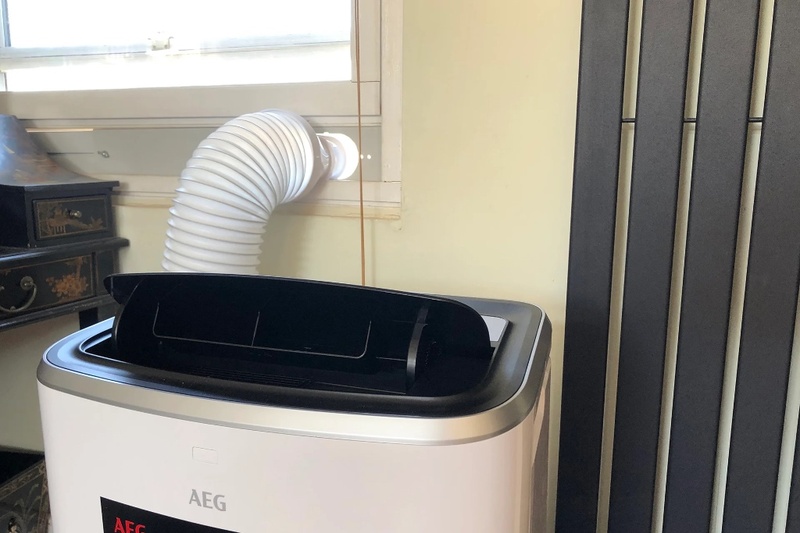
- Single-Hose: The AC takes in air from the room to cool its condenser and then exhausts that hot air outside through one exhaust hose. This creates slight negative pressure in the room (air that was inside is pushed out), which can cause warm air from adjacent areas to seep in.
Single-hose units are the most common and typically easier to install (only one hose). They work well in small rooms, but they are a bit less efficient since they can suck cooled indoor air to use for cooling the condenser.
- A dual-hose AC has two independent hoses—one that takes air from outside to cool the condenser (the part of the unit that is doing the “air conditioning”), and the second that exhausts the hot air back outside (the part of the unit doing the “refrigeration”).
Recall that the AC unit is not the thing in the room that is actually being cooled. The room is being cooled by air that is being recirculated through the unit, and on hot days like those in our illustration, the incoming air is not very cool.
Two big advantages of the dual-hose design are that (1) it doesn’t cause negative pressure inside the room (thus pulling in outside air that may not be too cool either, on a hot day) and (2) it cools the room faster.
For a cramped space, a single-hose unit will more often than not do the trick. These units are more compact, easier to place in a room, and friendly to a budget of $800 or less. But delivering that promised cool air does take some effort. Single-hose units pull air from inside the room, use it to cool the compressor, then exhaust it back outside along with any heat the compressor has generated. Most of the time, this imperfect, more door-like than window-like exhaust keeps the air cool enough. But some warm air does manage to sneak back in.
If a small room is not too hot for an air conditioner to handle, single-hose units do work. And they do a decent job. But dual-hose air conditioners are the units for which to reach if a room really needs to be cooled.
In conclusion, both kinds are capable of cooling a small room. Single-hose units are a bit easier to set up, and they are more portable. However, if you want better performance, especially in more demanding conditions, go for a dual-hose unit. In any case, keep in mind that all portable air conditioners need a hose running to a window or some sort of opening in order to vent the hot air out. They are not ventless, even if you get a single-hose unit.
Energy Efficiency
Reputation of Portable Air Conditioners:
Compared to window units or central AC, portable air conditioners aren’t that efficient – or at least they have that reputation. But some of the newer models have made improvements.
And when it comes to efficiency, the only thing worth considering is the unit’s EER or CEER – those two phrases mean essentially the same thing, because they’re both measurements of how efficient the unit is at cooling. To put it in the simplest terms, EER and CEER tell you how many BTUs you’re getting (which is to say, how much cooling you’re getting) per watt of electricity the unit uses.
Portables with inverters (the Midea Duo and LG, for example) are among the most efficient. These models have CEER ratings around 9-10, or higher, and for good reason. They can modulate their compressor speeds and don’t always run at full tilt (most run better in the 70%-100% capacity range). Also, if you get one of these inverter models, throw it in dual-hose mode.
Make sure to buy an energy-efficient portable AC if you are going to use it in a small room:
- Verify the CEER: If given, contrast CEER on a model-to-model basis. Even a difference of 1 point can be significant if the unit is going to run for many hours each day. Take, for example, a CEER of 10 as opposed to a 8. The former will use roughly 20% less energy compared to the latter for producing the same amount of cooling.
- Employ Energy-Conserving Settings: The majority of portable AC units have thermostats that switch the compressor off when a predetermined temperature is reached (the fan may continue to operate at times). Make use of settings like “Eco” or “Sleep,” which can allow the temperature to rise a few degrees or regulate the operation of the compressor to save energy once you’re cool enough.
- Correct Insulation: In a tiny room, tiny cracks can make a huge difference. Use the window kit correctly to seal the exhaust opening, and then close all access doors, windows, and other openings to the outside so that the cooled air stays in the room and the room cools down. Some people use insulating foam strips or window seal covers around the window kit for a tighter fit. This helps the AC cool the room faster and run less often.
- Keep the Unit Functional: Periodically clean or scrub the filters (about every couple of weeks). Dirt is the filter’s only enemy, and a dirty filter will make the unit work much harder, use more electricity, and give off much less heated air than normal. It might take a couple of hours, but that’s nothing compared to the benefits of having a working air conditioning unit in the summer and having a heat pump that works great in the winter
Smart Features and Controls
Today’s portable air conditioners are even smarter, with features that make it easier to control the cooling and maintain comfy conditions in a not-so-big space. Here are a few that we think it makes sense to check for:
- Wireless Compatibility: Most of the recent models have Wi-Fi, letting you handle the AC through a phone app. This means you can change the temp or the mode without getting up or even while you’re way on the other side of town. For instance, if you want to cool a space down before you get back home, you can turn the unit on while you’re still en route. Conversely, if you need it off and forgot to switch it earlier, you can do that as well. Some apps give you the option to set up a schedule.
- Voice Commands: An air conditioner that works with virtual assistants allows you to control the AC unit using just your voice and commands like “set the bedroom air conditioner to 70 degrees” when you’re in a position not conducive to using your hands.
- Timer and Schedule Programming: Nearly every unit comes with a timer—that’s 24 hours and fully programmable—that you can reach from the control panel or the remote. This is a “basic” feature necessary for the unit to work like an air conditioner and not a swamp cooler. It allows you to set daily routines, like having the unit run one hour before you go to bed and shut off again in the morning, or having it run while you’re at work and not at home. And
- Basic remote controls come with most units, but some offer enhanced functions. As noted, the BLACK+DECKER remote can act as a thermostat sensor, and De’Longhi’s remote senses temperature and humidity at your location. Controls like these help maintain more even cooling by guiding the AC based on where you actually are.
- Digital Displays & Touch Controls: It is useful to have a clear digital temperature display that shows the current setting at a glance. Controls on the unit that are more akin to a touchpad with indicator lights or an LCD panel make changing modes easier. Many portables now allow you to set exact temperatures (e.g., “75°F”) rather than just an ambiguous “Low/Med/High,” which is more precise control in a small space.
- Different types of alerts: Some kinds of ACs might not fully self-evaporate. (More on that in a moment.) If they don’t, they might alert you through an app or the unit’s display when the water reservoir is almost full, so you can go ahead and empty it (instead of waiting for it to beep at you, as the resealed test unit did). Honeywell’s air conditioner might tell you when its filter is too dirty and needs cleaning. Midea might tell you the same thing through an app.