Hot weather camping is not easy, a tent air conditioner can change everything. Be it an off-grid camping battery-powered AC or a plug-in one at a powered campsite, the correct one will cool you down without the weight.
We have studied the top portable ACs to use when camping with special interest in tent application, noise level, power consumption, portability (weight/size), ease of installation, and power source (battery, USB, wall, solar).
A brief comparison of our best choices is given below, and then each device is reviewed in detail.
Quick Comparison of Top Camping AC Units
| Portable AC Unit | Cooling (BTU) | Power Source | Weight | Noise (dB) |
|---|---|---|---|---|
| Zero Breeze Mark 2 | 2,300 BTU | Battery / 24V DC | 16.5 lbs | 52 dB |
| EcoFlow Wave 2 | 5,100 BTU | Battery / 110V AC | 32 lbs | 44 dB |
| EENOUR QN750 | 2,900 BTU | 24V DC / 110V AC | 22 lbs | 50 dB |
| BougeRV 3500 Portable AC | 3,500 BTU | 24V DC / 110V AC | 33 lbs | 50 dB |
| BLACK+DECKER 8000 BTU | 8,000 BTU (ASHRAE) | 115V AC | 46 lbs | 54+ dB |
| Evapolar evaCHILL | – (Evaporative) | USB (5V) | 1.7 lbs | 50 dB |
How to Choose a Portable Tent Air Conditioner
- Cooling Performance (BTU & Type): Look at the cooling performance in BTUs to suit the size of your tent. In small tents or one-person camping, ~2,000 3,000 BTU may be enough to help. Family tents that are bigger might require 5,000+ BTU to cool them down considerably. Observe the cooling system, compressor-based air conditioners have actual BTU ratings and dehumidify the air, and evaporative coolers (swamp coolers) use water to cool and perform best in arid climates. Evaporative coolers do not work well in humid regions because they increase the humidity of the air.
- Power Source & Efficiency: Think about the way you will power the unit. ACs powered by batteries or 12V DC can be powered by portable power stations or car batteries, which is perfect in off-grid camping. Wattage: the lower the watt draw the longer the battery will last. As an example, a 240W device can be powered by a 1000Wh battery approximately 4 hours. Other models can be charged by solar or can be fitted with additional batteries to be used longer. A typical 115V AC unit (higher BTU) may suffice, provided you are camping at sites with electrical hookups or you do not mind running a generator, but make sure your power source can handle the wattage (many 5000-8000 BTU units draw 500-900W).
- Portability (Size & Weight): Each pound is important when you are preparing a camping trip. AC units specifically designed to be used in camping weigh ~15-35 pounds, which is quite portable. Home portable ACs, on the contrary, may weigh 50+ lbs and occupy a lot of space. Seek carrying handles or a small size that can fit into your car. It is a trade-off between size and power, the more powerful the units are, the bigger and heavier they are. Select what you can carry easily and install in your camping site.
- Noise Level: An AC with low noise is important in achieving a good night sleep. Portable ACs specify a noise level in dB, anything below 50 dB or so is pretty quiet (equivalent to a conversation). ACs with compressors will be humming during cooling; the most efficient camping models will have variable-speed fans or so-called sleep modes to reduce noise at night. Remember that the faster the fan or the boost cooling mode is, the louder it will be. In case you are a light sleeper, then a low-noise unit should be your priority or you should turn on the AC before going to bed and use a fan at night.
- Setup & Ventilation: Consider how simple it is to install the AC in a tent. The majority of compressor portable ACs require venting of hot air outside the tent through an exhaust hose. Most camping tents have ventilation ports or you can pull the hose through a zippered door opening. Make sure that the unit you select has a hose and that it is long enough or flexible to your tent. Also, compressor ACs generate condensate (water) – choose models that evaporate water internally or have an in-built drain pan so that you do not have to empty water regularly. Evaporative coolers require no exhaust hoses or drainage, which makes them easier (they just need to be filled with water), but do not forget to provide airflow (such as a window or vent open) to prevent excessive humidity.
Best Portable Air Conditioners for Camping
1. Zero Breeze Mark 2 Portable Air Conditioner
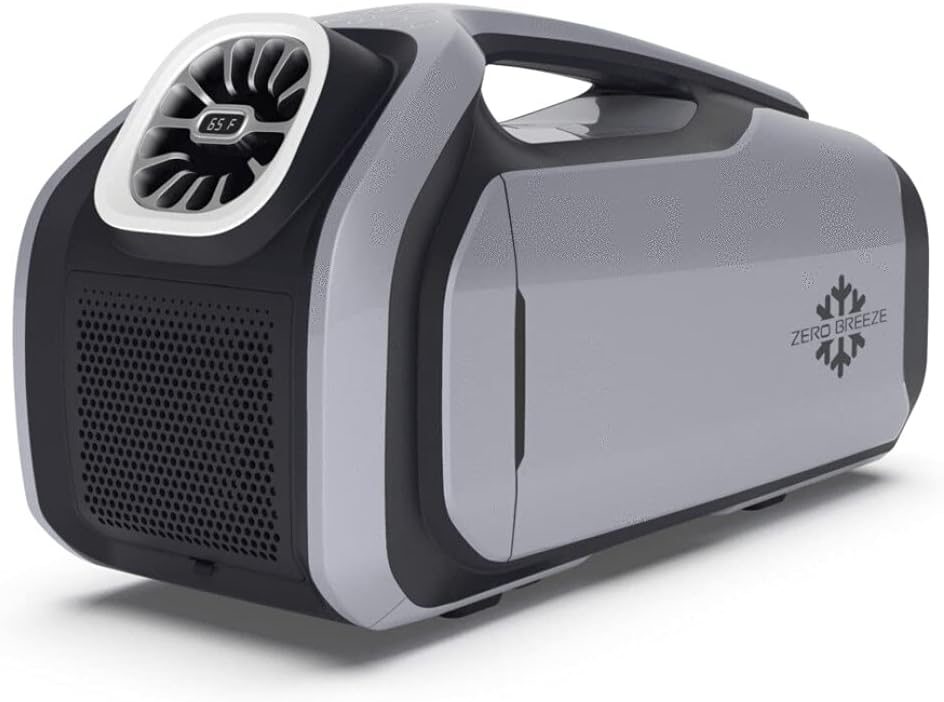
Zero Breeze Mark 2 is a well-known portable battery-powered AC that is specifically made to be used in the camp and outdoors. This unit weighs approximately 16.5 pounds and is small enough to be used during tent camping and it has a shoulder strap to carry.
It has a small rotary compressor that provides approximately 2,300 BTU of cooling, or enough to reduce the temperature inside a 2-4 person tent by several degrees. Zero Breeze was one of the few actual air conditioners that can operate on its own battery, which is why it is perfect to use during off-grid adventures in our study.
Power & Runtime: The Mark 2 can be powered using an optional lithium battery pack, or by using a 24V DC power source (it also comes with an AC/DC adapter to use with a wall outlet). A full battery provides about 3-5 hours of cooling based on the fan speed and ambient conditions. This is awesome to pass through the hottest part of the night.
It is also possible to connect it to a solar generator or a car outlet to use it longer. It is quite efficient at around 240W consumption on max. It is commonly used with a portable power station to run overnight.
Cooling Efficiency: You are not going to be able to make your tent an icebox, the Zero Breeze has 2,300 BTU, which is sufficient to be a personal cooler or to cool down the heat. It can blow cold air down to 60°F at the vent and in a tent it can cool the inside temp several degrees with some insulation.
It works best at night or in the shade (the noontime sun in a light tent can overwhelm it). Nevertheless, compared to its size, it offers a significant comfort enhancement within small areas. It also cools by dehumidifying, which is an advantage in humid climates.
Noise & Features: The Mark 2 has a noise level of approximately 52 dB (similar to a fan on medium). According to campers, it is quiet to the extent that one can sleep with it a few feet away. It has several fan speeds and even an attachment to a vent hose to blow hot exhaust air out of your tent.
It is easy to set up: place the unit in the tent, and the small exhaust hose outside (through a tent opening), and either connect the battery or plug it in. It does not require any drainage because it evaporates condensate in the exhaust. All in all, the Zero Breeze Mark 2 is the portable AC of choice of serious campers who require off-grid cooling and want a balance between portability and functionality, but at a high price (the advanced battery technology does not come cheap).
2. EcoFlow Wave 2 Portable AC (with Heating)
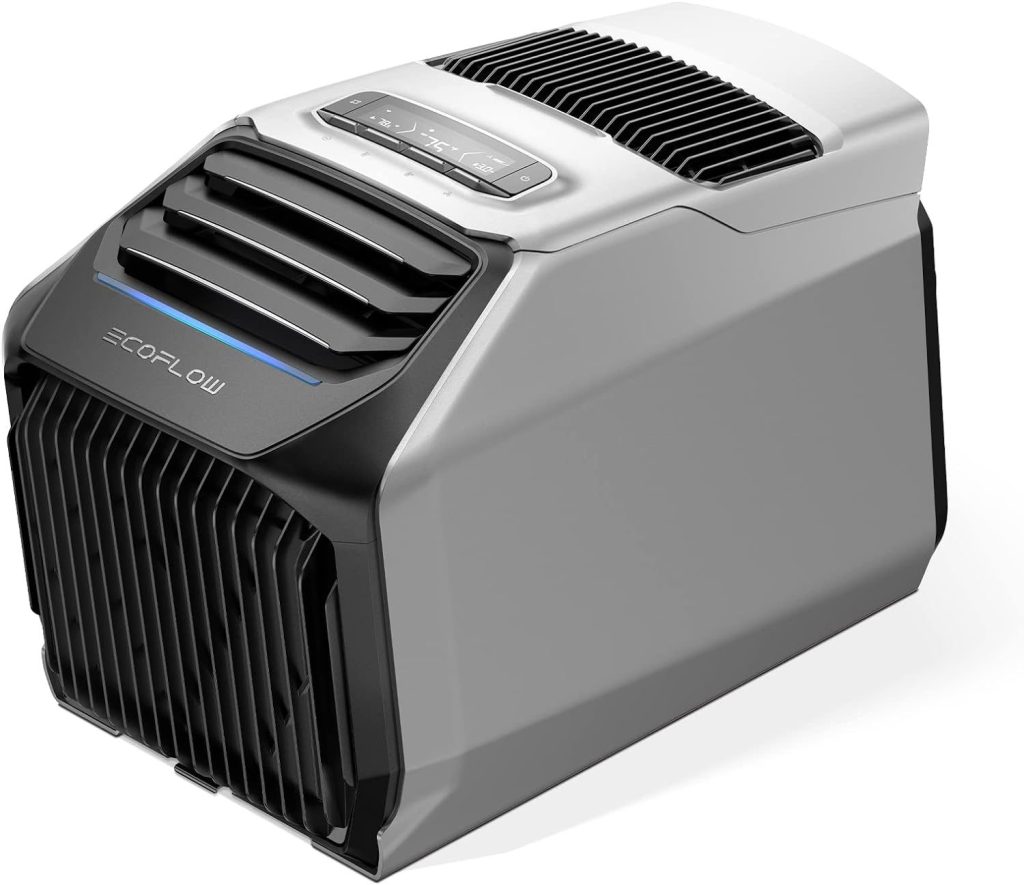
EcoFlow Wave 2 is a powerful portable AC that can also be used as a heater, which makes it a good option to use during camping in summer and during shoulder seasons. It is a second generation model by EcoFlow, who are well known battery power stations. The Wave 2 has a cooling power of 5,100 BTU (and 6,100 BTU heating), which is much more than the average camping AC unit.
It can rapidly cool down bigger tents, RV interiors or campers of up to approximately 64-86 sq ft (6-8 m2). But all that power is packaged in a bigger package, 32 pounds and approximately the size of a small suitcase.
Power Options: The Wave 2 can be powered on regular 110-120V AC power or powered by the add-on battery pack by EcoFlow to operate cordlessly. The battery (sold separately, ~1159Wh capacity) is fitted on the bottom of the unit. The battery gives you about 3 to 8 hours of battery life (3 hours on max cool, up to 8 hours on eco mode) as per the manufacturer. In practice, you should get ~3-4 hours of powerful cooling on battery.
The unit consumes approximately 500W in cooling mode so you can extend its run time with a large external battery or solar panels. A good one is that it can be charged by solar or car DC input as well as wall charging, so it can be used off the grid (though you will need a powerful power system to take full advantage of it).
Cooling Performance: Raw performance-wise, the Wave 2 tends to be regarded as the best-in-class cooling unit when it comes to camping. It is able to cool the temperature significantly quickly EcoFlow says that it can cool 10°F in 5 minutes in a small area. According to campers, it is able to maintain a mid-sized tent very comfortable, particularly at night.
At peak sun, as with any AC, it can have trouble with direct heat on your tent, but with its high BTU it has a fighting chance even in less than ideal conditions. The Wave 2 actively dehumidifies (as a true AC) unlike evaporative coolers, which is a major plus in hot, humid weather. It also features a heating mode to use during cool nights, in effect a mini heat pump.
Noise & Usability: EcoFlow has made this unit with low noise in mind, the noise level is 44 dB or less in the lowest setting. It is louder at full blast but otherwise it is quieter than a typical home portable AC. To sleep, you can put the low fan or eco mode to keep the noise low.
The Wave 2 does not need any drainage in cooling mode, unless you are in very humid conditions, because it has an internal evaporation system of condensate (so you do not need to empty water frequently). It is just like other ACs: you will have to connect the ducts that come with it (it is a dual-hose system, so there is an intake and exhaust duct) and take them outside the tent. This model is certainly more expensive and weighs more than you would want to carry around, but in case you value cooling power and have the resources to operate it, the EcoFlow Wave 2 is a great option when glamping and in large tents where comfort is the priority.
3. EENOUR QN750 Portable AC (2900 BTU)
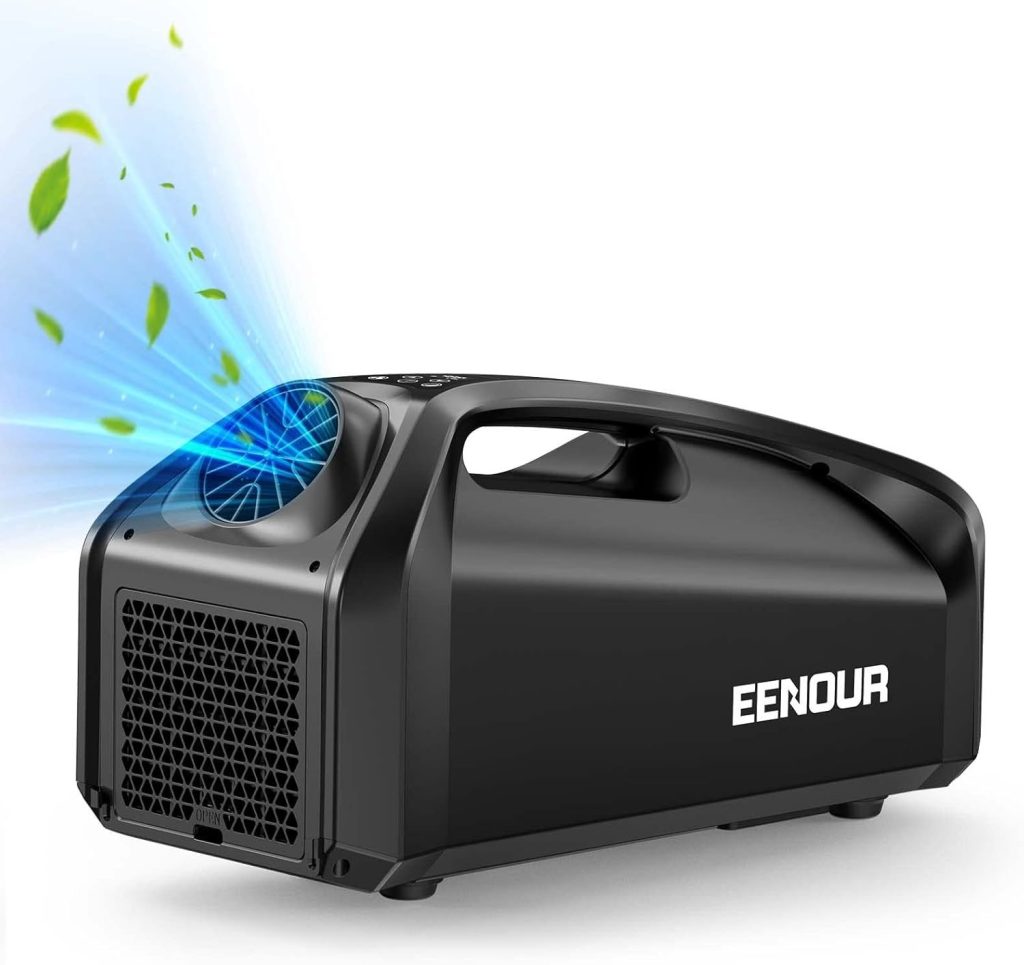
The EENOUR QN750 is a portable air conditioner that targets campers and RV travelers, which provides a good compromise between size, power, and cost. It has a 2,900 BTU cooling capacity, which puts it in the same league as the Zero Breeze, though the design is a little more utilitarian.
It is approximately 22 pounds and is solid, boxy in construction with a top handle to carry it. The QN750 is also popular with many campers who use it to tent camp, as it is an inverter compressor AC, which can adjust its cooling output, and run more efficiently and quietly once the desired temperature has been achieved.
Power & Compatibility: The QN750 is compatible with 24V DC power or standard AC (100-240V) using the provided adapter. It consumes approximately 250W when it is at full throttle. This is a fairly low power draw, which means it is possible to power it with a mid-size portable power station (e.g. 1000Wh battery would power it ~4 hours).
It does not have its battery, so you will have to connect to a power source: a wall outlet, a vehicle battery (with inverter), or a solar generator. The versatility is good, you can use it at a powered campsite and you are good to go, or you can use it off-grid and hook it up to a generator/battery system. Nighttime cooling Many overlanders run this unit off a Jackery, Bluetti or other power station at night.
Cooling & Usage: The 2,900 BTU cooling provides enough cooling to a small tent or van. Users say that it can be depended upon to maintain a tent in the 60s-70s °F at night when it is 80+°F outside. On really hot days in the direct sun, it may lag behind like most small ACs, but it is a good night cooler to make you sleep comfortably.
A particularly good example is the QN750 approach to achieving the target temperature: rather than turning off, it slows down the compressor and fan to continue providing a constant stream of cool air. This prevents the on-off cycling which may result in humidity peaks. Talking about humidity, it is a two-hose model, and it can release condensate along with the exhaust, so you will not have to drain water manually frequently (unless it is very humid).
Noise & Setup: The EENOUR QN750 has a noise level of less than 50 dB as per the specifications. Practically, it is quite quiet to campers, particularly after it ramps down. The inverter technology makes it much quieter and energy-saving compared to most of the cheap portable ACs.
Installation is simply connecting the supplied exhaust (and intake) hose and placing the unit so that the hot air will escape outside the tent. Make sure that it is leveled to enable it to handle condensation. Overall, the EENOUR is commended as simple to operate and useful on tents, with the only drawbacks being its price (though not expensive, still not as cheap as entry-level competitors) and the necessity to have an additional battery or power source. The QN750 is a good choice of tent AC in case you want a reliable one that is efficient and relatively quiet.
4. BougeRV 3500BTU Portable Air Conditioner
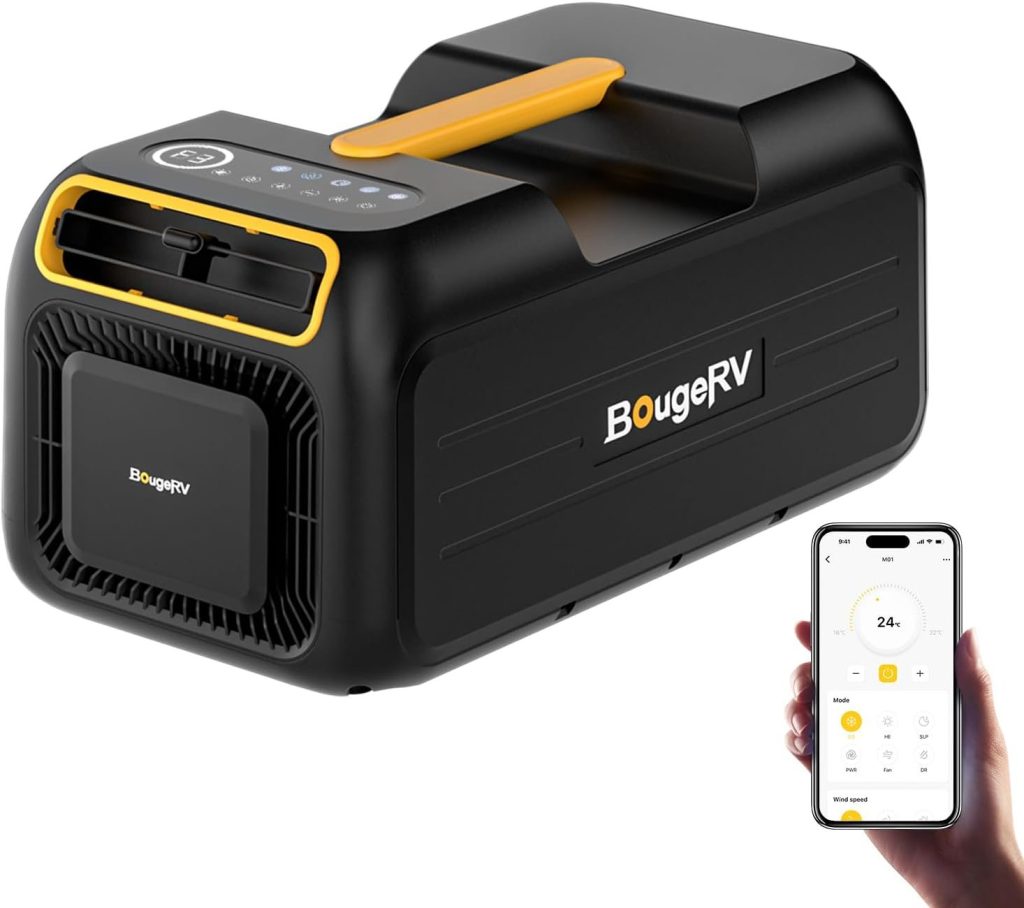
BougeRV, which specializes in RV and off-grid equipment, sells this 3,500 BTU portable AC unit, which is aimed at campers. It is a little bigger in capacity than the 2,000-3,000 BTU units and as such it is a little bigger and heavier. It weighs approximately 33 lbs, which is a little heavy when it comes to portable tent ACs, but still easy to carry around in case of a short move (it has side handles).
BougeRV 3500 is a compressor AC that has a dual-hose design. It can cool small enclosures such as tents, vans or truck campers, and is marketed to cool spaces up to ~212 cubic feet (approximately a 4-person tent) by approximately 18°F in 15 minutes.
Cooling & Features: This unit has 3,500 BTU which makes it fall in between the small battery ACs and full-size home ACs. It is able to cool the temperature in a tent to comfortable levels when the outside temperature is not scorching.
BougeRV says it can blow cold air so far that you will feel it even 10 feet away, which is handy in case you have a bigger tent or you want to direct it right at your sleeping spot. It has a digital thermostat where you can set a desired temperature (61-90 degree range) and has several modes such as a dehumidifier mode and a sleep mode. A remote control is included, and even a smartphone app (via Bluetooth) allows you to change the settings without getting out of bed, which is a pleasant convenience in the camp.
Power & Operation: This AC can be powered with a DC 24V source or AC power (110V using the adapter). It consumes about 300-350W during cooling (estimate, based on its BTU). When using it off-grid, you will require a large portable power station or generator because it has a greater power demand and weight.
As an example, a 100Ah deep cycle battery (approximately 1200Wh) would perhaps power it ~3-4 hours. It is most appropriate in campsites where you can recharge daily or have some AC power at some point. It can be continuously used on 115V shore power. The BougeRV 3500 has an internal condensate evaporation system, too, but in very humid weather you may have to drain water now and then (it has a drain plug).
Noise & Suitability: Noise is graded approximately 50 dB at a distance which is similar to other models of its type. It is usually not loud enough to keep one awake, particularly when the fan is on low or sleep mode. This unit is ideal because of its size and weight, and increased cooling capacity, which makes it ideal to those who need maximum cooling in a tent without having to use a full-size AC.
When you are at a single place (such as a base camp or in an RV park with a tent), the weight is not so much of a problem. It may be excessive on a small tent, but when you are camping in hot places and you have a medium to large tent, the BougeRV provides powerful cooling. It is a good option to campers with the capability to carry it and would rather have a cooler tent than a super-lightweight tent.
5. BLACK+DECKER BPACT08WT (8000 BTU Portable AC)
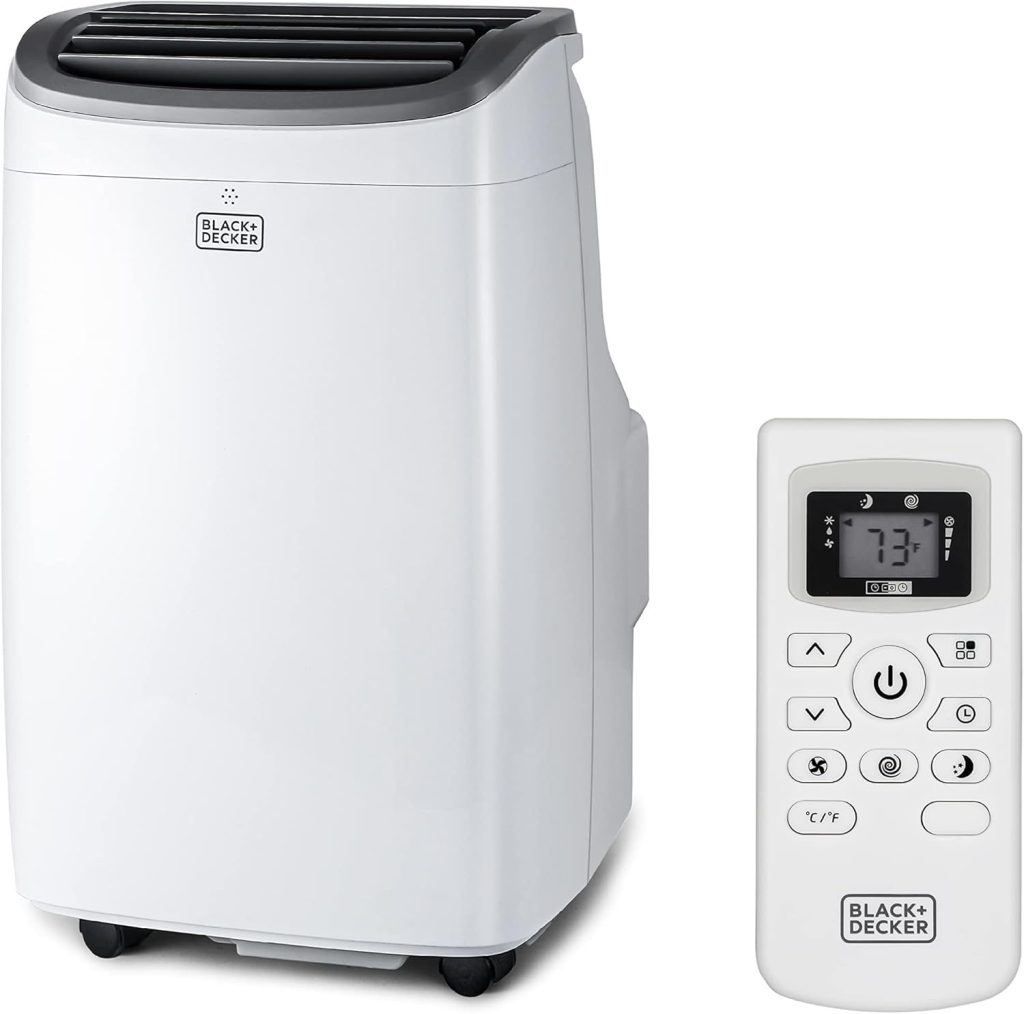
There are a lot of campers who have been able to use the regular home portable AC units in tents in a creative way. The BLACK+DECKER BPACT08WT is a proven and tested 8,000 BTU (ASHRAE) portable air conditioner that is designed to be used in small rooms but can be used as a camping tent AC in case you have a way to power it.
It is much bigger and heavier than the purpose-built camping ACs, which are approximately 46 lbs and 16x13x26 inches in dimension. So although it is termed as portable, it is a bit of a workout to move around. This unit is however much more powerful in terms of cooling capacity, and it can cool a large tent or even a series of tents (or canopy area) when placed appropriately.
Cooling Power: This BLACK+DECKER has a DOE/SACC rating of about 5,000 BTU (8,000 BTU by the older ASHRAE standard), which means that it can actually cool a tent like a small room. It can save your life during the day when you are camping in the extreme heat and you are stuck in a camp.
It has reduced the temperature of a huge 6-person tent to a drastic level, even when it is 90°F outside, but you will have to insulate and vent the tent properly. It is simply a normal AC, thus it will eliminate humidity (a great advantage) and make the conditions dry and cool. It has an in-built thermostat and will switch the compressor on and off to ensure that it keeps your desired temperature.
Power Requirements: The first thing is that this unit is powered by 115V AC only and consumes about 800 Watts or more when cooling. This implies that you will require a campsite that has an electrical connection or a generator that can support it. It is not usually feasible to run it off batteries (an average 100Ah battery would last an hour).
One of the strategies is to use a quiet inverter generator during the day and turn it off at night, cool the tent in the evening, and use fans at night, which is applicable to some campers. In case you do have shore power, then this AC is easy to use, just as it is at home (and you can run it all night without any problems).
Installation & Sound: You will have to install the exhaust hose and window adapter that comes with it in a tent. A makeshift vent can be fitted to many large tents or tent vestibules, some people zip the window kit into a tent door, or just make a flap opening to the hose. Ensure that the hot exhaust is blown out fully or you will be struggling with yourself.
Under most conditions, condensate is evaporated out the exhaust (it is self-evaporating), but in very humid weather it may accumulate in a tank that you would have to drain periodically. Noise-wise, this unit will be about 54-60 dB, which is the loudest on this list. It has the sound of a loud fan or white noise machine when it is running. This is acceptable or even drowns out outdoor noises to some people, and to others, it may be disruptive. Overall, the BLACK+DECKER 8000 BTU is a great deal as a cooling device in case you have power at hand – it is one of the cheapest devices per BTU. It is not specifically designed to be used in camping but with some creativity, it can make you very cool in the wild.
6. Evapolar evaCHILL Portable Evaporative Cooler
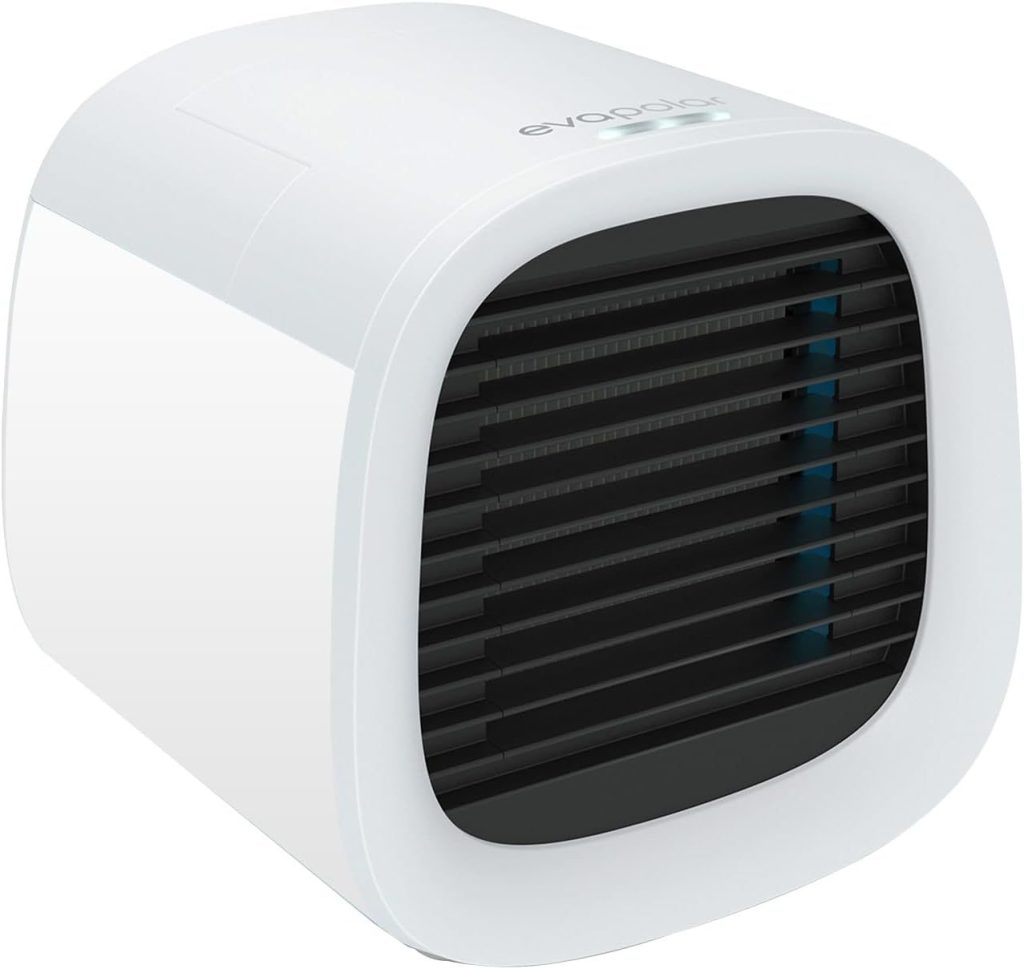
To campers who require something that is very portable and only need personal cooling, an evaporative cooler such as the Evapolar evaCHILL is worth considering. It is not a conventional AC, it is a mini USB powered cooler that cools the air by evaporating water. It is a mini swamp cooler on steroids, which you can put on a nightstand or next to your sleeping bag.
The evaCHILL weighs only 1.7 lbs and is approximately 7 x 7 x 7 inches, making it very easy to pack and carry. It is charged through a USB cable (5V, 2A), meaning that you can charge it with a portable battery pack, a car USB, or a solar charger. No heavy batteries, no compressors here.
Cooling and Use Case: The cooling is localized as there is no BTU rating (there is no compressor). You fill its internal tank with water (it has approximately 800 ml, and that lasts approximately 4-6 hours). The water is evaporated through a special cartridge cooling the air blowing out.
It may reduce the apparent air temperature by 10-15°F in a small region in a dry climate. The effect is less pronounced in a humid climate (several degrees of cooling with increased humidity). This is basically ideal in dry, desert-like situations or in spot-cooling a single individual. In a tent you would want to have it close to you and perhaps slightly air out the tent so as not to over-humidify the tent.
The EvaCHILL can turn a hot, dry tent into a much more comfortable place to sleep by blowing a fine spray of cool, wet air in your face.
Portability & Noise: The Evapolar is simple and beautiful, there are no exhaust hoses, no compressor noise. It is quite silent, normally about 45-50 dB (only the fan). It has no heavy components, and it uses power of approximately 7-10 Watts.
This implies that you can play it throughout the night using a USB power bank with a capacity of 20,000mAh. It is ready in a second: just pour water in, connect it to USB and turn it on. It is also a small humidifier and air cleaner (the evaporation cartridge cleans dust). The only thing to consider is that you will have to change the evaporative cartridge after every few months of usage (to avoid mold/mineral build up) and you should make it dry between uses.
Limitations: The Evapolar is not an ideal cooling solution to cool down a tent with multiple occupants, but it is an ideal cooling solution to help one person stay cool. When you are in a large tent with a group, you may require a unit per person so that it can be effective and it will not lower the ambient temperature of the tent much when the tent is enclosed.
Nevertheless, the evaCHILL is a nice gadget to have when one is camping alone or when one desires a low-power cooling device that can run silently throughout the night. It is particularly common with backpackers or minimal campers who cannot carry heavy AC units but would like to get some respite against the heat. It costs well below 100 dollars and is a cheap addition to your equipment that can help you through the hot summer nights without any complex installation.