Having the perfect humidity level in the bedroom is a necessity to ensure comfort, improved sleep and quality of air.
Too much moisture may cause musty smell, molds and dust mites, which affect your health. An effective bedroom portable dehumidifier can make the room more comfortable and humidity-free.
Here is a brief comparison of the 5 best bedroom dehumidifiers on Amazon, and then there is a detailed review and a buying guide.
Top 5 Best Portable Bedroom Dehumidifiers – Quick Comparison
| Dehumidifier | Capacity | Coverage | Noise Level | Key Features |
|---|---|---|---|---|
| hOmeLabs 22 Pint Dehumidifier | 22 Pints/Day | Up to 1,500 sq. ft. | ≈50 dB (Low) | Wi-Fi App Control, Energy Star, Wheels |
| Honeywell Smart Dehumidifier 30-Pint | 23 Pints/Day | Up to 1,500 sq. ft. | 51 dB (Low) | Wi-Fi & Alexa, 1.7 Gal Tank, 5-Yr Warranty |
| Waykar 2000 Sq. Ft Dehumidifier | Up to 34 Pints/Day | Up to 2,000 sq. ft. | 33–45 dB (Quiet) | Auto Humidistat, Continuous Drain, Compact |
| Midea Cube 20 Pint Smart Dehumidifier | 20 Pints/Day | Up to 1,500 sq. ft. | ≈42 dB (Low) | Collapsible Design, Wi-Fi, Large Tank |
| TABYIK 35 Oz Small Dehumidifier | 16 Oz/Day | Up to 280 sq. ft. | 28 dB (Whisper) | Thermo-Electric, 7-Color Night Light, Auto-Off |
#1 hOmeLabs 22 Pint Dehumidifier – Best Overall for Bedrooms
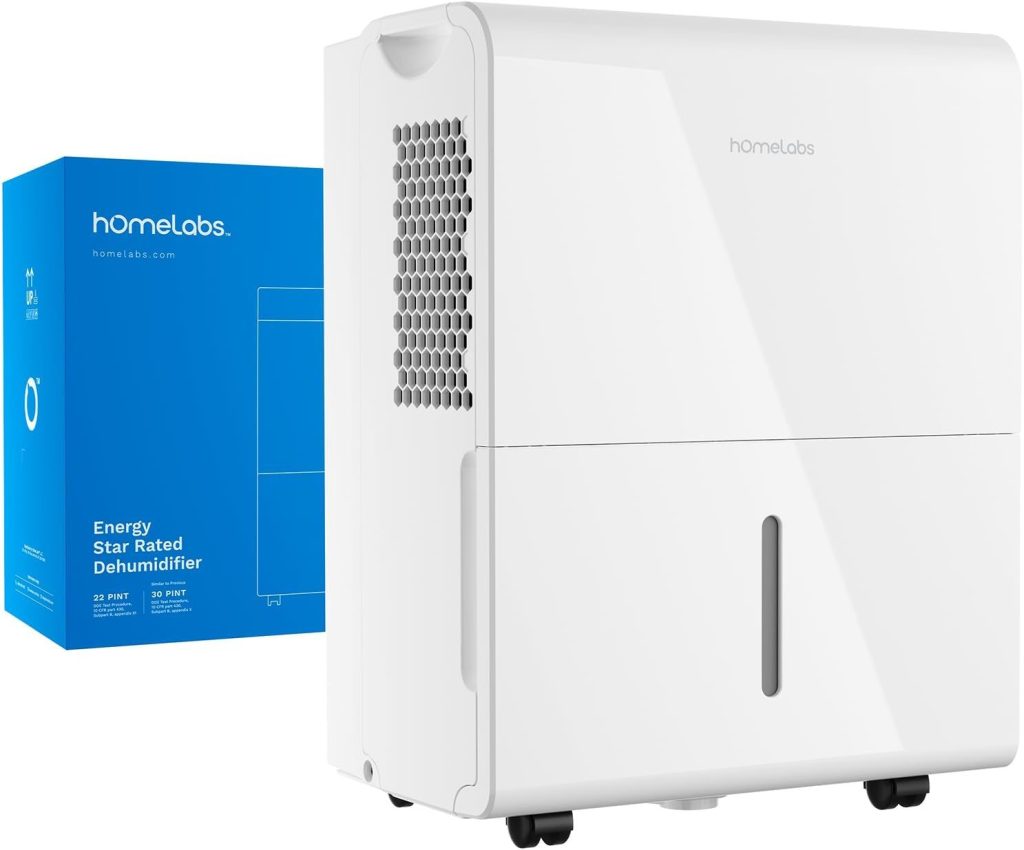
hOmeLabs 22 Pint Dehumidifier is an Energy Star certified, highly-rated unit that is suitable in medium-sized bedrooms. Having a moisture removal rate of 22 pints per day (used to be rated 30 pint in the older standards), it can dry out rooms of up to approximately 1,500 sq. ft.
This is what makes it an all-purpose master bedroom, guest room or even a small apartment.
The design has in-built wheels and handles that make it easily portable, and you can move it where you want. It is smooth and neutral in appearance and fits in most home decor.
Its Wi-Fi enabled smart control is one of its outstanding features. With the help of the companion smartphone app (iOS/Android), it is possible to control and change the humidity settings remotely. This dehumidifier also embraces schedules and alerts, which provide you with convenient control of the humidity of your bedroom without having to manually tamper with the machine at night.
Its easy installation and low fan mode operation are a plus to the users as it is crucial to those who sleep lightly.
The unit provides a continuous drainage facility through an outlet hose (sold separately) to operate it without any hassle or you can use the removable tank that has a capacity of approximately 0.8 gallons of water. There is an auto shut-off that switches off the dehumidifier when the tank is full to avoid overflow. In general, the hOmeLabs 22 Pint is a high-performance but quiet bedroom dehumidifier that offers a good balance of performance, smart features, and price, which is why it is our overall favorite.
#2 Honeywell Smart Dehumidifier 30-Pint – Quiet Comfort with Smart Controls

Honeywell Smart Dehumidifier (30-Pint) is a good choice to keep bedroom humidity comfortable due to its trusted brand quality and a wide range of smart features. It removes as much as 23 pints of moisture daily (30 pints, according to older DOE standards), which is appropriate in areas of about 1,000-1,500 sq. ft.
Although it performs so well, it is built with quiet operation in mind, and at about 51 decibels on low fan, it only produces a slight hum, which can easily be lost in the background of a bedroom.
This Honeywell dehumidifier is Wi-Fi-enabled and can be controlled using a specific mobile app and Alexa voice control. It is possible to set humidity levels, fan speed, turn it on and off remotely or by voice command, which is convenient to use at night or when you are not at home.
It has a digital humidistat display that is easy to read and it provides two fan speeds as well as a 24-hour timer and Sleep mode to operate even more quietly at night.
The build quality of Honeywell is also notable, and it has such features as a patent-pending anti-spill tank design (approximately 1.7-gallon capacity) to avoid making a mess when draining water, a washable air filter to clean the air, and caster wheels that roll smoothly. Protective features like thermal overload protection provide an added sense of security when used continuously.
This unit is manufactured to be reliable with a 5-year manufacturer warranty. To the people that prefer a silent, intelligent dehumidifier with a well-known brand, Honeywell 30-Pint Smart Dehumidifier is a high-end option to make a bedroom comfortable.
#3 Waykar 2000 Sq. Ft Dehumidifier (PD160B) – Best for Small to Medium Bedrooms

Waykar 2000 Sq. Ft Dehumidifier is particularly commended on its bedroom-friendly design, with its humidity control being effective and in a small, silent package. It has the capacity to dehumidify up to approximately 34 pints of moisture a day in very humid conditions (8.5 pints at the standard AHAM test conditions) and is thus appropriate to use in most bedrooms, living rooms or even bathrooms up to approximately 2000 sq. ft. in size.
Although it performs well, the Waykar has a low profile and is lighter than most similar units, which is excellent when it comes to moving around the rooms.
Its ultra-quiet operation is one of the outstanding features. At the low fan speed, it runs at about 33 dB, which is practically a whisper, so it will not disturb sleep. The noise is very moderate even when the fan is running at faster speeds and will not dominate the room.
The Waykar also produces very little heat when in use, so it will not cause your bedroom to become warm (as is often the case with dehumidifiers that run overnight).
This dehumidifier has an adjustable humidistat and auto mode: you can adjust the humidity level you want and the dehumidifier will automatically switch on and off to keep the level. The LED screen is deliberately less bright, that is, no blinding lights to wake you up at night.
It has an auto shut-off of 0.66 gallons removable water tank. To run continuously you can connect the supplied drain hose to direct the water to a floor drain, but there is no in-built pump, so the drain is gravity-fed. The basic control panel has a child lock, two fan speeds and a 24-hour timer. On the whole, Waykar PD160B is a very quiet and efficient device that can be used in bedrooms, and it is a great choice in small and medium bedrooms where noise is not a priority.
#4 Midea Cube 20 Pint Smart Dehumidifier – Innovative Design for Large Coverage

Midea Cube 20 Pint Dehumidifier is a new space-saving product that does not compromise on the performance. Having a capacity of 20 pints per day (old rating of about 30 pints), it is able to serve bedrooms and spaces of up to 1,500 sq. ft. without any problem.
The Midea Cube is special in that it has a collapsible cube design – when not in use, the unit folds into its water tank, cutting its size by about half so that it can be easily stored or placed. When operating, you may extend it to sit in its bucket or even position the main unit above the bucket, which makes the effective tank capacity of the dehumidifier much larger than the normal dehumidifiers.
It is a completely smart-enabled model: with the help of the Midea Air application, you can control the real-time humidity, change the settings, and get alerts. It is also compatible with Alexa and Google Assistant to use voice control.
The Cube has an in-built sensor that will inform you about the amount of water in the tank via the app, which is useful in case you do not want to be surprised by a full tank. The water reservoir is also very large (up to 3+ gallons when the cube is fully extended) so that the time between empties can be increased. Naturally, you may also use the provided hose to have continuous drainage in case you do not want to empty a bucket.
The Midea Cube is effective in terms of performance, as it is able to draw moisture even in bigger rooms or wet rooms. It has 2 fan speeds and is quite quiet (about 42 dB on low). Remember that on its maximum setting it is capable of a little more white noise and a bit of warmth, as the compressor is pushed harder.
Nevertheless, it can fit most bedrooms, particularly when it is located several feet away of the bed. Other features are auto-defrost (low temperature operation), auto-restart in case of power failures and easy-carry handle. The Midea Cube is a smartly designed device that fits into a small space or people who prefer smart features.
#5 TABYIK 35 Oz Small Dehumidifier – Best Mini Dehumidifier for Small Bedrooms

TABYIK 35 Oz Small Dehumidifier is a cheap Peltier dehumidifier that is ideal in small bedrooms, nursery, closets, or any small room of up to approximately 200-280 sq. ft. This small unit is thermo-electric (Peltier) based rather than using a compressor, and thus is ultra-quiet at just ~28 decibels.
It is the level of a whisper, so it is perfect to place it next to the bed or people who are sensitive to noise.
Although it is quite small (approximately 5.9 x 5.9 x 10.1 inches), the TABYIK can absorb up to 16 ounces of water per day (450 ml) in extremely humid environments (86 o F, 80 % RH). It gathers moisture in a transparent tank of 35 oz (1000 ml). The water level is easily visible in a glance and a soft ambient LED light is used to light the tank.
As a matter of fact, this dehumidifier has a 7-color ambient night light option – you can select to rotate the colors or stick to one color to provide a soothing glow to your bedroom at night (or turn it off altogether in case you prefer darkness).
The TABYIK dehumidifier is easy to use: there is only one button to switch on and another one can be used to switch the light on or off. Once the tank is nearly full (approximately 24 oz capacity is reached), it will automatically turn off and flash a red light to remind you that it is time to empty it, so there will be no spills.
It is highly energy-efficient, since it is a low-power device (consumes approximately 40W), and in a continuous operation it would consume approximately 1 kWh of electricity per day. It is also easy to maintain, all you need to do is clean the air inlet filter occasionally and empty the tank.
It will not dry out a big master bedroom or a wet basement, but the TABYIK 35 Oz is perfect at controlling the humidity in smaller spaces where a bigger dehumidifier would be excessive. It is a great small device to stop condensation on windows, stinky clothes, or overall sweatiness in enclosed areas, and yet it is silent as a mouse and can be carried anywhere.
Bedroom Dehumidifier Buying Guide
Selecting the most appropriate dehumidifier to use in the bedroom is a process that takes into account issues that are specific to a bedroom setting. You will need a unit that is able to remove moisture and at the same time be quiet and convenient.
We have divided the main considerations and features below to make an informed decision.
Room Size and Dehumidifier Capacity
Use a dehumidifier that is proportional to the size of your bedroom and the level of humidity. The dehumidifiers are commonly rated on the basis of the number of pints of water that they can eliminate within a day.
A typical bedroom (150-300 sq. ft.) can typically be served by a unit rated at 20-30 pints per day to keep the humidity comfortable (40-50% RH). A 1-10 pint/day machine (such as the thermo-electric minis) may be sufficient in a small room or a room with moderate humidity, but a 30-50 pint machine may be necessary in a large bedroom or in a very wet environment.
Remember that testing standards have been adjusted by the DOE in 2019, and newer ratings (e.g. 22 pint) may be equivalent to older 30 pint units, instead pay attention to the manufacturer recommended room coverage (in square feet). As a rule, it is better to be on the safe side and get a slightly larger capacity bedroom unit in case you live in a very humid climate or the room lacks good ventilation, since the unit will not have to work as hard (which can result in quieter, more efficient operation).
Noise Level for Nighttime Use
This dehumidifier will be used in a bedroom and therefore, quietness is essential. Ensure that the noise level (decibel rating) is checked.
A lot of compressor-based dehumidifiers run between 50-60 dB on high, which is roughly the same volume as a typical conversation. To use in the bedroom, seek a model with a low fan speed of about 40-50 dB or special sleep modes. There are some units such as Waykar or Honeywell which have been reported to have a quiet hum that will not disturb sleep. Thermo-electric (Peltier) models are very quiet (20-30 dB) and only work in very small rooms.
As a light sleeper, you may want to keep the dehumidifier at a greater distance to your bed or operate it earlier before bedtime, and then turn it off or to a low setting with a timer or humidistat control at night.
Tank Capacity and Drainage Options
Every portable dehumidifier will gather water in a tank (bucket) unless you have a drain. The size of the tank is important in that the smaller the tank the quicker it will fill up and you will have to empty it more often – perhaps even at night time in the case of a very damp room.
As an example a mini unit with a 1 liter tank may require emptying each day, a 20-30 pint unit usually has a tank of about 0.8 to 1.5 gallons which may last a couple of days of occasional use. In case you do not want to bother with emptying the tank, seek those models that have a continuous drain option.
Majority of compressor dehumidifiers (including those of medium capacity such as 22-30 pint) allow you to connect a regular garden hose to direct water to a floor drain or sink. But take care that unless the dehumidifier has an in-built pump, the drain is gravity-based, i.e. the end of the hose must be lower than the unit. Continuous drainage is convenient where you have an en-suite bathroom or where you can run a hose out of sight.
More expensive or larger units may have an internal pump that can force water up to a sink or out a window, although portable bedroom units less than 30 pints almost never have this capability, it is more common on larger 50+ pint models.
The other option is an auto shut-off when the tank is full (this is virtually in all the modern units). This makes the unit cease dehumidifying to avoid overflow and in most cases an indicator light will remind you to empty the bucket. A transparent or front loading water tank is an advantage so that you can have a glance at the water level.
Humidity Control and Settings
An adjustable humidistat should be present in a good bedroom dehumidifier. This will enable you to program a desired humidity (e.g. 45% relative humidity) and the dehumidifier will switch on and off to keep the desired humidity. Having a stable level of humidity is not only comfortable but also energy-efficient because the unit will not be turned on all the time when the required RH is achieved.
Seek digital controls or at least a plain dial to set humidity. Most units have incremental settings (e.g. 5 percent increments). Other less complex or smaller dehumidifiers may not have a humidity sensing ON/OFF, those you will have to operate manually or with a timer.
Talking about it, a timer feature comes in handy in a bedroom environment. The dehumidifier can be programmed to switch off or on after a specified number of hours.
As an example, you may set a timer to turn it off in the morning in case you want it to work only during your sleep. Or, on the other hand, run in the evening and switch off automatically at night. Also, units that have several fan speeds should be considered.
High speed is handy when you want to get moisture out of the air (after a humid summer day or when you first turn on the unit in a stagnant room), and low speed is excellent when you want to keep levels up in a quiet way. An exclusive Night mode or Sleep mode is an added advantage that reduces display illuminations and makes it the quietest mode.
Energy Efficiency
As a bedroom dehumidifier can be used several hours per day (during rainier seasons), energy efficiency is one of the aspects to consider.
On the larger models (typically 20 pint and larger) look for the Energy Star certification. Energy Star units are efficient to some degree and will consume less power to remove the same amount of water. This does not only save you money on your power bill but also means that the unit is usually cooler and possibly quieter due to efficient design.
Ensure the wattage or the approximate annual energy expenditure is checked. In most cases, an average of 200-300 watts may be used when operating a 22-pint dehumidifier. In perspective, that is equivalent to a couple of light bulbs. Thermo-electric mini dehumidifiers consume even less (about 40-70 watts on average), but once again they deal with much less moisture.
Also, bear in mind that larger capacity dehumidifiers, although they might consume more power directly, will achieve the humidity goal quicker and turn off earlier in a small room.
Conversely, a smaller unit may be forced to operate on a continuous basis. When energy consumption is a major issue, select a unit size that fits your space (not too large or too small) and employ such features as timers or humidistat control to prevent unnecessary use. Other intelligent dehumidifiers can also be tracked through apps to monitor the number of hours they run daily and you will be able to know the energy consumption.
Smart Features and Connectivity
The use of smart dehumidifiers has increased over the past years. The availability of Wi-Fi connection in a bedroom dehumidifier enables one to control it easily without having to move to the dehumidifier itself- in case it is at the other side of the room, or when you are already in bed.
Using a smartphone application, you will be able to monitor the current humidity level, adjust the settings, and get notifications (e.g. when the tank is full). Voice assistants such as Amazon Alexa or Google Assistant can be integrated so that the device can be turned on/off or humidity setpoints can be changed by voice.
These features are not required but may be useful to improve user experience, particularly, to tech-savvy users or users who wish to integrate the dehumidifier into their smart home automation (e.g., you can create a routine that switches on the dehumidifier when the humidity exceeds a certain level in the evening).
Remember that when it comes to any connected device, you would want to make sure that the app experience is stable. Such brands as Honeywell and Midea have developed apps and support.
hOmeLabs has also app control that is convenient to use. A manual unit may be good enough in case you want to keep things simple and do not want to experience any possible connectivity glitches. The main performance must be the priority, and smart features are a good bonus in case they exist.
Size, Portability, and Placement
You might not have much room in a bedroom, and size does count in the case of a dehumidifier. Measure the size, most 20-30 pint ones are about the size of a small trash can or bedside table (perhaps ~20 inches tall, 10-15 inches wide).
Measure to make sure that it fits in your bedroom, which may be small or you want to put the unit in a certain location (such as a closet or under a window). Portable dehumidifiers are usually fitted with caster wheels and handles. Wheels are very handy in moving the unit around when cleaning or when you wish to roll the unit to a different room.
Carry handles (usually top or side handles) assist in the lifting or transportation of the dehumidifier, as even the smaller compressor-based ones may weigh 20-30 lbs. An example is the Waykar PD160B which is comparatively lightweight and compact in its category and therefore easy to transport.
Moreover, think about the location to achieve the best results: a dehumidifier requires air circulation, so do not place it directly against the walls or behind furniture. Put a foot or two of space between it and walls and close the doors/windows when it is running so it is only dehumidifying your bedroom and not the great outdoors.
In case you want to use it in a closet or en-suite bathroom on a regular basis, make sure that the cord can be stretched to an outlet without risk (most cords measure about 6 feet). Others are designed with cord wraps to ensure that things are neat when not in use.
Maintenance and Upkeep
Luckily, dehumidifiers do not need much maintenance, but there are a couple of things that should be maintained to make sure that the dehumidifier lasts long and provides clean air. It goes without saying that the water tank should be emptied regularly so that the water does not stagnate and bacteria develop or the water has a musty odor.
Most of the tanks are detachable and come with handles or pour spouts that make them easy to dump. Rinse or wipe off the tank every now and then to avoid sliminess or mildew.
Most dehumidifiers include an air filter (normally washable) to collect dust and particles, both to filter the air and to safeguard the internal parts. In the case of a bedroom, this is fantastic since it can marginally serve as an air purifier by minimizing dust.
Make sure to clean the filter according to the recommendation usually once a month. Performance may be decreased by a clogged filter and the fan may be overworked. Most of the time it is just a matter of removing the filter and vacuuming it or washing with water and drying.
When continuous drainage is done with a hose, occasionally check the hose to see whether it is kinked or clogged, and make sure the drain pathway is clear.
In cooler areas, when your bedroom is very cold, you may want to know that compressor dehumidifiers have an auto-defrost feature to avoid frosting on coils (which can occur when room temperature falls below ~65F). Ensure that this operation is operational (you may observe the unit stop every now and then to defrost when necessary). This is automatically dealt with in most modern units.
Lastly, when the dehumidifier is not in use over long periods (e.g. in a dry winter), empty the tank, clean and dry it, clean the filter and store the unit in a dry location.
This will avoid the growth of mold or mildew in the storage. These are some easy maintenance procedures that will make your bedroom dehumidifier work effectively and last long.
Benefits of Using a Dehumidifier in the Bedroom
It is important to mention why it is worth investing in bedroom dehumidifier. Keeping the relative humidity at 40-50% in your bedroom can make it much more comfortable, the air will not be so heavy or sticky in summer, and you will not sweat so much at night.
Sufferers of allergy and asthma often feel better, as dust mites and mold grow well in high humidity; by controlling the humidity, the triggers can be minimized. Your bedding and clothes will remain fresher (no more that slightly damp feeling or musty odors). Electronics and wooden furniture in the room are also affected positively since they are less likely to be damaged by moisture or develop mold. Your sleep quality will even be better, because very humid air may cause difficulties breathing and sleeping restlessly.
With the help of a dehumidifier, you will make the sleeping environment cooler and more comfortable without making the AC work at very low temperatures.
A dehumidifier can be used alongside an air conditioner in the summer by those who have one. Air conditioners do dehumidify to some degree but in case your AC is too large or weather is mild, it may not run long enough to remove enough moisture.
That can be done by a small dehumidifier that can do the job in the background. A dehumidifier is even more essential in cooler seasons or when you have a basement turned into a bedroom, where you may not even use AC at all and humidity may be hanging around. In general, the presence of a special dehumidifier in the bedroom is the matter of controlling your comfort and health.
It is a rather small device which can significantly change the atmosphere in your room in terms of smell and comfort.
Compressor vs. Desiccant vs. Thermo-Electric
When browsing dehumidifiers, you might come across different technologies:
- Compressor Dehumidifiers: The most popular type to use at home (all the mid-size products in our top list are compressor-based). They are used to condense moisture by cooling coils. They work quite well even in bigger rooms and in humid environments. The negatives are that they are heavier (due to a compressor, similar to a mini fridge), make some noise and perform better at warmer temperatures (above ~60F).
- Desiccant Dehumidifiers: These are based on a moisture-absorbing material (desiccant) such as silica gel. True desiccant dehumidifiers are less popular in the U.S. market, and are mostly used in Japan or Europe in cool climates, in consumer models. They are able to operate at lower temperatures, and are usually lighter and quieter (no compressor). They however consume more energy per unit of water removed since they employ the use of a heater to dry up the desiccant.
- There are small rechargeable desiccant units (such as the Eva-Dry E-333) available to use in closets or gun safes, they quietly absorb moisture and you recharge them by plugging them in to dry out the crystals. They are excellent in small spaces, but in a bedroom, you would like an electric dehumidifier that actively circulates air.
- Thermo-Electric (Peltier) Dehumidifiers: These are the small ones such as the TABYIK which we tested. They apply a Peltier module to form a cold surface which condenses water. They are extremely silent (no compressor) and light. They consume very minimal power as well. They are however only effective in small spaces and in high humidity.
- When you place one in a big master bedroom that has high humidity, it will most probably be overpowered. They suit small bedrooms, bathrooms or as an addition to a closet. The first is that they hardly generate any heat in the room (only a little warmth), unlike the compressor types that do release some warm air.
To conclude, a compressor-based dehumidifier will be the de facto choice of effectiveness in most bedroom applications in the U.S., except when the room is very small or you require near-silent operation (where a thermo-electric unit will be adequate).
Desiccant models are an exotic option, but might be worth considering in case you required a very quiet, low temperature operation unit (and do not mind increased energy consumption). Never forget about the average temperature and the size of your bedroom and select the technology that suits your situation.
Price and Value (Avoiding Overpaying)
Although we are not going to talk about particular prices to follow the policy, it is necessary to think about the value you get concerning the features.
As a rule, the smallest thermo-electric dehumidifiers are the cheapest, however, once again they have a small area of coverage. Mid-range compressor models (20-30 pint) of such brands as hOmeLabs, Frigidaire, Tosot, etc. represent a performance/price sweet spot, as they are usually located in a middle price category and have such basic functions as humidistats and timers.
The top-end models or smart-connected models (Honeywell, Midea, etc.) may be a little more expensive because of the extra technology and brand reputation. Consider the features you really need. You are not a fan of Wi-Fi or digital screens? A less advanced model will cost you a bit less, but it will also keep your bedroom dry.
Conversely, spending a few dollars more on a well known brand with an extended warranty (5 years or more) may be worth it in the long run and service.
And long-term costs: a more efficient unit may be a little more expensive initially but cheaper to run on electricity. And a long-lasting unit will go through many seasons, but a very cheap no-name unit may have to be replaced earlier.
Review reliability – occasionally it is worth paying a little extra to avoid irritating problems (such as humidistats that do not work or rattling fans) to get a good night sleep. Luckily, there are a lot of alternatives in the market, and the five products that we have reviewed above will meet various budgets and requirements.