The following guide compares seven top natural gas garage heaters suited for garages, workshops, and small commercial spaces. The table below summarizes core specs to help narrow choices quickly.
| Model | BTU | Coverage | Type |
|---|---|---|---|
| Mr. Heater Big Maxx MHU80NG | 80,000 BTU | Up to 2,000 sq. ft. | Unit Heater, Vented |
| Dyna-Glo IR30NMDG-1 | 30,000 BTU | Up to 1,000 sq. ft. | Infrared Wall Heater |
| Modine Hot Dawg HD45AS0111 | 45,000 BTU | Medium garages | Unit Heater, High Efficiency |
| Reznor UDXC-45 | 45,000 BTU (two outputs) | Workshop / Shop | Ceiling/Wall Unit, Indoor |
| Comfort Glow 17,000 BTU | 17,000 BTU | Up to 570 sq. ft. | Direct Vent Wall |
| Comfort Glow 25,000 BTU | 25,000 BTU | Up to 825 sq. ft. | Direct Vent Wall |
| ProCom MN300TBA-B | 30,000 BTU | Up to 1,400 sq. ft. | Ventless Blue Flame |
Mr. Heater Big Maxx MHU80NG 80,000 BTU
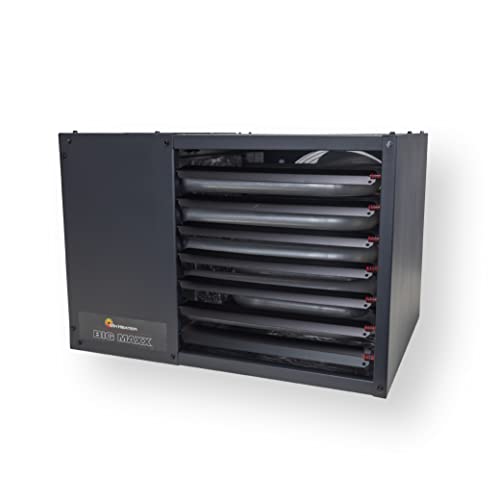
This unit heater delivers 80,000 BTU intended for large garages or small shops, with a stated coverage area up to 2,000 sq. ft. The package includes two angle brackets and a liquid propane conversion kit, though the thermostat, hose & regulator are not included. Heater dimensions are 29.33” L x 15.50” W x 26.37” H and the unit requires a minimum 8 ft. clearance from floor to base. Electrical rating is 120 V at 2.3 amps. The unit supports category 1 vertical and category 3 horizontal venting, which affects installation choices and vent routing. Considerations include venting configuration, professional gas hook-up, and compatibility with existing thermostats.
Dyna-Glo IR30NMDG-1 30,000 BTU

The Dyna-Glo model is a natural gas infrared wall heater that radiates heat to objects and people rather than warming air first, an approach similar to sunlight. It is rated up to 30,000 BTU and is intended to heat spaces up to roughly 1,000 sq. ft. This unit is listed as Natural Gas Ready and does not permit fuel conversion. Infrared heaters often provide faster perceived warmth at workstations and can be more efficient in spaces with open doors or drafts, because heat is delivered directly to surfaces.
Modine HD45AS0111 Hot Dawg 45,000 BTU
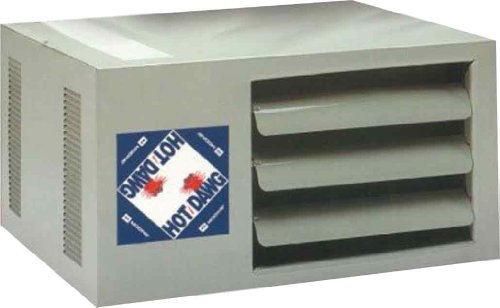
The Modine Hot Dawg is a compact, 45,000 BTU natural gas heater designed for quiet operation and certified for residential, commercial, and industrial use. The low profile and neutral color aim to reduce visual impact in finished garages. Its design focuses on durability and low noise, which can be important when the garage doubles as a workspace or hobby area. The unit’s stated efficiency and certification levels make it suitable where code compliance and reliable continuous operation are priorities.
Reznor UDXC-45 Ceiling/Wall Natural Gas

The Reznor UDXC-45 is an indoor unit heater rated for 45,000 BTU with two adjustable heating output levels (low fire and high fire), allowing modulation between milder and colder conditions. The series achieves an 83% thermal efficiency rating. It is configured for ceiling suspension or wall mounting using threaded-nut retainers at four suspension points; mounting hardware is sold separately. The unit emphasizes high performance and flexible mounting, intended for garages, workshops, and small commercial spaces.
Comfort Glow 17,000 BTU Direct Vent Wall

This direct vent natural gas wall heater provides 17,000 BTU and lists coverage up to 570 sq. ft. It uses a sealed burn system with Matchless Piezo ignition and a safety pilot that includes a pressure regulator to stop gas flow if the pilot extinguishes. The space-saving wall mount design has dimensions of 20 H x 27.3 W x 6.5 D inches. Direct vent models draw combustion air from outdoors and exhaust directly, which reduces indoor air impact and can satisfy stricter ventilation codes for occupied spaces.
Comfort Glow 25,000 BTU Direct Vent Wall

The larger Comfort Glow wall heater delivers 25,000 BTU and is rated to heat up to 825 sq. ft. Like the 17k model, it features a sealed burn system, Matchless Piezo ignition, and a safety pilot with a built-in pressure regulator. Mounting on a wall preserves floor space and offers a direct vent solution that keeps combustion gases isolated from the garage interior. The unit dimensions are 26.5 H x 32.25 W x 8.75 D inches.
ProCom MN300TBA-B Ventless 30,000 BTU

The ProCom MN300TBA-B is a ventless blue flame heater that produces up to 30,000 BTU and is claimed to heat areas up to 1,400 sq. ft. It includes thermostat control with High/Medium/Low settings and ships with wall mount hardware and base feet. Ventless blue flame units release combustion byproducts into the room and rely on room air for combustion and heat distribution. Local building codes and indoor air quality considerations often govern ventless use, and installation typically requires confirmation of adequate ventilation and CO monitoring.
Buying Guide: How To Choose A Natural Gas Garage Heater
This buying guide highlights key factors to evaluate when selecting a natural gas garage heater, including performance metrics, safety, installation, and regulatory considerations.
Determine Required BTU And Coverage
Calculate the approximate heat load for your garage by considering square footage, ceiling height, insulation level, and climate. A general starting point is 20 to 60 BTU per square foot depending on insulation and desired temperature rise. For lightly insulated or uninsulated garages in cold climates, choose higher BTU ratings. Manufacturers provide guideline coverage (e.g., 17,000 BTU → ~570 sq. ft.), but use these as estimates rather than guarantees.
Vented Versus Ventless Systems
Vented heater types include direct vent and unit heaters that exhaust combustion products outdoors. These are preferred when indoor air quality or code compliance is a concern. Ventless heaters, like blue flame models, are more space-efficient and simpler to install but allow combustion byproducts into the space and are restricted or discouraged in many jurisdictions and for attached living areas. Confirm local building codes before choosing a ventless unit.
Infrared (Radiant) Versus Forced Air
Infrared heaters (e.g., Dyna-Glo) heat objects and people directly, offering faster perceived warmth near the heat source and better performance when doors open frequently. Forced air or unit heaters (e.g., Mr. Heater, Reznor) heat air and move it with fans, providing broader distribution and quicker warming of entire volumes. Choose based on whether you need spot heating or whole-space heating.
Efficiency And Output Control
Look for stated thermal efficiency and multi-stage outputs. Higher efficiency reduces wasted fuel and can lower operating cost. Units with multiple output levels or thermostatic control allow more precise temperature management and reduce cycling. For variable-use garages, two-stage or modulating capability is often beneficial.
Installation And Venting Requirements
Vented units require proper flue sizing and routing; the Mr. Heater supports category 1 vertical and category 3 horizontal venting which affects vent materials and clearances. Ceiling-mounted units need secure hanging points and possibly additional bracing. Confirm minimum clearances from combustible materials and the floor, and whether a professional HVAC or gas fitter is required by code.
Safety Features
Prioritize models with sealed combustion, safety pilots, pressure regulators, and automatic shutoff features. Direct vent systems that isolate combustion air from the occupied space reduce indoor pollutant risks. Ventless units need room oxygen depletion sensors or CO monitoring to satisfy safety guidelines. Consider adding a dedicated carbon monoxide detector and ensuring proper ventilation during operation.
Noise And Workspace Considerations
Noise levels matter when the garage is used as a workshop. Quiet operation is promoted by some manufacturers (e.g., Modine). Infrared heaters often operate silently, while forced-air units may use low-static fans that produce steady noise. Review specifications and installation placement if noise could interfere with tasks.
Mounting Options And Space Constraints
Decide between ceiling-mounted, wall-mounted, or floor-mounted options. Ceiling mounts save floor space and distribute heat broadly, while wall-mounted direct vent units offer compact installation. Ventless models may be wall or floor mounted but check minimum clearances. For garages converted to workshops or dual-use rooms, low-profile and neutral finishes reduce visual impact.
Fuel Conversion And Compatibility
Some units include conversion kits for propane/natural gas, while others are Natural Gas Ready with no conversion permitted. If future fuel options are possible, choose a model with certified conversion kits and follow manufacturer instructions. Gas pressure requirements and line sizing must be verified to ensure adequate supply at full BTU output.
Permits, Codes, And Professional Installation
Many localities require permits and inspections for permanent gas appliance installations. Codes may restrict ventless use in some occupancies. Professional installation by a licensed gas fitter or HVAC technician helps ensure proper venting, gas pressure, combustion safety, and code compliance. Factor installation complexity and permit timelines into the selection process.
Comparing Models For Typical Use Cases
- Large uninsulated shop or 2-car garage: High BTU unit heaters (e.g., Mr. Heater 80,000 BTU) with proper venting are appropriate for whole-space warming.
- Medium insulated garage or workspace: Mid-range unit heaters (e.g., Modine Hot Dawg, Reznor UDXC-45) balance efficiency, noise, and coverage.
- Spot heating near benches or open doors: Infrared (Dyna-Glo) provides fast, targeted warmth and is effective where ambient air moves.
- Small, well-ventilated garage without venting options: Ventless models (ProCom) may be considered if allowed by code and paired with ventilation and CO detection.
When evaluating specific models, compare BTU output, venting requirements, efficiency figures, safety devices, mounting flexibility, and control options. Cross-check manufacturer installation manuals for required clearances, venting category, and accessory lists to ensure compatibility with your space and local regulations.