Finding the right electric garage heater depends on space, installation preference, and heat output. The table below summarizes seven top units selected for garages, workshops, and small commercial spaces, showing brand and primary power type to help narrow choices quickly.
| Product | Brand | Power / Type |
|---|---|---|
| Comfort Zone Hard-Wired Ceiling Mount CZ220 | Comfort Zone | 5,000 watt – Ceiling-mounted |
| TEMPWARE 7,500-Watt Digital Ceiling Heater | TEMPWARE | 7,500 watt – Hardwired ceiling |
| CTSC 10,000W Digital Fan-Forced Heater | CTSC | 10,000 watt – Hardwired |
| NewAir NGH160GA00 Portable Garage Heater | NewAir | 120V portable – Ceramic fan |
| EUHOMY 7,500 Watt Ceiling Workshop Heater | EUHOMY | 7,500 watt – Ceiling/wall mount |
| TEMPWARE 5,000-Watt Ceiling Mount Heater | TEMPWARE | 5,000 watt – Compact ceiling/wall |
| VEVOR 10,000-Watt Digital Shop Heater | VEVOR | 10,000 watt – Wall/ceiling |
Comfort Zone Hard-Wired Ceiling Mount Heater

This unit is a fan-forced, ceiling-mount heater designed for garages, workshops, and warehouses where floor space is limited. The hard-wired installation maximizes stability and permanence for commercial-style heating. Heavy-gauge steel construction provides durability against temperature swings and harsh shop environments. Adjustable louvers and a flexible mounting angle let installers direct airflow to targeted zones, which improves comfort and reduces wasted heat.
Safety features include an overheat protection and a thermal cut-out switch that help prevent dangerous conditions. The design emphasizes space-saving, overhead heating and consistent heat distribution rather than portability or plug-in convenience.
TEMPWARE 7500-Watt Digital Ceiling Heater
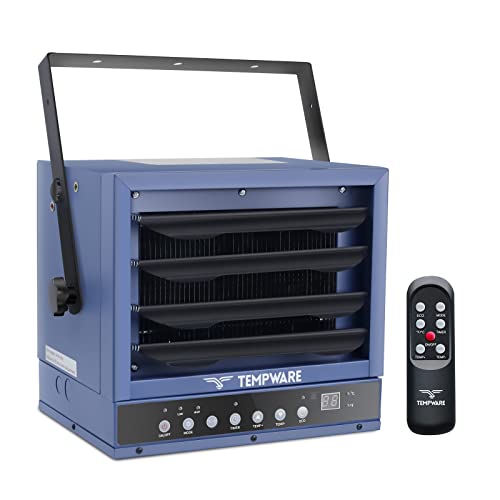
The TEMPWARE 7,500W unit offers high heat output suitable for large garages or workshops up to roughly 1,250 sq ft when installed properly. It features adjustable louvers, variable mounting angle, and two heat settings (6,250–7,500W). A digital control panel and full-function remote support user-friendly operation.
Built-in ECO mode and a 12-hour timer help manage runtime for energy savings. The integrated thermostat adjusts output between 45°F and 95°F and an overheat sensor shuts the unit off automatically if temperatures exceed safe levels. This model emphasizes smart energy management and remote control convenience for larger hardwired installations.
CTSC 10000W Electric Garage Heater

The CTSC 10,000W unit targets heavy-duty garage and shop applications with multiple heat settings (10,000W / 7,500W / fan-only) and a digital thermostat. A notable addition is a voltage display screen to assist with troubleshooting installation issues related to undervoltage, which can be a common source of performance problems.
Constructed from SPCC cold-rolled steel, the heater includes ETL certification and overheat protection. It offers both panel and remote control for convenient adjustments. This model focuses on high capacity, serviceability, and safety for larger workspaces where electrical supply and installation expertise are considerations.
NewAir NGH160GA00 Portable Garage Heater

The NewAir NGH160GA00 is a 120V portable ceramic heater intended for small garage spaces up to about 160 sq ft. It offers two heat modes, an internal thermostat, and a tilting head for directional heat. A carry handle enables relocation as needed between bays or rooms.
Safety features include a cool-to-the-touch exterior and automatic shut-off to prevent overheating. A powerful fan (200 CFM) combined with a ceramic heating plate provides rapid, localized warmth. This unit emphasizes portability, quick heat, and plug-in convenience over whole-bay coverage.
EUHOMY 7500 Watt Hardwired Ceiling Heater

The EUHOMY 7,500W heater supports both top and wall installation and includes four angle adjustment options for precise air distribution. With a rated BTU around 25,590 and a wattage range of 5,630–7,500W, it’s designed to heat areas up to approximately 1,250 sq ft. Noise is minimized at about 58 dB in normal operation.
Key features include a 9-hour timer, remote control, ECO mode, and a wide temperature range. Thick-gauge steel construction and ETL compliance highlight durability and safety. The unit targets users who need adjustable installation methods and energy-saving modes for medium to large garages.
TEMPWARE 5000-Watt Ceiling Mount Shop Heater

This TEMPWARE 5,000W heater offers three heat settings (3,000W / 4,000W / 5,000W) and adjustable louvers for directed airflow. Rated for up to about 592 sq ft, it is a compact option that still delivers industrial-strength performance for single-bay garages or workshops.
Its space-saving design allows floor placement or mounting on walls or ceilings to conserve workspace. Heavy-duty steel construction and ETL certification emphasize safety for daily workshop use. This model suits purchasers seeking compact but robust hardwired options for moderate-sized areas.
VEVOR 10000-Watt Digital Shop Heater

The VEVOR 10,000W heater provides wide coverage targeted at larger garages and light industrial spaces. Two adjustable power levels and intelligent temperature control maintain consistent temperatures with a small variance (about 2°F), which supports stable workshop environments.
Manufactured with SPCC cold-rolled steel and ETL-certified safety features, the unit includes overheat automatic power-off and a 9-hour timer with remote control. Emphasis is placed on precise temperature stability and high air circulation for even heating across larger areas.
Buying Guide: How To Choose An Electric Garage Heater
Selecting an electric garage heater involves matching heating capacity, installation method, and safety features to the space and intended use. The sections below explain key factors and trade-offs to evaluate before purchase.
Heat Output And Coverage
Heater capacity is typically expressed in watts or BTUs. As a quick reference, 1 watt ≈ 3.412 BTU/hr. Higher wattage units (7,500W–10,000W) can heat multiple hundred to over a thousand square feet in a garage with typical insulation. Smaller 120V portable units (1,000–1,500W) are designed for spot heating or smaller bays.
Estimate required power by considering square footage, ceiling height, and insulation. Uninsulated garages require more capacity than insulated spaces. Choose a model rated for at least the size of the area and, if in doubt, opt for slightly higher capacity if electrical supply permits.
Installation Types: Hardwired Versus Portable
Hardwired 240V units (ceiling/wall mount) provide high output and are suited for whole-bay heating. They require professional electrical installation and are more permanent. Portable 120V heaters plug into standard outlets and are flexible for moving between bays, but their coverage and output are limited.
Consider electrical infrastructure: many heavy-duty heaters require a 240V circuit and may need panel upgrades. Verify available breakers and consult a licensed electrician for hardwired installations.
Mounting And Airflow Direction
Ceiling-mounted and wall-mounted heaters save floor space and distribute heat from above, which can improve natural convection. Look for adjustable louvers and mounting angle options to direct warm air where occupants work. Fan-forced designs circulate air faster, while some units rely more on radiant heat—fan-forced units are usually better for evenly distributing warmth in a garage.
Controls, Timers, And Thermostat Accuracy
Digital controls, remote operation, and built-in timers add convenience. ECO modes and adjustable thermostats help manage runtime and reduce energy use. For workshop comfort, thermostats with fine resolution (<2°F variance) maintain consistent temperatures and reduce cycling.
Remote controls and programmable timers let users warm the space only when needed, lowering operating costs compared to continuous manual operation.
Safety Features And Certifications
Essential safety features include overheat protection, thermal cut-outs, tip-over protection (for portables), and cool-touch housings. ETL or UL listings indicate third-party testing for electrical and fire safety. For garages with flammable vapors or dust, review manufacturer guidance and local codes before mounting heaters near work areas.
Build Quality And Durability
Look for heavy-gauge steel or SPCC cold-rolled steel housings for workshop-duty use. Industrial-grade units typically tolerate temperature fluctuations, impacts, and workshop contaminants better than lightweight plastic units. Corrosion-resistant finishes and robust fan assemblies extend service life in harsh environments.
Noise Levels
Fan-forced heaters generate some noise; check decibel ratings when quiet operation is important. Units marketed for garage use usually produce more sound than domestic bedroom heaters; a specification around 50–60 dB is common for medium-capacity models.
Energy Use And Operating Cost
Estimate operating cost by converting watts to kilowatts (kW = watts / 1000). Multiply kW by hours used per day and by local electricity rate ($/kWh) to estimate daily cost. For example, a 7,500W unit is 7.5 kW; running it one hour uses 7.5 kWh. Using timers, ECO modes, and thermostats reduces runtime and energy bills.
Maintenance And Serviceability
Maintenance is typically limited to keeping intake and exhaust areas clear of debris and ensuring the fan and louvers are free of dust. For hardwired units, access panels and straightforward wiring help with diagnostics. Voltage readouts and status indicators on some models aid troubleshooting when supply or motor issues occur.
Comparisons And Use Cases
- Large, multi-bay garage or light workshop: Prefer a hardwired 7,500–10,000W ceiling or wall unit with ETL certification, digital thermostat, and remote control for whole-space heating.
- Single-bay or insulated garage: A 5,000W ceiling mount unit can provide adequate warmth while saving floor space.
- Spot heating and flexibility: A 120V portable ceramic heater is best for short-duration, spot-focused work or where 240V isn’t available.
- Noise-sensitive spaces: Choose units with lower decibel ratings or timed operation to run heaters when the space is not occupied.
Final Selection Checklist
- Confirm available electrical supply (120V vs 240V) and breaker capacity.
- Match wattage to square footage and insulation level.
- Decide on permanent (hardwired) vs portable installation needs.
- Verify safety certifications (ETL/UL) and overheat protection features.
- Check control options: thermostat accuracy, timer, remote, ECO mode.
- Ensure mounting flexibility and airflow direction meet workspace layout.
- Review construction materials for durability in workshop conditions.