Finding the best diesel heater for garage means balancing power, fuel efficiency, safety, and installation options. The table below summarizes the seven diesel heaters covered here, with their core specs to help narrow choices quickly.
| Product | Power / Output | Key Features |
|---|---|---|
| LF Bros 5KW All-in-One (B0CBTN3HC1) | 5 kW / 4700–17000 BTU | 110V/12/24V, remote, LCD, -40℉ to 104℉, 0.18–0.53 L/h |
| VEVOR 8KW Diesel Heater (B0CFQNR4SP) | 8 kW | Bluetooth app, auto altitude compensation, 12V, 20–25 m² coverage |
| LF Bros 5KW All-in-1 Plateau (B0D66FZQ94) | 5 kW | Plateau mode, tested to 17,000 ft, 110V/12V, remote, timer |
| LF Bros 5KW Compact Model (B0C7BS72QG) | 5 kW / 4700–17000 BTU | Compact size, 110V/12/24V, 24-hour timer, LCD |
| VEVOR 8KW with CO Alarm (B0DKTFRH98) | 8 kW | Built-in CO alarm, leak-proof tank cap, 12–24V compatibility |
| Kedite 8500W Diesel Heater (B0FF4384QN) | 8.5 kW | Fast warm-up, low noise, multi-voltage support, remote & LCD |
| Protemp 175,000 BTU Forced Air (B002R15ZJG) | 175,000 BTU | Thermostat, wheels, durable for large garages and workshops |
LF Bros 5KW All-in-One Diesel Heater

This LF Bros all-in-one diesel air heater provides 5 kW (approximately 4700–17000 BTU) and a fuel consumption range of 0.18–0.53 L/h. The unit supports 110V, 12V, and 24V inputs and ships with a transformer for direct 110V connection, reducing the need for extra adapters when installing in a home garage.
Key usability features include an LCD controller, a pre-paired remote with roughly 100 ft range, and a working temperature range from -40°F to 104°F. Installation materials and a QR-code linked installation guide are included to simplify setup. This model is positioned for stationary spaces like shops and basements as well as mobile applications.
VEVOR 8KW Diesel Heater With App Control

The VEVOR 8KW model is designed for larger garages and work areas, with an 8 kW output and recommended coverage of about 215–269 ft² (20–25 m²). Heating components include a sandblasted aluminum heat exchanger for rapid heat transfer and a claim of warm temperatures within ten minutes of startup.
Controls include Bluetooth app control, a 32 ft remote, and an LCD controller. Notable for altitude performance, it features automatic altitude compensation up to 18,045 ft (5,500 m), which adjusts combustion for thin-air environments. Temperature set points range from 46°F–96.8°F.
LF Bros 5KW Plateau-Mode Diesel Heater

The LF Bros N2-T 5 kW model emphasizes altitude readiness. It is tested at 17,000 ft and offers a plateau mode for high-elevation operation. The unit uses aviation-grade plugs and an antifreeze power cord intended for very cold climates.
Power flexibility includes an included 110V transformer for plug-and-play in residential garages, plus 12V vehicle compatibility. The package contains an LCD/T4 controller, remote control, and a timer for scheduled operation. Documentation and QR-coded video instructions are provided for installation and maintenance.
LF Bros Compact 5KW Diesel Heater

This compact LF Bros model measures approximately 13.6 × 6 × 15 in, making it suited to constrained garage locations. Rated at 5 kW (4700–17000 BTU), it reports the same fuel range of 0.18–0.53 L/h and an operating temperature window of -40°F to 104°F.
Included are 110V/12V/24V compatibility, a 24-hour on/off timer with single or multi-period timing modes, and an LCD display that shows real-time operation. The compact footprint aims to simplify mounting and placement in smaller workshops or attached garages.
VEVOR 8KW Diesel Heater With CO Alarm

This VEVOR 8 kW parking heater focuses on safety and diagnostics. It integrates a built-in CO alarm that monitors carbon monoxide levels and can alert or auto shut off under hazardous conditions. Other safety features include overheat protection, a leak-proof fuel tank cap, and a fuel level indicator.
The unit supports DC 12–24V operation with adapter options for plug-and-play versatility. VEVOR highlights a cast aluminum body, ceramic igniter, high combustion efficiency (≥90%), and a claimed low fuel use—about a gallon per night under specific conditions—when maintaining cabin heat across larger areas.
Kedite 8500W Diesel Heater Quick Warm-Up
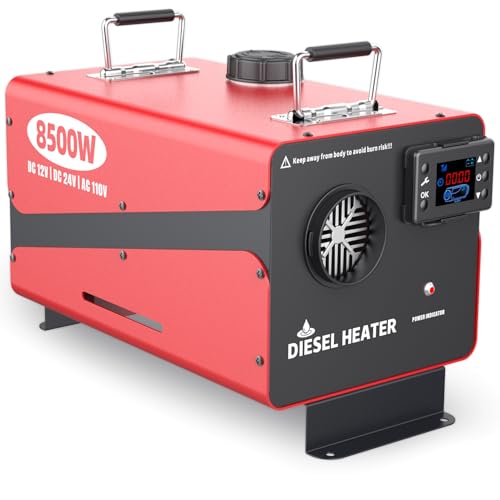
The Kedite all-in-one diesel air heater advertises an 8.5 kW output and a rapid warm-up design intended to raise interior air temperatures quickly. The manufacturer describes adaptive fuel control that modulates consumption by sensing cabin temperature, which aims to reduce fuel use compared to older units.
Other noted attributes include multi-voltage support (110V/12V/24V), an LCD monitor, remote control, and claims of ultra-quiet operation for minimal disturbance during overnight or worksite use. The product copy emphasizes low noise and energy-efficient automatic adjustments.
Protemp 175,000 BTU Forced Air Heater

The Protemp 175,000 BTU forced-air heater is a jobsite-style option for very large garages, barns, or workshops. It is designed to heat up to approximately 4,300 sq ft when using kerosene or diesel and includes a built-in thermostat and digital readout for temperature management.
Durability features include heavy-duty wheels and a handle for portability between work areas. This heater is a different category than compact parking heaters: it provides high-output, direct forced-air heating appropriate for ventilated garages or outdoor-covered spaces where robust airflow and high BTU output are required.
Buying Guide: Choose The Right Diesel Heater For Your Garage
Selecting a diesel heater for a garage involves matching heating capacity, fuel efficiency, power options, and safety features to your space and use case. This guide covers the main considerations for an informed purchase.
Heating Capacity and Output
Measure garage volume (length × width × height) to estimate required output. Output is expressed in kW or BTU. Small garages often need 3–5 kW units; larger or poorly insulated shops may require 8 kW or a high-BTU forced-air model like the Protemp. Over-sizing may waste fuel; under-sizing will leave the space underheated.
Fuel Consumption and Efficiency
Fuel use varies by model and set point. Look for stated fuel consumption ranges (L/h or gallons/hour) and combustion efficiency figures. Lower consumption with efficient combustion reduces running costs. Some models include adaptive fuel management or efficiency claims tied to thermostatic control.
Power Source and Installation
Consider available power: many parking heaters support 12V/24V DC for vehicle battery use and 110V/220V AC for garage plug-in operation. Models that include a transformer for 110V simplify installation in a residential garage. Installation complexity depends on mounting, exhaust routing, fuel tank placement, and electrical connections.
Altitude and Cold-Climate Performance
If the garage is at elevation, choose a heater with altitude compensation or plateau mode. High-altitude models adjust combustion for thin air to maintain performance. Specified altitude ratings (e.g., tested to 17,000 ft or automatic compensation to 18,000 ft) are important for mountain-area installations.
Safety Features
Key safety elements include CO monitoring or alarm, overheat protection, leak-proof fuel fittings, and secure exhaust routing. Built-in CO alarms can automatically shut the unit down or alert occupants. Ensure adequate garage ventilation and follow local codes for indoor combustion equipment.
Controls and Convenience
Look for thermostats, timers, remote control, and modern conveniences like Bluetooth app control. Timers and programmable on/off cycles reduce fuel use and let you preheat the garage. Remote range and app features provide flexibility for pre-warming before arriving at the shop.
Noise and Comfort
Noise specifications vary. Some units advertise ultra-quiet operation or silent fan designs for minimal disturbance during overnight garage use. For workshops or attached garages, lower noise can be a meaningful comfort factor.
Size, Mounting, and Portability
Compact models are easier to fit in constrained locations and can be mounted under benches or on walls. Larger forced-air heaters are less portable but deliver high output. Consider whether the heater will remain stationary or needs to be moved between job sites.
Maintenance and Serviceability
Routine items include fuel filter replacement, nozzle cleaning, and periodic combustor or glow-igniter checks. Units with accessible service points and clear documentation reduce long-term upkeep time. Verify parts availability and local service options for major models.
Application-Specific Considerations
– For single-car garages or small workshop spaces: 5 kW parking heaters with plug-in 110V options can be economical and simple to install.
– For larger or poorly insulated garages: 8–8.5 kW
– For mountain or high-altitude garages: select units with automatic altitude compensation or plateau testing.
– For enclosed spaces with limited ventilation: prioritize units with CO detection and ensure proper exhaust routing.
Comparisons and Trade-Offs
Parking-style diesel air heaters (5–8 kW) are compact, fuel-efficient, and suited to enclosed garages or vehicle preheating. Forced-air jobsite heaters like the Protemp deliver much higher BTU and are appropriate for large, ventilated spaces. Safety, installation effort, and running cost are the primary trade-offs between compact parking heaters and large forced-air units.
When evaluating options, match the heater’s output, fuel efficiency, and safety features to your garage size, power availability, altitude, and how often the heater will run. Proper installation and routine maintenance are essential for safe, reliable operation.