A strong solution is needed to enhance the quality of indoor air in a whole house. There are two main types of the best whole house air purifier: in-duct systems, which are combined with centralized HVAC, and high-capacity portable ones, which are able to circulate and clean the air in large spaces.
To make it easier to find the best whole-home air cleaner, here is a brief comparison of the best of both worlds, HVAC-integrated purifiers and sturdy portable HEPA units.
| PURIFIER | TYPE | COVERAGE | KEY FEATURES |
|---|---|---|---|
| Aprilaire 2410 Whole-House Air Cleaner | HVAC Integrated (MERV 13 Filter) | Entire HVAC system (2000 CFM) | MERV 13 media, traps ~97–98% allergens , annual filter changes, silent operation |
| RGF Reme Halo In-Duct Purifier | HVAC Integrated (UV + Ionizer) | Entire HVAC system | UV-C & PCO technology, kills germs & mold , neutralizes odors, 24V easy install |
| IQAir HealthPro Plus Air Purifier | Portable (True HEPA) | Up to ~1125 sq ft | HyperHEPA filter (99.5% at 0.003 microns) , 3-stage (pre/charcoal/HEPA), wifi-enabled |
| Levoit EverestAir Smart Air Purifier | Portable (True HEPA) | Up to ~1395 sq ft (2 ACH) | 360 CADR (354 CFM) , smart PM2.5 sensor & app, washable pre-filter, quiet mode |
| Medify MA-112 UV Air Purifier | Portable (H14 HEPA) | Up to ~3700 sq ft (1 ACH) | Dual intake design, 950 CADR , H14 HEPA + carbon + UV, wheels for mobility |
Top 5 Whole House Air Purifiers (Centralized & Portable)
1. Aprilaire 2410 Whole-House Air Cleaner – High-Capacity HVAC Filter
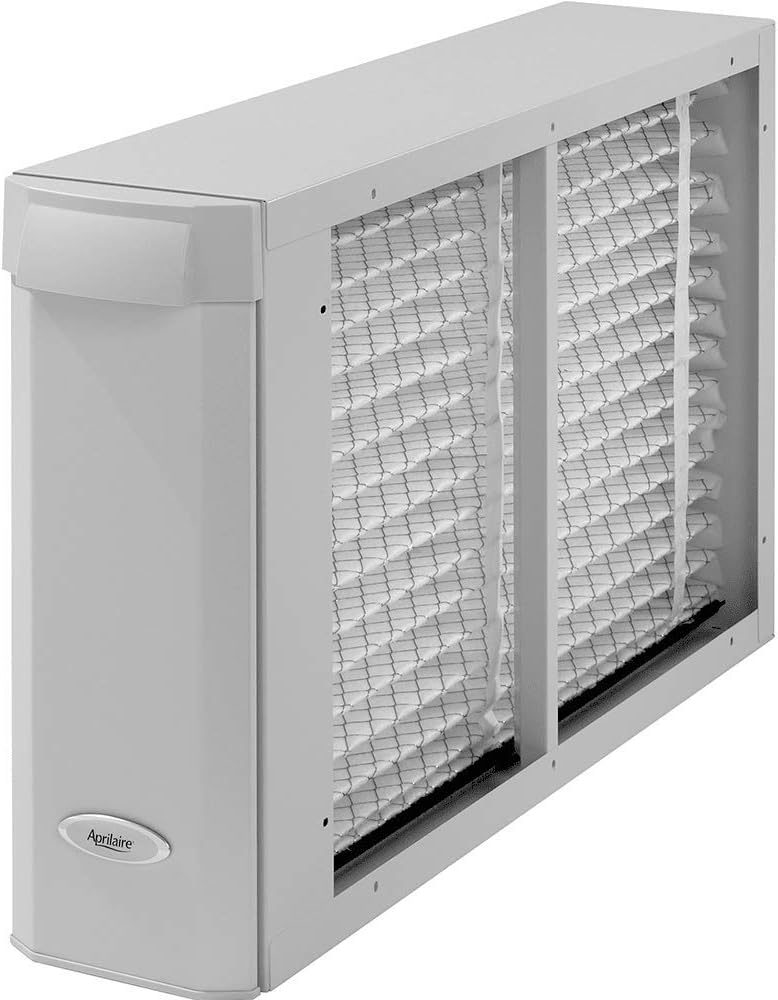
The Aprilaire 2410 Whole-House Air Cleaner is a central HVAC air purifier which scrubs the air in your entire home using a pleated MERV 13 media filter. It is fitted on the return air duct of your furnace or AC and silently captures pollutants as the air flows through. This filter cabinet offers 30 times the filter media of a typical 1 inch furnace filter, so it can trap approximately 98 percent of the visible dust and 97 percent of the pollen-sized particles in the air .
The outcome is that the air is much cleaner that circulates to all rooms whenever your HVAC system is in operation.
The main strengths of the Aprilaire 2410 are that it is simple and low maintenance. It is passive and does not require electricity or moving components, your HVAC blower does the work. Maintenance is minimal as the heavy-duty filter should only be replaced every 12-24 months. It has an excellent airflow capacity (up to 2,000 CFM), which makes it suitable to serve large homes as a whole-house solution.
Allergy sufferers who own homes like the fact that the Aprilaire is effective in eliminating dust, pet dander and spores in the entire house. It also assists in the preservation of your HVAC system, as the ducts and coils will be cleaner (Aprilaire has a benefit called Clean Coil).
Remember that this unit is aimed at particles (such as dust, pollen, smoke) and does not contain activated carbon or UV light to deal with odors or germs. It is most suitable to the people who are mainly interested in the removal of allergens and dust on a whole-house level. To clean the air thoroughly, you may combine it with an in-duct UV purifier (such as the Reme Halo) to eliminate microbes and odors.
The Aprilaire 2410 is easy to install by a professional or an experienced DIYer, and it is mounted to the duct and may frequently use the existing furnace filter slots. On the whole, Aprilaire 2410 is a great whole-house filtration system upgrade of central HVAC systems that has quiet, efficient operation and long-lasting filters.
2. RGF Reme Halo In-Duct Air Purifier – Advanced Whole-Home Sanitization
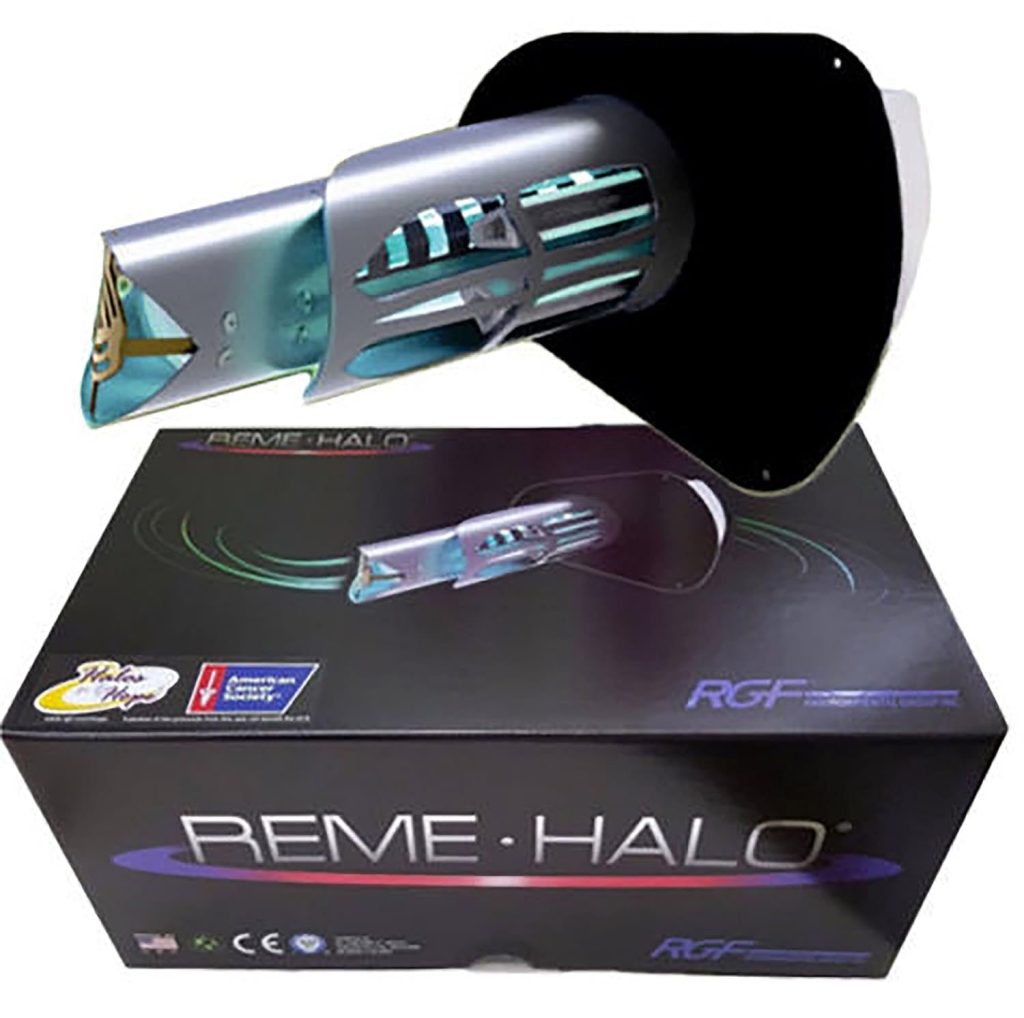
The RGF Reme Halo In-Duct Air Purifier is an active purification system that installs into your HVAC ductwork to purify airborne germs, odors and VOCs throughout your entire home. The Reme Halo, unlike filter-based cleaners, produces low-level molecules of hydrogen peroxide and bipolar ions by using a 24V powered UV-C light and photocatalytic matrix to clean the air in your home .
These advanced oxidizers are proactive in finding the contaminants in the air and on surfaces, and the bacteria, viruses, mold spores, allergens, and odors are reduced wherever the air moves. It actually makes your ductwork a whole-home disinfection system.
The outstanding characteristics of the Reme Halo are that it addresses the pollutants that are not captured by the regular filters. It has the ability to reduce cooking odors, pet odors and volatile organic compounds (chemical fumes) significantly by oxidizing them. Meanwhile, its ionization makes particulate pollutants stick together, which allows your HVAC filter to trap smaller dust.
The unit processes up to 6 tons (approx. 2,000+ sq ft) of air and is on continuously when your HVAC blower is on. It is also CARB certified ozone-safe, and complies with stringent California ozone emission standards, so it cleans without toxic byproducts. The new model has an indicator that will remind you to change the removable UV cell after every 2 years in order to achieve the best performance.
Installation The Reme Halo is usually installed by inserting into the HVAC plenum or main supply duct through a small hole (most units are supplied with a quick-mount plate). It can be a DIY job that takes less than an hour to install by many handy homeowners or you can have an HVAC technician do it. When it is installed it works in the background.
Remember the Reme Halo is supplementary to your HVAC filter, it is great at killing microbes and reducing odors, but it is not a substitute to particle filters. To get the best out of it, combine it with a good whole-house filter. The Reme Halo is one of the best whole-house solutions to install in your home, especially to control odor and to reduce germs, if you desire an in-duct air purifier that actively cleans and deodorizes the air in your home.
3. IQAir HealthPro Plus Air Purifier – Premium Whole-Home Coverage (Portable)
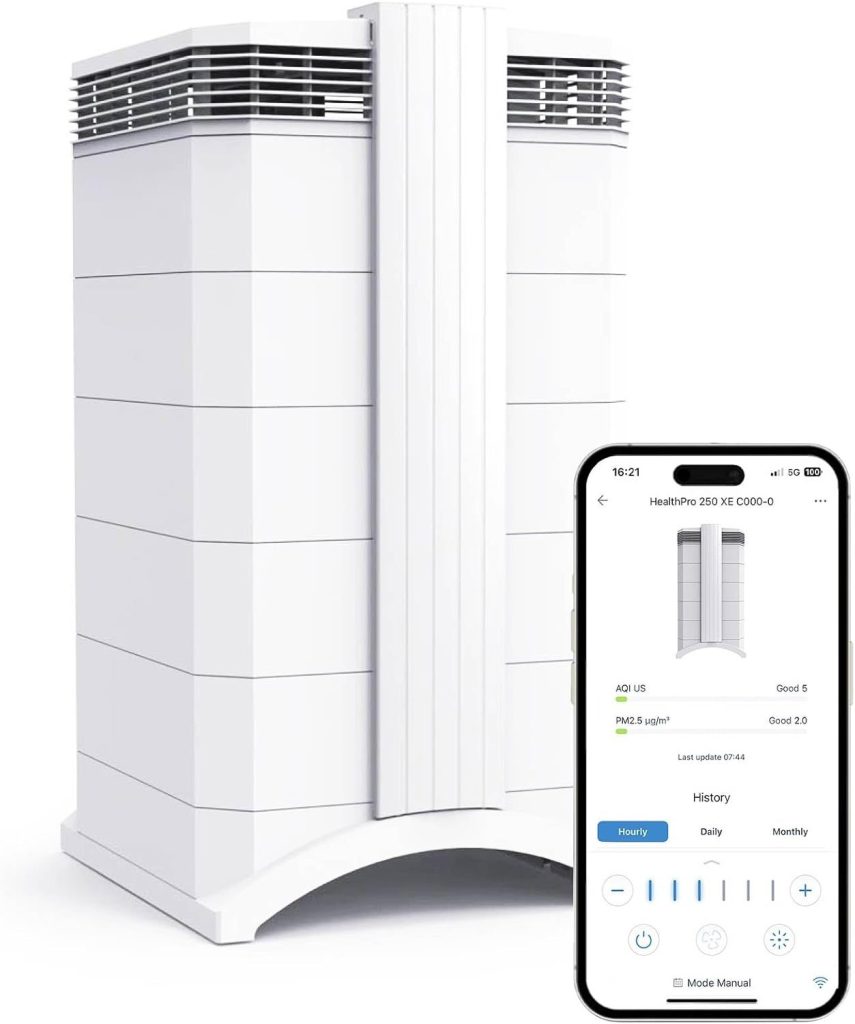
The IQAir HealthPro Plus Air Purifier is a high-end portable air purifier with a reputation of having a medical-grade filtration and capacity to deal with large rooms, which makes it an option as a whole house purifier in many houses. This machine is Swiss-made and provides very clean air with the help of a strong fan and a 3-stage filter system.
It has a proprietary HyperHEPA filter, which is rated to capture 99.5 percent of particles as small as 0.003 microns well beyond normal HEPA capability . This implies that it has the ability to eliminate ultra-fine pollutants such as smoke, viruses, and even some of the VOC molecules that are not captured by ordinary purifiers. It also has a chunky V5-Cell gas & odor filter with activated carbon to adsorb chemicals and odor and a dust pre-filter.
In terms of performance, the IQAir HealthPro Plus is designed to clean the entire house of up to roughly 1,1001,200 sq ft (five air changes per day in that area). It also has a Clean Air Delivery Rate of high and a 6-speed fan capable of generating up to ~300+ CFM airflow which is able to clean several rooms or a whole floor when located in the middle.
People report that it can make a significant difference in the quality of air to relieve allergies and asthma symptoms by eliminating pet dander, pollen, and smoke particles to virtually zero. Although it is powerful, it has been well-designed to reduce noise and it is on casters so that it can be easily moved around the rooms. Being a premium device, it has also smart features such as a filter life monitor and optional Wi-Fi/App control (the “Plus XE” model) to remotely monitor the air quality.
Maintenance is not common but when it is required, the filters are of high capacity and long lasting. The big HyperHEPA cartridge is good for up to 4 years, the gas filter up to 2 years, on average use, but replacement filters are an investment. The unit is also an investment as it is one of the more expensive ones in the market.
Nevertheless, the IQAir HealthPro Plus is the best whole house air purifier when it comes to the quality of filtration in case one is interested in hospital-grade air purification at home. It is particularly advised in settings with extreme allergies, wildfire smoke, or chemical sensitivities where its ultra-fine particle filtration and high gas absorption are better than less expensive alternatives. Although it is not permanently installed (as part of HVAC), most users report that running the IQAir on a high setting in a central location can dramatically improve air quality in an entire small house or large apartment.
4. Levoit EverestAir Smart Air Purifier – Smart Large-Room Purifier for Whole Home Use
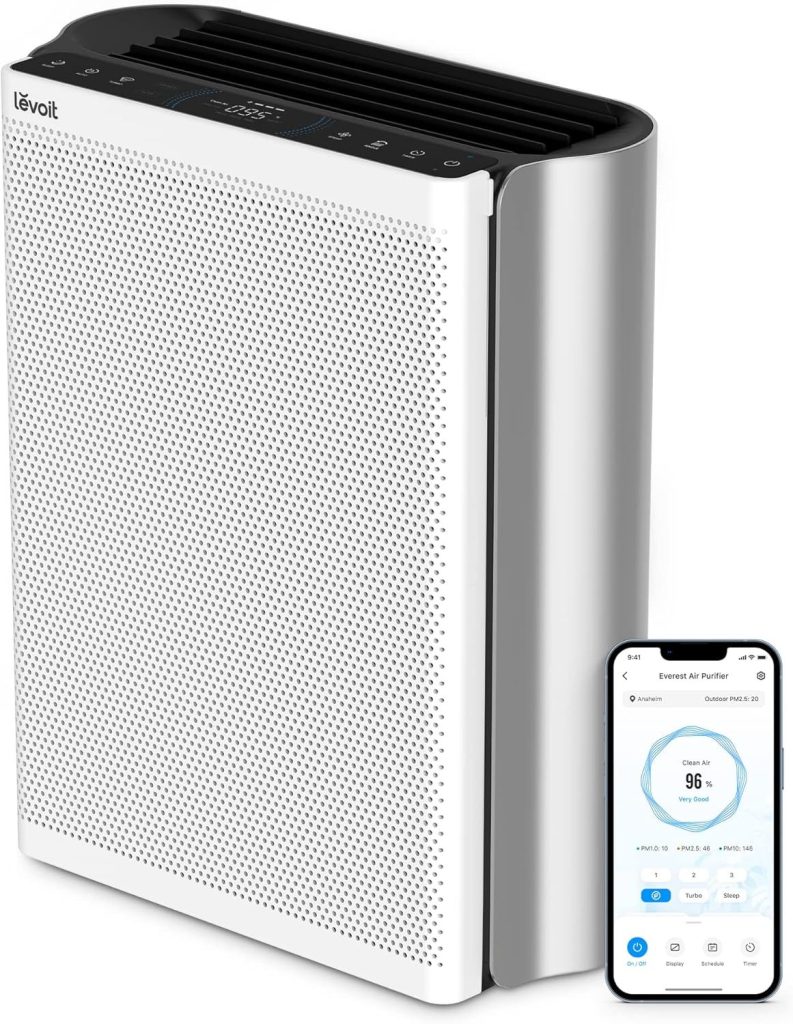
The Levoit EverestAir Smart Air Purifier is a potent Wi-Fi connected air cleaner that is suitable to be utilized as a whole-house purifier in most cases due to its capacity to work in extra-large rooms and open-concept spaces. The most powerful model available by Levoit, the EverestAir has a Clean Air Delivery Rate of approximately 360 CFM, and can fully filter a 558 sq ft room five times an hour (or up to ~1395 sq ft with two air changes per hour).
This air flow, together with a 3-stage filtration system (pre-filter, H13 True HEPA, and activated carbon filter), allows it to trap 99.97 percent of airborne particulates such as dust, smoke, and allergens, in addition to minimizing odors caused by pets, cooking, and so on.
The difference between the EverestAir and other products is that it combines smart technology and ease of use in the entire home. It has an inbuilt laser particle sensor that provides real-time PM1.0, PM2.5 and PM10 values on the screen and automatically changes fan speed in Auto Mode to ensure clean air.
This implies that the unit is able to increase its speed when it senses pollution (e.g. cooking smoke in the kitchen) and reduce its speed when the air is clean and still remain efficient. You can remotely check the air quality in your home with the VeSync mobile app (and voice control through Alexa or Google Assistant), create schedules, and control several Levoit purifiers in case you use them in different rooms. This connectivity is excellent in controlling the air quality in the entire house.
Whole-home coverage is also possible in the design of the EverestAir: the vent louvers on top of the unit are adjustable (45, 60, 75, 90) to angle the purified air in the desired direction. It even has smooth wheels, so you can roll it to a strategic place (such as a central hallway) to get the most out of it.
The Levoit is fairly quiet, even with its wide coverage, at approximately 24 dB on Sleep Mode to use at night, and has a HEPA Silent mode, which dims the lights and reduces the noise. It is easy to maintain: the combo filter is semi-washable (the washable pre-filter is used to prolong its life) and has a life of 6-12 months depending on the usage. The unit will remind you when it is time to check or change filters.
The Levoit EverestAir is one of the best whole-house air purifiers in the portable category, and it is a modern, hands-off solution that users will want. It is especially appropriate to tech-savvy homeowners or those who have smart homes.
This purifier has a high CADR, intelligent sensing, and adjustable airflow, which allows it to keep the air clean in large living rooms and even in several rooms, giving the whole house comfort without requiring professional installation.
5. Medify MA-112 UV Air Purifier – Ultra High CADR for Largest Spaces
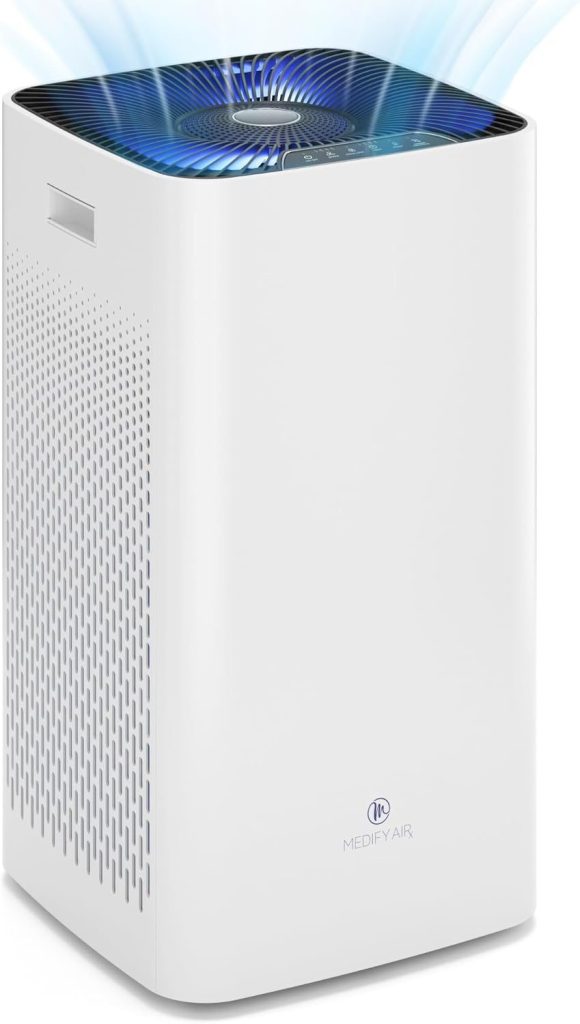
The Medify MA-112 Air Purifier is a monster of a portable air purifier that is designed to work with very large rooms and even entire apartments or houses. It has a twin intake system and two sets of filters which enables it to circulate a huge amount of air – up to 950 (cubic feet per minute) of clean air output on full power .
Medify boasts that the MA-112 can clean up to 3,700 sq ft in one hour, or 2,500 sq ft in half an hour (which is several air changes in a typical house) . This is why it is a perfect solution to open floor plans, multi-story lofts, or a rapid air purification of an entire house when located in the center.
The MA-112 has a good filtration technology. It has a multi-stage design on both sides: a washable pre-filter, a H14 True HEPA filter (better than a standard HEPA filter, which traps 99.97 percent of particles as small as 0.3 microns), and a thick activated carbon filter against odors and chemicals.
The version also features an inbuilt UV-C light module, which exposes the interior filters to UV to kill any bacteria or virus trapped in the filters, providing an additional germ protection layer. It also has an ionizer feature (anion mode) that can also aid in reducing particles; it is optional and can be turned off in case it is not needed. This thorough filtration makes the MA-112 an effective filter against all manner of dust and smoke, as well as microscopic aerosolized viruses, which makes it a good choice in the case of heavy pollution or wildfire smoke.
The Medify MA-112 is simple and potent to use. It has a simple touch panel with several fan speeds (including a quiet sleep mode) and a numeric air quality indicator that shows the current concentration of particles. There is an Auto mode, which uses a laser sensor to control the fan speed according to the quality of air in the room, which is a set-and-forget solution considering its ability to cover a large area.
It is a very big and heavy machine (more than 20 inches wide and 28 inches tall), however, it has caster wheels, so you can move it around the house. Most people place it in a central place to cover the entire house and relocate it to particular rooms (such as a bedroom at night) when necessary.
One of them is that the fan noise of the MA-112 is audible at full power (as it should be with this much airflow). In the majority of cases, though, it can be operated at a lower level to keep the air clean after a quick clean.
The cost of filter maintenance will be recurring, as there are two large HEPA-carbon filter sets, replacements can be on the high side, and they are normally required every 6-12 months depending on usage. Nevertheless, in case you want one of the most powerful capacity air purifiers in the market, the Medify MA-112 is a performer. It is a great option in bigger houses, with almost commercial air cleaning capability in a domestic size. It can clean and purify an enormous amount of air whether it is open living areas, basements or an entire floor, the MA-112 can circulate and clean the air in the entire house without any permanent installation.
Whole House Air Purifier Buying Guide
To select the best whole house air purifier, you have to know the needs of your home and the main peculiarities of such systems. A guide on what to look at when comparing centralized (HVAC-integrated) purifiers and high-capacity portable units to use in the whole-home is given below.
Coverage Area and Air Flow Capacity
The first one is the coverage of the purifier in terms of the area that it can cover. Whole-house purifiers must be able to process the air of your whole house or a large part of it. In the case of HVAC-integrated systems, coverage is not typically quoted in square feet, but rather by your HVACs airflow (CFM) and duty cycle.
An effective in-duct purifier will clean all the air that goes through the furnace/AC, which in a normal house would be able to reach every room eventually. Make sure that your HVAC has an airflow rate that can be supported by the unit (e.g., 1200+ CFM on a typical 3-ton system). Portable purifiers, however, are listed in square footage coverage. Find a model that has a high Clean Air Delivery Rate (CADR) which is suitable to the size of your home.
Generally speaking, a purifier must be able to cover the entire house, so as a rule of thumb, a purifier must have a CADR rating that is at least two-thirds of the square footage of your home (assuming 8 ft ceilings). As an example, a 1500 sq ft house would be well served by ~1000 CADR (additive across devices or a single large unit) to cover the whole house. Large-capacity portables such as the Medify MA-112 (950 CADR) or Levoit EverestAir (~360 CADR) can serve large spaces: they are rated to clean on the order of 2000-3000+ sq ft per hour .
Practically, coverage is influenced by such factors as layout and the position of doors, a single portable unit will clean adjacent open areas most effectively. In case your house is large with numerous rooms or has several stories, you may be required to move the unit after some time or have more than one purifier to cover the whole house.
Filtration Technology and Effectiveness
Whole-house purifiers are sold with different filtration technologies, which have advantages and disadvantages:
- High-Efficiency Filters (HEPA/MERV): These are physically trapping. The portable purifiers usually employ True HEPA filters, which trap 99.97 percent of the particles 0.3 microns or larger (and the high-quality ones such as H14 trap even smaller 0.1 micron particles). This is fantastic in eliminating dust, pollen, pet dander, mold spores and even smoke. Media filters with a MERV rating of 11-16 are common in integrated HVAC purifiers. A whole-house unit with a MERV 13-16 filter can trap most of the 0.31-1 micron particles (comparable to HEPA) and lower MERV ratings are aimed at larger dust and pollen. Select a type of filter depending on what you are most concerned about: allergies and smoke, a true HEPA or high-MERV is best. It is worth noting that HVAC may need to be checked to see if it can handle an ultra-fine filter, as high MERV filters are dense, and your blower may not be able to handle it, or you may want to look at a powered bypass HEPA system.
- Ultraviolet (UV-C) Light: UV purifiers (such as the Reme Halo or other in-duct UV lamps) kill microorganisms, viruses, bacteria, mold, by damaging their DNA with ultraviolet light. UV is frequently used in conjunction with your HVAC system in a whole-house setting: the UV lamp is mounted in the duct or close to the coil and the passing air is sterilized, and mold cannot grow in the HVAC. UV can be quite effective at killing airborne germs, however, dead microbes can still be left as particles (which can then be caught by filters). UV systems are not self-cleaning; they typically are applied with filters. Seek UV systems which are ozone-free and safety tested (most high quality models comply with UL or CARB ozone standards).
- Photocatalytic Oxidation (PCO) & Ionizers: Other high-end whole-house purifiers (such as the Reme Halo and Air Oasis models) produce oxidizing molecules or ions which are released into your house. PCO is a UV light and catalyst that generates oxidizers (e.g. a small quantity of hydrogen peroxide) capable of degrading VOCs and odors, and also destroying microbes in the air. Ionizers emit charged ions which make particles stick together or to surfaces eliminating them in the air. The advantage of such active technologies is that they are able to neutralize the pollutants even beyond the unit itself and reach rooms not near the HVAC vents. They are excellent in odor control and additional germ reduction. They are however not independent dust solutions, you will still require filters to trap the particulate matter. Ensure that the system using ionizer does not generate harmful ozone as a by-product (trustworthy brands will be ozone-safe).
- Activated Carbon and Gas Filters: In the case of odors, chemicals, or smoke, consider purifiers that have a large activated carbon filter. Portable models may have carbon filter stages to trap cooking fumes, pet odors, chemicals off-gassed, or wildfire/cigarette smoke. Carbon may also be added to whole-house HVAC purifiers (some media filters are a layer of carbon infused). As an example, the IQAir HealthPro Plus has multiple pounds of carbon to control the gases. The more the carbon, the better and more lasting the odor removal. This is a key factor in case you are interested in thorough air cleaning (particulates + gases). In case you decide to use an HVAC system that does not contain carbon, you can either install stand-alone carbon room purifiers or install carbon filters in the return vents to enhance the elimination of odors.
HVAC Integration vs. Portable Use
It is important to decide whether to use in-HVAC whole-house purifier or portable units (or a combination). A purifier that is integrated with an HVAC treats the air of the whole house with the help of the existing ductwork. The most obvious is that it covers the entire house with one installation, all rooms with a vent are purified by the air when the system is operating. Hidden systems (no noise in living areas, no floor space occupied) are usually integrated systems and usually must be professionally or skillfully installed, particularly electronic or UV systems. They are an excellent option in case you already have central heating/cooling that operates on a regular basis.
Nevertheless, remember that they purify the air only when the HVAC blower is turned on. In order to maintain constant air cleaning, you might have to operate the fan all the time or at regular intervals (most thermostats have a circulate setting) and this may consume a little more energy. Moreover, not all houses have forced-air HVAC (e.g., radiator heating or mini-splits) and, in that case, in-duct purifiers are out of the question, and the best solution is portables.
Standalone portable whole-house purifiers can be located in a central place. The benefit is flexibility, you can use them in any house, with or without HVAC, and you can address certain problem areas (such as running a unit in the bedroom at night to deal with allergies). High-capacity portables are basically a portable version of a whole-house filter, you can move it or add additional units to cover more area.
They also tend to be equipped with such features as air quality sensors, multiple speeds, and remote controls that in-duct systems do not have. The negative is that one portable may not cover all the corners of a multi-room house at the same time, particularly when the doors are closed or the house has a complicated structure. To have even coverage you may require several units. Also, portables will add a certain amount of noise (running fans) and take up space in your room. Think about the design of your house: open floor plans are good candidates to a powerful portable purifier, but a highly divided house may do better with an in-wall system or multiple smaller units in strategic locations.
Smart Features and Controls
The newer air purifiers usually have smart capabilities that can be quite helpful in ensuring the quality of air in the entire house is maintained with ease. Most premium portable purifiers also include Auto mode and in-built particle sensors. This implies that the device will keep sampling the air and increase or decrease the speed of its fan to maintain clean air.
This is fantastic in a whole-house scenario, e.g. in case it detects a surge in particles (perhaps you cooked or the dog stirred up some dust), it will temporarily increase. Intelligent connectivity (Wi-Fi) is also widespread: models such as the Levoit EverestAir allow you to track the current air quality in real-time on your phone and even operate the purifier through an application or voice assistant. This comes in handy in case you are planning to incorporate the purifier into a bigger smart home system or program it to run more during specific times (such as allergy season or when there are high pollution hours). Other purifiers will display the air quality (a numerical PM2.5 display or a series of colored lights) that will tell you the status of your whole-house air at a glance.
By comparison, the majority of integrated HVAC purifiers are fairly dumb devices, i.e. they turn on/off with the blower or have a basic on/off of their own. They tend to have no fancy controls (as they are hidden). An exception is that some HVAC systems and thermostats can be programmed to activate air cleaning mode when an air quality monitor is activated, although this is not common yet.
When comparing products, determine the extent to which you are willing to pay such conveniences. In case you want a set-and-forget solution, an integrated purifier or a portable with auto-mode will suit you well. A smart portable purifier will provide more interaction to you in case you are an active user who likes to optimize and actively monitor the air quality. Such features as filter replacement indicators, child lock, remote control, and scheduling can all contribute to the user experience, particularly when the whole home is used on a daily basis.
Maintenance and Operating Costs
Whole-house purifiers are not only an investment in terms of initial cost but also a long term maintenance cost. Replacement of filters, energy consumption and other maintenance should be taken into consideration:
- Filter Replacement: The large whole-house filters (such as Aprilaire cartridges) are convenient and cost effective with a life span of 1-2 years (they may cost between 40-100 dollars to replace). Portable HEPA-filtered purifiers usually require replacement of the filters after 6-12 months, and large purifiers have large (and sometimes multiple) filters which can be expensive (usually 50-150 dollars per set). Compare prices and suggested intervals of filters when choosing. There are brands that provide filter subscription or bundle packages. Also, take into account that multi-stage purifiers (pre-filter, HEPA, carbon) imply several parts to change, but pre-filters are frequently washable. The filters of the IQAir, as an example, are costly, yet each of them has a lifespan of several years because of their size . The Medify MA-112 comes with two sets of filters, which doubles the price, but the sets do not have to be replaced too often. Include them in your budget.
- Energy Consumption: Using an air purifier on a constant basis will increase your power bill. Integrated units ride your HVAC blower – the additional electrical load is primarily any powered components (UV lamps 15-20W, electronic filters 20-30W). The fan itself of HVAC will consume more power when it is always on. Portable units can vary a lot in power consumption: high-CADR units may consume 50-100+ watts at full power. Seek Energy Star ratings or manufacturer specifications; e.g. the Levoit EverestAir is ~70W on high and the IQAir is ~27W on low, ~145W on high. Auto modes and only running at full blast when necessary or circulating your HVAC fan every now and then instead of 24/7 (unless it is required to address serious problems) are the best ways to reduce expenses. As a rule, the operation of a purifier is relatively cheap in comparison to HVAC heating/cooling, but it is worth knowing in case you intend to run several units simultaneously.
- Other Maintenance: UV lamps (in case of usage) should be periodically replaced, typically after 1-2 years, when they lose their intensity. It is another expense (e.g., Reme Halo replacement cell costs may be 100-150 dollars) and labor in case you have somebody to install it. Electronic precipitator cells (as in certain Honeywell and Trane whole-house systems) should be washed every few months to remain efficient. A passive media filter can be more suitable in case you are not ready to do such cleaning. Sensor lenses on portables can require dusting every now and then to remain precise and exterior grills ought to be vacuumed to eliminate noticeable accumulation of dust. All this is not too much of a burden, yet a whole-house purifier is not a zero-maintenance device. The trick is to do what it says in the maintenance schedule, a clogged filter or burnt-out UV light will not clean your air. The indicators are available on most purifiers or you can use calendar reminders.
Noise Level and Placement Considerations
The noise level of a purifier may be quite important, in case it is used in the living rooms or bedrooms. The central HVAC purifiers win in this aspect, they are practically silent in your home (you may only hear the usual air flowing through the vents). The sound is at the blower in the basement or attic and not in the room. This is attractive to sound sensitive people to in-duct systems.
On the other hand, portable whole-house purifiers have strong fans that may be noisy when set at high levels. Look at the decibel ratings where given. Most large units generate about 60-70 dB on max (as loud as a loud fan) and fall to almost silent 25-30 dB on the lowest setting. In case you intend to operate a portable unit around the clock in occupied rooms, look at one with a good noise-to-CADR ratio — it should do a good job even at medium or low settings, which are quieter. As an example, IQAir HealthPro has several fan speeds to strike a balance, and it is designed with noise-dampening. The sleep mode of the Levoit EverestAir is extremely silent with only 24 dB, but with less airflow.
Performance also depends on placement. The best whole-home circulation is achieved by having a portable purifier in an open, central place in the house. It can be placed close to a cold air return or a hallway so that it can pull air in different rooms. Ensure that the air intake and outlet are not blocked; leave it a few feet away of walls or furniture so that it can pull and push air effectively.
In case you have to cover a certain floor or a certain area (such as only upstairs bedrooms), you may install the unit there and use natural airflow between the floors (which may be limited). In other situations, two small purifiers at opposite sides of a house may be more effective and less noisy than one large one on turbo in the middle.
In-duct units: In the case of in-duct units, location is more a matter of installation: e.g. a filter cabinet will usually be placed on the return duct, a UV purifier may be placed close to the supply plenum. A qualified person will select a good location. All you need to keep in mind is that with any HVAC solution, you will need to operate the fan frequently enough that you will be able to circulate all the air through the system several times a day.
In a very quiet space, noise produced by an HVAC fan may be heard through vents, but usually it is a low level white noise.
Initial Cost vs. Long-Term Value
Lastly, look at your budget and how it suits your needs. Whole-house air purifiers are relatively inexpensive (several hundred dollars to buy an HVAC filter cabinet or a good large room air purifier) to very expensive (more than 1000 dollars to buy the best systems or several units). Consider the issues you are attempting to address: If you have serious allergies, it may be quite worthwhile to invest in a high-quality HEPA system such as IQAir or a HVAC filter + UV combo to get the health benefits and relief.
Conversely, in case you only need to minimize dust and low-level odors, a mid-level product such as a Levoit or Honeywell portable unit may be sufficient without costing you an arm and a leg. Consider the cost of installation as well, an in-duct purifier may require the services of an HVAC technician. Portable units are free to install, but when you purchase a number of them to cover the entire house, the price also accumulates.
One way some homeowners are trying to do this is a hybrid: e.g. put a moderately priced MERV 13 media filter in the HVAC (to provide baseline whole-house dust filtration whenever the heat/AC is on), and add a portable HEPA purifier in the most used room (like the living room or bedroom) to increase air cleaning where you spend the most time.
This may be economical and make you have several layers of protection. Keep in mind that better indoor air quality will pay dividends in the long run (less allergies, healthier respiratory system), so it is an investment in health as well as comfort. You can read reviews and maybe test a purifier in one room to see whether it is having an effect before investing in equipping the whole house.
To conclude, the most suitable whole-house air purifier to you will be based on the layout of your home, the availability of a central HVAC system to utilize, and the type of contaminants you wish to deal with. Taking into account the coverage area, type of filtration, integration, smart features, and maintenance, you will be able to choose a solution that will make the air in your whole house clean and healthy.
Be it a state-of-the-art in-duct purifier or a heavy duty portable unit, a good whole-house air purifier will allow you and your family to breathe easier in every room.