Overview: This guide compares seven popular natural gas wall heaters by BTU output, heating technology, and coverage. The table below summarizes the models selected for residential and small commercial spaces.
| Model | Type / Technology | Max BTU | Coverage (approx.) |
|---|---|---|---|
| Dyna-Glo IR30NMDG-1 | Infrared | 30,000 BTU | Up to 1,000 sq. ft. |
| ProCom MN300TPA-B | Ventless Infrared | 30,000 BTU | Up to 1,400 sq. ft. |
| ProCom MN300HBA-B | Ventless Blue Flame | 30,000 BTU | Up to 1,400 sq. ft. |
| Comfort Glow 25,000 BTU | Direct Vent | 25,000 BTU | Up to 825 sq. ft. |
| Dyna-Glo 10,000 BTU | Vent Free Blue Flame | 5,000–10,000 BTU | Up to 300 sq. ft. |
| Comfort Glow 17,000 BTU | Direct Vent | 17,000 BTU | Up to 570 sq. ft. |
| Mr. Heater MHVFBF30NGT | Vent Free Blue Flame | 30,000 BTU | Up to 1,000 sq. ft. |
Dyna-Glo IR30NMDG-1 30,000 BTU Natural Gas Infrared Wall Heater

This Dyna-Glo unit is a natural gas infrared wall heater designed to radiate heat directly to objects and people rather than only heating air. The product is specified as Natural Gas Ready and does not permit fuel conversion. Peak output reaches 30,000 BTU/hr, and the manufacturer rates coverage at up to 1,000 sq. ft.
Infrared technology is noted for creating a sun-like warmth that heats surfaces first. Installation requires mounting on a suitable wall and proper clearances. Infrared units often provide quick, localized comfort and can be effective in rooms with higher ceilings where air-based convection is less efficient.
ProCom MN300TPA-B Ventless Natural Gas Infrared Space Heater

The ProCom MN300TPA-B is a ventless infrared mini heater using natural gas with a maximum output of 30,000 BTU. The product listing indicates it can heat areas up to 1,400 sq. ft. and is suitable for offices, bedrooms, and living rooms. The unit ships with wall-mount hardware and base feet for floor placement.
Integrated controls offer High/Medium/Low thermostat control, allowing modulation of heat flow. The profile is described as slim and modern to fit in living spaces. As a ventless infrared model, it radiates heat and does not require a separate flue, but local codes and ventilation should be considered before installation.
ProCom MN300HBA-B Ventless Blue Flame Heater With Base Feet

The ProCom MN300HBA-B is a ventless blue flame heater rated at 30,000 BTU, intended to heat up to 1,400 sq. ft. It operates on natural gas only and requires no electricity. The unit uses a push button piezo ignition and manual control with three heat settings: Low, Medium, and High.
Safety features listed include an Oxygen Depletion Sensor (ODS) with automatic shut-off. The inclusion of base feet allows floor placement as an alternative to wall mounting. Ventless blue flame heaters rely on room air for combustion and distribute heat via convection rather than radiant heating.
Comfort Glow 25,000 BTU Direct Vent Natural Gas Wall Heater

Comfort Glow’s 25,000 BTU model is a direct vent natural gas wall heater designed to heat approximately 825 sq. ft. The unit employs a sealed burn system with a matchless piezo ignition and a safety pilot that includes a pressure regulator to stop gas flow if the pilot is extinguished.
As a direct vent unit, combustion air is drawn from outdoors and exhaust is routed directly outside, reducing indoor combustion byproducts. The design is intended for wall mounting and features a compact footprint. Direct vent heaters are commonly specified where indoor air quality or combustion venting is a priority.
Dyna-Glo 10,000 BTU Natural Gas Blue Flame Vent Free Wall Heater

The Dyna-Glo 10,000 BTU wall heater is a vent-free blue flame model with variable output from 5,000 to 10,000 BTU, suitable for areas up to 300 sq. ft. The blue flame technology convects heat by warming room air, similar to central heating systems.
This model is indicated as Natural Gas Ready with no fuel conversion permitted. Vent-free units are designed to be highly efficient at delivering room heat since they do not lose combustion heat through a vent, but they do require attention to ventilation, occupant density, and local code compliance.
Mr. Heater MHVFBF30NGT 30,000 BTU Vent Free Blue Flame Natural Gas Heater
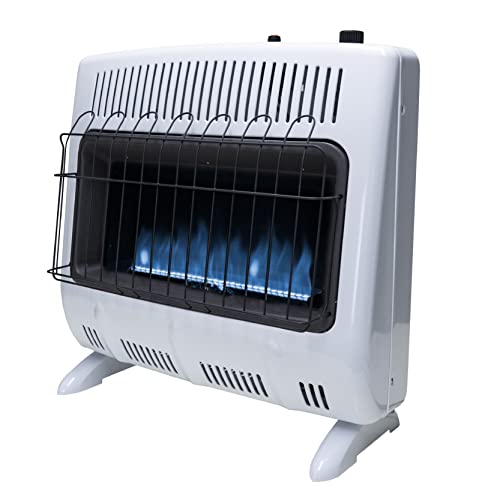
The Mr. Heater MHVFBF30NGT is a vent free blue flame wall mount heater providing up to 30,000 BTU. Manufacturer notes indicate effective heating for spaces up to 1,000 sq. ft. and operation up to altitudes around 4,500 feet.
The unit includes a built-in thermostat for precise temperature control and a free battery to power its electric ignition. The blue flame burner is noted for fuel-efficient convection heat, with a stated low consumption rate. Vent-free blue flame heaters distribute even heat via warmed room air without requiring a flue.
Buying Guide: Choosing The Right Gas Wall Heater
Selecting a gas wall heater requires matching heater type, BTU output, and safety/ventilation to the intended space. The following sections explain critical considerations and compare common technologies to help in decision-making.
Heating Technology: Infrared vs. Blue Flame vs. Direct Vent
- Infrared (Radiant): Heats objects and occupants directly. Effective for localized comfort, drafts, or high-ceiling spaces. Best where immediate surface warmth is preferred.
- Blue Flame (Ventless/Convection): Heats the air by convection; heat circulates throughout the room. Provides steady, whole-room warmth. Vent-free models are highly efficient but introduce combustion byproducts into the room.
- Direct Vent (Sealed Combustion): Uses outside air for combustion and vents exhaust outdoors. Maintains indoor air quality and is often required by code in certain installations.
BTU Output And Room Sizing
Estimate required BTU by room volume, insulation quality, and climate. Rough guideline: 10–30 BTU per sq. ft. depending on insulation and climate. For example, a well-insulated 400 sq. ft. room may need 4,000–12,000 BTU, while larger or poorly insulated spaces require higher outputs.
Select a heater with adjustable output or multiple heat settings if exact sizing is uncertain. Oversized units may cycle frequently; undersized units may not maintain comfort.
Ventless vs. Vented Considerations
- Ventless Advantages: Higher delivered efficiency, easier installation (no flue), and lower upfront cost.
- Ventless Limitations: Indoor combustion products remain in the room; require ODS and adherence to occupant density limits; may be restricted or prohibited by local codes.
- Vented/Direct Vent Advantages: Better indoor air quality, fewer restrictions in code-restricted areas, often allowed in bedrooms and sleeping quarters where ventless may not be.
Controls, Ignition, And Safety Features
Thermostat control allows automatic temperature regulation and energy savings. Manual controls provide simplicity but require manual adjustment. Check if the thermostat is built into the unit or requires an external control.
Ignition types: Piezo or matchless mechanical ignition removes batteries or electric reliance. Electric ignition provides convenience but requires a power source or battery backup.
Safety systems: Oxygen Depletion Sensors (ODS), sealed combustion, pressure regulators, and automatic shut-off pilots are critical safety features. Confirm that the model includes ODS if ventless and a sealed system if maintaining indoor air quality is required.
Installation, Clearances, And Codes
Wall heaters have specified clearance distances
Local building codes and regulations may limit ventless heaters or require permits. Check local code jurisdiction and fuel gas codes before purchase. Professional installation is recommended where codes require it or where venting is needed.
Fuel Type, Conversions, And Altitude
- Fuel type: Confirm the unit is configured for natural gas or LP/propane. Many models are specific to one fuel and may not permit conversion.
- Altitude: Combustion performance can change at higher elevations. Some manufacturers specify maximum altitude ratings; verify suitability if above sea level.
Maintenance And Longevity
Regular maintenance includes cleaning air passages, checking pilot assemblies, and inspecting seals and vent terminations on vented units. Ongoing maintenance affects safety and fuel efficiency. Verify availability of replacement parts and service documentation.
Efficiency, Fuel Consumption, And Operating Cost
Vent-free units deliver more of the combustion energy into the living space but may affect indoor air quality. Direct vent units exhaust combustion products outside, slightly reducing delivered heat but improving indoor air quality.
Compare manufacturer fuel consumption metrics and BTU output to estimate operating costs. Consider thermostat control and zone heating to limit runtime and reduce fuel use.
Use Cases And Comparative Perspectives
- Basements and Garages: Vent-free blue flame units work where quick, whole-room heat is needed and ventilation can be managed.
- Dayrooms and Sitting Areas: Infrared units provide comfortable surface warmth and are effective for spaces with draft issues.
- Bedrooms and Tight Homes: Direct vent models are often preferred to preserve indoor air quality and meet stricter code requirements.
- Remote Locations: Non-electric piezo ignition models are useful where electricity is unavailable.
Warranty, Support, And Brand Considerations
Review the manufacturer warranty and support network. Established brands may offer broader parts availability and technical guidance. Ensure model documentation includes installation diagrams and service instructions.
Final Selection Tips
- Match BTU output to the actual room load rather than nominal coverage claims.
- Confirm whether the heater is vented or vent-free and check local regulations.
- Prioritize safety features like ODS and sealed combustion where relevant.
- Consider installation complexity and whether professional installation is required.