The right heater keeps aquarium water stable for healthy fish and plants. Below is a quick comparison of seven top-rated submersible heaters chosen for different tank sizes and safety features.
| Product | Wattage / Range | Suitability |
|---|---|---|
| HITOP Adjustable Aquarium Heater (50W) | 50W, 68–93°F | Up to 15 gallons |
| HiTauing Rapid Heating Heater (300W) | 300W, 63–94°F | 40–75 gallons |
| Orlushy 25W Small Submersible Heater | 25W, preset 78°F | 1–6 gallons |
| HiTauing Upgraded 300W Heater | 300W, 63–94°F | 20–75 gallons |
| PULACO 25W Betta Heater | 25W, preset 78°F | Up to 6 gallons |
| Tetra HT 50W Electronic Thermostat | 50W, preset 78°F | 2–10 gallons |
| FREESEA Adjustable Submersible Heater | 100–500W options, 64–95°F | 20–40 gallons (varies by wattage) |
HITOP 50W Adjustable Aquarium Heater

This HITOP 50W aquarium heater is designed for small tanks up to 15 gallons and measures about 7.2 inches with a 4.9 ft power cord. The unit uses 2mm thickened quartz glass, advertised as 33% thicker than standard 1.5mm tubing for improved safety and durability. Temperature is adjustable from 68°F to 93°F and the thermostat automatically turns the heater on or off when the water crosses the set point. The shaker-style control simplifies setup and the included suction cup supports vertical placement.
HiTauing 300W Rapid Heating Aquarium Heater
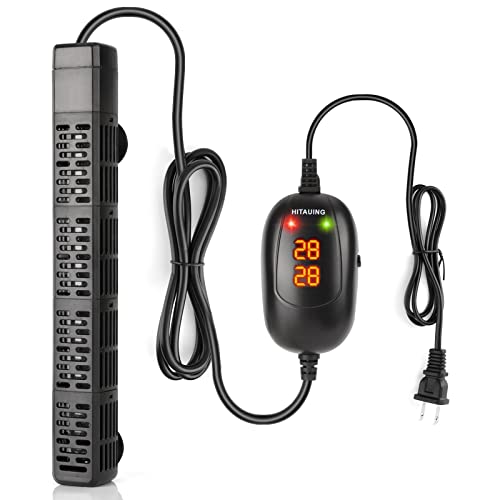
The HiTauing 300W model highlights fast heating using a nickel-chromium heating wire and silicon carbide conduction. It supports both Fahrenheit and Celsius controls with a range of 63–94°F (17–34°C). Built-in protections include an intelligent water sensor that shuts the heater off if fully out of water and an over-temperature protection that prevents overheating. The outer shell is ABS and the heating tube is explosion-proof quartz glass, intended for durability and safety in 40–75 gallon tanks.
Orlushy 25W Small Submersible Heater

The Orlushy 25W heater is a compact option for very small tanks (1–6 gallons). It is 4.7 inches long and ideal for low water levels and cramped setups. This model has a preset 78°F constant temperature with ±3°F accuracy and uses a stair-shape heating cycle with indicator lights: red when heating and green when maintaining temperature. The outer shell is heat-resistant ABS and the heating element contains nickel-chromium wire and non-corrosive quartz glass.
HiTauing Upgraded 300W Explosion-Proof Heater

This HiTauing upgraded 300W heater emphasizes an explosion-proof quartz glass tube and a protective ABS outer shell. Suitable for freshwater and saltwater tanks, it lists a temperature range of 63–94°F and is intended for 20–75 gallon aquariums. The unit features a sensitive temperature control probe and an intelligent sensor that stops heating if the head is about 5cm out of water, showing an error code and switching on a safety indicator.
PULACO 25W Betta Heater With Thermometer Strip
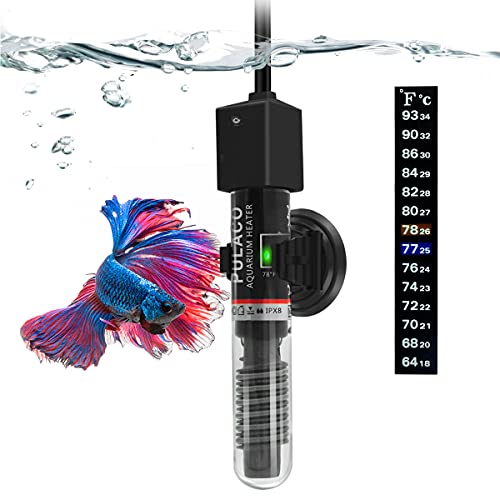
The PULACO 25W heater is targeted at betta tanks and small desktop aquariums up to 6 gallons. It is designed to be fully submerged and offers a preset 78°F automatic control with ±3°F accuracy. Installation can be vertical or horizontal and a free thermometer strip is included for external monitoring. The heater cycles between red (heating) and green (holding) lights to indicate status.
Tetra HT 50W Submersible Heater With Thermostat

The Tetra HT 50W heater uses an electronic thermostat and is marketed for 2–10 gallon aquariums. The built-in thermostat maintains water at 78°F, with indicator lights showing heating (red) and reached temperature (green). Safety features include automatic shutdown for electrical shorts. The unit is intended for tanks with hoods or glass canopies and provides simple, plug-and-play operation without manual temperature adjustment.
FREESEA Adjustable Submersible Aquarium Heater

The FREESEA heater line spans multiple wattages (100W–500W) and the digital controller offers an adjustable 64–95°F range with ±1°F accuracy. The unit includes overheating and off-water protection, with error codes (E1 for out of water, E2 for mechanical failure). The external LED controller displays current and preset temperatures and warns when the unit auto-shuts off. Recommended wattage varies by tank size; 100W models are cited for ~20–40 gallons.
Buying Guide
This guide covers the key considerations when selecting a fish tank heater, comparing common technologies and safety features so you can match a heater to your aquarium setup.
Wattage And Tank Size
Wattage determines how quickly and effectively a heater can raise water temperature. A common rule is about 3–5 watts per gallon for indoor tanks in typical room temperatures. Small tanks (1–10 gallons) often need 25–50W. Medium tanks (20–40 gallons) typically require 100–200W. Large tanks (40+ gallons) may need 300W or multiple heaters for redundancy.
Heater Types And Thermostat Control
Heaters fall into three operational types: preset (single fixed temperature), adjustable analog, and digital with external controller. Preset heaters are simple and reliable for common tropical setups. Adjustable analog heaters allow manual tuning. Digital controllers offer precise set points, readouts, and often better accuracy and alerts.
Materials And Construction
Quartz glass tubes are common for heating elements; they transfer heat efficiently and resist corrosion, while ABS shells provide impact protection and a safer exterior. Look for claims of explosion-proof or thickened glass if durability is a priority, especially in active tanks or with boisterous livestock.
Safety Features
Key protections include off-water shutoff (stops heating if exposed), over-temperature prevention (halts heating above set limits), and error codes or indicator lights. Automatic shutoff for electrical faults adds protection. For saltwater systems, choose models with corrosion-resistant internals and secure seals.
Placement And Mounting
Most heaters come with suction cups for vertical attachment near a return flow or filter outlet to promote even heat distribution. Some models allow horizontal placement for shallow setups. Ensure the heater is fully submerged to the recommended level and positioned where flow moves heated water through the tank.
Accuracy And Monitoring
Accuracy is expressed in degrees (±1–±3°F common). Digital controllers and external thermometers provide more reliable monitoring than heater indicator lights alone. Consider an independent aquarium thermometer or a controller with a separate probe for continuous validation.
Redundancy And Multi-Heater Strategies
For large or critical systems, using two smaller heaters on opposite ends reduces thermal shock risk if one fails. This also improves temperature stability and reduces reliance on a single device.
Compatibility With Freshwater And Saltwater
Many heaters specify compatibility with both freshwater and saltwater. Saltwater can accelerate corrosion; choose models with quartz glass elements and robust seals. Verify the manufacturer’s saltwater suitability if you run a marine tank.
Maintenance And Lifespan
Regular inspection for cracks, loose wiring, or abnormal noises is essential. Clean the heater surface of algae and mineral deposits periodically with a soft cloth; avoid sudden temperature changes when removing or reinstalling the heater. Unit lifespan depends on usage, build quality, and maintenance.
Practical Comparisons
- Preset tiny heaters (Orlushy, PULACO, Tetra): best for nano tanks and bettas; minimal setup and stable for common tropical temps.
- Adjustable quartz heaters (HITOP, FREESEA): balance between control and simplicity; suitable for small to medium tanks.
- High-wattage digital/explosion-proof units (HiTauing series): designed for larger aquariums where rapid heating, multiple protections, and digital displays are required.
Troubleshooting Tips
If a heater cycles excessively, check thermostat accuracy, tank size/wattage match, and room temperature fluctuations. If the heater appears damaged or shows error codes for off-water or mechanical failure, unplug immediately and inspect. Replace cracked glass or malfunctioning units promptly to avoid harm to livestock.
Energy Use Considerations
Heaters run intermittently once the target temperature is reached. Better-insulated tanks and stable room temperatures reduce runtime. For energy efficiency, select an appropriately sized heater rather than oversizing, and consider using a thermostat-controlled outlet for precise control where appropriate.