Stay comfortable outdoors with efficient, weather-resistant electric patio heaters. This guide compares seven top models suited for residential and light commercial use, showing key specs and features to help you choose the right unit for your space.
| Product | Type | Power | Notable Feature |
|---|---|---|---|
| SereneLife Outdoor Electric Patio Heater | Standing Infrared | 1500W | IP65 Waterproof, Remote |
| Dr Infrared Heater DR-238 | Wall/Outdoor Infrared | 900–1500W | IP55 Rated, Remote |
| Paraheeter 3-in-1 Infrared Heater | Wall/Ceiling/Tripod | 1500W | Tip-over Shutoff, CSA |
| Star Patio Infrared Heater | Freestanding Infrared | 1200W | 180° Oscillation |
| VAGKRI 42″ Tower Heater | Tower Infrared | 620–1500W | 9 Heat Levels, IPX5 |
| PowerScale Infrared Heater | Wall-Mounted Infrared | 1500W | 24H Timer, IP65 |
| HAIMMY 42″ Infrared Tower Heater | Tower Infrared | 620–1500W | 9 Heat Levels, Safety Lock |
SereneLife 1500W Standing Heater

The SereneLife Outdoor Electric Patio Heater is a 1500W infrared standing heater designed for decks and patios. It offers three power settings and a remote control for convenient operation from seating areas.
Key features include an aluminum reflector to focus output, an IP65 waterproof rating for outdoor durability, and quiet operation suitable for social spaces. The infrared design warms people and surfaces directly rather than heating air, which can be more effective in breezy environments.
Because it uses standard electric power and emits odorless, gas-free warmth, this model is an alternative to propane units where fuel storage or emissions are a concern.
Dr Infrared DR-238 Outdoor Heater
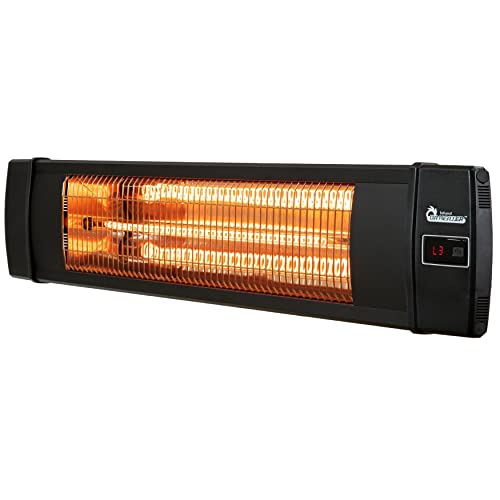
The Dr Infrared DR-238 is an IP55-rated heater suitable for both indoor and outdoor use, making it flexible for patios, garages, and restaurant patios. It runs on standard 120V power and is remote controlled.
It delivers clean, instant infrared heat with three power settings—900W, 1200W, and 1500W—allowing for tailored output depending on ambient conditions.
Because of its IP55 protection, it tolerates dust and low-pressure water jets, and the infrared heating approach reduces wasted energy by warming objects directly rather than large volumes of air.
Paraheeter 3-In-1 Mountable Heater

The Paraheeter Electric Outdoor Heater offers a three-in-one installation: wall, ceiling, or tripod mount. This versatility suits varied patio layouts and fixed or temporary setups.
Safety is emphasized with a metal grille, grounded plug, and automatic tip-over shutoff. It uses carbon infrared elements to transfer heat directly to people and objects, which is efficient for outdoor use where wind can disperse warmed air.
The manufacturer highlights lower operating costs compared with propane units and minimal emissions, making it a choice where emissions, noise, and maintenance are concerns.
Star Patio 1200W Oscillating Heater

The Star Patio infrared heater uses honeycomb-shaped elements for consistent heat output and a 180° oscillation function to spread warmth across wider seating areas.
This 1200W freestanding heater claims to heat up to about 110 sq. ft. and operates quietly, using infrared radiation to deliver direct, sunlight-like warmth that performs well even in breezy conditions.
Design features include a matte black finish and a long-life heating tube intended for extended use. The oscillation option can be helpful for heating multiple people without moving the unit.
VAGKRI 42″ Tower Infrared Heater

The VAGKRI 42″ tower heater offers 1 second fast heating and nine adjustable power settings from 620W up to 1500W. The tower format provides a narrow footprint while offering a wide-angle heating spread.
Its 100° wide-angle coverage and IPX5 waterproof rating make it suitable for various outdoor locations where occasional moisture is present. The multiple heat levels enable fine-tuning for sitting areas, dining tables, and partially enclosed patios.
For spaces requiring rapid warmth and adjustable intensity, this model emphasizes flexibility and quick response.
PowerScale Wall-Mounted Infrared Heater

The PowerScale infrared unit is a wall-mounted solution with 1500W output, a 24-hour timer, memory function, and nine heat levels. It carries an IP65 rating, indicating strong protection against dust and water.
Safety features include overheating protection and automatic shutdown in unsafe conditions. The memory function restores the last heat level on restart, which is helpful for repeat settings in commercial or frequent-use residential installations.
This model targets users who want fixed installation, programmable operation, and additional safety certifications for outdoor environments.
HAIMMY 42″ Infrared Tower Heater

The HAIMMY 42″ Infrared Heater features a tall heating tube designed to warm from the feet upward, providing more even coverage for seated users. It offers nine heat levels and 1–9 hour timers for scheduled operation.
Safety lock, tip-over, and overheat protection help meet common outdoor safety expectations. The unit emphasizes carbon fiber heating elements for instant, focused warmth akin to sunlight.
Its compact tower design suits patios and indoor-outdoor transitional areas where footprint and directional warmth matter.
Buying Guide: Choosing An Electric Patio Heater
This section outlines the most important criteria to compare when selecting an electric patio heater. Consider the intended use—residential vs. commercial, covered vs. open-air—and match features accordingly.
Heating Technology: Halogen, Carbon, Or Ceramic
Infrared halogen and carbon heating elements emit radiant heat that warms people and surfaces directly, which is efficient outdoors because it minimizes heated-air loss to wind.
Ceramic heaters typically use convection and fans; they can warm air more uniformly indoors but are less efficient in windy or open spaces.
Power Output And Coverage
Look at wattage ranges (commonly 900–1500W for plug-in models). Higher wattage generally provides greater range, but coverage depends on design—reflectors, oscillation, and element length affect effective warm zones.
Tower and standing units concentrate warmth vertically, while wall and ceiling units can cast heat over a table or fixed seating. Oscillation helps distribute warmth across wider seating areas.
Mounting Options And Footprint
Freestanding towers are portable and easy to relocate. Wall- or ceiling-mounted
Tripod or adjustable mounts offer temporary use and angle adjustment. Choose mounting based on patio layout and desired heat direction.
Weather Resistance And Durability
Check IP ratings: IP65 or IPX5
Materials like aluminum reflectors resist corrosion. For commercial or exposed installations, prioritize units with higher ingress protection and robust construction.
Controls, Programmability, And Safety
Remote controls, timers, and multiple heat levels add convenience. Features like memory functions and 24-hour timers
Key safety features include overheat protection, auto shutoff on tip-over, grounded plugs, and protective grills. Look for ETL/CSA listings for additional assurance.
Energy Efficiency And Operating Cost
Electric infrared heaters convert most input power into usable radiant heat. However, costs vary by wattage and runtime. Models with multiple heat levels and timers allow lower average consumption.
Compare performance in terms of targeted heating—radiant models can be more efficient than space heaters that attempt to warm entire air volumes.
Noise And Comfort Considerations
Infrared radiant heaters are typically quiet
For windy locations, radiant heaters maintain perceived warmth better than convective units that heat air.
Installation, Maintenance, And Lifespan
Wall-mounted and ceiling models may require a professional electrician if hardwired. Plug-and-play units simplify setup but may have placement constraints due to cord length and outlet location.
Maintenance is typically minimal: keep reflectors and grills clean and check weather seals. Replace halogen/infrared tubes per manufacturer guidance to maintain output.
Commercial Versus Residential Use
Commercial settings often need higher duty cycles, sturdier construction, and official safety listings. Models with oscillation, long-life heating elements, and serviceable parts suit restaurants and event spaces.
Residential buyers may favor portability, quieter operation, and simpler controls for occasional use on patios and decks.
Comparing Form Factors
| Form Factor | Best For | Pros | Cons |
|---|---|---|---|
| Freestanding Tower | Flexible placement | Portable, narrow footprint | Can be tipped over if unstable |
| Wall/Ceiling Mount | Fixed seating areas | Out of the way, directed heat | Requires installation, less mobile |
| Mounted Halogen | Quick, direct warmth | Instant heat, compact | Tube replacement may be needed |
Final Comparison Tips
Match heater wattage and coverage claims with your patio size. Prioritize IP rating and safety certifications based on exposure to elements and use frequency.
Consider whether portability or permanent mounting better fits your lifestyle. Choose models with programmable timers and multiple heat levels to balance comfort and energy consumption.