Finding the right heater for a camper involves balancing size, power, safety, and heating method. The table below summarizes seven well-suited electric heaters and hot-water solutions for campers, RVs, tiny homes, and vans to help narrow options quickly.
| Product | Type | Key Strength |
|---|---|---|
| Caframo True North Heater | Low-profile fan heater | Rugged, anti-freeze setting |
| Dreo 1500W Space Heater (Fast Heating) | Portable PTC ceramic | Fast heat, wide coverage |
| Dreo 2025 Upgraded Space Heater | Portable PTC ceramic with thermostat | Precise temp control |
| WINHL Small Portable Heater | Compact PTC ceramic | Auto oscillation, remote |
| ENVI Plug-in Electric Panel Heater | Low-wattage wall panel | Fan-less silent operation |
| Feelrogast 8-Gallon Mini Tank | Plug-in mini water heater | Instant hot-water storage |
| 3000W Tankless Electric Water Heater | On-demand tankless | Instant continuous hot water |
Caframo True North Low Profile Heater

The Caframo True North is a compact steel-bodied heater designed for durability and steady warmth. Its feature set includes five settings for heat and fan control, allowing users to switch from steady low output to maximum circulation. The unit is built with a solid steel housing and a low-profile form factor that fits into tight storage spaces common in campers.
An anti-freeze setting automatically activates when temperatures drop to 38°F (3°C), making it useful for winter storage or for preventing frozen compartments. The adjustable thermostat provides total climate control with three heat and two fan settings for tailored comfort. This heater is often chosen where rugged construction and simple controls are priorities.
Dreo 1500W Fast Heating Portable Heater

This 1500W PTC ceramic heater is engineered for rapid warmth and broad distribution. The advertised Hyperamics Tech and PTC element produce fast heat delivery—claimed to cover spaces up to roughly 250 sq. ft. with a strong airflow velocity. A 70° oscillation spreads heat across larger interiors, which can be helpful in open camper layouts.
Built-in safety includes tip-over and overheat protection, a 24-hour auto-off, and flame-retardant materials. The unit is ETL-listed, signifying compliance with key electrical safety standards. Control features are aimed at convenience in small spaces where quick, controlled heating is required.
Dreo 2025 Upgraded Heater With Thermostat

The 2025 Upgraded Dreo adds a precise thermostat and a new heat-funnel design to extend warm-air reach. It offers 1500W PTC heating coupled with an enhanced NTC chipset for temperature control in 1°F increments from 41–95°F. This level of precision supports efficiency in limited power scenarios.
Safety measures include a tilt-detection sensor, overheat protection, and V0 flame-retardant materials. The design intends to increase both reliability and energy savings by modulating output precisely. Such control can be beneficial in campers where maintaining comfort without overtaxing electrical supply is critical.
WINHL Small Portable Heater With Oscillation

The WINHL small-space heater emphasizes compact design and even heat distribution via wide-angle automatic oscillation. It uses PTC ceramic heating technology for fast warm-up and continuous heat delivery in smaller interiors such as camper vans and small RV rooms.
Controls include a remote for adjusting temperature, fan speed, heating modes, and a 12-hour timer—functions that support hands-off operation while relaxing or sleeping. The product’s feature set targets efficient, directed warming in confined spaces with remote convenience.
ENVI Plug-In Electric Panel Wall Heater
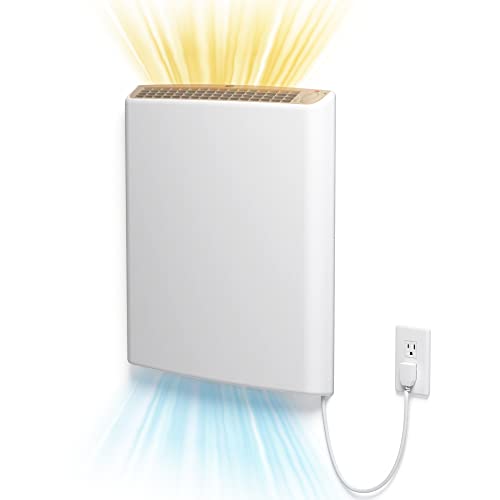
The ENVI plug-in panel heater is a low-wattage, fan-less wall unit that provides gentle, silent warmth via convection. It is designed to run 24/7 if needed and maintains a low surface output—around 90°F—minimizing draft and airborne dust circulation, which can benefit allergy-sensitive users.
Safety features include a wall-sense sensor that cuts power if the unit is removed and a patented quiet, fan-less design called “Stack Convection.” Its slim form can be installed on a wall to free floor space—useful in compact camper interiors. The unit aims for steady background heat rather than rapid blast heating.
Feelrogast 8-Gallon Plug-In Mini Tank Heater

The Feelrogast 8-gallon mini tank heater stores and rapidly reheats hot water for point-of-use applications in campers, RVs, and tiny kitchens. It offers adjustable temperature from 86–167°F and uses a stainless-steel heating element for high heat utilization. The unit suits under-sink or compact wall/floor mounting scenarios.
Certifications include CE, RoHS, and FCC. Safety systems listed are electrical insulation on inlet/outlet, leakage protection plug, high-temp limiting device, and automatic temperature control. This solution reduces wait times for hot water and can be paired with a low-flow faucet to extend hot-water availability on limited supply systems.
3000W Tankless Instant Electric Water Heater

This 3000W tankless electric unit offers on-demand hot water with a digital display and rapid temperature response. It claims substantial temperature rise depending on flow (e.g., up to an 82°F increase at 0.3 GPM). The heater provides continuous hot water without a storage tank, which can be attractive for long showers or multiple fixtures if sufficient power is available.
Built-in protections include water/electric isolation, IPX4 splash resistance, dry-boil protection, and automatic shutoff under overheating. The product’s compact casing and plug-in form factor make it a point-of-use option, but the relatively high power draw should be matched to available campground or inverter capacity.
Buying Guide: Choosing An Electric Heater For A Camper
Selecting an electric heater for a camper is a multi-factor decision. Consider power availability, heating method, safety features, size and mounting, and noise and air quality. The following sections break down these considerations and compare common approaches.
Power Availability And Wattage
Campers often run on shore power, generator, or an inverter tied to battery capacity. Typical portable heaters are 1500W, which is a common maximum on many household circuits and many shore-power pedestal limits. Panel heaters and low-wattage models draw less and can run continuously without overloading a small inverter.
Tankless water heaters at 3000W or higher require special attention to available current and may not be compatible with many RV electrical systems without upgraded shore power or a high-capacity inverter/charger. Mini tanks (e.g., 1500W) offer hot water with lower instantaneous draw than large tankless units.
Heating Method: Fan-Forced, PTC Ceramic, Panel, Or Tank
- PTC ceramic / fan-forced: Fast warm-up and directional heat. Good for quickly heating living space. Typical 1500W units are portable and include safety cutoffs.
- Fan-less panel convection: Silent and dust-light, best for maintaining baseline warmth. Slower to change temperature but more efficient for long-term background heating.
- Mini storage tank: Stores hot water for immediate use with lower power spikes. Suitable for sinks and short showers depending on tank size.
- Tankless on-demand: Continuous hot water without storage but often requires higher wattage and steady power delivery.
Safety Features To Prioritize
Key safety items for camper use include tip-over protection, overheat cutoffs, water and electricity isolation for hot-water units, and certifications such as ETL or CE. For wall-mounted or plug-in heaters, look for surface temperature controls
Installation And Mounting
Portable heaters require no modifications; simply place on a stable surface and plug in. Wall panels and hard-mounted units free up floor space but require secure attachment and attention to clearances. Hot-water appliances may require plumbing and electrical integration; mini tanks often install under sinks, while tankless units may require dedicated wiring.
Noise, Air Quality, And Comfort
Fan-forced heaters move air and may create noise and circulation of dust. Panel heaters and sealed mini tanks are quieter and reduce dust movement—beneficial for allergy-sensitive occupants. Oscillation and directional airflow can distribute heat evenly in open camper layouts.
Energy Efficiency And Control
Thermostat control and timers improve efficiency by regulating runtime and preventing overheating. Precision thermostats (1°F increments) help maintain stable temps without cycling at full power. Consider programmable timers or remote controls for convenience and reduced energy consumption.
Comparing Options For Typical Camper Scenarios
- Short trips with shore power: A 1500W PTC portable heater offers quick warmth and convenience.
- Long stays or overnight comfort: A low-wattage ENVI-style panel can maintain a comfortable baseline temperature with minimal noise and continuous operation.
- Hot water needs with limited power: A 1500W mini tank provides stored hot water with modest draw; match tank size to expected usage.
- On-demand hot water and steady shore power: A tankless unit delivers continuous hot water if the electrical supply can support its wattage.
Maintenance And Longevity
Regularly clean intake areas and maintain clearance around heaters to preserve airflow and prevent dust buildup. For water heaters, flush tanks periodically to reduce mineral buildup and inspect seals for leaks. Verify electrical cords and plugs for wear consistent with mobile use.
Final Selection Checklist
- Confirm your camper’s maximum continuous amperage and usable wattage.
- Decide whether space heating or hot-water provision (or both) is the priority.
- Match heater wattage to available power and select safety-certified models.
- Choose mounting style—portable, wall, or under-sink—based on space and use patterns.
- Prioritize thermostat control and safety features for overnight operation.