Choosing a pool heater for an inground pool involves balancing speed, efficiency, durability, and climate suitability. The table below summarizes seven top-rated options for a range of pool sizes and heating strategies.
| Product | Type | Key Capacity / Feature |
|---|---|---|
| Hayward Universal H-Series W3H250FDN | Natural Gas | 250,000 BTU, cupro-nickel heat exchanger |
| AQUASTRONG Inverter Heat Pump | Electric Heat Pump | 75,000 BTU, inverter, WiFi, heating & cooling |
| MICOE 35,000 BTU Heat Pump | Electric Heat Pump | 35,000 BTU, titanium exchanger, app control |
| WOPOLTOP 100,000 BTU Inverter | Electric Heat Pump | 100,000 BTU, full DC inverter, WiFi |
| FibroPool FH270 | Electric Heat Pump | 70,000 BTU, titanium exchanger, high efficiency |
| Raypak PR336 | Natural Gas | 336,000 BTU, integral fin copper exchanger |
| Doniks 72,000 BTU Inverter | Electric Heat Pump | 72,000 BTU, high COP, smart defrost |
Hayward Universal H-Series 250K

The Hayward Universal H-Series 250,000 BTU is a high-output natural gas heater designed for inground pools and spas requiring fast temperature recovery. The unit’s cupro-nickel heat exchanger offers enhanced resistance to corrosion caused by unbalanced water chemistry, improving longevity when compared to standard copper exchangers.
Hayward highlights an industry-leading hydraulic design that reduces circulation pump run time, which can lower operational energy consumption. This model is suited for pool owners who need rapid heating after heavy use or seasonal temperature dips. Because it is gas-fired, it requires proper venting and professional installation in compliance with local codes.
AQUASTRONG 75,000 BTU Inverter

The AQUASTRONG 75,000 BTU inverter heat pump offers dual-mode heating and cooling for pools up to 21,000 gallons and provides app-enabled remote control. The inverter design allows variable output from the compressor to match load, improving efficiency across a wide range of ambient conditions.
Manufacturer claims include precision control from 47–104°F in heating mode and 47–83°F for cooling, plus performance metrics such as a high COP and up to 70% energy savings versus traditional electric resistance. This model is a fit for owners seeking balance between seasonal temperature control and energy efficiency, particularly in moderate climates.
MICOE 35,000 BTU Heat Pump
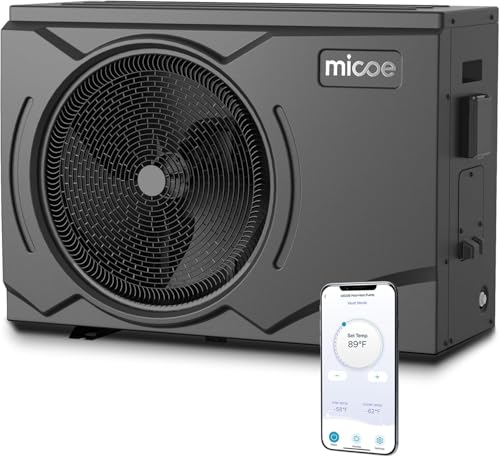
The MICOE 35,000 BTU inverter heat pump is targeted at smaller inground pools and above-ground pools up to roughly 12,000 gallons. It includes a titanium heat exchanger that performs well with filtered saltwater and is built for longevity where corrosion resistance is important.
Operating ranges include heating to 104°F under optimal conditions and cooling to 45–82°F, with an auto-defrost function for cold climates. Smart features enable scheduling and temperature adjustments via app or control panel, which helps owners preheat water to optimal levels before use.
WOPOLTOP 100,000 BTU Inverter

The WOPOLTOP 100,000 BTU model features full DC inverter design and is rated for pools up to 26,000 gallons. The inverter-controlled compressor and fan modulate output for efficient operation and reduced cycling losses, boosting seasonal performance and lowering energy consumption.
Key highlights include a high COP (claimed up to 6.8), WiFi control for remote monitoring, and combined heating/cooling capability. This unit is intended for large inground pools where continuous, efficient heating is preferred over short-term rapid heating provided by a gas unit.
FibroPool FH270 70K Electric

The FibroPool FH270 is a high-efficiency electric heat pump that uses ambient air to transfer heat to pool water. Designed for inground pools up to about 15,000 gallons, the unit uses titanium exchangers and high-pressure compressors for durable performance.
FibroPool positions this model as a clean electricity alternative to gas, ideally suited to humid climates down to about 50°F ambient. The FH270 emphasizes long-term operating cost savings, quiet operation, and reduced environmental impact compared with fuel-based heating.
Raypak PR336 336K Natural Gas

The Raypak PR336 is a high-capacity 336,000 BTU natural gas heater intended for very large inground pools or rapid recovery needs. Features include an integral fin copper exchanger tube and corrosion-free polymer headers to improve lifespan and heat transfer.
Raypak models feature user-friendly backlit LCD controls and are commonly installed where fast temperature recovery is required, such as public pools, heavy-use residential pools, or installations in colder spring/fall months where gas heating is favored for speed.
Doniks 72,000 BTU Inverter
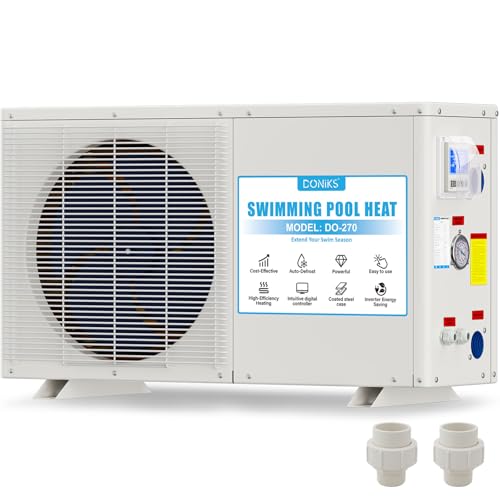
The Doniks 72,000 BTU inverter heat pump emphasizes inverter efficiency, smart app control, and low noise operation. With a claimed high COP and a silent design around 52 dB, it targets homeowners who want energy efficiency and minimal acoustic impact.
Other features include a smart auto-defrost routine and app scheduling, making it suitable for year-round control in many regions. It is presented for pools up to roughly 9,000 gallons but can serve larger pools depending on climate and insulation.
Buying Guide
Selecting the right inground pool heater depends on several objective factors: pool volume, local climate, desired warm-up speed, fuel availability, installation constraints, and operational efficiency.
Heater Types and How They Compare
- Natural Gas Heaters: Provide rapid heat and fast recovery for frequent or large temperature changes. They are well-suited to colder climates or pools used intermittently where quick warm-ups are needed. Requirements include gas supply, ventilation, and professional installation.
- Electric Heat Pumps (Air-to-Water): Move heat from ambient air into pool water, offering much higher seasonal efficiency (high COP) than gas. Heat pumps are best for maintaining temperature over time and perform best in moderate to warm climates.
- Inverter/Variable-Frequency Heat Pumps: Use DC inverter compressors to modulate power, reduce cycling, and improve part-load efficiency. They typically yield lower energy bills and quieter operation compared with fixed-speed units.
Key Technical Considerations
- BTU Sizing: Match heater output to pool volume, heat loss, and local climate. Larger BTU ratings speed recovery but may cost more to run. Use manufacturer capacity guidance and consult a professional for exact sizing.
- COP (Coefficient Of Performance): For heat pumps, COP indicates efficiency. Higher COP (e.g., 5–7) means more heat per unit of electricity. Gas heaters are rated by BTU output rather than COP.
- Heat Exchanger Material: Titanium and cupro-nickel exchangers resist corrosion from salt systems and unbalanced chemistry—important for durability with saltwater chlorination.
- Heating Range & Defrost: Confirm ambient operating ranges and automatic defrost capabilities for cold-weather performance if you plan to extend seasons into cool months.
Installation, Maintenance, And Compliance
- Gas Unit Installation: Requires gas line sizing, proper venting, and local code compliance. Placement must consider combustion air and exhaust pathways.
- Electrical Requirements: Heat pumps need adequate 220–240V supply and correctly sized breakers. Inverter models may have higher startup specifications but lower ongoing draw.
- Maintenance: Regular filter and circulation maintenance extends heater life. Inspect heat exchangers and corrosion-prone parts, and follow winterization procedures for climates with freeze risk.
Operational Costs And Environmental Impact
- Fuel vs Electricity: Gas heaters heat quickly but typically have higher fuel costs and greenhouse gas emissions. Heat pumps use electricity and can be far more efficient over time, especially if paired with renewable power.
- Seasonal Use Patterns: For continuous seasonal use, heat pumps usually cost less to operate. For occasional rapid heating, gas may be more practical despite higher running costs.
Smart Features And User Experience
- WiFi And App Control: Remote scheduling lets owners preheat pools for events and monitor energy use remotely.
- Noise And Location: Inverter heat pumps generally run quieter. Consider sound levels and siting near living areas.
- Warranty And Support: Compare manufacturer warranties on compressors and heat exchangers, and verify local support availability for service or replacement parts.
Choosing For Specific Scenarios
- Large Inground Pools / Fast Recovery: Consider high-BTU gas models like the Hayward 250K or Raypak 336K.
- Energy Efficiency / Year-Round Comfort: Inverter heat pumps (AQUASTRONG, WOPOLTOP, Doniks) offer superior seasonal efficiency and modulated output.
- Saltwater Pools: Select units with titanium or cupro-nickel exchangers for corrosion resistance (MICOE, Hayward cupro-nickel, FibroPool titanium).
- Cold Climates: Evaluate defrost capability and compressor design; gas remains fastest for extreme cold, while advanced inverter heat pumps extend operation into cooler ambient ranges with defrost cycles.
When comparing units, weigh both short-term installation complexity and long-term operating cost. Objective assessment of pool size, climate, usage frequency, and system compatibility will narrow options effectively.