The right pool heater keeps your water comfortable across seasons. Below is a quick comparison table of the seven selected heaters covering key type and capacity to help you decide at a glance.
| Model | Type | Key Capacity |
|---|---|---|
| Hayward W3H250FDN | Natural gas | 250,000 BTU |
| AQUASTRONG Inverter Heat Pump | Electric inverter heat pump | 35,000 BTU |
| WOPOLTOP 100,000 BTU Heat Pump | Full DC inverter heat pump | 100,000 BTU (30 kW) |
| Raypak PR336AENC49 | Natural gas | 336,000 BTU |
| MICOE 35,000 BTU Inverter | Electric inverter heat pump | 35,000 BTU |
| FibroPool FH270 | Electric heat pump | 70,000 BTU |
| FIVECUBS Immersion Heater | Portable immersion heater | 2,000 W (portable) |
Hayward Universal H-Series 250,000 BTU

The Hayward W3H250FDN is a high-output natural gas pool and spa heater designed for in-ground systems. Its 250,000 BTU capacity suits larger pools or those requiring rapid temperature recovery after heavy use. The heater uses a cupro nickel heat exchanger for enhanced corrosion resistance, improving longevity in variable water chemistry environments.
Hayward highlights an industry-leading hydraulic design that reduces circulation pump run time, potentially lowering operating energy consumption for the pool system. This model is positioned for users needing powerful, fast heating and for climates where gas remains the most practical option.
AQUASTRONG Inverter 35,000 BTU Heat Pump

The AQUASTRONG Inverter is an electric heat pump offering 35,000 BTU and inverter-driven efficiency suited to pools up to about 9,000 gallons. It provides heating and cooling modes with a wide operating temperature range, enabling extended swim seasons in moderate climates.
Key features include WiFi-capable app control, a programmable timer, and a claimed 15.8 COP through DC variable frequency technology. The inverter design allows continuous modulation of output for energy savings versus on/off compressors, which can reduce runtime and power spikes during operation.
WOPOLTOP 100,000 BTU Full DC Inverter

The WOPOLTOP 100,000 BTU model is a full DC inverter pool heat pump with dual heating and cooling capability, designed for larger or colder-climate pools up to roughly 26,000 gallons. Variable frequency operation in both compressor and fan yields smoother power draw and improved efficiency compared to conventional fixed-speed units.
It features a high-quality compressor targeting a COP up to 6.8 and WiFi app control for remote monitoring and scheduling. The inverter approach reduces cycling and provides more precise water-temperature maintenance, making it suitable when fast recovery and lower energy consumption are priorities.
Raypak PR336AENC49 336,000 BTU Natural Gas

The Raypak PR336AENC49 is a commercial-grade natural gas heater with a 336,000 BTU rating for rapid heating and high-demand applications. It uses an integral fin copper exchanger tube with polymer headers to reduce corrosion and improve durability in harsh pool environments.
Raypak includes backlit LCD controls for straightforward operation and monitoring. This model is typical for large residential or small commercial pools where maximal heat output and quick temperature recovery are important, and where gas infrastructure exists.
MICOE 35,000 BTU Inverter Pool Heater
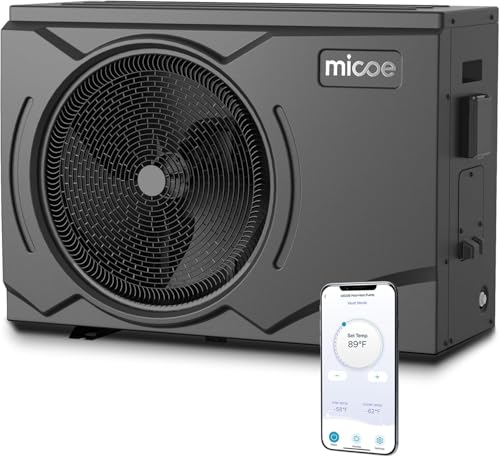
The MICOE 35,000 BTU inverter heat pump is targeted at above-ground pools and smaller inground pools up to about 12,000 gallons. It features a titanium heat exchanger
Designed to operate across a broad range of ambient temperatures, this unit includes smart app scheduling, auto-defrost, and both heating and cooling modes. Recommended pre-heating lead time of 12 hours is noted for efficient temperature attainment.
FibroPool FH270 70,000 BTU Heat Pump

The FibroPool FH270 is an all-electric heat pump rated at 70,000 BTU, designed for above-ground pools up to 27 feet round and in-ground pools up to 15,000 gallons. It emphasizes high efficiency via titanium heat exchangers and high-pressure compressors.
FibroPool markets this model as a clean and green alternative to fossil-fuel heaters, ideal in humid climates down to about 50°F ambient. It is positioned for pool owners seeking reduced fossil fuel use and lower operating emissions with dependable late-season performance.
FIVECUBS Portable 2000W Immersion Heater

The FIVECUBS 2000W immersion heater is a compact, portable device for very small pools, buckets, stock tanks, or portable spas. It delivers rapid local heating and features an auto shut-off when water reaches a target temperature to help prevent overheating.
This unit is intended for temporary or emergency warming rather than continuous pool heating. The stainless steel construction and upgraded magnesium oxide element target quick heat transfer, but safe use requires full submersion and adherence to electrical safety precautions.
Buying Guide — How to Choose the Right Pool Heater
Selecting the best heater depends on pool size, climate, energy costs, and installation constraints. This guide summarizes key considerations and compares major heater types so you can match features to needs.
Heater Types and When to Choose Them
- Electric Heat Pumps — Move heat from air into water; high efficiency (COP often 4–7) and lower running costs in mild climates. Best for extending seasons in moderate to warm regions and for saltwater pools when equipped with titanium exchangers.
- Inverter Heat Pumps — Use variable-speed compressors for precise control and improved efficiency. Recommended for energy-conscious owners who want quieter, more consistent temperature control.
- Natural Gas or Propane Heaters — Provide the fastest heating and maintain temperature in very cold ambient conditions. Suitable for quick recovery and heavy-use pools, or when electricity costs are high or heat pumps underperform in cold climates.
- Portable Immersion Heaters — Useful for small inflatable pools, stock tanks, or emergency situations. Not recommended for continuous heating of standard pools due to limited output and safety considerations.
Key Specifications to Compare
- BTU or kW Output — Measure of heating power. Larger pools and faster heat-up needs require higher BTU ratings. Match output to pool volume and desired temperature rise.
- COP (Coefficient of Performance) — For heat pumps, higher COP means more heat per unit of electricity. Inverter models often deliver higher average COP by modulating output.
- Pool Volume and Desired Temperature — Calculate gallons and factor in expected temperature increase. Manufacturers provide recommended pool sizes; use them as a baseline but consider local heat loss factors.
- Ambient Operating Range — Heat pumps have minimum recommended ambient temps; gas heaters perform well in cold climates where heat pumps may struggle.
- Heat Exchanger Material — Titanium or cupro-nickel exchangers perform better with saltwater or unbalanced chemistry; polymer headers can reduce corrosion risk in gas heater designs.
- Controls and Connectivity — WiFi, app controls, and scheduling improve convenience and can optimize energy use through timed heating.
Installation, Permitting, and Site Requirements
Gas heaters require fuel lines and proper venting; professional installation and local permits are often necessary. Heat pumps need adequate airflow clearance and a level pad; inverter units may need dedicated electrical circuits. Verify that the equipment fits your mechanical pad and plumbing layout.
Running Costs and Environmental Considerations
Gas heaters provide rapid heat but usually cost more to operate per BTU than efficient electric heat pumps, depending on local fuel prices. Electric heat pumps use less energy per heat unit and reduce onsite emissions if electricity comes from cleaner sources. Consider long-term operating costs and local utility rates when evaluating total ownership cost.
Durability, Maintenance, and Warranty
- Choose heat exchangers compatible with your water type (salt vs. freshwater).
- Regular maintenance: filter cleaning, checking flow rates, and scheduled service lengthen system life.
- Review manufacturer warranties for components like compressors, heat exchangers, and control boards.
Noise, Aesthetics, and Location
Heat pumps produce fan and compressor noise; inverter models often run quieter. Place equipment away from living areas and ensure local regulations are met. Gas units generate combustion noise and require venting clearances.
Practical Selection Checklist
- Confirm pool volume in gallons and target temperature rise.
- Decide whether rapid heat (gas) or energy efficiency (heat pump) is the priority.
- Match heater capacity (BTU/kW) to pool size and climate.
- Check compatibility with saltwater if applicable (titanium or cupro-nickel exchangers recommended).
- Verify electrical/fuel infrastructure and installation requirements.
- Consider smart controls, quiet operation, and warranty coverage.
Comparative Summary
| Priority | Best Type | Notes |
|---|---|---|
| Fastest Warm-Up | Gas Heater | High BTU output; effective in very cold weather |
| Lowest Operating Cost (mild climates) | Electric Inverter Heat Pump | High COP, modulating output, WiFi control options |
| Eco-Friendly Operation | Electric Heat Pump | Lower onsite emissions; best when electricity is clean |
| Temporary/Small Pools | Immersion Heater | Portable, limited scope; requires strict safety practices |