The following guide reviews top gas pool heaters suitable for a range of pool sizes and installation types. Each selected model highlights key features such as BTU output, heat exchanger material, and control type to help compare options quickly.
| Product | BTU | Key Feature |
|---|---|---|
| Hayward Universal H-Series | 250,000 BTU | Cupro-nickel heat exchanger; hydraulic efficiency |
| Hayward H-Series 135k | 135,000 BTU | Compact; cupro-nickel exchanger |
| Raypak 336,000 BTU | 336,000 BTU | Integral fin copper exchanger; LCD controls |
| Raypak 266,000 BTU | 266,000 BTU | Digital LCD diagnostics; high-wind resistant |
| Raypak 206,000 BTU | 206,000 BTU | Cupro-nickel exchanger; robust mid-range output |
| Raypak Polymer Headers P-R156A | 156,000 BTU | Polymer headers; digital thermostat |
| Master Temp 250,000 BTU | 250,000 BTU | Compact design; pre-mixed combustion |
Hayward Universal H-Series 250k Heater

The Hayward W3H250FDN Universal H-Series is a 250,000 BTU natural gas heater designed for in-ground pools and spas. It features a durable cupro-nickel heat exchanger that provides increased corrosion resistance compared to standard copper, which helps protect against damage from unbalanced water chemistry.
The unit emphasizes hydraulic efficiency, reducing pool pump run time and delivering energy savings through improved circulation design. Intended for longevity and reliable performance, this model is positioned for owners seeking a mid-to-high capacity heater with corrosion-resistant materials and solid hydraulic engineering.
Hayward H-Series 135k Natural Gas Heater

The Hayward W3H135FDN is a 135,000 BTU natural gas model intended for smaller in-ground pools or spas. It uses a cupro-nickel heat exchanger and claims faster speed-to-heat capability thanks to efficient hydraulic performance.
This model includes an intuitive electronic control panel for simplified operation. Its lower BTU output compared to larger units makes it a better match for moderate-sized pools where quicker warm-up and reduced fuel use are priorities.
Raypak 336,000 BTU Natural Gas Heater

The Raypak PR336AENC49 is a high-capacity 336,000 BTU natural gas heater designed for large pools or heavy-duty heating requirements. It features an integral fin copper exchanger tube paired with corrosion-free polymer headers to balance thermal transfer and durability.
The model includes backlit LCD controls for easier reading and adjustment. High BTU output supports faster recovery times for sizable water volumes, making it suitable where rapid temperature maintenance or large surface area heating is required.
Raypak 266,000 BTU Digital Pool Heater

The Raypak 266,000 BTU digital heater is specified for elevations between 2,000’–6,000′ and includes an LCD digital display that monitors temperature and provides service diagnostics. The unit highlights high-wind resistance, improving outdoor reliability in breezy installations.
Onboard diagnostics and accurate temperature readouts support easier troubleshooting and precise control. This model sits in the upper mid-range BTU class and targets pool owners who need robust performance with elevation compensation and diagnostic features.
Raypak 206,000 BTU Cupro-Nickel Heater
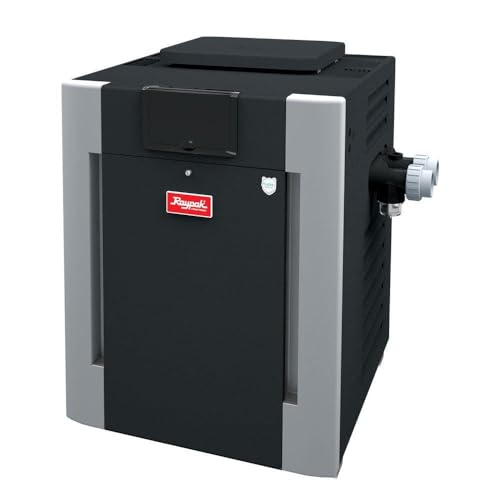
The Raypak P-R206A-EN-X delivers 206,000 BTU with a cupro-nickel gas pool and spa heat exchanger. Cupro-nickel construction is designed to resist corrosion from saline or poorly balanced pool water better than plain copper.
This mid-sized unit fits pools requiring steady heating without the highest BTU capacity. It is often selected for durability in environments where water chemistry can be challenging and corrosion resistance is a priority.
Raypak Polymer Headers P-R156A Digital Heater

The Raypak P-R156A-EN-C provides 156,000 BTU and emphasizes polymer headers and a digital thermostat with automatic water bypass. Polymer headers aim to resist corrosion while keeping manufacturing costs down.
Features like a digital thermostat and automatic bypass simplify operation and help maintain consistent water temperatures. This model is an option for medium-sized pools where polymer header durability and straightforward controls are desired.
Master Temp 250,000 BTU Compact Gas Heater

The Master Temp 250,000 BTU natural gas heater is described as a compact unit featuring pre-mixed gas combustion technology and a rotating digital display for flexible installation and monitoring.
Compact footprint suits installations with limited space. Pre-mixed combustion aims for consistent heating and improved fuel efficiency by optimizing the gas-to-air mixture before ignition. This unit targets pool owners who need a high-capacity heater with a smaller physical profile.
Buying Guide
Selecting the right gas pool heater requires evaluating capacity, materials, controls, installation factors, and long-term maintenance. Below are objective considerations and comparisons to inform a purchase decision.
Pool Size And BTU Sizing
Match heater capacity to pool volume, desired temperature rise, and recovery time. BTU requirements vary with climate, pool surface area, and insulation (covers reduce BTU needs). Higher BTU models heat faster but consume more fuel during operation. For average in-ground pools, mid-range models (150k–266k BTU) are common; large pools may need 300k+ BTU.
Heat Exchanger Material
Common heat exchanger materials include copper, cupro-nickel, and polymer headers. Copper offers strong thermal conductivity but can corrode in improper water chemistry. Cupro-nickel improves corrosion resistance, making it suitable for saltwater pools or poor water balance. Polymer headers resist corrosion and can offer cost advantages but may have different longevity and repair profiles.
Ignition And Controls
Heaters use either standing pilot or electronic ignition (intermittent pilot/direct spark). Electronic ignition conserves gas by eliminating continuous pilot flames. Digital controls and backlit LCDs provide precise temperature readouts and diagnostics; analog dials are simpler but offer less feedback.
Hydraulic Efficiency And Bypass
Hydraulic design affects pump run time and heating efficiency. Some models include automatic water bypass to maintain proper flow and protect the heat exchanger. Efficient hydraulics can reduce circulation demands and lower operating costs.
Altitude And Environmental Factors
High-elevation installations may require models rated for altitude or factory adjustments, as burners behave differently at elevation. Wind exposure can affect combustion stability; look for high-wind resistant
Installation And Space Considerations
Confirm physical dimensions, clearance requirements, and venting type. Compact units can fit tight spaces but may offer fewer internal components for serviceability. Ensure local codes and gas supply sizing meet manufacturer requirements. Professional installation is recommended to comply with safety and permit standards.
Fuel Type And Compatibility
Natural gas and propane are common. Verify the model’s fuel type and whether conversion kits are available if fuel type differs. Gas supply line size and pressure must match the heater’s demand; larger BTU units require correspondingly larger gas service.
Maintenance And Durability
Material choice, ease of access for service, and available diagnostics influence long-term maintenance. Cupro-nickel and polymer header designs aim to reduce corrosion-related failures. Regular water chemistry management and annual inspections prolong heater life.
Warranty And Parts Availability
Compare manufacturer warranty terms and check for local parts and service networks. Diagnostic displays that log faults can simplify repairs and reduce service time. Consider the availability of replacement heat exchangers and common parts when evaluating models.
Noise, Venting, And Safety Features
Combustion noise, venting requirements (direct-vent vs atmospheric), and built-in safety features like high-limit switches and freeze protection are important. Ensure the selected unit meets safety standards and that venting is compatible with the installation site.
Cost Of Operation
Operational cost depends on BTU output, efficiency, run-time, and local gas prices. Higher BTU units heat faster and may run for shorter intervals, while lower BTU units run longer. Using a pool cover, optimizing pump runtime, and ensuring proper insulation reduce overall fuel consumption.
Material Comparison Summary
- Copper: Excellent thermal transfer; less corrosion resistance.
- Cupro-nickel: Improved corrosion resistance; recommended for salt or poorly balanced water.
- Polymer headers: Corrosion-resistant options; balance of cost and durability.
Feature Trade-offs
High BTU capacity plus advanced controls and durable heat exchangers typically increases upfront cost but can improve performance and reduce replacement frequency. Compact models offer space savings but may be less service-friendly. Choose based on priority: speed-to-heat, longevity in corrosive environments, compact footprint, or diagnostic capability.