
Choosing the right heater keeps aquatic turtles active and prevents illness. The table below summarizes seven top options selected for reliability, safety features, and tank-size coverage.
| Product | Brand | Best For |
|---|---|---|
| TetraFauna Aquatic Reptile Heater 100W | Tetra | Small tanks up to 30 gallons |
| Zoo Med TURTLETHERM 300W (100 gal) | Zoo Med | Large aquariums up to 100 gallons |
| ZazaFi 300W Aquarium Heater | ZazaFi | Adjustable digital control, medium to large tanks |
| HiTauing 300W Submersible Heater | HiTauing | Rapid heating with safety sensors |
| HANLESHUKA Submersible Aquarium Heater | HANLESHUKA | Durable quartz glass, multiple wattage options |
| Zilla Aquatic Reptile Heater | Zilla | Shatter-resistant, up to 40-gallon terrariums |
| Zoo Med TURTLETHERM 150W (50 gal) | Zoo Med | Preset safety for 50-gallon tanks |
TetraFauna 100W Aquatic Reptile Heater

The TetraFauna Aquatic Reptile Heater 100 Watts is designed specifically for aquatic reptiles such as turtles, frogs, and newts. It is intended to heat up to 30 gallons and maintain an optimal habitat temperature.
- Aquatic reptile heater: optimized for terrarium water and small aquatic habitats.
- Automatic thermostat: compact, submersible heater maintains a preset 78°F target.
- Protective plastic cage: includes a plastic cover to reduce direct contact and protect animals.
This model emphasizes simplicity and safety for smaller tanks where a fixed target temperature is appropriate. The built-in thermostat reduces manual adjustments while the plastic cage guards against direct turtle contact with the heating element.
Zoo Med TURTLETHERM 300W Heater

The Zoo Med TURTLETHERM 300W is an automatic preset aquatic turtle heater made to heat larger tanks up to 100 gallons. It aims to keep water near 78°F, a common preferred temperature for many aquatic turtle species.
- Preset temperature: safely heats water up to 78°F (26°C) to support aquatic reptiles.
- Digital thermometer: an integrated display and included suction cup simplify monitoring and positioning.
- Automatic shut-off: the heater turns off if removed from water for added safety.
This preset approach is useful where consistent, aquarium-level warmth is needed without frequent readjustments. The display and mounting help confirm current water temperature while safety shutoff reduces risk if the unit is exposed to air.
ZazaFi 300W Digital Aquarium Heater

The ZazaFi 300W is a feature-rich aquarium heater with an external digital controller, fast heating capability, and safety-focused construction suitable for freshwater and saltwater setups.
- Fast heating & dual control: nickel-chromium wire supports quick heat transfer; control in °F and °C (63–94°F / 17–34°C).
- Explosion-proof quartz glass: submersible glass tube with ABS shell for impact and heat resistance.
- External digital display: IC controller shows live temperature and allows precise setpoints via plus/minus buttons.
The external controller offers visible readout and precise adjustment, which is helpful for species or setups needing tight temperature ranges. The explosion-proof materials and dual control options address both safety and usability priorities.
HiTauing 300W Submersible Heater
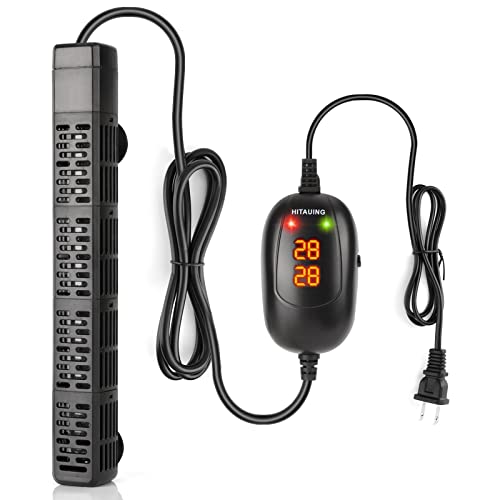
The HiTauing 300W combines rapid heating with intelligent sensing and over-temperature protection. It targets both safety and consistent aquarium conditions for medium-to-large turtle tanks.
- Rapid heating & dual temperature: compatible with tanks sized for 40–75 gallons; supports °F and °C switching (63–94°F / 17–34°C).
- Intelligent sensor and over-temp protection: automatic shutoff if the heater is out of water or exceeds set temperature.
- Explosion-proof quartz glass: durable glass tube and ABS shell minimize breakage and scalding risks.
The integrated safety sensor addresses common risks when units are exposed or malfunction. This model suits aquarists wanting both quick recovery after water changes and automated protection against overheating or dry exposure.
HANLESHUKA Submersible Aquarium Heater

The HANLESHUKA submersible heater emphasizes safety, durability, and a smart dual-temperature control suitable for different tank sizes and species.
- Premium safety & durability: explosion-proof quartz glass tube, fast nickel-chromium heating wire, and high-temp ABS shell.
- Versatile heating: marketed for fish and turtle tanks, with silicon carbide conduction for even heat distribution.
- Smart dual temperature: switch between °F and °C by holding both buttons; user-friendly controller for fine adjustments.
Materials and construction target long-term reliability in aquariums where breakage and uneven heating are concerns. The dual temperature system supports precise settings across hobbyist and reptile needs.
Zilla Fully Submersible Reptile Heater

The Zilla Aquatic Reptile Heater is made to keep aquatic reptiles safe with shatter-resistant construction and protective coverings. It is designed for terrariums up to 40 gallons.
- Safety-focused construction: shatter-resistant materials and protective coverings reduce direct contact and breakage risk.
- Ideal for aquatic reptiles: suitable for turtles, newts, and frogs in habitats up to 40 gallons.
- Fully submersible and easy installation: includes suction cups for vertical or horizontal placement.
The Zilla unit is targeted at reptile keepers wanting a robust, straightforward heater with protective features to prevent direct shell contact and accidental breakage in smaller- to medium-sized habitats.
Zoo Med TURTLETHERM 150W Heater

The Zoo Med TURTLETHERM 150W provides a preset temperature solution for aquariums up to 50 gallons. It is a smaller-capacity counterpart to the 300W model and includes monitoring and safety features.
- Preset heating: safely heats water to about 78°F (26°C), suitable for many turtle species.
- Digital thermometer display: included display with suction cup mounting for convenient monitoring.
- Automatic shut-off: turns off when removed from water, reducing dry-run or overheating risk.
This model is appropriate where a steady preset temperature is preferred and space or tank volume calls for a mid-range wattage heater. The display helps verify performance without complicated setup.
Buying Guide
The buying guide below highlights the main considerations for selecting a heater for a turtle tank. Focus on tank size, temperature control, and safety features to match species needs and habitat setup.
Tank Size and Wattage Recommendations
Choose heater wattage based on aquarium volume and ambient room temperature. As a rule of thumb:
- Up to 20 gallons: 50–100W
- 20–40 gallons: 100–200W
- 40–75 gallons: 200–300W
- 75–100+ gallons: 300W or higher, or use multiple units for redundancy
These ranges account for heat loss and provide headroom during colder ambient conditions. Using multiple smaller heaters can prevent complete failure if one unit stops working.
Preset vs Adjustable Thermostats
Preset heaters (e.g., Zoo Med TURTLETHERM preset models) deliver consistent temperatures without manual tuning, which is useful for common turtle temperature needs.
Adjustable digital heaters (e.g., ZazaFi, HiTauing) provide precise control and visible readouts. Adjustable units are better for species with specific temperature preferences or for seasonal adjustments.
Safety Features to Prioritize
- Automatic shut-off: prevents dry-run heating if the unit is lifted out of water.
- Explosion-resistant materials: quartz glass or reinforced tubes reduce breakage risk.
- Protective guards: cages or ABS shells limit direct contact between turtles and hot elements.
- Over-temperature protection: sensors that cut power if setpoints are exceeded.
Safety features reduce injury and equipment damage and are particularly important in enclosures with active or heavy-bodied turtles.
Placement, Flow, and Temperature Distribution
Place heaters where water flow distributes heat evenly. Avoid burying under decor or substrate. Use an aquarium pump or filter flow to circulate warmed water and prevent hot or cold spots.
Mount heaters horizontally or vertically as manufacturer allows. Suction-cup mounted digital displays should be visible without disturbing the habitat.
Materials, Durability, and Breakage Risk
Heaters are commonly constructed from quartz glass or reinforced materials with ABS shells. Quartz offers fast heat transfer but can be fragile; ABS-sheathed units reduce breakage risk. Protective cages assist in preventing direct animal contact and reduce the chance of cracked tubes from impacts.
Accuracy and Monitoring
External digital controllers provide more accurate readouts and are easier to calibrate. Mechanical preset units often maintain acceptable ranges for many species but do not allow fine tuning.
Use a separate aquarium thermometer to cross-check the heater’s display periodically. Dual-sensor monitoring (heater display plus independent thermometer) improves reliability.
Redundancy and Backup Strategies
For large or temperature-sensitive setups, consider two heaters split across the tank to reduce single-point failure risk. Lower-watt dual units reduce the impact if one fails and help maintain stable temperatures during maintenance.
Compatibility With Saltwater vs Freshwater
Choose heaters rated for saltwater if using a brackish setup. Corrosion-resistant components and sealed connections are important in marine environments.
Maintenance and Troubleshooting
- Clean heaters regularly to remove biofilm that can insulate the element and reduce efficiency.
- Inspect for cracks, discoloration, or erratic display readings as signs of impending failure.
- Replace suction cups and guards if worn to maintain secure mounting and safety spacing.
Feature Comparison Summary
| Feature | Preset Models | Adjustable Digital Models |
|---|---|---|
| Ease of Use | High | Medium (requires setup) |
| Temperature Precision | Medium | High |
| Safety Sensors | Often included | Often included plus over-temp protection |
| Best For | General turtle habitats | Species-specific or sensitive setups |
When selecting a heater, balance wattage, safety features, and temperature control against the specific needs of the turtle species and the tank environment. Proper placement, monitoring, and periodic maintenance extend heater life and support stable, healthy conditions for aquatic reptiles.

