
Warm rooms quietly and efficiently. This guide compares seven popular oil-filled radiator heaters from leading brands, highlighting features, safety, and performance to help identify the right model for bedrooms, living areas, and home offices.
| Model | Brand | Key Feature |
|---|---|---|
| Amazon Basics Portable Oil Radiator Heater | Amazon Basics | 3 heat settings, 7 fins, 1500W |
| Dreo Oil Filled Radiator (Remote) | Dreo | Rapid heat dispersion, digital controls |
| De’Longhi EW7707CM | De’Longhi | ComfortTemp auto control, thermal slot design |
| PELONIS Champagne Oil Filled Radiator | PELONIS | 5 temperature settings, ECO mode, remote |
| De’Longhi Dragon Digital TRD40615E | De’Longhi | Digital display, 24-hour timer, large radiant surface |
| Dreo Radiator Heater (8 Fins) | Dreo | 8 M-shaped fins, enhanced dissipation area |
| PELONIS PHO15A2AGB Basic Oil Filled Radiator | PELONIS | Simple controls, whisper-quiet operation |
Amazon Basics Portable Oil Radiator

This model offers three heat settings — High (1500W), Medium (1000W), and Low (600W) — enabling temperature customization for different rooms and conditions. It features seven oil-filled steel fins that store and radiate heat, maintaining warmth even after the unit cycles off.
The design emphasizes quiet operation since heat is delivered via convection without a fan, suitable for bedrooms and offices where noise is a concern. The unit also lists over-heat protection and ETL certification for electrical safety. Dimensions are approximately 11″D x 14.8″W x 25.2″H, making it compact enough to move between rooms on casters.
Dreo Oil Filled Radiator (Remote)

Dreo’s oil filled radiator delivers 1500W of silent heating and claims improved heat dispersion with advanced fin design. The unit is described as boosting efficiency and dispersing heat faster than some competitors, using seven advanced fins for wider coverage.
Controls include a remote, digital thermostat options, and an eco mode that maintains temperature with algorithm-driven adjustments. Safety features are emphasized with triple overheat protection, tilt protection, and ETL listing. These protections are designed to reduce fire risk and provide safe operation in homes with pets or children.
De’Longhi EW7707CM Oil Filled Radiator

De’Longhi’s EW7707CM is designed for straightforward operation with simple controls for adjusting power and temperature. It incorporates ComfortTemp, a feature that automatically maintains optimal temperature and power levels to improve efficiency versus running at max thermostat continuously.
The unit’s thermal slot design increases heat flow while keeping surface temperature lower, which can reduce surface burn risk. De’Longhi promotes improved room heating efficiency and user-friendly controls for consistent comfort in living rooms and bedrooms.
PELONIS Champagne Oil Filled Radiator

Pelonis’ Champagne model uses 1500W and specialized fins to create 360° warm air circulation. It offers three heating modes and five temperature settings (65°F–85°F) with an adjustable thermostat and an ECO mode to reduce energy use while maintaining comfort.
The unit includes a remote, caster wheels, and a carry handle for portability. Pelonis highlights rapid whole-room heating without overly drying the air, and safety features typically include tip-over protection and overheat safeguards common to modern oil-filled heaters.
De’Longhi Dragon Digital Radiator
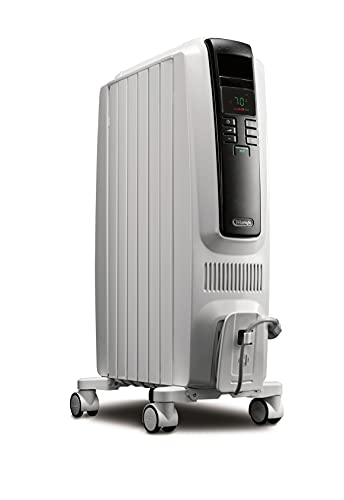
The De’Longhi Dragon model features a digital control panel with an LED display and a 24-hour timer for scheduled operation. De’Longhi claims the design provides 75% more radiant surface area than some older models, increasing heat transfer efficiency and accelerating warm-up times.
This radiator emphasizes programmable convenience and rapid, distributed warmth via increased convection. Built-in safety elements include automatic shutoff in overheat scenarios and stability features to reduce tip-over incidents. The digital interface is suited to users who prefer precise temperature programming and timed operation.
Dreo Radiator Heater, 8 Fins

This Dreo variant features eight M-shaped fins designed to increase dissipation area and promote even heat distribution across larger rooms. The product description highlights a 59.5% higher dissipation area compared to standard designs, intended to minimize cold spots.
The heater operates at 1500W with multiple heating modes, a digital thermostat, remote control, and a 24-hour timer. Safety is emphasized through tip-over protection, flame-retardant materials, and triple overheat protection with ETL certification, addressing multiple risk points for household use.
PELONIS PHO15A2AGB Basic Oil Heater

The PELONIS PHO15A2AGB emphasizes fast heating and lasting, gentle warmth through 1500W power and hot-air circulation. It offers three heating modes (600W/900W/1500W) to match heat output to room size and conserve energy where possible.
This model is whisper-quiet due to lack of a fan, making it appropriate for bedrooms and offices. Basic controls and mobility via caster wheels are typical, and safety features include overheat protection and stable base design to minimize tipping risks.
Buying Guide
Selecting an oil-filled radiator involves evaluating wattage, heat distribution, controls, safety, and portability. The following sections break down the most important factors and compare typical design choices so readers can match features to room usage and household needs.
Wattage and Room Size
Most models listed operate at 1500W as maximum power, which is common for supplemental heating in rooms up to roughly 150–200 square feet depending on insulation and ceiling height. Lower settings (600W–900W) reduce energy consumption for smaller spaces or milder chill.
Match heater capacity to room size: 1500W for medium rooms and open living areas; lower wattage settings for bedrooms or offices. Use multiple lower-wattage heaters for zoned heating rather than overheating a whole house.
Fins, Surface Area, and Heat Dispersion
Heat output is linked to the radiator’s radiant surface area and fin design. Models with more fins or M-shaped fins (like some Dreo units) aim to increase surface area and spread heat evenly to minimize cold spots. De’Longhi models may emphasize unique slot or panel designs to boost convective flow.
Consider units with larger dissipation areas for larger rooms to get more uniform warmth. Smaller or fewer fins can still be effective in compact rooms but may concentrate heat closer to the unit.
Controls: Thermostat, Timers, and Modes
Control options range from simple mechanical knobs to digital thermostats, remote controls, and programmable timers. Digital displays and 24-hour timers (found on De’Longhi Dragon) enable scheduled heating and precise temperature maintenance, which can improve comfort and energy efficiency.
Eco or intelligent modes adjust output to maintain comfort while reducing power use. For users who prefer hands-off operation, automated thermostat and timer features are particularly useful.
Safety Features
Key safety elements include overheat protection, tip-over shutoff, flame-retardant materials, and certified testing (ETL/UL). Triple overheat protection and safety plugs are common on newer models, while low-surface-temperature designs reduce burn risk.
Choose units with multiple safety mechanisms if the heater will be used in homes with children, pets, or heavy foot traffic. Stability and a reliable automatic shutoff system are critical for unattended operation.
Energy Efficiency and Operating Cost
Oil-filled heaters are generally efficient for steady, long-duration heating because the oil stores and radiates heat even when the element cycles off. Units with ComfortTemp or ECO modes can reduce cycling and save energy.
To minimize operating cost: use programmable timers, keep doors closed, and leverage lower heat settings once the room is warm. For frequent short bursts of heat, radiant or ceramic fan heaters might be more responsive but noisier and less energy-efficient for prolonged use.
Noise and Indoor Comfort
Oil-filled radiators operate very quietly because they rely on convection rather than fans. This makes them suitable for bedrooms, nurseries, and home offices. Models that advertise “whisper-quiet” or “no fan noise” are preferable when silent operation is important.
They do not dry the air as much as forced-air systems, which can help maintain indoor humidity and comfort during winter months.
Portability and Physical Footprint
Most radiator heaters include caster wheels, handles, and relatively compact footprints for room-to-room mobility. Consider height and width for storage and placement near furniture. Units with integrated cord storage reduce tripping hazards.
Also evaluate the surface temperature and clearance requirements listed by the manufacturer to ensure safe positioning near walls and furnishings.
Durability, Warranty, and Brand Considerations
Established brands often provide clearer warranty terms and support. De’Longhi, Pelonis, and Dreo emphasize proprietary features and multi-layer safety testing. Check warranty length and what it covers (electrical components, heating elements, etc.).
Read manufacturer documentation for recommended maintenance and expected service life. Oil-filled radiators typically require little maintenance beyond cleaning and ensuring vents/fins are not obstructed.
Comparisons for Specific Needs
- Quiet bedrooms and offices: choose models described as whisper-quiet or fanless (PELONIS PHO15A2AGB, Amazon Basics).
- Precision control and scheduling: choose digital and programmable units with timers and thermostats (De’Longhi Dragon, Dreo digital models).
- Large-room dispersion: units with extra fins or increased surface area (Dreo 8-fins, De’Longhi Dragon) provide more even warmth across larger areas.
- Energy savings: models with ECO or ComfortTemp modes reduce runtime and cycle frequency (Pelonis ECO mode, De’Longhi ComfortTemp, Dreo eco features).
Installation, Placement, and Safe Operation
Place heaters on flat, stable surfaces at least the minimum clearance distance from combustibles as specified in the manual. Avoid covering units or placing them near curtains. Keep cords away from walkways and ensure outlets are rated for continuous use. Unplug when not in use for extended periods.
Follow manufacturer instructions for tip-over tests and recommended maintenance. Ensure rooms have adequate ventilation and smoke detectors for overall household safety.

