Residents of apartments usually require cooling systems that are effective but will not bother neighbors and significantly increase the cost of energy.
The positive thing is that the current window and portable air conditioners are more efficient in terms of energy consumption and quiet than ever before.
In this guide, we will point out the best-rated AC units that can be used in apartments and we will only mention the portable and window ACs that are quiet and have low energy consumption.
You may require a portable AC that is compact and easy to carry, or a high-efficiency window AC, we have selected the best ones in terms of cooling power, noise, and apartment-friendly features.
The following table is a brief comparison of the top quiet, energy-efficient air conditioners to use in apartments, and then the detailed reviews and a thorough buying guide.
| Air Conditioner | Type | Cooling Capacity | Room Size | Noise Level | Energy Efficiency |
|---|---|---|---|---|---|
| Midea Duo Smart Inverter Portable AC | Portable | 12,000 BTU (SACC) | Up to 450 sq ft | 42–53 dB | Inverter (uses ~40% less energy) |
| LG Dual Inverter Portable AC (14,000 BTU) | Portable | 10,000 BTU (DOE) | Up to 450 sq ft | ≈44 dB (Sleep Mode) | Inverter (35% energy savings) |
| Whynter ARC-14S Dual Hose Portable AC | Portable | 9,500 BTU (SACC) | Up to 500 sq ft | 51 dB (low) | Dual-hose (higher efficiency) |
| Black+Decker BPACT14WT Portable AC | Portable | 7,700 BTU (DOE) | Up to 350 sq ft | ~54 dB | Sleep/Energy Saver modes |
| Midea U Inverter Window Air Conditioner | Window | 8,000 BTU | Up to 350 sq ft | 32–42 dB | Energy Star (35% less energy) |
| LG Dual Inverter Smart Window AC (12k BTU) | Window | 12,000 BTU | Up to 550 sq ft | as low as 44 dB | Energy Star (35% savings) |
| Windmill 8,000 BTU Smart Window AC | Window | 8,000 BTU | Up to 350 sq ft | ~50 dB | Energy Star Certified |
| Soleus Air “Saddle” Window AC (8,000 BTU) | Window | 8,000 BTU | Up to 375 sq ft | Whisper Quiet | Energy Saver + WiFi |
Top Portable Air Conditioners for Apartments
Portable AC is an excellent option to rent because some renters cannot install a window AC or prefer to move the AC across rooms.
The most efficient portable air conditioners in apartments are dual-hose or inverter-type to be more efficient and less noisy. Here we look at the best portable ones that are characterized by low noise, high cooling and energy saving characteristics that are perfect to use in apartments.
#1 Midea Duo Smart Inverter Portable Air Conditioner (14,000 BTU)
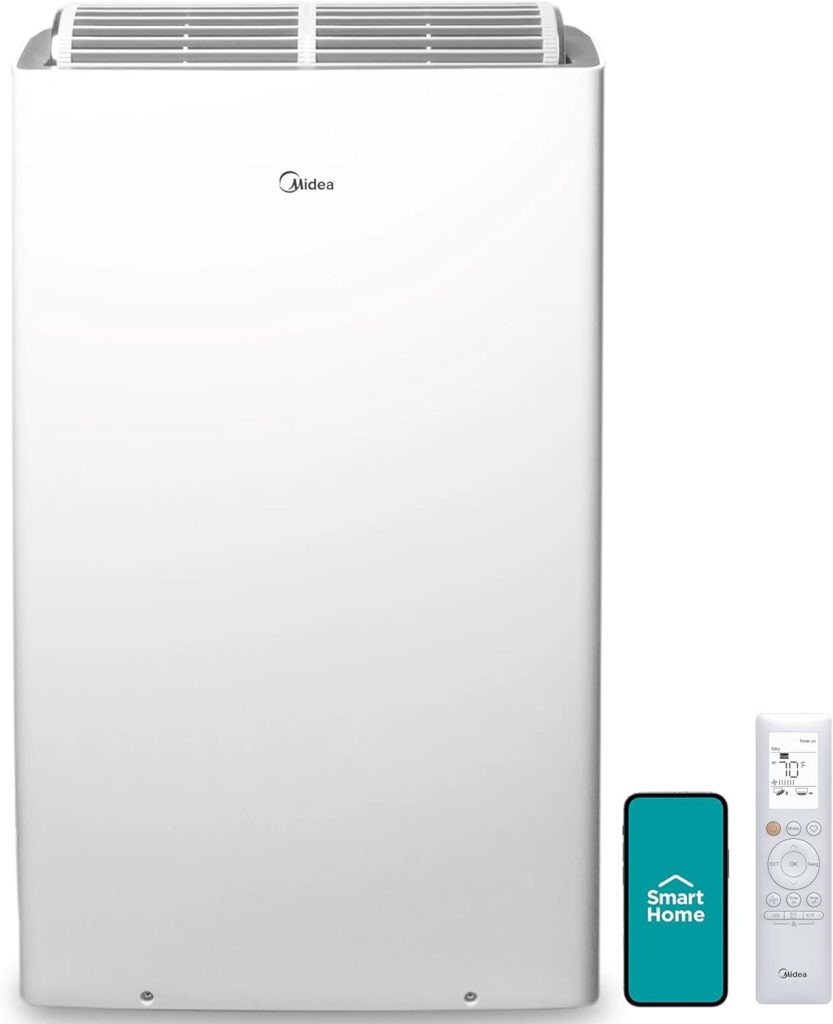
Midea Duo Smart Inverter Portable AC is considered by many to be the best overall portable air conditioner because of its power, quietness, and efficiency.
This 14,000 BTU (12,000 BTU SACC) air conditioner has a dual-hose inverter system, which is a unique aspect of this model that enables it to cool quicker and with much less energy compared to the conventional models. As a matter of fact, the variable-speed inverter technology of its portables can save as much as 40 per cent more energy than non-inverter portables. Midea Duo is also very quiet; users say it is as low as 42 dB on low, which is one of the quietest in its category. This is approximately as loud as a library, so it is not going to interfere with your conversations or TV. Cooling performance is good, even with the low noise, it can easily deal with a living room or studio apartment up to ~550 sq ft, and quickly bring the temperature down on hot days. The model is equipped with intelligent Wi-Fi (Alexa/Google Assistant), which allows you to change the settings using your phone or voice. The other convenient features are an in-built dehumidifier mode, a sleep mode that makes it ultra-quiet at night, and an easy-install window vent kit. The only cons are size (it is a bit big and ~70 lbs, like most dual-hose models) and price, but among the portable ACs that are both ultra-quiet and energy efficient, the Midea Duo is one of the best.
#2 LG Dual Inverter Portable Air Conditioner (14,000 BTU / 10,000 BTU DOE)
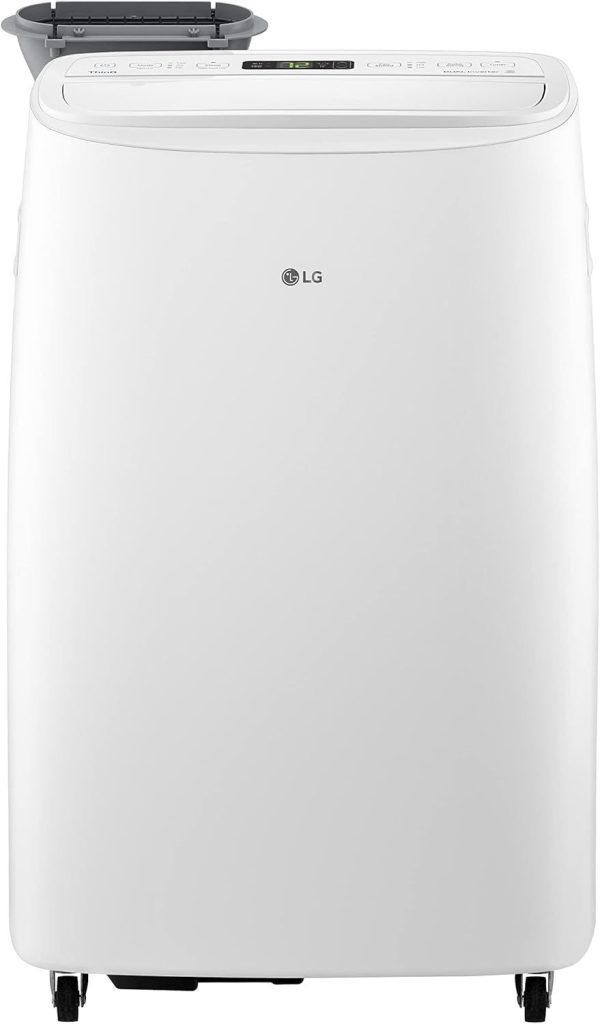
Another outstanding quiet portable choice is the LG Dual Inverter Portable AC, with LG Dual Inverter Compressor technology.
It has a 14,000 BTU (ASHRAE) capacity which is approximately 10,000 BTU less than the newer DOE standard but can effectively cool medium to large rooms (up to ~450 sq ft). With the inverter compressor, this unit saves up to 35 percent of energy consumption over and above the minimum Energy Star requirements, and that translates to a reduced electricity bill in the long term. It is also ultra-quiet, in fact, it can operate at about 44 dB in Sleep Mode, which means it is as silent as a library, which is perfect when you want to use it at night, in a bedroom or a small apartment. Users like the quick even cooling that this LG offers without the racket of the compressor turning on and off (the inverter maintains the temperature by running at variable speed). This model has intelligent Wi-Fi connectivity (LG ThinQ app), digital thermostat and full-function remote. It is also dual fan speed and auto-swing air vent to circulate cool air. The unit weighs ~70 lbs and is on rolling casters and handles to move it more easily. There is one caveat: the LG Dual Inverter is significantly quieter than regular portable ACs, but, like all portables, it can sound a soft whoosh of air on high fan settings. All in all, it is a balanced, energy-efficient portable AC, which is ideal to use by apartment residents who want a quiet cooling device with smart capabilities.
#3 Whynter ARC-14S Dual Hose Portable Air Conditioner (14,000 BTU)
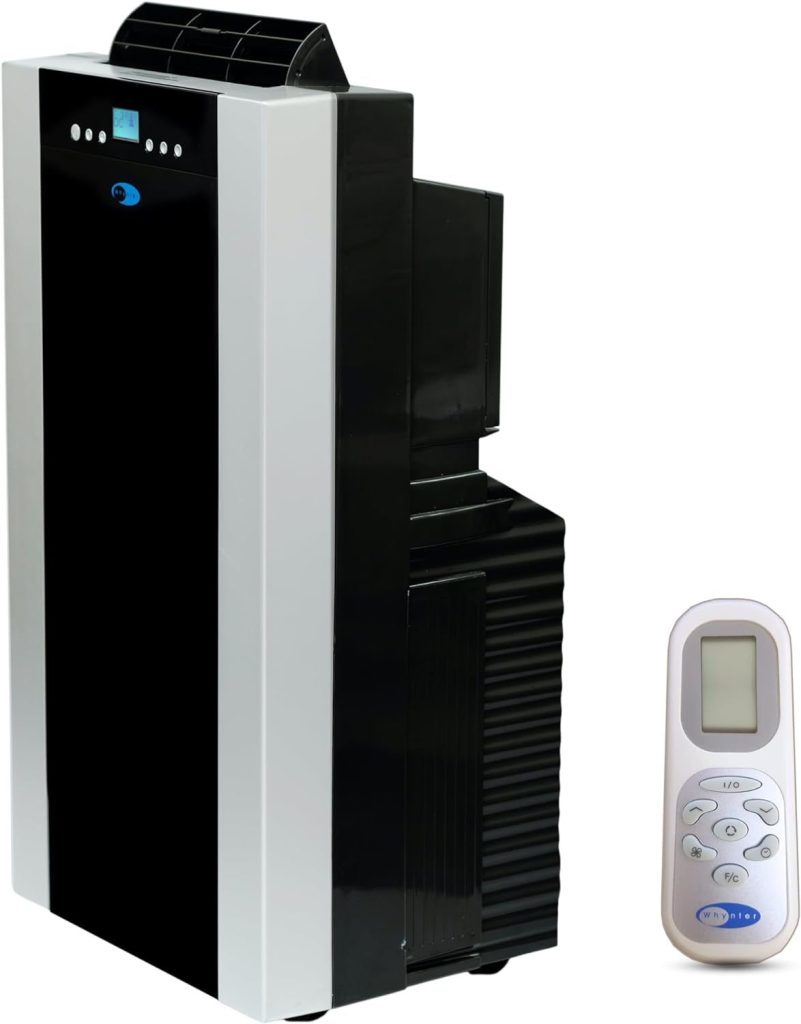
When you want to cool a bigger space or simply a reliable workhorse, the Whynter ARC-14S is a highly rated portable AC that is known to be powerful.
This is a traditional 14,000 BTU (9,500 BTU SACC) unit with a dual-hose system that cools up to 500 sq ft of space more efficiently without causing negative pressure. It has even been awarded 2024 Best Overall Portable Air Conditioner by Good Housekeeping, which speaks of its performance. In spite of the high output, the Whynter ARC-14S is quite reasonably quiet considering its size: about 51 dBA at low fan speed. It is not that loud to be heard in many bedrooms and the constant buzzing becomes background noise. Efficiency is fairly good (its rated CEER ~8) and it does not waste cooled air since a dual-hose system is used, which is a good thing in terms of electricity consumption. This model is not an inverter and therefore the compressor will be on/off but due to its high cooling speed, it is likely to achieve the desired temperature faster and can turn off earlier. The ARC-14S has a built in dehumidifier mode (up to 71 pints/day) and includes an activated carbon filter to assist in eliminating odors, a nice feature in apartment air quality. It has three working modes (cool, fan, dehumidify) and a complete set of the window exhaust installation. You should remember that the unit is quite large (approximately 35 tall and 80 lbs) and has a rather utilitarian look in two-tone black and silver. It is not as smart as the newer ones (no Wi-Fi), but when it comes to raw cooling power in a quiet-ish, efficient unit, the Whynter ARC-14S is still a favorite, particularly in larger apartment rooms or high-heat conditions.
#4 Black+Decker BPACT14WT Portable Air Conditioner (14,000 BTU)
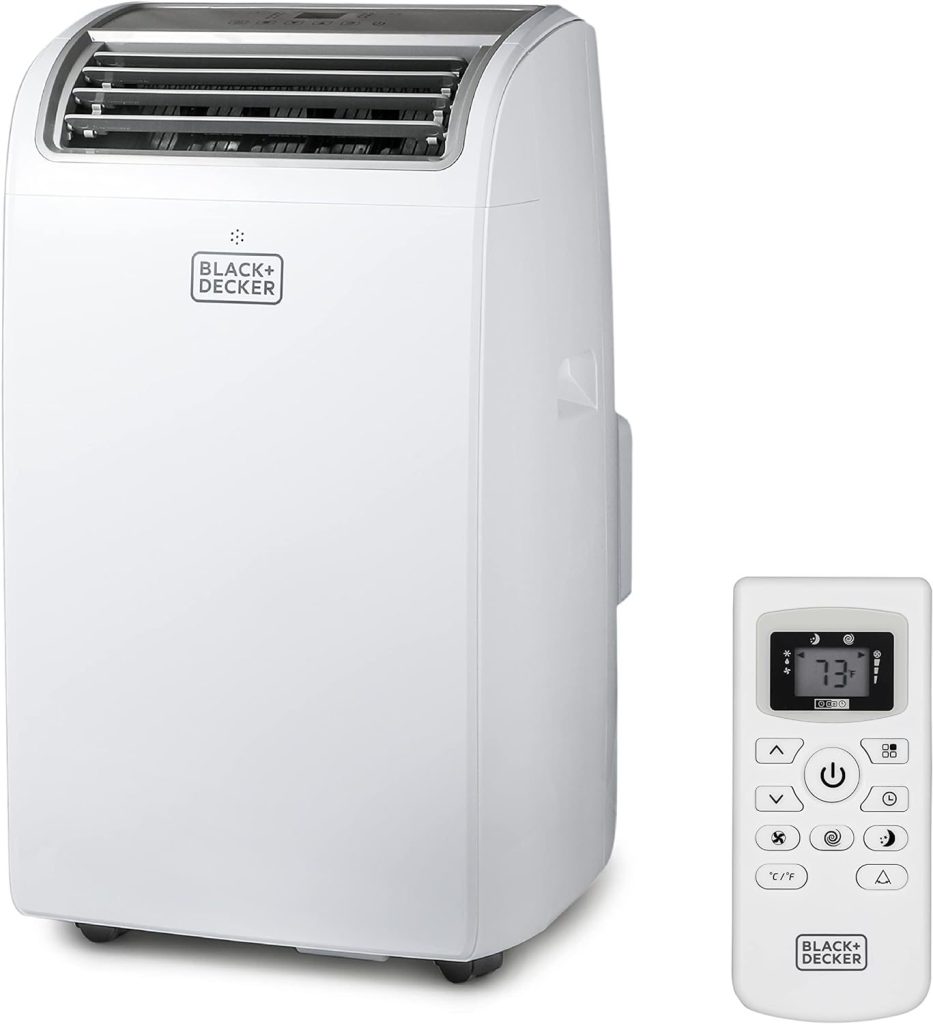
The Black+Decker BPACT14WT is a common cheap portable AC that is very popular in apartments and is affordable to those with a tighter budget or those who need a lighter-duty unit.
This single-hose model with 14,000 BTU (7,700 BTU DOE) is not as technologically advanced as the inverter or the dual-hose models above but it provides a steady cooling effect to the room of about 300-350 sq ft (suitable to a bedroom or a small living room). It is a simple LED display, has remote control and three modes (cool, fan, dehumidify), and 24-hour timer. The noise level is about 52-54 dB on low fan – slightly louder than the high-end models, but still tolerable by a lot of people (similar to moderate rainfall noise). It is not quite whisper quiet, but most apartment users can live with the constant white noise, particularly when used during the day or when it is not so close to a bed. The BPACT14WT has a Sleep mode and an Energy Saver mode which turns the compressor off and on in order to save power after the desired temperature is achieved. It is installed with a standard 115V outlet and can be installed using the window slider kit that comes with it. A good thing about this Black+Decker is that it is relatively small in size, easier to transport on its castor wheels and occupies less space. Remember that it is a single-hose model, which will not perform as well in hot weather (because it can pull in hot air through gaps), and will not have the temperature control of an inverter AC. The Black+Decker is convenient and performs well enough, however, when it comes to cooling a small room in an apartment, it is a cheap solution. It is a decent option when you need to have a portable air conditioner that is cheaper and more compact than a quiet one, and it is one of the most popular portable air conditioners on Amazon with a good reason.
Top Window Air Conditioners for Apartments
The most effective method of cooling an apartment room is often a window AC, which simply blows the heat out the window, and usually consumes less energy than portables.
The recent window units are also designed with inverter compressors and better designs to reduce noise. Installation is typically easy (no permanent changes) to renters, and even some of the newer models maintain the capability to open your window. The following are the most quiet and energy efficient window air conditioners that are ideal to live in apartments.
#1Midea U Inverter Window Air Conditioner (8,000 BTU)
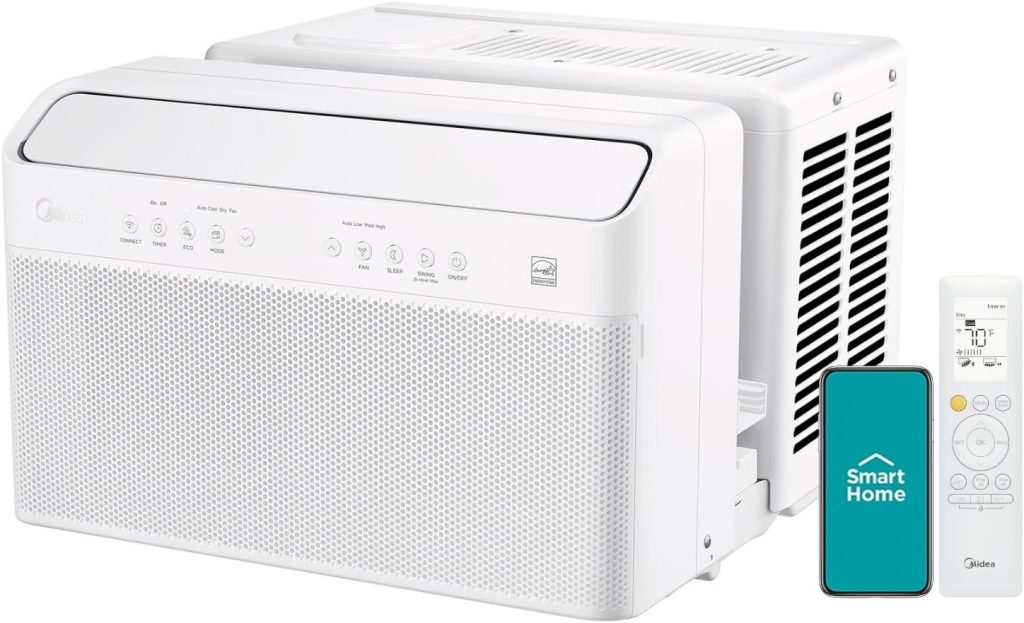
The Midea U-Shaped Inverter AC has transformed the window units by its exclusive design and excellent performance.
It is an 8,000 BTU model with a U-shape, which allows your window to slide down between the AC, which not only blocks the noise but also gives you the possibility to open the window when the AC is off. The outcome is an ultra-quiet operation, as little as 32 dBA at the lowest setting which is almost silent. In practice, users report that the Midea U is significantly quieter than standard window ACs (Midea claims that it is 9 times quieter than the standard units). It is therefore the best in apartments where you may be sleeping or working in the same room with the AC. The cooling performance is excellent even though it is very silent. The Midea U was the first window AC to receive the ENERGY STAR Most Efficient award with more than 35 percent energy savings over conventional window units. It has the secret of the DC inverter compressor, which adjusts the speed to keep the temperature without wasting energy. This implies reduced electricity bills and reduced pressure on the electrical circuit in your apartment. It has a ~15 SEER (Combined Energy Efficiency Ratio) that makes it easily outdo the standard models. In addition to efficiency and silence, this AC is feature-rich: built-in Wi-Fi to control it with a smartphone, Alexa/Google Assistant support to control it by voice, and a solid installation bracket that makes it unusually secure (the shut window is locked by an anti-theft mechanism). Most apartment dwellers are fond of the U-shape design that does not block much of the window view and lets in light, making the room appear open. The bracket system makes installation a little longer the first time but it is possible as a DIY project and it is very stable when set up. The Midea U is a window AC game-changer in general: it is very quiet, highly efficient, and apartment-friendly, which makes it the best window AC you can purchase to use in a bedroom or living room.
#2 LG Dual Inverter Smart Window AC (12,000 BTU)
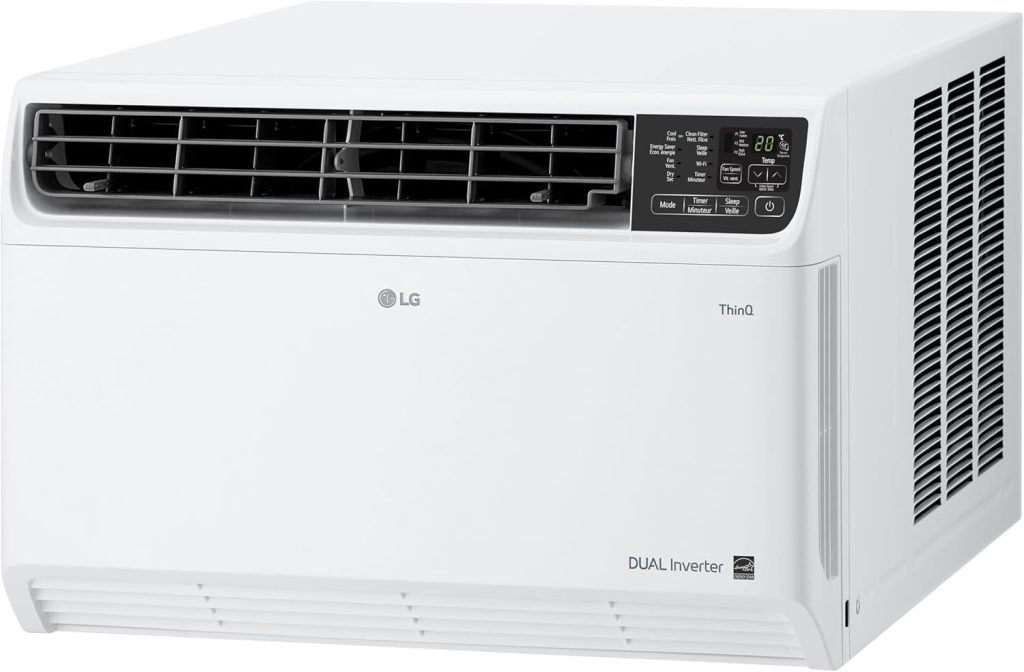
The Dual Inverter series of LG also introduces remarkable silent and efficient performance to the window air conditioners.
The LG 12,000 BTU Dual Inverter Window AC (such as model LW1222IVSM, to name but one) is a powerful one that can be used in larger rooms or small apartments (up to ~550 sq ft). With LG dual inverter compressor, this AC can also run at a very low sound level of only 44 dB on its Quiet/Sleep mode, which is extremely low considering the high capacity of this unit. At even faster fan speeds, the sound is a much smoother hum with no harsh compressor clunks of the older ACs. One of the outstanding features is energy efficiency: it is more than 35 percent better than the Energy Star requirements, i.e. it consumes much less electricity to generate the same cooling capacity. Practically, such efficiency (15 CEER, approx.) will keep your summer utility bills down, which is a huge advantage to apartment budgets. LG dual inverter also ramps up and down slowly, therefore, it does not change the room temperature as much as it switches on and off. The model has all the modern conveniences, such as Wi-Fi access (turn it on or change temperature with LG ThinQ app or voice control through Alexa/Google Assistant). It is a sleek digital display, remote-controlled, and has features, such as 24-hr timer, Energy Saver mode, and four cooling and fan speeds. LG also has a LoDecibel 9 Quiet Operation technology and a top air discharge with adjustable vents to move air quietly and evenly. Installation: It is like a normal window unit (it fits windows that are double-hung 27-39 inches wide) it is a bit heavy (80 lbs) so you may need a helping hand to install it. After installation, users claim that it cools rooms very quickly. This LG Dual Inverter AC is a good compromise in an apartment: it is very quiet, it has smart features, and it is very energy efficient, not to mention a well-known brand.
#3 Windmill 8,000 BTU Quiet/ECO Window Air Conditioner
The Windmill AC (8,000 BTU) is a sleek, design-conscious window air conditioner that was designed to work in apartments.
It has a smooth appearance, curvy edges, and a white finish that does not stand out in the decor as much as most of the ugly ACs. More than appearance, the Windmill is designed to be quiet and comfortable cooled. It runs at around 50 dB on low, which is quiet enough to sleep to most people, and it has a auto-dimming LED display, to keep your room dark at night. It is Energy Star certified, which means that it is a solidly efficient unit (its EER is approximately 12). It is not an inverter model, but has a constant fan mode which tends to reduce sudden compressor sounds by maintaining flow of air. The 8k BTU Windmill has a room capacity of ~350 sq ft, making it perfect in bedrooms, home offices or other small living spaces in apartments. Its main strengths include the easy installation: Windmill has a ready-made installation kit and a simple instruction, so you can install it in your window within a short period of time without additional tools. Renters of apartments are fond of that convenience (and your landlord will be fond of no complicated alterations). The AC is also smartly connected to Wi-Fi, which means that you can operate it using the Windmill app or use voice commands (it works with Google Assistant and Alexa). It implies that you can switch it on when you are not at home to pre-cool your apartment or set it to save energy. The other pleasant additions are a washable antimicrobial filter (with a light that tells you it needs a filter change) and a stylish magnetic front cover that can be easily removed to clean. On the whole, Windmill AC is an excellent option in case you appreciate a silent, stylish window air conditioner that can still cool the room effectively. It is not as ultra-efficient as the inverter models but it compensates with design, easy to use features and quiet comfortable focus.
#4 Soleus Air “Saddle” Over-the-Sill Air Conditioner (8,000 BTU)
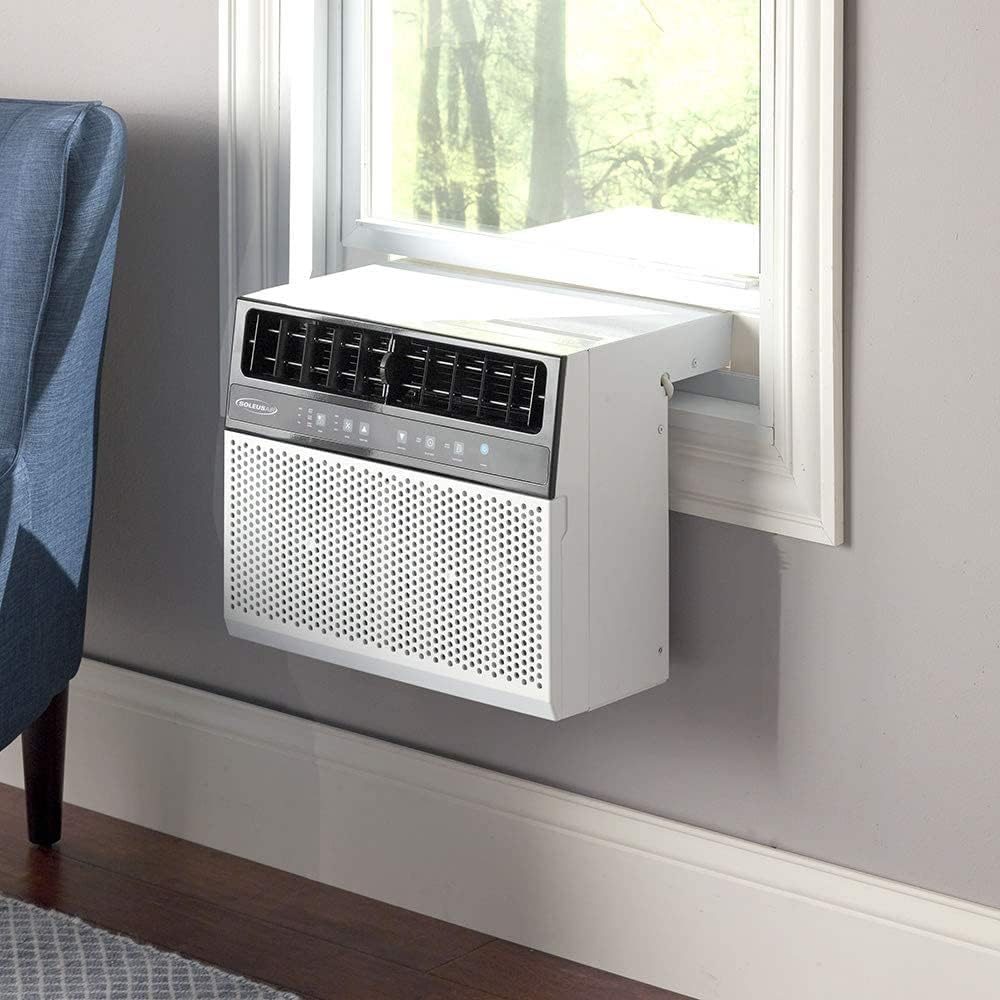
Soleus Air Exclusive 8,000 BTU is a special window air conditioner that sits on the window sill like a saddle and this is a brilliant idea that can be used by people living in apartments.
The Soleus Air is not like the traditional window ACs that cover the window, instead, it is half in and half out allowing you to slide your window closed over it. This design implies that you will still be able to open and operate your window as usual when the AC is fitted and you will still have your window view and natural light. It is also one of the quieter units to run, as most of the loud parts (the compressor and the condenser) are not in the room. It is claimed to be very quiet inside by the users, which is perfect to use in studios or bedrooms where the AC is close. The Soleus is Wi-Fi compatible and can be operated through Alexa, which means you can control it remotely or by voice, which is convenient to renters. It is digital and it also has a remote. The fact that it does not need any tools to install is a big selling point: you just slide the unit over the sill and lock the supports in place, which makes it both safer and easier to install than heavy window units (no chance of it falling out). To be energy efficient, it has some important modes such as 24-hour timer, Energy Saver mode and Sleep mode to save power when the full cooling is not required. Although it is not directly stated that it is Energy Star certified, the innovative design of the Soleus naturally prevents any leakage of cool air and drafts that may be experienced in the traditional window units, and this is beneficial to efficiency. It has 8,000 BTUs, and it is appropriate in an area of about 300-375 sq ft. One thing: make sure your window sill is wide enough to fit the size of the unit (it requires approximately 4-6 inches of space on the sill and fits windows that are approximately 24-48 inches wide). In general, the Soleus Air saddle AC is an excellent apartment-friendly product, it is so quiet, so simple to install (especially to people who cannot lift a large window AC), and you can still have your window. It is an ideal option when you want to cool the windows of high-rise apartments or in any situation when a traditional window AC is not possible or preferable.
Buying Guide: Choosing a Quiet & Efficient Apartment AC
When purchasing an air conditioner to your apartment, you have to consider cooling requirements, as well as noise, energy consumption, and installation limitations.
Here are some of the main aspects that we will discuss in this buying guide to enable you to make the right decision when you are buying the best quiet, energy-efficient AC to use in your space.
Portable vs. Window AC – Which is Right for You?
The initial choice is the one between a portable AC and a window AC.
A window AC tends to be more efficient and cool more than an equal BTU rating, since it exhausts heat to the outside. A window AC is usually the most popular energy-wise cooling option in case your apartment permits the use of window units and you have an appropriate window. They do not occupy floor space and are usually quieter within the room (the noisy compressor is out). Conversely, portable air conditioners are placed in the room and they release hot air through a hose out of a window. Portables are a decent choice when you do not have anything to mount in your window (building regulations or window type) or when you want to transfer the device between rooms. They are also renter-friendly as they do not require much and permanent installation. Portable ACs are however not as efficient, as many single-hose models can suck in warm air through cracks (thus making them work harder). They also exhaust some of the cooled indoor air to the outside wasting some energy. This has been bettered in newer dual-hose and inverter portables which can be fairly efficient. Regarding the noise, portables tend to be fully in your room, thus you will hear the fan and the compressor. The most silent portable models (such as those using inverter compressors) are now in the same range as window units on low power, although generally window ACs are quieter indoors since some of the noise is secluded outdoors. Take into account your apartment structure and regulations: in case you have a regular double-hung window and are allowed to install a window AC, it could be the less noisy and more effective path. Otherwise, a portable AC will also make you feel comfortable, you just need to find a model that is efficient and be ready to hear a little more white noise.
Cooling Capacity – Getting the Right BTU for Your Space
It is important to choose an AC of the right cooling power (BTUs).
A small unit will not be able to cool your room and an over-sized unit will cool too fast without dehumidifying (and may come on/off a lot). Approximately speaking, you require around 20 BTU per square foot of living area of a window or portable AC (this may change depending on the height of the ceiling, sunlight, etc.). As an example, a small bedroom of about 150 sq ft may require about 5,000-6,000 BTUs, a living room of 300 sq ft may require 8,000-10,000 BTUs and an open-plan studio of 450 sq ft could require 10,000-14,000 BTUs. The above picks indicate the approximate room size that each one of them can handle. In case your apartment room is highly exposed to the sun (south or west facing windows), with high ceilings, or with bad insulation, go to the higher BTU side. On the other hand, in the case of the shaded or the lower level apartments, you will not require that many BTUs. Note that portable ACs usually are rated in two BTU numbers: the older ASHRAE number and the newer DOE SACC number. The DOE/SACC BTUs (which are also referred to as CEC or DOE BTUs) is always the figure to consider as this is the effective cooling of the unit after taking into consideration the hose losses. As an example, a 14,000 BTU portable may actually be ~8,000 BTU in SACC – appropriate to a smaller area than the bare number would imply. Energy efficiency is also guaranteed by proper sizing- a well sized AC will not run in short frequent cycles but rather in long steady cycles which is more efficient than short frequent cycles of an oversized unit. Measure your room and compare it with the BTU rating and get your perfect fit.
Energy Efficiency – Save Money & Power
The air conditioners may consume much power and therefore consideration of efficiency will save on the electricity bill.
Check the window AC units to have the Energy Star certification which indicates that the AC unit meets or exceeds certain EER (Energy Efficiency Ratio) and CEER (Combined Energy Efficiency Ratio) standards established by the EPA. We recommended only Energy Star rated window units (some of them even reached the status of the Most Efficient). The CEER of Energy Star models is usually 12 or greater and older models could be 10 or less. Although, at present, there is no Energy Star program in the portable ACs (standards are still in the development), you can determine the efficiency by checking the EER/CEER or SACC rating of the unit. The greater the EER (BTUs/Watt) the greater the cooling per watt of power. To give an example, an EER of 10 indicates 10 BTUs per watt; an EER of 15 (such as the Midea U window AC) indicates 15 BTUs per watt, which is much better. The inverter air conditioners are the most efficient. Unlike using a compressor at maximum and then switching off, an inverter AC runs at variable speeds to keep the temperature constant, thus preventing energy wastage. The inverters are able to save 20-40 percent of energy consumption as compared to the non-inverters. In case you intend to operate your AC several hours a day, an inverter model (such as the Midea U, LG Dual Inverter, or Midea Duo portable) can be worth it in energy savings. Also, pay attention to such features as Energy Saver mode (the fan and compressor are switched off and on periodically after the target temp is achieved) and programmable timers/thermostats, which do not allow the AC to work longer than it is necessary. Even easy things can enhance efficiency: close doors and windows when the AC is on, close blinds/curtains to block heat of the sun, clean the filter regularly (a clogged filter makes the AC work more). All these will make the apartment cooler at a reduced price.
Noise Levels – Finding a Quiet AC
An air conditioner that is loud will be very disruptive in a small apartment and therefore a low decibel (dB) level is important.
Most AC makers will specify a noise level in decibels; as an example, ~40 dB is very quiet (library level), 50 dB is a quiet conversation, and 60 dB is normal conversation or TV background. Silent operation was one of our product choices. Here, inverter ACs once more excel – they do not use the harsh on/off cycles and thus a lot of the sudden noise is removed. As an example, the Midea U window AC can go as low as the 30s dB and LG inverter units at around mid-40s dB on low settings. The low to medium fan of portable ACs is usually 50-57 dB. The lowest decibel level of the portable we recommended (Midea Duo) was measured by some users at night when the compressor is idle at low-40s dB. The best way to be sure you are purchasing a quiet model is to look for words such as Quiet Mode or Sleep Mode or manufacturers who specifically promote low noise. In addition, dual-hose portables do not always need to work as hard (no negative pressure problem), which may make them a little quieter than single-hose. Mechanically, a smaller BTU unit will tend to be quieter than a larger BTU of the same series so don not oversize more than you need. When using it you can reduce noise by placing the AC on a flat, hard surface (portables) to reduce vibrations and by leaving the fan at a steady speed – it is sometimes the change in speed or compressor on/off that is noticeable. Tip number two: set the timer or smart app to cool the room down before you require complete silence (such as before bedtime) so that the unit can perhaps operate on a lower fan speed or cycle less during your sleep. All in all the technology of new ACs has improved a long way- you no longer have to put up with a noisy rattling box in your window. With a model that is reputed to have quiet operation (and adhering to some of the best practices of setting up), you can keep your apartment cool and quiet.
Installation and Apartment Considerations
Consider how you will use that AC in your apartment before purchasing it.
In the case of window air conditioners, make sure that your windows are compatible: most window air conditioners need a standard double-hung window that opens upwards. In case of sliding windows or casement windows, you may have to consider models that are casement specific or go with a portable AC. And, read your lease or building policies, some apartments have policies regarding exterior facing units or that window units must be professionally installed or have brackets to support them. Safety matters: when you are many stories high, make use of the support bracket that comes with it or a certified AC bracket to ensure that there is no possibility of the unit loosening. On the inside, fill gaps with foam insulation strips (which are normally provided), to prevent drafts or insect penetration around the AC. In the case of portable ACs, ensure that you have some space close to a window or a balcony door to exhaust the hose. The window slider kits are normally suitable to the standard window width (or vertically in a sliding window). Take the measurement of your window opening to ensure that the kit will fit to the size. You will also like to have the hose with the least kinks and as short as possible to be efficient, typically the hose is 4-6 feet in length, so an outlet window should be within this length. It is advisable to have some curtains or window covers around the vent panel to minimize backflow of hot air. We suggest plugging your AC (window or portable) into the wall, directly, when possible, – do not use extension cords, AC units use a lot of current (usually 8-12 amps on 115V models). Most newer models have auto-restart (restoring settings after a power cut) that comes in handy when your apartment is in an area where power cuts are frequent or when you are using a smart plug to operate the AC. Finally, there is off-season storage: portable ACs can be wheeled into a closet during off-season, but window units will probably remain in their position throughout the season. When you take out a window AC in winter, store it in a safe place (and don t forget to put the window screen back!). In general, portable and window air conditioners can be installed and operated in apartments with a little bit of planning, and the only thing that you need to do is to select the type that will suit your window and comfort requirements.
Additional Features to Consider
Contemporary air conditioners are equipped with diverse functions which might make your apartment more comfortable and convenient.
Some of them are the following:
- Smart Connectivity: Wi-Fi enabled ACs allow you to operate the device through your phone or through voice assistants. This may be excellent to program the AC to switch on by the time you arrive home or to check the energy consumption. The smart apps are available in all the models of the inverters that we have discussed (Midea, LG, Windmill, Soleus).
- Remote Controls & Thermostats: A good remote enables you to control temperature even when you are in the other end of the room. Other remotes (such as the B+D follow me remote) include a thermostat sensor which informs the AC what temperature you are in, so that it can cool you more accurately. This may be convenient in an apartment where air conditioner may be on one side of the room and you are lying on the other.
- Dehumidifier Mode: Most ACs have a dry or dehumidify mode that does not cool a lot but removes moisture. When you are in a humid climate, you can enhance comfort by operating this mode on days when it is not so hot. Portable units can require their condensate tanks to be emptied in dehumidify mode (except those with self-evaporative systems).
- Fan-Only Mode: This is helpful when you want to ventilate or simply want to have air flow without cooling. It can also be used to introduce cooler night air via a window unit in case the design permits (Midea U, for example, can introduce outside air when the window is open).
- Filters and Air Quality: Enquire on the type of filter used by the AC. They have washable filters, which you are expected to rinse the dust out after every few weeks to get the best out of them. Other units have extra filtration (such as activated carbon filters in the Whynter ARC-14S to remove odors, or antimicrobial coating of the filter in the Windmill). They are good features to have, in case you are sensitive to the air quality.
- Directional Air Louvers: It is useful to be able to direct the cold air in small apartments so as to prevent cold spots. The 4-way adjustable louvers are common in most window ACs. The portable ACs typically have swing louvers or adjustable vents on top. This will enable you to blow air to your sitting position or away your bed when necessary.
- Size and Aesthetics: A large appliance is an ugly sight in a small apartment. In case the looks count, one may refer to the more design-oriented models such as the Windmill or the saddle-like Soleus, which are slimmer than the average units. Take measurements of the area where you are going to install the AC (particularly portable ones, so that it does not block anything). Portable ACs too require some space around them to allow air flow.
When you compare these features with your requirements, you will be able to find an AC that cools efficiently and silently as well as fits well in your apartment life.
Keep in mind that the best air conditioner you can have in your apartment is the one that makes you comfortable without giving you new headaches be it noise, high bills or installation problems. Any of the units in our list will be a good competitor in those aspects, and you can make your choice with confidence and anticipate a cooler and quieter home.