Window air conditioners are great devices that help to endure hot summers, however, they may be susceptible to electrical surges and voltage variations.
Sudden increase or decrease of power may destroy the compressor or electronic control of a window AC, causing a costly repair or even replacement of the entire unit.
The most effective surge protector to use on a window air conditioner is a cheap method of protecting your AC against lightning, power surge and brownouts.
Not every surge protector is however appropriate to the high power draw of an AC unit. The most important thing is to select a surge protector that is heavy-duty, high joule rating of surge absorption, and preferably with features such as overload protection or voltage regulation of appliances.
This paper will discuss and compare some of the best surge protectors that will fit in the residential window air conditioning unit.
We discuss a variety of products including smart energy-monitoring plugs to simple high-joule power strips that will help ensure your window air conditioner does not go up in smoke.
To get a quick view of our best selections of window AC surge protectors, the table below shows the comparison table, after which we will review each product and give a detailed buying guide to guide you in making the right decision.
| Surge Protector | Surge Rating | Outlets | Key Features |
|---|---|---|---|
| BSEED 3-Outlet Appliance Surge Protector | 140 J | 3 (Wall Tap) | Under/Over voltage protection, 3-min delay, 15A capacity |
| BSEED Single-Outlet Refrigerator Surge Protector | 140 J | 1 (Plug-In) | Under/Over voltage protection, delay timer, compact plug |
| Ludger LUDX-AC Appliance Surge Protector | 140 J | 1 (Plug-In) | ETL certified, 4-min safety cycle, status LEDs |
| Cable Matters 1350-Joule Surge Protector | 1350 J | 1 (Wall Plug) | High surge absorption, 15A appliance rated, low clamping voltage |
| Belkin 12-Outlet Heavy-Duty Power Strip | 3940 J | 12 (Strip) | Wide-spaced outlets, 8-ft cord, 15A circuit breaker |
| APC 11-Outlet SurgeArrest + USB | 2880 J | 11 + 2 USB | USB charging ports, flat plug, UL certified |
| Tripp Lite ISOBAR6Ultra Surge Protector | 3330 J | 6 (Strip) | All-metal housing, isolated filters, lifetime warranty |
Best Surge Protectors for Window AC Units – Product Reviews
#1 BSEED 3-Outlet Appliance Surge Protector

BSEED 3-Outlet Appliance Surge Protector is a model that is intended to be used with the appliances that consume a lot of power, such as window air conditioners and refrigerators.
It simply fits into a wall socket and has three safe outlets, so you can hook up your AC and two other low-load gadgets. This unit offers complete voltage protection – it protects against sudden surges and also against under-voltage (brownout) conditions. The BSEED protector will automatically switch off power in case the voltage is too low or too high to protect your AC unit.
One of the outstanding characteristics of this surge protector is the delay timer inbuilt in it.
Once there is a power outage or fluctuation in voltage, the device implements a 3-minute delay to restore power. This delay is important in the window AC units since it avoids fast cycling of the compressor. The LED indicator lights on the protector are very clear and indicate its status (normal, delay, or voltage fault) and you can be sure when your air conditioner can be switched back on. This BSEED model has a 15-amp (1875W) rating, which is enough to deal with the average load of a residential AC. It has a small wall-tap size, so there are no additional cords needed, it fits against the outlet. All in all, it is a good option to people living in regions where there is a risk of voltage surges or frequent power cuts, as your window air conditioner will only operate when the power supply is safe.
#2 BSEED Single-Outlet Refrigerator Surge Protector

To have a smaller solution, the BSEED Single-Outlet Surge Protector provides the same protection in a one-outlet package.
Although it is sold as a refrigerator product, it is also effective with window air conditioners and other products. This is a wall plug and has a single receptacle where you can plug your AC. It has an automatic under/over-voltage protection, similar to its 3-outlet version, to break power in case the supply goes outside of the safe range (usually around 90V low or 135V high). It also has a delay of its own (about 3-4 minutes) to restore power safely after the voltage has normalized, thus sparing your AC compressor of overload.
The one-outlet BSEED protector is very simple to operate, just insert it into the wall, and insert your window AC into it.
It has status (voltage OK, delay active etc.) LED indicators, so you can know what is happening at a glance. The good thing about this unit is that it is small and plug in and therefore does not create a lot of clutter and it is good when you only need to protect one appliance. It has a 15A capacity, which is capable of supporting power draw of standard window AC units. Remember that, like the majority of dedicated appliance surge protectors of this kind, the surge absorption (joule rating) is low (about 140 J), so it is intended to clamp smaller surges and mainly to trip during extreme voltage events. Practically, this protector will die to protect your AC, and you will have rest of mind when there is a thunderstorm or a brownout.
#3 Ludger LUDX-AC Appliance Surge Protector

Another plug-in surge protector is the Ludger LUDX-AC that is designed to protect air conditioners and other related appliances.
It is also unique in the sense that it is ETL certified, which means it is of high safety standards. The unit will protect your window AC against power surges, high voltage, as well as low voltage incidents by cutting the electricity in case of anomalies. It also has a large operating voltage range (approximately 85V-135V) and when the voltage exceeds this range, it will cut the output to save your equipment.
One of the major characteristics of the Ludger LUDX-AC is its 4-minute safety cycle.
Once it switches off because of a surge or outage, it takes four minutes before your AC can switch back on. This is a bit longer wait (than the usual 2-3 minutes) and gives you an added confidence that your AC compressor will not short-cycle. The device also has LED indicators to inform the status (normal operation, delay active, or fault condition) and thus the user is not left in the dark about the situation. Ludger protector is compatible with 2-prong and 3-prong plugs, which is why it can be used in older or newer homes. It is 15A/1875W which fits most window units. Its joule rating is relatively low (as is the case with other appliance-specific protectors), but its advantage is that it actively opens the power in unstable conditions. In case you have frequent lightning storms or grid problems, Ludger LUDX-AC can provide the tested and reliable protection to extend the life of your AC.
#4 Cable Matters 1350-Joule Surge Protector
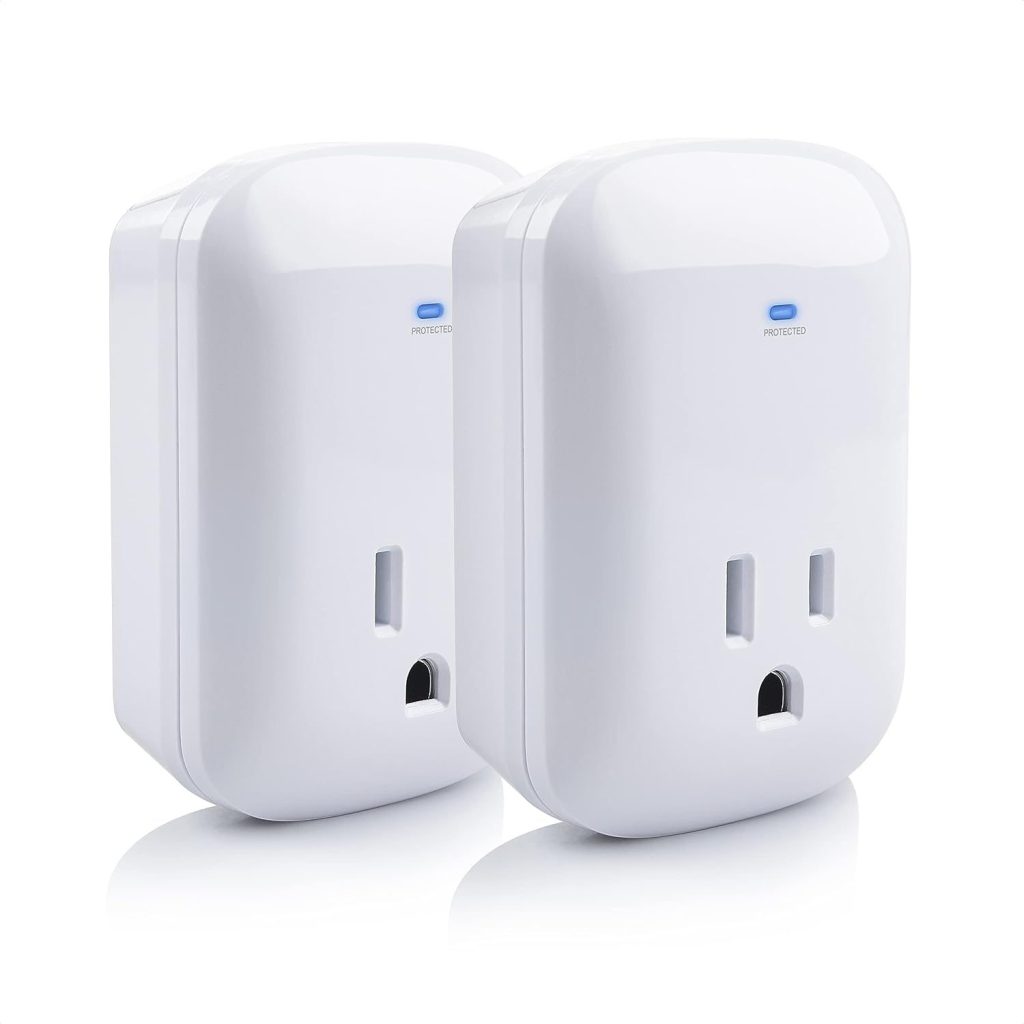
Cable Matters Single-Outlet Surge Protector is a high-joule suppressor that is suitable in protecting a window air conditioner against power surges that are harmful.
As opposed to the voltage cutoff style protectors, this device is aimed at the absorption and diversion of sudden surges (such as lightning strikes or switching by the power company). It provides a high surge absorption capacity of 1350 Joules in a mini wall-plug device. This implies that it can absorb several minor surges or a single large surge and avert that electricity to fry the circuits of your AC. It is rated at 15A/1875W, so it can carry the electrical demand of an air conditioner or any large appliance.
It is very easy to install as you only need to plug this protector into the wall and then plug in your AC.
On the inside it has good quality MOVs with a low clamping voltage (about 500V) that respond fast and clamps down spikes before they can get to your AC. The Cable Matters unit, unlike appliance-style protectors, does not cut power during brownouts; it just keeps supplying power, and only interferes to suppress surges. There is an LED status light that shows when protection is on (and alerts you that the unit should be replaced after a big surge). It is a good basic surge protector on window AC units, though it is not a high quality unit, at its price point and surge rating, it is a good unit.
#5 Belkin 12-Outlet Heavy-Duty Power Strip

The 12-Outlet Heavy-Duty Surge Protector by Belkin is a power strip that will be able to protect your window AC and other devices simultaneously.
It has a high energy rating of 3,940 joules, which means that it is designed to withstand massive surges and spikes to provide a high level of protection. This surge protector has 12 AC outlets that are spaced to fit bulky plugs (such as the plug of a window AC) as well as normal ones. In case you have your air conditioner in the same space as other electronics, this power strip will allow you to safeguard all of them using a single product. It is 15A and has an integrated circuit breaker, which will trip at over 1875W (so it will turn off the power in case an AC plus other devices draw too much).
It has a cord length of 8 feet and a low-profile plug that is flat, which is easier to access far-away wall outlets or fit behind furniture.
Belkin is a reliable brand name and this unit is covered by a lifetime warranty and an additional connected equipment protection guarantee. LED indicator lights indicate when surge protection is in use and indicates that the outlet is grounded correctly. Although it lacks automatic voltage regulation of dedicated appliance guards, the Belkin has a high joule rating which offers strong protection against transient spikes. It is a great choice when you require a flexible surge protector that can support your window AC as well as other appliances, though, you should remember about the overall power consumption so you do not exceed safe limits.
#6 APC 11-Outlet SurgeArrest + USB
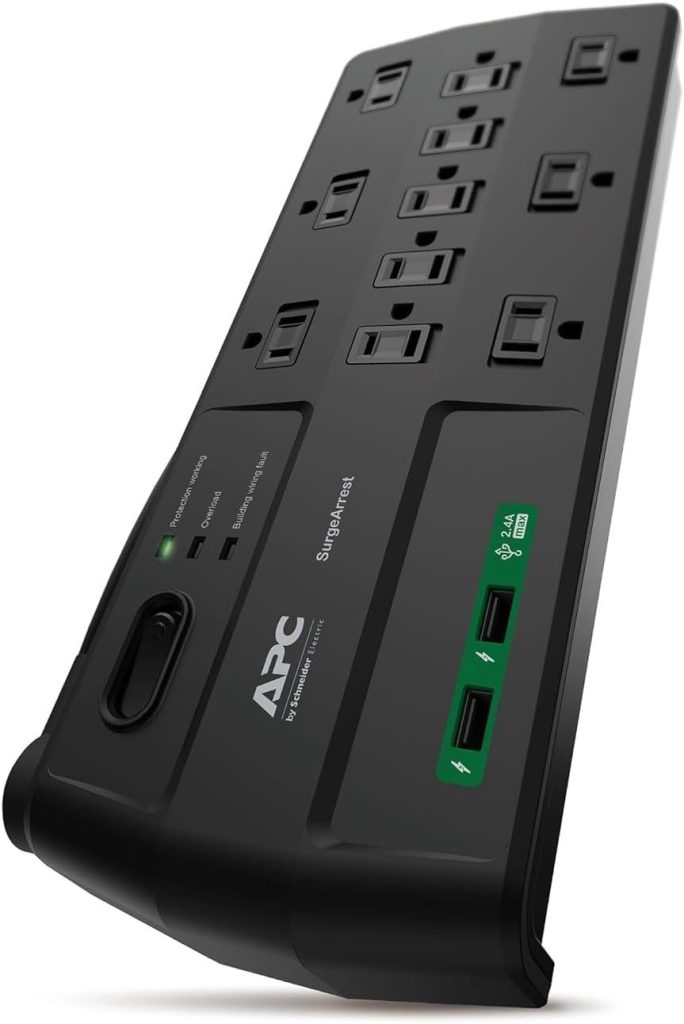
APC SurgeArrest P11U2 is a high-featured surge protector by a reputable company in power protection.
It has 11 AC sockets to power your window AC and all other devices you might have and two USB ports (2.4A total) to charge phones or tablets. This APC unit has a surge energy rating of 2880 joules, which means it can absorb a lot of excess energy of spikes, leaving your appliances intact. The strip is well constructed using a 6 foot heavy duty cord and a space saving 90 flat plug that can be easily fitted behind furniture.
Regarding safety, APC SurgeArrest has a 15A circuit breaker and the LED indicators displaying the message of Protection Working and Ground OK.
This will allow you to ensure that your AC is on a grounded circuit and the surge protection is in effect. In case the MOV components wear out due to a mega-surge, the fail-safe design of APC will kill the power, and you will not run your AC unprotected unknowingly. It is also UL certified on surge protection. It does not control low voltage in brownouts, but its high joule rating and reputation are the best bets to have a peace of mind. The extra USB charging ports are a convenient extra to use in everyday life. In general, APC P11U2 is a great overall surge protector to protect a window air conditioner and other electronics.
#7 Tripp Lite ISOBAR6Ultra Surge Protector

Tripp Lite ISOBAR6Ultra is a surge protector of professional level that can be effectively used in the cases when durability and maximum surge protection are a priority.
It offers a maximum of 3330 joules of protection and it is also characterized by its rugged all-metal housing that makes it highly durable and more capable of heat dissipation under heavy loads. It is a model with 6 outlets and uses isolated noise filter banks to minimize interferences between devices. (Noise filtering is more important to sensitive electronics, but it does mean that the ISOBAR is high-end designed and will not interfere with other devices even when the compressor of your AC turns on.) It also has a 6-foot cord and right-angle plug that saves space to place it anywhere.
The ISOBAR6Ultra is fitted with 15A resettable circuit breaker, diagnostic LEDs power, protection and wiring fault.
The high confidence in the performance of this unit is indicated by the fact that Tripp Lite provides this unit with a lifetime warranty and a connected equipment insurance policy. It is also of a high construction quality and so it can withstand extensive use in harsh conditions. Tripp Lite ISOBAR6Ultra is one step above the ordinary protectors because it can withstand severe surges and harsh environments, which is why it is one of the best options to protect your window air conditioner (and any other expensive electronics) in the long run.
Buying Guide: Choosing a Surge Protector for Your Window AC
It is also important to choose the appropriate surge protector to a window air conditioner in terms of safety and efficiency.
These are the main aspects to take into consideration when comparing options:
- Joule Rating (Surge Protection): The joule rating shows the amount of surge energy that the protector can absorb. In case of a window AC, you should find a surge protector that has a higher joule rating (at least 1000 J or more) to provide protection against high spikes. The greater the joules, the more likely the device can handle several surges over time, and it provides longer protection.
- Current & Power Capacity: Ensure that the surge protector has the electrical load capacity of your AC. Most window units in the U.S. are 120V and pull as much as 15 amps (approximately 1800 watts). The protector must be 15A/ 1875W and above. Do not overload the protector – do not use a strip to plug in several high-wattage appliances along with your AC, since this may overload the device. In case your AC is of very high amperage or a 240V one, then get a special protector that is made to fit it.
- Under/Over-Voltage Protection: When you are in a location that has frequent brownouts (low voltage) or voltage spikes, the surge protector that has automatic voltage cut-off is a good option. These (usually referred to as voltage protectors or brownout protectors) will cut power in case of a low voltage or high voltage, and restore power once it has stabilized. This aspect safeguards the motor and electronics of the AC against damages caused by unstable power supply.
- Delay Feature: An in-built delay timer is very advisable to air conditioners. This characteristic maintains the power off a couple of minutes following a blackout or a power surge. The delay allows the compressor of the AC to equalize pressure before restarting thus avoiding strain or damage. Surge protectors, which are specific to appliances, nearly always have a 2-4 minute delay; general surge strips usually do not, so make your choice depending on how critical that is to your application.
- Outlets: Choose a single outlet unit or a multi outlet power strip. In case the AC is the only device you want to protect on that wall outlet, a single-outlet surge protector (plug-in type) makes things easier and less cluttered. In case you intend to safeguard more devices (such as a TV, fan, or computer in the same room), a multi-outlet surge protector strip is more convenient to use, but make sure it is a heavy-duty one and keep in mind that the total load on any one circuit should not be more than 15A.
- Build Quality & Safety: Find surge protectors with good brands and ensure that they are safety certified by UL or ETL listing. A heavy construction (such as a metal case or flame retardant case) may be a sign of a unit that is expected to be subjected to high stress. Also, there are surge protectors with thermal fuses or overload breakers to provide additional protection. There are also high-end models that have lifetime warranties and equipment connected guarantees that can make you sure of their quality.
- Indicator Lights & Alarms: Most quality surge protectors include LED lights which indicate that the device is being protected (and in some cases whether it is grounded). These lights come in handy to make sure the device is on and that your outlet is grounded (important to make sure surge protectors work). When a large surge occurs and the protector has absorbed the surge, the surge absorption capacity of the protector may be exhausted, then some units will turn off or exhibit a light that it is no longer protecting, then the device must be replaced. Some protectors have audible alarms, although more often there are LED indicators.
- Smart Features (Optional): Some newer surge protectors or smart plugs may have Wi-Fi capability, which enables you to control your window AC remotely or monitor its energy usage. They are not required to protect your surge, but they may be convenient in case you would like to monitor the energy consumption of your AC or control it on/off with a phone app or smart home system. In case you choose a smart plug or strip, make sure you check twice that it supports the current of the AC (15A) and that it also offers surge protection. Never focus on smart features more than electrical specifications, safety is the most important.
Remembering these factors, you will be able to select a surge protector that would suit you and protect your window air conditioner.
Keep in mind that a good surge protector is an investment into the life of your appliance.
Based on the expense of fixing or substituting an AC unit, it is a smart precaution to utilize a suitable surge protector (and substitute it when it becomes worn out).
You can also add a whole-house surge protector at the main electrical panel to these point-of-use devices in case you own your home.
Having the proper protection, you can operate your window AC without any hesitations even in stormy weather or on a shaky power grid.
Frequently Asked Questions
Can I plug a window air conditioner into a surge protector?
Yes, you can use a window AC with a well-rated surge protector, but you should use the correct type.
Most standard power strips are not designed to support the high current draw of an AC over a long period and that is why some appliance manuals warn against them. But a heavy-duty surge protector (15-amp rated, and with a high joule rating, and ideally an appliance-grade model) is typically safe to use with window AC units. In this article, all the suggested products can be used along with an air conditioner. Ensure that the surge protector is directly connected to a wall outlet (not daisy-chained with extension cords), and as a precaution check the plug and protector periodically to ensure that it is not excessively hot. A surge protector when applied properly can provide an added sense of safety and should not impair the performance of the AC.
How many joules do I need in a surge protector for my AC?
The joule rating is the amount of energy that a surge protector can absorb due to power surges.
In the case of a window air conditioner, one should purchase a surge protector that has at least a few hundred joules of protection, and better yet 1000 joules or more to ensure solid protection. The greater the joule rating the more (and larger) surges it can withstand before becoming worn. As an example, 1000-4000 J protectors are perfect on high-cost or delicate devices such as AC units, particularly in locations prone to storms. Note that appliance-specific voltage protectors may be lower joule-rated (e.g. 140 J) since they protect your AC in other ways (by cutting off power in potentially dangerous voltage conditions). Choosing one of those may cost you some surge absorption capacity in exchange of the additional voltage regulation capabilities. In general, the higher the joules the more peace of mind in surge protection.
Will using a surge protector affect my AC’s performance or energy usage?
No, a surge protector will not have any noticeable impact on the cooling ability of your air conditioner or power consumption.
Surge protectors are just placed in the middle between the wall outlet and your device and they keep an eye on unsafe voltage spikes. They do not limit the usual flow of power in normal circumstances. The amount of power that your AC will require to operate will be the same and the surge protector will not come into play unless there is a surge or fault. The only minor difference is that certain appliance-specific protectors will not restart the AC immediately after a power failure (because of the delay feature built in), but that does not make a difference in the cooling capacity, it is there to protect the compressor. The surge protector itself consumes a very small amount of power (only sufficient to light indicators, typically a few cents per year of electricity). Therefore you will not have an increment in your electric bill by using one.
Is it really necessary to use a surge protector for a window air conditioner?
Although not necessarily required to operate, it is highly advisable to use a surge protector on your window AC to save your investment.
A window AC is an expensive device and it has sensitive electronics (control boards, digital displays, etc.) and a compressor motor which is vulnerable to voltage spikes. In case you are in a region where thunderstorms are common, unreliable power, or grid switching, then your air conditioning is vulnerable when it is directly connected to the wall. An effective surge protector is cheap insurance, it will absorb or chop off surges that would otherwise fry the AC. Lack of one, a nearby lightning strike or sudden power spike would destroy the AC in a second. A lot of people have surge protectors on their computers or television; since an AC can be just as costly, it is logical to do the same to it. Concisely, your AC will work without a surge protector, but you will be gambling with its life each time a surge occurs.
What’s the difference between a surge protector and a voltage stabilizer for ACs?
A surge protector protects your AC against sudden high voltage spikes (and some models will also switch off when the voltage gets too low), in other words, it responds to bad power events.
A voltage stabilizer on the other hand regulates and adjusts the voltage going to your appliance actively so that the voltage level is constant. Stabilizers (or voltage regulators) are more prevalent in areas where the supply voltage varies a lot out of the normal range; they will guarantee that your AC will always get say 120V (or 230V in some countries) regardless of what the input power is. Voltage stabilizers in window ACs are not very common in the U.S. due to the relative stability of the grid, and the ACs being designed to accept some variation. Most users would be happy with a surge protector with under/over-voltage cutoff and it is far more economical. A stabilizer is usually bigger and more expensive: it may be applied to highly sensitive electronics or in off-grid/ backup power scenarios. To conclude, a surge protector should be sufficient to protect a window AC in an American home, though you may have abnormal voltage fluctuations and require 24-hour regulation.