When you want to improve the air quality in your home, you are likely to address both indoor pollutants and dry air. This is where a air purifier and humidifier combo comes in, a single device that filters the air of airborne contaminants and at the same time adds moisture to the air.
The all-in-one devices assist you in breathing cleaner and more comfortable air without having to deal with multiple machines, which makes them a perfect choice of space-saving homeowners.
We compare the 5 best air purifier and humidifier combos (all on Amazon) below, including their room coverage, filtration, humidification capacity, noise levels and main features. We then give detailed reviews of each of the models and a detailed buying guide to assist you in making the right choice of combo unit to suit your needs.
| Product | Coverage Area | Filtration | Humidifier Tank | Noise Level |
|---|---|---|---|---|
| Dyson Purifier Humidify+Cool Formaldehyde | Up to 800 sq ft | True HEPA + Carbon + Formaldehyde filter | 1.0 gal (up to 36 hrs use) | ~49 dB max (quiet auto mode) |
| Sharp Smart Plasmacluster Ion (KCP110UW) | Up to 2,603 sq ft (at 1 ACH) | True HEPA + Carbon + Ionizer* | 0.53 gal (2 L) tank | 21 dB low / 55 dB high |
| Brondell O2+ Revive | Up to 627 sq ft (3 ACH) | Dual True HEPA + Carbon + VOC filter | ~1 gal (350 mL/h output) | ~36 dB low / 50 dB high |
| Afloia 2-in-1 HEPA Air Purifier | Up to 438 sq ft | True HEPA + Carbon filter | 100 mL mini humidifier | 24 dB low (whisper quiet) |
| ORB 2-in-1 Air Purifier & Humidifier | Up to 300 sq ft | True HEPA + Carbon filter | 0.5 gal (12–15 hrs runtime) | <30 dB (very quiet) |
*Ionizer can be disabled to prevent ozone generation.
Top 5 Air Purifier and Humidifier Combo Reviews
1. Dyson Purifier Humidify+Cool Formaldehyde
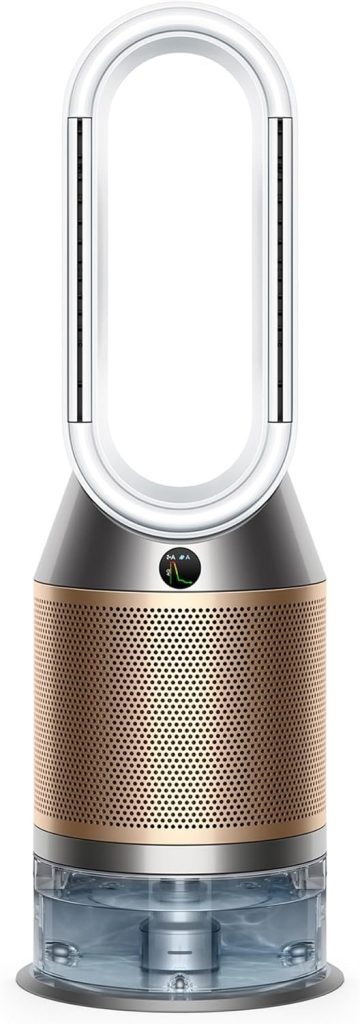
The Dyson Purifier Humidify+Cool Formaldehyde is a premium combination device that does well in both air cleaning and humidification. It employs Dyson superior filtration system, which has a True HEPA filter and a special catalytic filter that kills formaldehyde.
This model was able to eliminate more than 95 percent of airborne PM2.5 and PM10 particles within 30 minutes in lab tests, and even 75 percent of formaldehyde gas in the test chamber. It implies that it is efficient when it comes to trapping common allergens (dust, smoke, pollen, etc.) and volatile chemicals, and your air will be much cleaner. The unit also circulates clean air around the room using a bladeless fan design (it is also a cooling fan), and the in-built Dyson Air Quality sensor automatically changes settings to keep the air clean.
This Dyson is meant to cover large rooms of up to 800 sq. ft., so it is good to use in an open concept living room or even in several adjacent rooms. It has a large 1-gallon water tank that can run up to 36 hours on a full tank of water.
The humidifier has an ultraviolet cleanse technology that maintains the water hygienic and thus produces moisture that is free of bacteria. The user has the choice of Auto mode (where humidity and purification are balanced automatically) or manual fan speeds and humidity levels can be set. Although it is a powerful machine, the Dyson is quiet in its lower modes of operation – about 40-50 dB at full fan (similar to a normal conversation) and virtually silent on sleep mode. It is also full of intelligent functions: there is a clear LCD that shows the real-time air quality and humidity, and you can control/monitor it through the Dyson smartphone app or the remote that comes with it. Alexa or Siri voice control is also supported. Naturally, all these features are expensive and replacements of the filters (and occasional thorough cleaning of the humidifier components) increase the maintenance cost. The unit is also quite high (more than 3 feet) and slightly heavy, thus occupies some space. However, when it comes to the best overall performance of an air purifier-humidifier combo with state-of-the-art technology, it is difficult to surpass this Dyson in terms of providing really clean and comfortably humidified air.
2. Sharp Smart Plasmacluster Ion Air Purifier & Humidifier (KCP110UW)

The Sharp Smart Plasmacluster KCP110UW is a combo unit with many features that can be used in extra-large spaces. It is uniquely rated to cover up to 2,603 sq. ft. (at one air change per hour) which is approximately 538 sq. ft. with normal 4.8 ACH purification, which is still quite large to cover large rooms or entire apartments.
This unit is equipped with the patented technology of Sharp Plasmacluster Ion, as well as True HEPA filter and activated carbon filter, which helps to eliminate 99.97 percent of air pollutants (dust, smoke, pet dander, etc.) and neutralize odors. It is possible to turn off the ionizer in case one is worried about ozone (the concerned). The Sharp in practice is a powerful air cleaner that can match a dedicated air cleaner, and it has the advantage of having a built-in humidifier to keep the humidity at a comfortable level.
The Sharp has a 0.5-gallon (2L) water tank, which will keep medium-to-large rooms steadily humidified; at full blast it will require a refill after perhaps 8-12 hours of constant operation. The unit measures humidity and can automatically vary its output of mist to achieve your desired level before over-humidifying.
Another highlight of this model is its intelligent connectivity, it is Wi-Fi enabled and has a companion Sharp app, and it is also compatible with Amazon Alexa and Google Assistant to give voice commands. The app provides you with the real-time air quality, fan/humidify settings control, and even advanced scheduling (e.g. set different modes during the week). The machine also has a color-changing air quality indicator and a control panel that has a “Express Clean” mode to purify the air quickly. The Sharp is quite loud, but it is quite quiet, with only ~21 dB on low fan (nearly silent) and up to ~55 dB on max, given that it has a strong fan. The users like the auto mode which increases the fan only when necessary and most of the time the noise is minimal. Remember, this is not one of the cheapest combo units available (but usually a little cheaper than the Dyson), and it is a big machine (approximately 25” high by 15” wide). It also does not have the heavy-duty humidification of a dedicated humidifier, although it is effective at keeping you comfortable in dry climates, the 0.5 gal tank is not very large in very dry climates. On the whole, Sharp KCP110UW is a great option when you have to monitor a large space and prefer a smart hands-off air quality solution that you can monitor and control remotely.
3. Brondell O2+ Revive True HEPA Air Purifier & Humidifier
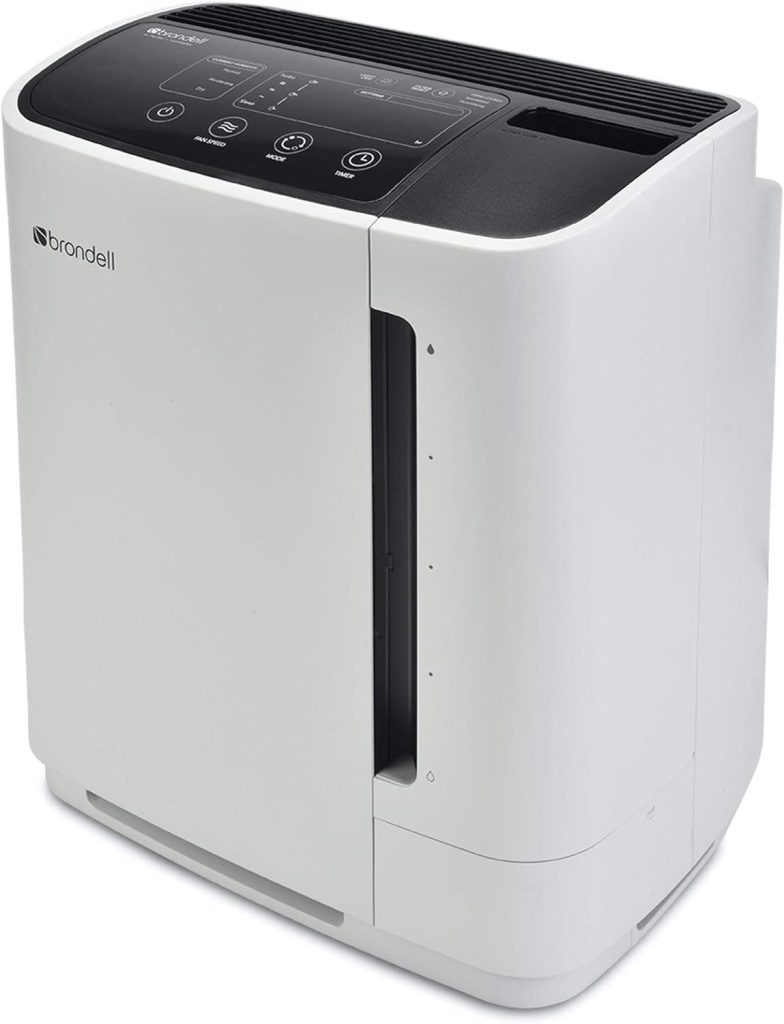
The Brondell O2+ Revive is a mid-range combo unit with a reputation of having a multi-stage filtration and allergy-friendly design. The Revive is a relatively small device that contains five layers of filtration, such as a washable pre-filter, a granulated carbon filter to remove odors/VOCs, a dedicated off-gassing reduction filter, and two True HEPA filters.
It has a dual-HEPA configuration, so it can trap particulates extremely effectively, which is excellent news to people with allergies or asthma, because it can filter pollen, dust, and other allergens to the bare minimum. Actually, Brondell promotes that the Revive with its dual suction design pumps more air at a quicker rate, purifying the air within a shorter period of time than single-filter machines. It is rated to rooms of about 600+ sq. ft. (three air changes per hour at 627 sq. ft.) and can be used in living rooms, big bedrooms or offices. A built-in air quality indicator light will tell you the current air quality with a single glance and you can control the fan speed manually (5 levels) or use Auto mode so that it can change speed accordingly.
The Revive is a humidifier that operates through an evaporative humidification system that has a wick filter. On its highest setting it can produce up to 350 mL of moisture per hour, which is enough to keep a moderately dry environment at healthy humidity levels (approximately a gallon of water in 8 hours).
It has an Auto Humidity mode which will automatically adjust the moisture output depending on the current humidity of the room, which is a nice set and forget feature. The water tank is approximately 0.8-1 gallon (not clearly stated, but it lasts approximately 24 hours on lower settings before it requires refilling). People usually remark that the Revive is very quiet during operation, at low fan speeds it is about 35 dB (very quiet), and even at high speeds it is not too loud (comparable to a fan on medium, about 50 dB). Brondell focused on ease-of-use features: it is easy to control, it has filters change indicators, and even auto-off timer. The only small drawback is that the humidifier is not as potent as some standalone models, although it is constant in its humidity production, so you may be disappointed with its humidity output in case you live in a very dry climate. It is also a bit heavy (~20 lbs) with all those filters, and it may cost a bit to replace two HEPA filters (and carbon and evaporative pads) annually. Nevertheless, the Brondell Revive is a leading candidate that offers a good balance of performance and cost to those who desire extra-thorough air filtration (perfect in case of allergies) with good humidification in a single device.
4. Afloia 2-in-1 HEPA Air Purifier with Humidifier (Miro Pro)
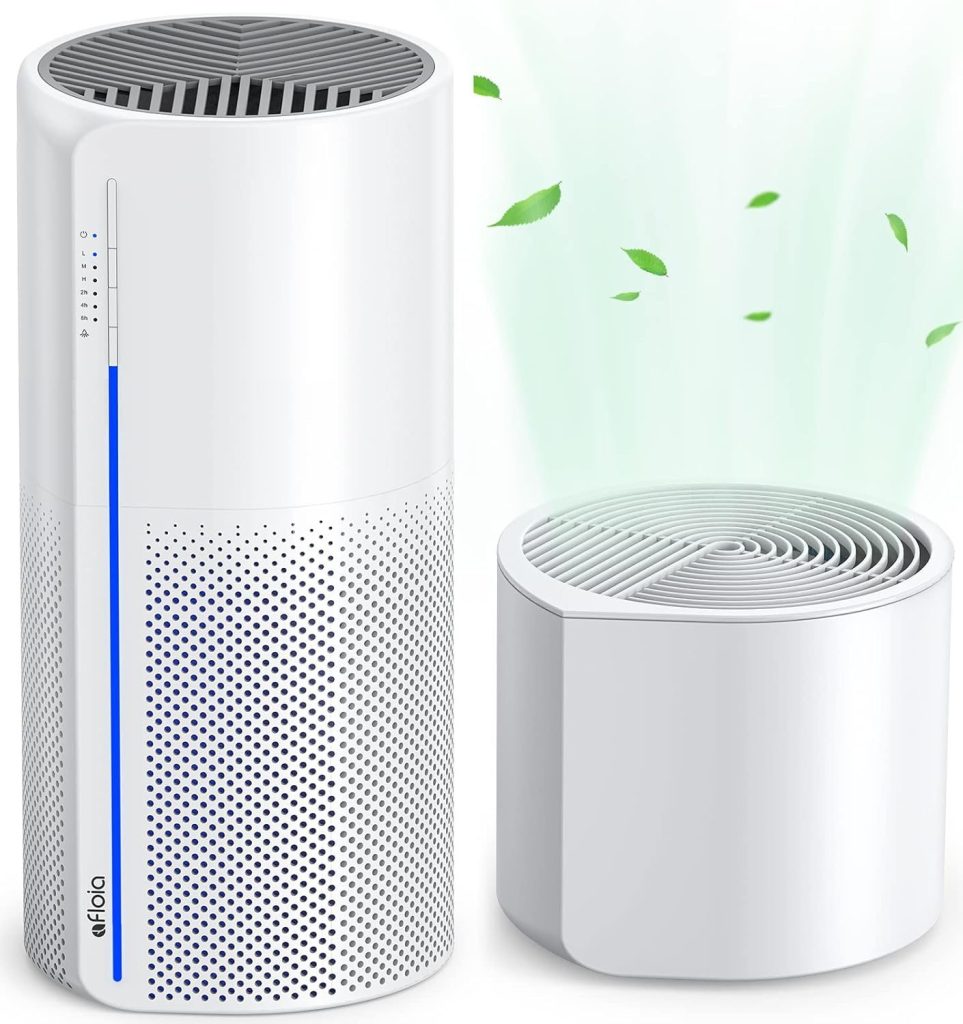
The Afloia 2-in-1 Air Purifier and Humidifier (commonly known as the Afloia Miro Pro) is a cheap combo device that is ideal in small rooms and small budgets. It has a good 3-stage filtration system (pre-filter, H13 True HEPA filter, and activated carbon filter) at a lower price: the pre-filter removes large particles, H13 True HEPA filter removes fine allergens, and activated carbon filter removes odors (this combination traps 99.97 percent of particles 0.3 microns and above, including dust, smoke, pet dander, etc., and helps with light odors).
It has a rating of approximately 215 sq. ft. at 4.8 ACH (which is equivalent to an area of up to ~438 sq. ft. with one air change per hour) so it is most appropriate to bedrooms, nurseries, or home offices. The modular design is one of the outstanding characteristics of the Afloia: the humidifier part is a small tank module that is connected to the bottom of the air purifier. When you only need to use it as a purifier you can actually detach and remove the humidifier part and save space or storage headache. The water reservoir is rather small (approximately 100 mL capacity) and moisture is added with an evaporative wick. This implies that it is more of a personal humidifier, it will give local humidity to make a bedroom more comfortable, but it is not going to increase humidity significantly in a large space. You should expect to refill it every day when you run the humidifier continuously. The tradeoff of that little tank is that the unit is quite small (only 7.6” x 7.6” footprint and less than 22” tall).
In quiet, unobtrusive operation the Afloia excels. It is very quiet in the lowest setting (approximately 24 dB, which is practically inaudible) and even when the fan is set to a higher speed, it remains rather quiet in sound, which is why it is a perfect choice to use in bedrooms at night. It has a soft night light that has various colors, and you can switch it off in case you want complete darkness. The controls are simple (the basic model does not have a smart app or sensors, so it is simple).
The fan speed is manually controlled and you can switch the humidifier on/off separately. Due to its low cost and design, some trade-offs are present: on the one hand, the humidifier effect is small, it is useful against slight dryness but not as powerful as bigger humidifiers (some people would have liked it to be stronger). It is also lightweight and largely plastic, which makes it easy to carry (weighs ~5.7 lbs), but a couple of reviewers said it does not feel as solid as more expensive models. It lacks an auto mode and air quality sensor, so you will have to do it manually. Nevertheless, these minor drawbacks do not make the Afloia 2-in-1 any less popular as an entry-level air purifier-humidifier: it is energy-efficient, very quiet, and does a good job of cleaning the air in small rooms and adding a bit of humidity. This small unit is a good choice when it comes to dorms, offices, or small bedrooms or anyone who wants a budget-friendly combo.
5. ORB 2-in-1 Air Purifier and Humidifier
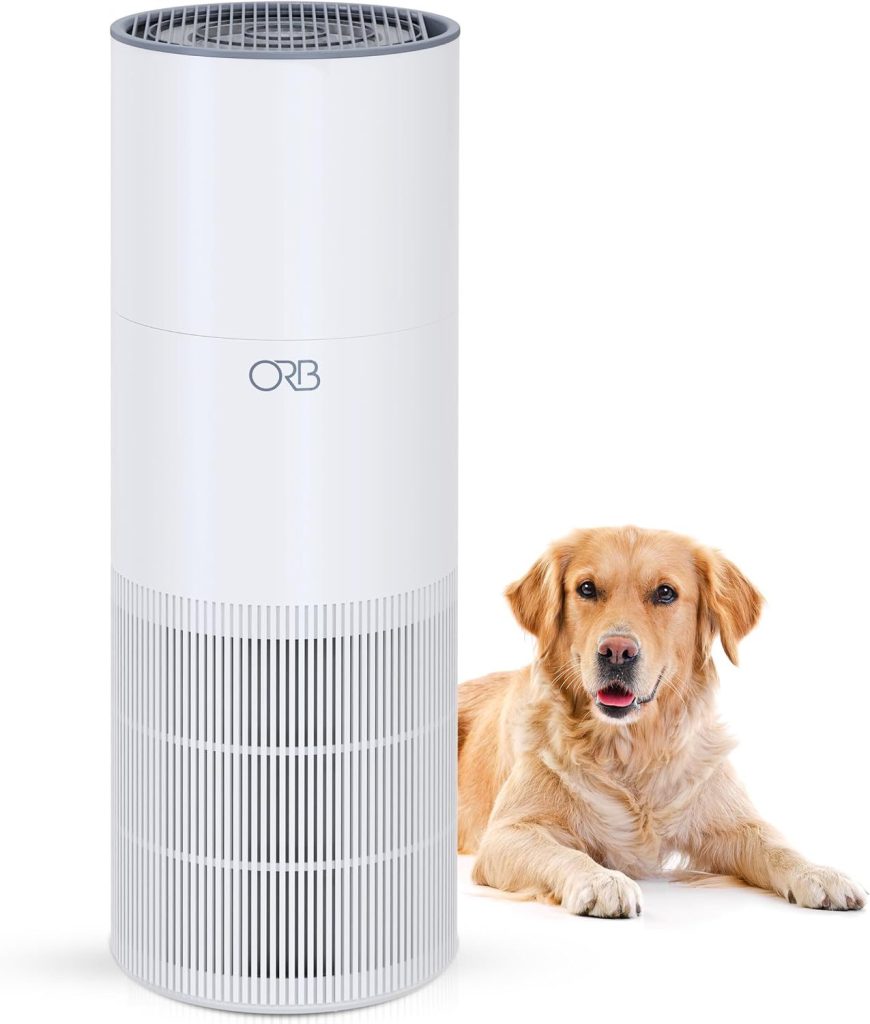
The ORB 2-in-1 Air Purifier & Humidifier is a tower that is small enough to provide comfort throughout the year in cramped areas. The ORB has a cylindrical shape that is only 25 inches high and 7.7 inches in diameter, which means that it can fit in a corner of a bedroom or an office without occupying a lot of floor space.
The miniature size does not mean that it lacks a True HEPA filter and activated carbon filter (with a pre-filter) that can effectively eliminate dust, smoke, pollen and odors in rooms as large as 300 sq. ft. That is, it is just the right size to fit small to medium rooms. Similar to the Afloia, the ORB has a modular humidifier design: there is a separate humidifier module on top of the machine. It has a 0.5 gallon water tank (approximately 1.9 liters), which is rather generous considering the size of this combo unit – it can last up to 12-15 hours before it needs to be refilled. The humidifier is evaporative, so it will not generate white dust or excessively wet mist; it will use a wick filter to introduce moisture in a clean manner (walls and furniture will not become wet). You can fill it easily on the top. This design enables the ORB to work as a purifier-only, in case you remove the humidifier module, and you have flexibility in different seasons.
The ORB is also affordable, but it has such pleasant features as an air quality sensor and indicator light (it turns red when the air is dirty, blue when the air is clean) and a remote control so you can easily turn it on or off in bed or on the couch. It also has easy, user-friendly controls on the unit and even an auto mode that changes the fan speed based on the air quality sensed.
The manufacturer emphasizes the quietness of the ORB and, in fact, the users report that it is very quiet, especially on low where it is practically silent, and even at full fan speed it is not disturbing (just a soft white noise). This is appropriate in bedrooms or nurseries where one is concerned with noise. Maintenance is one of the things to take into consideration: the filters of the ORB might not be as common as those of larger brands, and some owners reported that replacement filters are somewhat difficult to locate when it comes to changing them. You should purchase an additional filter in advance or inquire about it. In addition, the build quality and performance is good at the price, but it might not be as durable as the more expensive models (considering the lighter materials). All in all, the ORB 2-in-1 is a space-saving device that does the basics quite well: it keeps your air fresh and comfortably moist with little effort. It is a perfect solution to small apartments, dorm rooms, or offices where you want a non-obstructive, do-it-all air gadget at a low price.
Buying Guide: How to Choose the Best Air Purifier and Humidifier Combo
All-in-one air purifier and humidifier products can make your indoor environment much better, yet you need to choose the one that suits your needs. These are the major considerations and angles of comparison to make when purchasing a combo unit:
Room Size Coverage
The first specification to look at is coverage area. All air purifier-humidifier combinations are rated according to the size of a particular room (usually in square feet). This shows the largest space that it can serve effectively in purifying and humidifying. To get the best performance, select a unit that is rated at least as large as your room, or a little larger.
Actually, professionals recommend that you should choose a combo unit that is rated to a space that is a little larger than yours, instead of one that barely fits the requirement. This will improve the air cleaning and humidifying efficiency – it can be more efficient (and quieter) to run a large-capacity unit at a lower speed than it is to run a small unit at full blast.
Look at the definition of the coverage. Other manufacturers base it on one air change per hour (ACH), which gives a higher square footage figure, whereas the CADR (Clean Air Delivery Rate) standard is ~4.8 air changes per hour per square footage of a particular room (which gives a smaller recommended room size). To give an example, a device may state that it is effective up to 500 sq ft at one ACH, but in a highly polluted area you would want it in a room half that size to clean it well.
Generally speaking, the bigger the unit (the more the fan can move), the larger the room it can cover (so, in case you have an open living/dining area, you should get a high-capacity model (e.g. Sharp or Dyson)). A smaller unit such as Afloia or ORB will be enough in the case of bedrooms or offices. It is better to over-capacity than under-capacity.
Filtration Technology
The combo has a purifier side that is essential in eliminating pollutants. Be sure that the unit has a True HEPA filter (this is the gold standard to trap fine particles (99.97% of particles 0.3 microns or greater) such as dust mites, pollen, mold spores and smoke. True HEPA (commonly referred to as H13 grade) filters are found in many quality combo devices.
Avoid such terms as HEPA-type or HEPA-like, which are not real HEPA and are not as effective. The above five products reviewed all have genuine HEPA filtration to give peace of mind. Besides, the majority of combos have an activated carbon filter that adsorbs odors, smoke, and volatile organic compounds, which is essential in case you want to eliminate smells or chemical fumes. Others such as the Brondell Revive even include additional filters (e.g. formaldehyde or off-gassing chemicals) or even dual HEPA filters to provide greater airflow.
Do not use ionizers or UV gimmicks unless they are well done. Ionizers electrically charge the particles to aid them to clump or stick to filters, however, they may generate a little ozone, which is an irritant. In case a combo unit is ionizer, make sure that it is turnable off. An example is the Sharp Plasmacluster ionizer, which has been proved safe and optional.) UV-C lamps may also be employed to sterilize the water (as in Dyson humidifier) or germs on the filter; this is okay as long as it is contained, but not a feature to die on.
Pay attention to HEPA and carbon as the main filtration techniques. Also, the cost and schedule of the filter replacement should be considered. New HEPA (and carbon) filters will be needed in combo units about every 6-12 months, and maybe humidifier wick changes. Enquire on the availability and cost of such filters to the models you are interested in. It is prudent to select a brand/model that has filters easily accessible so that you do not have to have headaches later on (e.g. Dyson and Brondell filters are easy to find, but a smaller brand like ORB might be a bit more difficult to find replacements).
Another point: having an air purifier does not affect the performance of the humidifier negatively, people are afraid that the filter will dry the air, but that is not the case. The particulate matter is trapped in the HEPA filters in microns, and the water vapor molecules are approximately 1,000 times smaller (in nanometers), and the humidity is free to pass through.
Concisely, the purifier purifies the air and the humidifier humidifies it and they do not interfere with each other as they can be used concurrently.
Humidification Capacity
On the humidifier part, look at the water tank capacity and output. The bigger the tank (in liters or gallons), the longer the unit can operate without the need to refill it. As an example, Dyson 1-gallon tank has a range of 36 hours on low, but a small 100 mL module on a mini unit may last only a few hours.
Unless you want to refill regularly, seek a tank of at least 1 gallon (~4 liters) capacity to cover the entire room with humidity, or be ready to fill smaller tanks every day. The type of humidification also counts: the majority of combo units employ evaporative humidification (a wick filter is filled with water and a fan blows through it to evaporate moisture into the air). The advantages of evaporative systems are that they do not produce white mineral dust and tend to be self-regulating (they humidify faster when the air is dry, and slow as humidity increases). All the above models are evaporative and therefore no white dust on furniture.
Other combos (or standalone humidifiers) employ ultrasonic mist, which may result in a visible mist and elevated humidity levels fairly rapidly, but these are less common in combo units due to the possibility of the minerals in the mist clogging the air filters. Combos are done with evaporative. Look at the specifications of humidification rate where available e.g. Brondell 350 mL/hour. This is a clue on the amount of moisture it can add.
In a very dry climate or in winter with the furnace on, you may require a greater output or larger tank to keep a large room at say 40-50 per cent relative humidity. Otherwise, a smaller humidifier component will suffice in the case of moderate needs. Also, whether there is an auto-humidity control or at least a hygrostat in the unit. Other models such as Brondell and Dyson are able to auto-regulate the humidity: you set a desired level (e.g. 50% RH) and the machine will work to maintain that, which is very convenient. Others may simply keep on humidifying and so you may have to switch them off when the room becomes too wet. When you select a unit with a small tank, check whether it has an auto shutoff when the water is out (most do) or scheduling capabilities, so that it does not run out of water unnecessarily.
Noise Level
Since such devices will probably be used over several hours, particularly in bedrooms or living rooms, the level of noise is a critical comfort element. Look at the decibel (dB) levels in case they are provided. A lot of manufacturers specify the noise at low fan speed (and even at high).
To give you some idea of the scale, about 20-30 dB is very quiet (library levels or quieter), 40-50 dB is a low background hum (such as a fan on low or a quiet office), and above 60 dB can begin to be obtrusive (the same as normal conversation or a fan on high). The most effective air purifier-humidifier combinations are designed to be as silent as possible given that humidifiers are usually used at night. An example is that the Sharp and Afloia units have a sleep setting of 21-24 dB which is almost silent to most individuals. Dyson and Brondell also possess night modes or low settings which are bedroom friendly. Bigger units at full blast will be a bit noisy (Dyson and Sharp can reach about 50-55 dB at full blast), but in auto mode they do not have to run at full blast all the time.
In case you are highly sensitive to noise, you should seek references to a “sleep mode” or a special quiet mode on the device. This normally turns off any lights and turns the fan to low speed. In addition, smart auto fan units are also advantaged because they only rev up when pollution levels are high or when humidity is way off the set point otherwise they idle in silence.
Each of the above-mentioned models has at least 2-3 fan speed settings to strike the balance between performance and noise. As a rule, smaller units (with smaller fans) may be slightly quieter, but it is not a strict rule, design also plays a part. User reviews on noise can be useful because a dB value does not reflect the quality of sound (e.g. any rattling or high-pitch whine). All the five selections in our list are reported to be quiet during regular use, and are good to use at night. When used in a bedroom you may even find a bit of white noise is welcome, although none of these should be too loud on their low settings to interfere with sleep.
Maintenance & Cleaning
The combo devices need constant maintenance to work efficiently. You will be required to change the air purifier filters at the right time and also maintain the humidifier section clean. The HEPA and carbon filter replacements are usually required every 6-12 months, depending on the use and the recommendation of the manufacturer. Consider that expense- filters cost as little as 20 dollars and as much as 100+ dollars each.
Brondell dual HEPA is two filters to purchase (but each one is used half as hard), Dyson filters are expensive but last approximately one year, etc. In addition to filters, in case the unit contains a wick or humidifier filter, it should also be periodically replaced or cleaned (to avoid mineral deposits or mold). As an example, the Brondell has evaporative pads, which are supposed to be replaced after a few months, and Dyson offers cleaning kits to its evaporator. It is also a good practice to adhere to the product manual maintenance schedule to ensure that your air is clean and your humidifier is hygienic.
The humidifier part should be cleaned in particular. When not cleaned, standing water may grow mold or bacteria. Find models that are easy to take apart and wash out, because you will want to rinse out or lightly scrub the water tank and any wick filter at least once a week (more often, if you use it every day).
Others are made of antimicrobial material or have UV sterilization (Dyson, as an example, has UV-C light to kill bacteria in the water). Still, it requires cleaning on a regular basis. Units of simpler design (less crevices in the tank, large openings) will be easier to maintain. You may look at the manual to find out the cleaning instructions before purchasing it. A machine with excess nooks where water may be left may be a pain to clean. Maintenance of all our recommended models is easy to use: e.g., the small tank of Afloia can be lifted out and washed, Dyson guides you through a deep clean cycle, etc.
Also, it is advisable to use distilled water in the humidifier when your tap water is hard. This has the potential to minimize mineral deposits and white dust, which prolongs the life of filters and makes them easier to clean. Most evaporative humidifiers do not produce white dust, even with hard water (minerals remain on the wick), but the minerals will eventually clog the wick, distilled water does not do this.
In case distillation is not possible, frequent cleaning is even more significant.
Smart Features & Controls
Consider what type of control and monitoring options you desire. Simple models may only include manual knob or button controls to adjust fan speed and to turn humidification on/off. Higher end models have digital displays indicating items such as the current humidity level, room air quality (PM2.5 concentration or a color coded indicator) and filter life status.
A smart connectivity combo may be of interest to you, especially in case you are a tech enthusiast. As an example, the Sharp unit is Wi-Fi enabled and can be operated by a smartphone app or even by voice control using Alexa/Google Assistant. The combo of Dyson also includes an app with the detailed graphs of the air quality and remote control in any location. These are convenient features, you can monitor the air quality of your home when you are not at home or you can program the machine to turn on before you get home. They are also able to fit into smart home routines.
Features such as an auto mode (where the built-in sensors automatically control the speed of the fan and the amount of humidifier output) are extremely helpful to operate hands-free even without Wi-Fi. A scheduler/auto shutoff timer is handy in case you do not want the machine to be running all the time. Others have a remote control (such as the ORB) to allow you to change settings in bed.
And check out the small details: Do the controls make sense? Do you have a child lock (in case you have children)? Can we switch off indicator lights at night? Does the unit remind you that the tank is empty or filters are to be changed? These convenience features will not directly affect the performance, but it enhances the user experience. As an example, a low-water indicator and auto-shutoff on the humidifier will make sure that the device will not simply run dry and possibly overheat. Maintenance is made easy by the use of filter change indicators. The more expensive models (Dyson, Sharp, Brondell) in our list are the most bell-and-whistle-laden, but the less expensive models (Afloia, ORB) are all about the basics with a couple of convenient extras such as lights and remote control. Choose what features you need to have.
App control may not be necessary to you, in case you are comfortable walking over to push a button and read humidity using a separate hygrometer. However, in case you are fond of the concept of accurate tracking and connection to your smart house, invest in a model that has them.
Taking into account the above-mentioned factors, such as the size of the room, the quality of filtration, the capacity of the humidifier, noise, maintenance, and smart features, you will be able to choose the best air purifier and humidifier combo that suits your lifestyle. The market has a solution whether you want a heavy-duty one to cover a large living area or a small quiet assistant in the bedroom. Each of the five products discussed above has its strengths, and therefore, this guide and comparison will help you to eliminate some of them and find the one that is the most suitable to your priorities.
Using the right combo device, you will be on the path of having a cleaner air and ideal humidity in your home all year round.